

May 27
🌱XRPL EVM infrastructure is getting ready for new exciting use cases:
⚡️Now supporting ripple:native micropayments, same fees as XRPL
💻Adding a programmability to combine logic micropayments 3s finality
🦊Brand new wallet.xrplevm.org allows multinetwork management in 1 wallet
5
13
57
2,685

May 21
GOOD MORNING EVERYONE 🌅
Nobody talks about which blockchain they use to top up their crypto card.
But that choice is quietly deciding how much you lose before a single purchase.
Solana USDT transfers $0.002.
TRON $0.10.
Ethereum L2 $0.20.
Small numbers until you're topping up weekly.
What I appreciate most about @KoloHub is the multinetwork flexibility isn't just a feature checkbox.
It's genuine fee optimization built into daily spending. You pick the cheapest route, fund the Visa card, spend in 190 countries. Transfer settles in under 10 seconds.
I don't usually say this, but network selection is what separates people actually living in crypto from people still just experimenting with it.
Stablecoin volume crossed $15.6 trillion in Q3 2025. The people moving that volume aren't guessing which chain to use.
Are you paying attention to your network choice or just hitting send?
Also don't stop quacking for @wallchain and @3look_io.
gQuack Quack 🦆

99
38
106
478

May 4
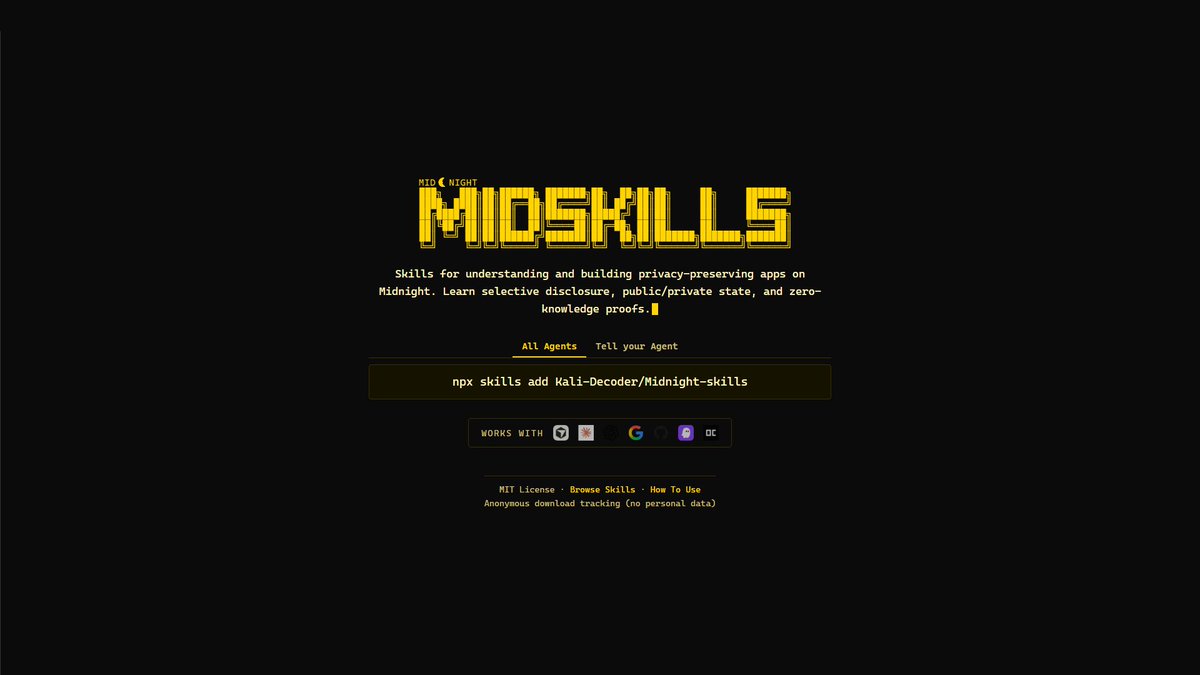
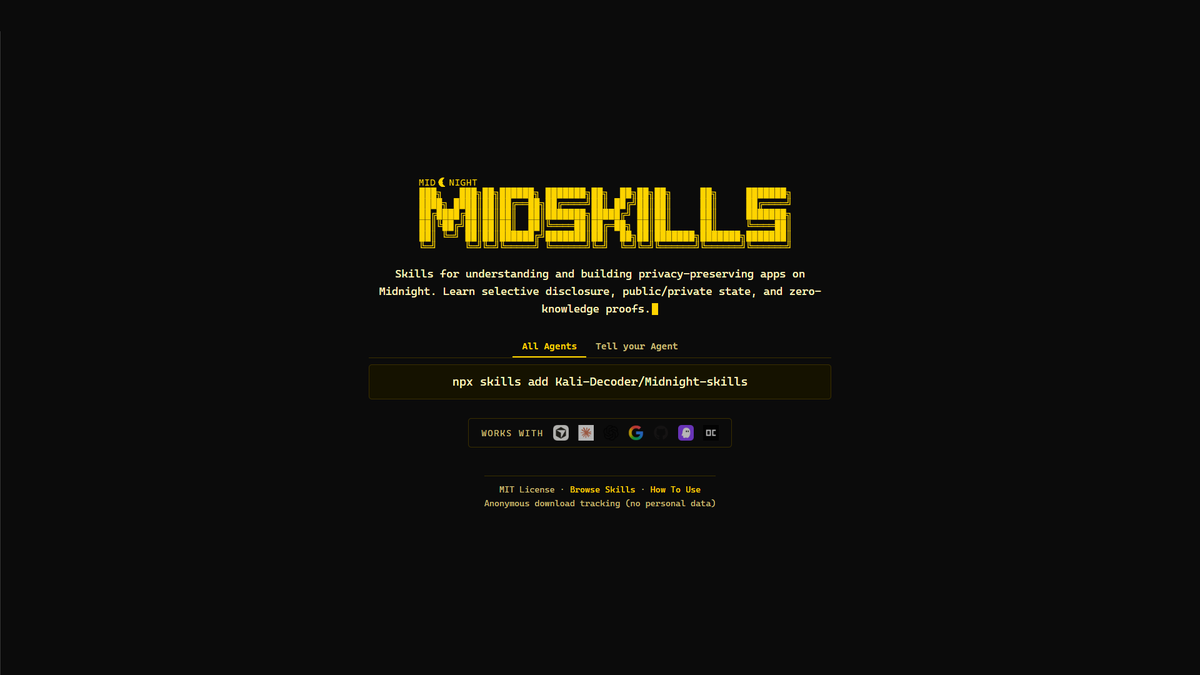
Introducing @MidnightNtwrk Skills 🚀
A new way for developers to learn, build, and ship on Midnight faster than ever.
Midnight Skills are modular, plug-and-play knowledge blocks designed for AI agents and developers each skill is a focused guide that can be fetched, read, and used instantly while building.
From integrating wallets to deploying privacy-first smart contracts, everything is structured to reduce friction and speed up development.
What you get:
• @OneAmXYZ Wallet integration for smooth transaction flows
• Compact a TypeScript-like DSL for ZK smart contracts • Midnight.js SDK for full dApp development .
• Testing and debugging support .
• Multinetwork deployment from a single codebase .
• Indexer for querying and real-time data .
• Security best practices for privacy-first apps .
• Deep dive into Midnight architecture and ZK model.
This is about making privacy-preserving app development simple, structured, and scalable.
Start building smarter on Midnight.

Most AI agents are dumb for one simple reason:
they’re forced to read docs written for humans.
So they hallucinate.
Miss edge cases.
Break on real workflows.
We fixed that.
Midnight Skills = structured, machine-readable knowledge your agent can actually use.
Not docs. Not tutorials.
-> ZK contracts
-> wallet flows
-> privacy audits
-> multi-network deploys
8 files. Plug in. Ship.
built for agents building on @MidnightNtwrk
me @itsNikku876
8
13
50
7,483

Apr 15
Future Safenet uses
• @devanoneth shares in the Safe forum important functions to decentralize like signature collection and gasless submission
• After the Safenet Devcon 2024 event I looked forward to multinetwork Safe actions like managing owners, settings, app sign ins, and permissions. These still are possible with long term success of Safenet.
• For context there's an Ethereum wide initiative on compatibility with the @ethinteroplayer
• In the Safe ecosystem @candidelabs is building towards multinetwork Safes
x.com/heymarcopolox/status/2…
Feb 10

We lost a valued customer last year.
They needed chain abstraction. Managing Safe accounts across multiple chains, and the signing overhead was killing their UX. Every key rotation meant six separate ceremonies. Every guardian update, same thing. Their users were drowning in signatures.
They asked if we had a solution. We said no.
Not because we couldn't build it. Chain abstraction was the 2025 narrative. Everyone was shipping it. We could have done it in weeks. Feature velocity, customer win, done.
But every solution we looked at had the same problem: trusted intermediaries. Relayers you had to trust. Wrapped assets. New points of failure. For infrastructure that secures savings, checking accounts and treasuries? No.
So we told them we didn't have it. They went with someone else.
That one stung.
You second guess it. Maybe we're being too pure. Maybe we're just slow.
But the teams we work with are building neobanks. Real money, real users. If a relayer goes down, if a bridge gets hacked, it's not our problem to solve. It's their users' funds. We can't sell infrastructure we don't control.
Then EIL was announced at Devconnect.
I was skeptical at first. But I read @yoavw's post on how EIL work under the hood. L1 as source of truth. Voucher system with economic guarantees. No trusted relayers. No new intermediaries.
It clicked.
Suddenly we had a way to build chain abstraction without compromising on what matters.
So we built Safe Unified Account.
Here's what it does:
• Sign once for operations across multiple L2s (Merkle proof verification)
• Atomic cross-chain via EIL integration (L1-anchored, not trust-based)
• No bridges, no relayers, pure cryptographic verification
The flow:
1. Construct UserOps for each chain
2. Arrange in Merkle tree
3. Sign root once
4. Submit with proofs to bundlers
5. Each chain verifies independently
For atomic operations, EIL's voucher system provides economic guarantees through XLP staking/slashing. Same signed voucher that claims funds on source releases funds on destination. Guaranteed by L1, not by trust.
The module is feature complete. Audit pending. We're sharing now to get feedback before we lock it down.
I don't know if we'll get that customer back. Maybe they're happy with what they chose. Maybe the trusted relayer approach works fine for them.
But I know we can finally offer chain abstraction to the teams building on Safe without asking their users to trust what they shouldn't have to trust.
Sometimes saying no is just buying time until you can say yes the right way.
1
5
105

Mar 18
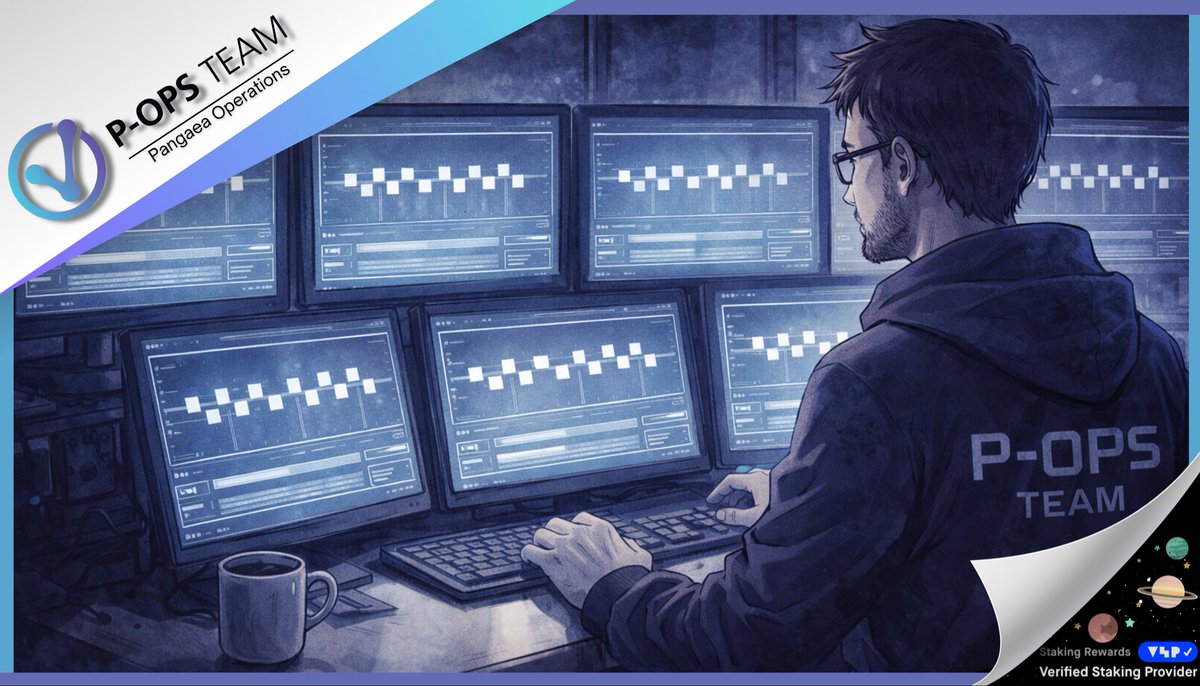
🌘 AFTER-HOURS REPORT
Log: Validator Surface Consistency
P-OPS TEAM | Multi-Network Staking Operations
🕰️ Context
As global activity tapers, validator systems transition into a cleaner observation state.
Fewer transactions.
Less mempool contention.
Clearer signal across execution and consensus layers.
Tonight’s focus: surface-level consistency across validator behaviour — how uniformly nodes are executing, voting, and finalising without daytime pressure.
🔎 Observed
📡 Vote propagation maintaining tight relay intervals across peer sets
🧱 Block proposal acceptance aligning closely with first-round inclusion
🔁 Minimal variance in pre-vote to commit timing across validator clusters
📊 Execution outputs converging with near-identical state root generation
Across multiple supported networks, validator behaviour exhibited high synchronisation fidelity.
Not faster.
More consistent.
📡 Read
Consistency is the quiet benchmark of mature validator infrastructure.
When variance compresses across the active set, it signals:
• Deterministic execution environments across operators
• Stable peer topology with minimal propagation asymmetry
• Balanced stake distribution avoiding dominant routing paths
• Infrastructure tuned for predictability over peak throughput
This is where networks become mechanically reliable.
Not because nothing is happening —
but because everything is happening the same way.
🛠️ Posture
🗂️ Execution trace alignment sampled across validator subsets
📈 Timing variance tracked against rolling multi-epoch baseline
🔎 Peer relay efficiency monitored for hidden latency divergence
⚙️ System parameters held within deterministic operating thresholds
No deviation patterns emerging.
🌘 Status
Execution Consistency: High
Vote Timing Variance: Compressed
Peer Propagation: Uniform
Network Posture: Deterministic
The after-hours window removes noise.
What remains is structure.
Tonight, that structure is holding with precision.
🛡️ P-OPS TEAM — validating consistency beneath the visible layer.
☎️ Stay Connected
🌎 pops.one
🌳 linktr.ee/p_opsteam
🐥 x.com/POpsTeam1
↗️ t.me/POPS_Team_Validator
👾 discord.gg/jJ8aaMwPwa
#AfterHoursReport #POPSTeam #ValidatorOps #ExecutionLayer #ConsensusSignal #StakingInfrastructure #MultiNetwork
1
7
13
144
Mar 4
🌘 AFTER-HOURS REPORT
Log: Delegation Drift Scan
P-OPS TEAM | Multi-Network Staking Operations
🕰️ Context
Late trading hours across global markets often coincide with quieter on-chain activity — but for staking systems, these windows are when structural behaviour becomes easier to observe.
Without daytime transaction noise, delegation movement patterns surface more clearly.
Tonight’s focus: delegation drift across validator sets.
🔎 Observed
📥 Gradual delegation inflows appearing across mid-tier validators
🔁 Minor stake rotations between established operators rather than large migrations
📊 Active set weight remaining evenly distributed across monitored networks
🧮 Delegator behaviour favouring reliability over marginal APR variance
Across several supported networks, stake movement was measured rather than reactive.
The market appears to be prioritising continuity and operational reputation over short-term reward optimisation.
📡 Read
Delegation drift is one of the clearest indicators of delegator sentiment.
When reallocations occur slowly and proportionately, it suggests:
• Confidence in validator infrastructure
• Reduced speculative behaviour among delegators
• Long-term yield strategies replacing rapid APR chasing
Healthy validator ecosystems rarely exhibit abrupt stake concentration.
Tonight’s signal reflects gradual capital positioning rather than reactionary flows.
🛠️ Posture
🗂️ Delegation distribution indexed across supported networks
📈 Validator weight monitored against historical baseline
🔎 Stake flow patterns logged for multi-epoch comparison
⚙️ Operational parameters remain steady
No structural imbalance signals detected.
🌘 Status
Delegation Flow: Balanced
Validator Weight: Distributed
Delegator Sentiment: Stable
The quiet hours often reveal the strongest signals.
Delegation patterns tonight suggest confidence in infrastructure continuity.
🛡️ P-OPS TEAM — validating stability across the networks beneath the surface.
☎️ Stay Connected
🌎 pops.one
🌳 linktr.ee/p_opsteam
🐥 x.com/POpsTeam1
↗️ t.me/POPS_Team_Validator
👾 discord.gg/jJ8aaMwPwa
#AfterHoursReport #POPSTeam #ValidatorOps #DelegationFlow #StakingInfrastructure #MultiNetwork #OperationalSignal
10
17
117

Mar 3
New Update is Live!
Analytics for all your MultiNetwork needs!
Sign up for Waitlist today for early access to all tools with incentives attached for early users!
1
3
42
Feb 27
Catching up on this one and it's great to learn about Splits as an option to manage multiple accounts
🟢 Update on @safe that you can now create a multinetwork Safe across many protocols with the same address
🔑 Passkey support is in development

🔥 Safe{Wallet} Goes Multichain: Gasless Deployment with the Same Address Across Multiple Chains ! 🔥
Deploy your account effortlessly across 15 networks with a single click—using the same address on every chain.
No gas fees on major L2s — it's never been easier to go multichain! 🧵 📽️
1
2
53
Feb 25
🌘 AFTER-HOURS REPORT
Log: Cross-Chain Reward Settlement
P-OPS TEAM | Multi-Network Staking Operations
🕰️ Context
Reward accrual cycles concluded across supported networks this evening, creating a clean observation window for settlement behaviour rather than performance metrics.
This phase exposes economic consistency — how rewards crystallise, distribute, and compound across differing PoS architectures.
🔎 Observed
💠 Reward distribution events executed within expected epoch boundaries
🧾 Minor timing variance across chains reflecting distinct finality models
🔄 Auto-restake patterns continuing at steady participation levels
📊 Commission outcomes aligned with projected yield curves
📡 Read
Settlement cadence remains structurally sound.
Shorter finality networks demonstrate smoother accrual rhythm.
Longer epoch designs present clustered reward realisation.
Reward accounting integrity holds across chains.
Delegator yield profiles track within forecasted APR bands.
🛠️ Posture
🗂️ Reward timing indexed per network
📈 APR delta compared against rolling 7-day baseline
🔎 Cross-chain commission verification completed
⚙️ Operational parameters unchanged
🌘 Status
Reward Integrity: Verified
Distribution Timing: Within tolerance
Economic Signal: Stable
🛡️ P-OPS TEAM — validating the economics beneath the performance.
☎️ Stay Connected
🌎 pops.one
🌳 linktr.ee/p_opsteam
🐥 x.com/POpsTeam1
↗️ t.me/POPS_Team_Validator
👾 discord.gg/jJ8aaMwPwa
#AfterHoursReport #POPSTeam #ValidatorOps #RewardSettlement #StakingInfrastructure #MultiNetwork #OperationalSignal
1
9
15
150
Feb 17
The most promising pitch for a 100% onchain multinetwork @safe
Feb 17

Safe Unified Account demo is live.
Multichain account management without the complexity:
→ One signature across Ethereum, Optimism, Arbitrum
→ Passkey support (Face ID/fingerprint login)
→ Add guardians, rotate keys across all chains instantly
Built on Safe. Link below
1
2
10
1,847
Feb 16
🌘 AFTER-HOURS REPORT
Log: Liquidity Edge Conditions
P-OPS TEAM | Multi-Network Staking Operations
🕰️ Context
As liquidity thinned into the evening cycle, staking flow did not accelerate — it narrowed.
Fewer transactions, but clearer intent behind each movement.
After-hours windows tend to reduce noise. What remains is typically deliberate.
🔎 Observed
📥 Moderate-sized delegations consolidating into established validators
🔄 Minimal churn from long-standing delegator cohorts
📊 Commission sensitivity appearing neutral across monitored sets
🧭 No reactive behaviour linked to short-term APR variance
📡 Read
This is conviction-weighted flow.
When volume drops but allocation quality holds, it suggests delegators are acting from prior evaluation rather than impulse.
The absence of reactive switching is itself a signal — stability is being priced in.
🛠️ Posture
🗂️ Delegation cohorts segmented by tenure and behaviour profile
📈 Cross-network consistency check running on validator inflow ratios
⚙️ Infrastructure steady; no parameter adjustments introduced
👀 Monitoring focused on persistence of conviction across epoch boundaries
🌘 Status
Staking Activity: Selective
Delegation Mix: Cohort-driven
Validator Confidence Signal: Sustained
🛡️ P-OPS TEAM — operating when the volume drops and the signal sharpens.
☎️ Stay Connected
🌎 pops.one
🌳 linktr.ee/p_opsteam
🐥 x.com/POpsTeam1
↗️ t.me/POPS_Team_Validator
👾 discord.gg/jJ8aaMwPwa
#AfterHoursReport #POPSTeam #StakingOps #DelegationFlow #ValidatorConfidence #CryptoStaking #MultiNetwork #OperationalDiscipline
11
18
139
Feb 11
Congrats on leading building the next generation of multinetwork @safe accounts!
For those who also have to look it up, EIL is Ethereum Interop Layer.
Exciting. Bookmarking in Brave to learn more later.
blog.ethereum.org/2025/11/18…
1
3
58
Feb 9
🌘 AFTER-HOURS REPORT
Log: Delegation Preference Signals
P-OPS TEAM | Multi-Network Staking Operations
🕰️ Context
As the day’s activity resolved, staking systems continued to surface a different class of signal — not performance-driven, but preference-driven.
These hours reveal how delegators behave when reacting to information rather than events.
🔎 Observed
📥 Small, deliberate delegation adjustments appearing across supported networks
🔀 Stake reallocations favouring consistency over headline yield
🧮 Validator weight stabilising after earlier discretionary movement
📊 No concentration spikes; delegation spread remaining healthy and distributed
📡 Read
This reflects informed delegation behaviour.
Rather than chasing short-term variance, delegators appear to be responding to reputation, continuity, and operational confidence.
The signal here isn’t urgency — it’s selection.
🛠️ Posture
🗂️ Delegation movement indexed by size and frequency
👥 Validator preference trends logged for longitudinal tracking
⚙️ No operational changes introduced to avoid influencing behaviour
👀 Monitoring focused on pattern formation rather than volume
🌘 Status
Staking Activity: Intentional and measured
Delegation Mix: Balanced
Validator Confidence Signal: Positive
🛡️ P-OPS TEAM — reading the human layer of staking.
☎️ Stay Connected
🌎 pops.one
🌳 linktr.ee/p_opsteam
🐥 x.com/POpsTeam1
↗️ t.me/POPS_Team_Validator
👾 discord.gg/jJ8aaMwPwa
#AfterHoursReport #POPSTeam #StakingOps #DelegationSignals #ValidatorSelection #CryptoStaking #MultiNetwork #OperationalAwareness
1
9
19
153
Feb 4
📸⚖️ STAKE SNAPSHOT | Weight in Motion
P-OPS Team | Live Validator Operations
📷 Captured during a routine execution window across supported networks — a moment where delegated stake is actively expressing itself through timing, participation, and balance.
🧭 Why this window matters:
Staking outcomes form while systems are moving, not when attention spikes.
Here, delegated weight translates into steady proposer flow, even peer selection, and predictable reward formation.
🔎 Observed across networks:
⚖️ Stake weight flowed cleanly through proposer rotation
⏱️ Slot cadence held its shape across regions and chains
🧠 Resource utilisation tracked proportionally to assigned weight
🛜 Peer interactions remained evenly distributed during low-variance conditions
⚙️ These conditions support dependable yield formation.
🧩 Delegation is being converted into performance through repetition and discipline.
📈 Over time, snapshots like this define validator character — consistent timing, balanced coordination, and stable behaviour across many environments.
🛡️ Current posture:
📸 Snapshot recorded across active networks
⚖️ Stake behaviour aligned with expectations
⚙️ Continuous observation in progress
✅ Operations continue.
☎️ Stay connected with P-OPS Team
🌎 pops.one
🌳 linktr.ee/p_opsteam
🐥 x.com/popsteam1
↗️ t.me/POPS_Team_Validator
👾 discord.gg/jJ8aaMwPwa
#Staking #Delegation #Validators #ProofOfStake #CryptoInfrastructure
#MultiNetwork #ValidatorOps #Consensus #NetworkHealth #Web3
#CryptoOps #OnChain #Uptime
7
17
150
Feb 2
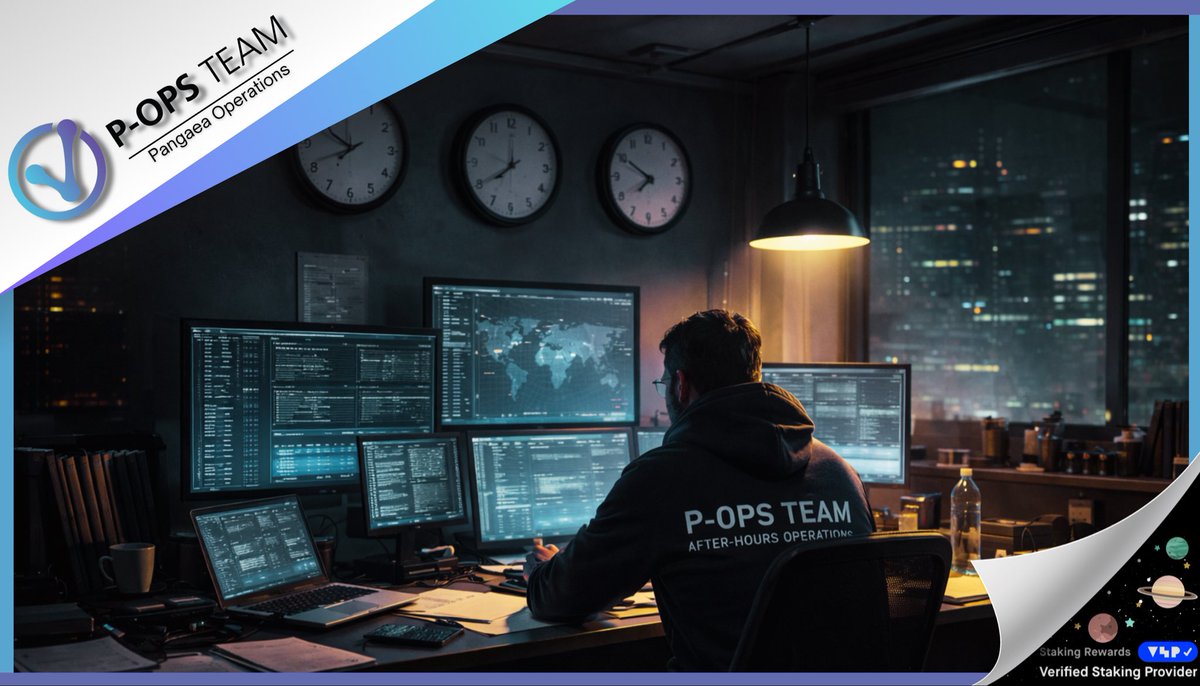
🌘 AFTER-HOURS REPORT
Log: Boundary Behaviour Under Low Load
P-OPS TEAM | Multi-Network Operations
🕰️ Context
As the UTC evening window settled and traffic thinned, several supported networks moved into clean, low-contention states.
These hours expose behaviour without throughput masking it — especially around epoch boundaries and validator handoffs.
🔎 Observed
🧭 Epoch and round transitions resolving cleanly, cadence tightening briefly at handoff
📡 Gossip flow orderly; a small peer subset arriving late-but-valid with consistent timing
⏱️ Commit paths inside tolerance, with short, repeatable headroom contraction
💸 Rewards and liveness unchanged — movement observed in margin, not outcome
📡 Read
This reflects boundary pressure, not instability.
Under low load, precision carries more weight.
Production continues as expected, but buffers thin briefly during role changes — predictably and without escalation.
🛠️ Posture
🗂️ Boundary windows indexed for repeatability
👥 Peers tagged by arrival spacing and commit proximity
⚙️ Parameters held to preserve signal clarity
👀 Watchlist updated for low-noise margin compression
🌘 Status
Networks: Stable
Boundaries: Clean, brief margin tightening
Confidence: High
🛡️ P-OPS TEAM — steady reads when the network winds down.
☎️ Stay Connected
🌎 pops.one
🌳 linktr.ee/p_opsteam
🐥 x.com/POpsTeam1
↗️ t.me/POPS_Team_Validator
👾 discord.gg/jJ8aaMwPwa
#AfterHoursReport #POPSTeam #ValidatorOps #Consensus #Epochs #InfraOps #NightShift #MultiNetwork #OperationalAwareness #LatencyBudget
9
16
132
Jan 29
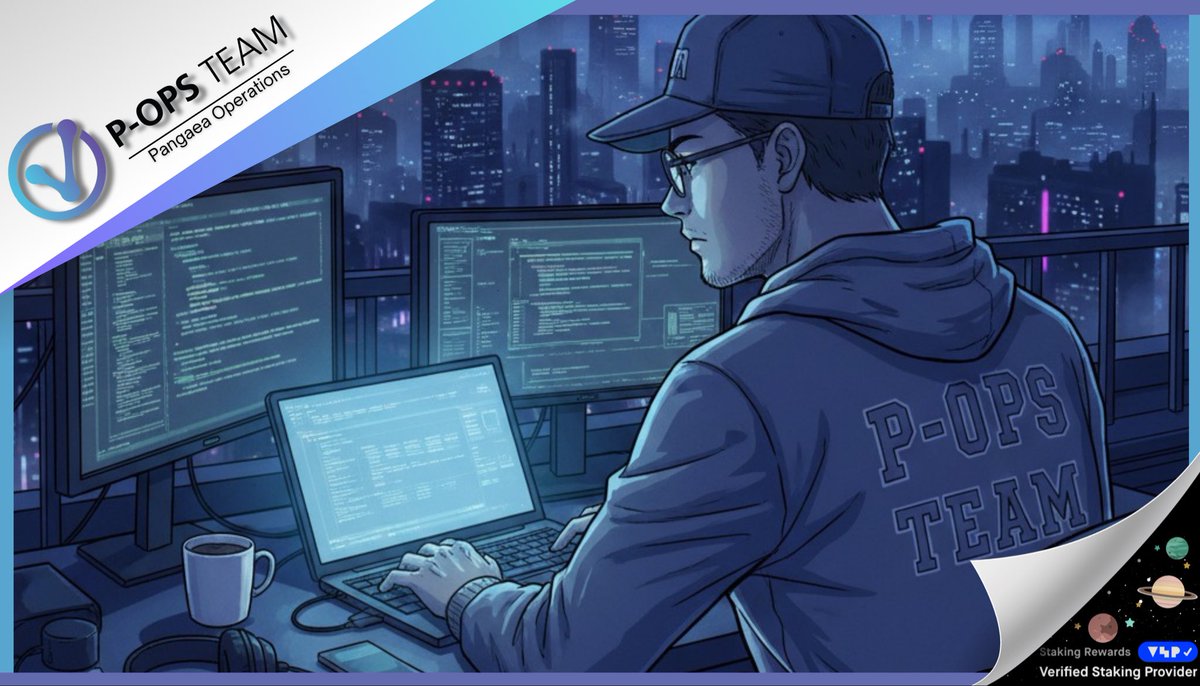
⌨️ KEYSPACE
🌌 P-OPS TEAM | After-Hours Signal
🌙 Tonight wasn’t about observing the chain.
🧠 It was about noticing where attention naturally settled once activity thinned.
🌐 Traffic eased.
🔇 The environment quietened.
⚙️ The system kept moving — confidently.
✨ That’s the signal.
🧭 The Shift
🌗 Earlier activity gave way to something more intentional.
🎯 Not slower — just more exact.
📦 Blocks arrived with purpose.
🤝 Peers behaved like veterans of repetition.
🧠 Familiarity carried execution forward.
👀 What Stood Out
🧩 Execution stopped adjusting itself.
⏱️ Timing stabilised into pattern.
🔗 Participation flowed without renegotiation.
🪞 The network showed its default posture.
💡 The Quiet Advantage
🌘 In windows like this, yield isn’t pursued directly.
📈 It compounds through behaviour.
🧠 Familiar paths taken cleanly
⚙️ Habits reinforced under calm conditions
🧱 Infrastructure that doesn’t seek attention
📍 Position strengthens without announcement.
🧑💻 Operator Read
🌍 Across supported networks:
🧭 Validator posture stayed composed
⏳ Cadence remained elastic
⚖️ Trust weight accumulated naturally
🔒 Discipline did the work.
🔐 KEYSPACE — SEALED
🧠 Signal captured
⚙️ Readiness sustained
⏭️ Momentum carried forward
🌒 The window passed cleanly.
🌅 The next epoch inherits the benefit.
☎️ P-OPS TEAM | Validator Infrastructure
🌍 pops.one
🌳 linktr.ee/p_opsteam
🐥 x.com/popsteam1
↗️ t.me/POPS_Team_Validator
👾 discord.gg/jJ8aaMwPwa
#Keyspace #AfterHoursOps #ValidatorLife #Consensus #MultiNetwork #Staking #Web3 #POpsTeam
9
19
163