Decoding active sites in high-entropy catalysts with attention-enhanced models
High-entropy catalysts—materials where four or more transition metals share the same lattice—offer a vast compositional space for exceptional catalytic performance. But that richness is also their curse: with multiple elements randomly occupying sites, pinpointing which local atomic arrangement actually drives the reaction becomes extraordinarily difficult.
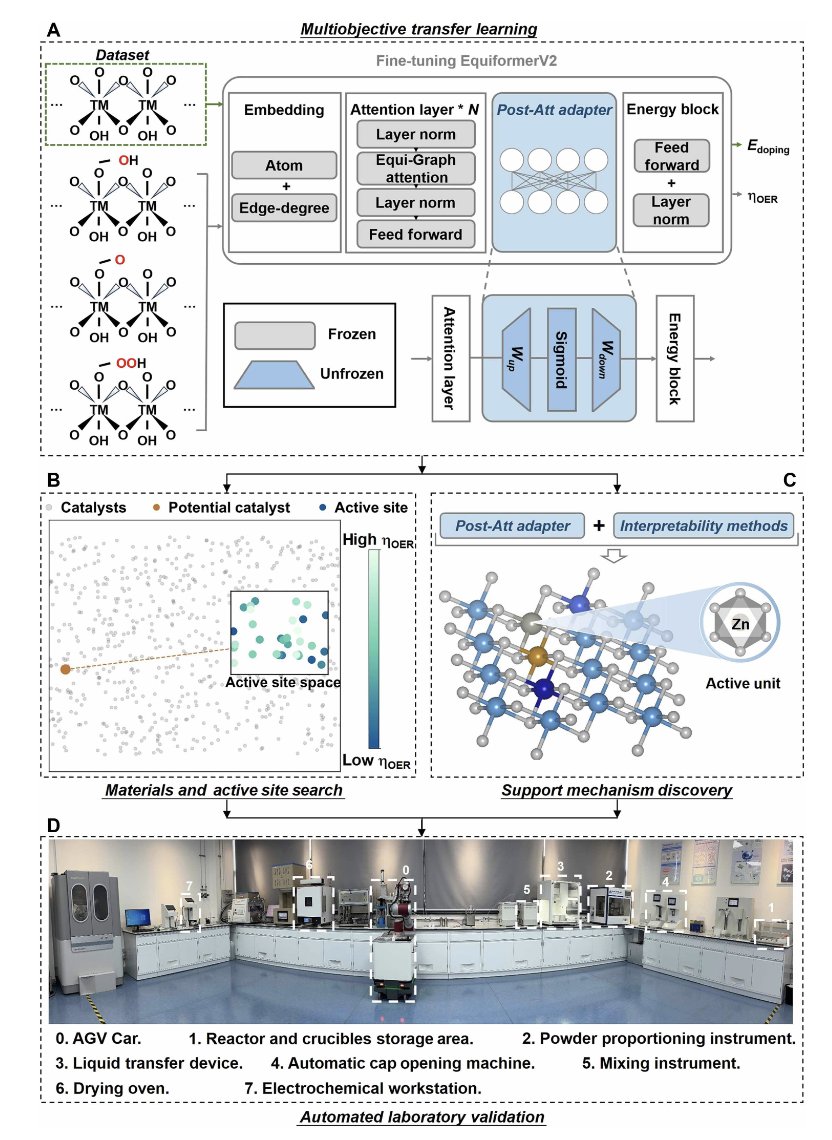
Liang Yin and coauthors tackle this for the oxygen evolution reaction (OER) in high-entropy CoOOH catalysts, relevant to water electrolysis and clean hydrogen production. They build a multiobjective transfer learning framework on EquiformerV2, an equivariant transformer pretrained on broad materials data. Instead of full fine-tuning, they introduce a lightweight Post-Att Adapter inserted after the attention layers, trained on 4,822 high-entropy CoOOH structures while keeping pretrained weights frozen. This adapter simultaneously predicts OER overpotential and doping formation energy, achieving mean absolute errors of just 4.5 mV/atom and 3.6 meV/atom, respectively.
What makes this work distinctive is how the authors leverage attention scores for interpretability—extracting which transition-metal-centered octahedra the model considers most important, transforming it from a black-box predictor into an active-site discovery tool.
They screen 17,500 catalysts from a space of over 3 million compositions, applying dual criteria for activity and stability to identify eight top candidates. These were synthesized and tested in a fully automated laboratory with robotic preparation and electrochemical characterization. The best performer, TiFeNiZn-CoOOH, achieved 263 mV overpotential at 100 mA/cm², a Tafel slope of 39.2 mV/dec, and 97.5% retention after 120 hours.
The deeper insight comes from scaling the analysis across more than 5 million structures. Two generalizable design principles emerge: Zn dominates active site occupation (72–93% probability across systems), and the [CoNiZn] coordination environment consistently yields the lowest overpotential—even though it is not the most frequent configuration. Electronic structure calculations confirm that Zn shifts O(2p) orbitals toward the Fermi level, creating gap states that lower the OER energy barrier.
This work illustrates a maturing paradigm: parameter-efficient fine-tuning of pretrained models, mechanistic interpretability from attention weights, and closed-loop automated validation—turning the combinatorial challenge of high-entropy materials into an opportunity.
Paper:
science.org/doi/10.1126/scia…