
multisolver settlements coming soon on garden
enjoy higher swap limits and a clean breakdown on the explorer
Jan 13

good design work isn’t always flashy. better IA, better use of space, better rhythm & more under the hood. new / old
1
12
940

26 Jul 2025
The real layer zero is execution coordination. We talk a lot about interoperability. About connecting chains, syncing liquidity, moving assets.
But none of it works without coordination.
Warden is the invisible mesh that turns fragmented blockchains into a unified system. It doesn’t just move tokens. It orchestrates execution.
It’s not just multichain. It’s multinode, multisolver, and multiagent.
A true Layer Zero for intent based coordination.

45
43
203

24 Jul 2025
KeyStone Engine continued...
6.) The compiler-rt project
compiler-rt.llvm.org/
Provides highly tuned implementations of the low-level code generator support routines like "__fixunsdfdi" and other calls generated when a target doesn't have a short sequence of native instructions to implement a core IR operation. It also provides implementations of run-time libraries for dynamic testing tools such as AddressSanitizer, ThreadSanitizer, MemorySanitizer, and DataFlowSanitizer.
7.) The MLIR (Multi-Level Intermediate Representation) subproject
mlir.llvm.org/
A novel approach to building reusable and extensible compiler infrastructure. MLIR aims to address software fragmentation, improve compilation for heterogeneous hardware, significantly reduce the cost of building domain specific compilers, and aid in connecting existing compilers together.
8.) The OpenMP subproject
openmp.llvm.org/
openmp.org/
Provides an OpenMP runtime for use with the OpenMP implementation in Clang.
9.) The polly project
polly.llvm.org/
Polly is a high-level loop and data-locality optimizer and optimization infrastructure for LLVM. It uses an abstract mathematical representation based on integer polyhedra to analyze and optimize the memory access pattern of a program. We currently perform classical loop transformations, especially tiling and loop fusion to improve data-locality. Polly can also exploit OpenMP level parallelism, exposing SIMDization opportunities.
10.) The libclc project
libclc.llvm.org/
Aims to implement the OpenCL standard library.
Khronos Group - The OpenCL Specification Version: 1.1
khronos.org/registry/OpenCL/…
11.) The Klee project
klee-se.org/
KLEE Symbolic Execution Engine
KLEE implements a "symbolic virtual machine" which uses a theorem prover to try to evaluate all dynamic paths through a program in an effort to find bugs and to prove properties of functions. A major feature of klee is that it can produce a testcase in the event that it detects a bug.
📄 KLEE: Unassisted and Automatic Generation of High-Coverage Tests for Complex Systems Programs
KLEE is used to thoroughly check all 89 stand-alone programs in the GNU COREUTILS utility suite, which form the core user-level environment installed on millions of Unix systems, and arguably are the single most heavily tested set of open-source programs in existence. KLEE-generated tests achieve high line coverage — on average over 90% per tool (median: over 94%) — and significantly beat the coverage of the developers' own hand-written test suites.
When we did the same for 75 equivalent tools in the BUSYBOX embedded system suite, results were even better, including 100% coverage on 31 of them. We also used KLEE as a bug finding tool, applying it to 452 applications (over 430K total lines of code), where it found 56 serious bugs, including three in COREUTILS that had been missed for over 15 years. Finally, we used KLEE to cross-check purportedly identical BUSY-BOX & COREUTILS utilities, finding functional correctness errors & a myriad of inconsistencies.
llvm.org/pubs/2008-12-OSDI-K…
PDF
llvm.org/pubs/2008-12-OSDI-K…
📄 KLEE symbolic execution engine in 2019
link.springer.com/content/pd…
📄 KleeNet: Discovering Insidious Interaction Bugs in Wireless Sensor Networks Before Deployment
A debugging environment that effectively discovers such bugs before deployment. KleeNet executes unmodified sensor network applications on symbolic input & automatically injects non-deterministic failures. As a result, KleeNet generates distributed execution paths at high-coverage, including low-probability corner-case situations.
comsys.rwth-aachen.de/filead…
📄 KLEE-Multisolver: Multi-solver Support in Symbolic Execution
srg.doc.ic.ac.uk/files/paper…
KLEE-MultiSolver
An extension to KLEE that uses the metaSMT framework to add support for multiple SMT solvers (Boolector, STP and Z3), & its evaluation on 12 Coreutils applications.
srg.doc.ic.ac.uk/projects/kl…
2
86

19 Aug 2024
Instant close & multisolver
One of the most anticipated updates for me personally.
Big step into achieving something no one else could achieve so far.
100% liveness through modularity...gonna write a more detailed thread on why being online 100% of the time is the most important aspect for perp dexes in the coming days!
Great update, thanks @levysaur & @IntentX_ team
2
2
32
5,892

18 Dec 2023
multisolver IRL

13
1,207

13 May 2022
Feel like we're in a free fall of climate change & social issues?
Multisolver @BethSawin has some big ideas on how to solve multiple immediate and long-game problems.
Learn more on the podcast bit.ly/3Pa9K8L
2
3

Hanf ist nun mal #Multisolver, da muss es jetzt einfach schneller gehen.
2

29 Oct 2021
#Houdini 19 testing vellum unified multisolver
#indiegamedev #indiedev #goprocedural #gamedevelopment #gamedev #indiegame #gametools #animation3d #cg #CGI #VFX #3dartist #gameart #sidefx #3D #sidefx
1
3
9

9 Sep 2021
Day (3/100) of #100DaysOfCode
DSA:
>Graph
- Multisolver - Smallest, Longest, Ceil, Floor
- Kthlargest Path
- Number Of Islands
From
#pepcoding
WEB:
- Learnt about MongoDB and Mongoose. Created a basic schema for the user.
by
#HiteshChoudhary
#100daysofcodechallenge
5

I just watched this - thank you @bethsawin A name for the thought process and work I’ve been doing/ seeking. I am a multisolver. The Power of Multisolving for People and Climate | Elizabeth Sawin | TED... youtu.be/prF8trTallQ via @YouTube #commonsense for certain!
1
2

25 Apr 2021
人、青パネル、台風をmultisolver制御
青パネルはmaterialfractureとbulletsolverで割れるように設定したものを持ってきてるのに砕けない(助けてクレイジーダイヤモンド) #Houdini
1
2

27 Dec 2020
MultiSolver知らなかったので普通に分けて作ってたマン
次の制作に大きく活躍しそう
1
2

8 Dec 2020
Much like in #permaculture design, „Multisolvers ask themselves different questions. One is: How does solving my problem help solving yours? As a multisolver you have to care about somebody else‘s problem as much as about your own.“ ...
1
1
1
8 Dec 2020
Wow, I just learned from @bethsawin that I’m a #multisolver, (and why I often struggle with people who try to play a different game)...👇
2
1
2

5 Dec 2020
I think that with FEM is possible with a multisolver but it’s incredibly slow compare to vellum.
1
2

30 Nov 2020
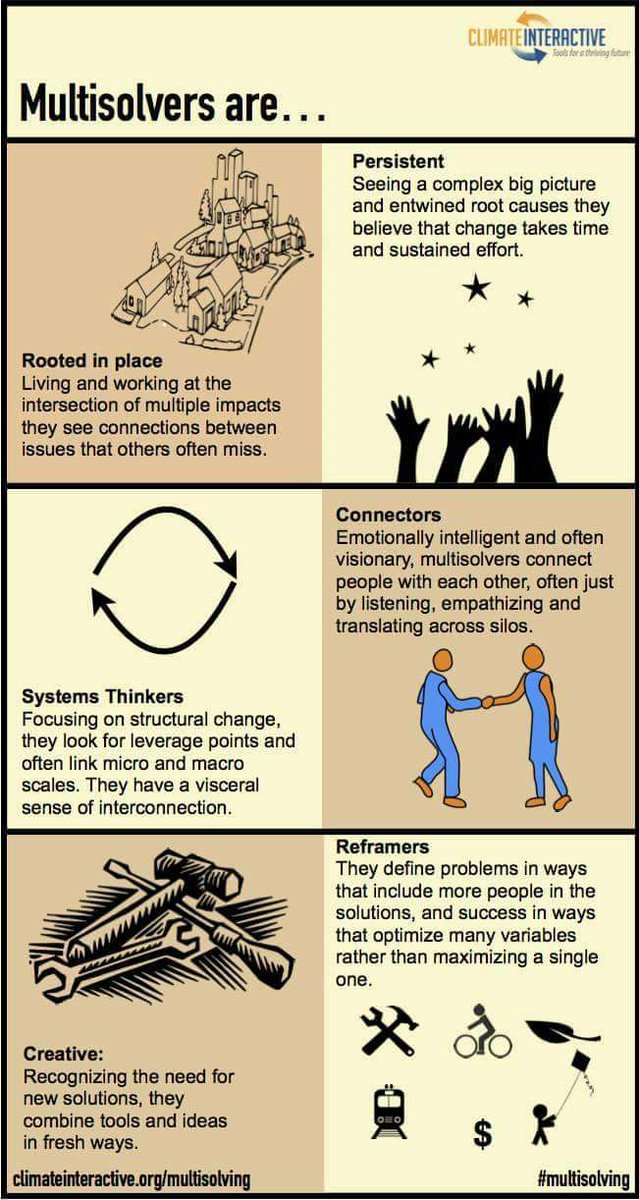
The closer we get to becoming a “multisolver” — the more impactful a contribution we can make to society. And in these times, that should be our objective.
30 Nov 2020

1
2

23 Nov 2020
良いなあこれ。でも入門用の解説ばっかり書いてる自分には活躍の場がないツールになっちゃうか……
Storm The multisolver tool - シミュレーションソフト「Storm 0.5」最新プロモーション映像が公開!学生向け超低価格版もあるよ 3dnchu.com/archives/storm-th…
1

23 Nov 2020
Storm The multisolver tool - シミュレーションソフト「Storm 0.5」最新プロモーション映像が公開!
学生向けは超低価格版もあるよ
3dnchu.com/archives/storm-th…
ちなみに現在ブラックフライデーセール中
学生版:$29
インディ版:$89
#VFX #Storm #3dnchu
1
29
182
