
Jun 5
🚀 The Future of Programming: How Uncle Bob's AI Agent System Works
AI is no longer just a tool for generating snippets of code. We're entering a new era where multiple AI agents collaborate together, each with a specialized responsibility, operating much like a real software engineering team.
Robert C. Martin ("Uncle Bob"), author of Clean Code and one of the most influential figures in software development, recently shared an AI-driven workflow that leverages specialized agents to build software with a strong focus on quality and correctness.
💡 The big shift: What's fascinating isn't that AI can write code. What's fascinating is how this system is designed to prevent mistakes.
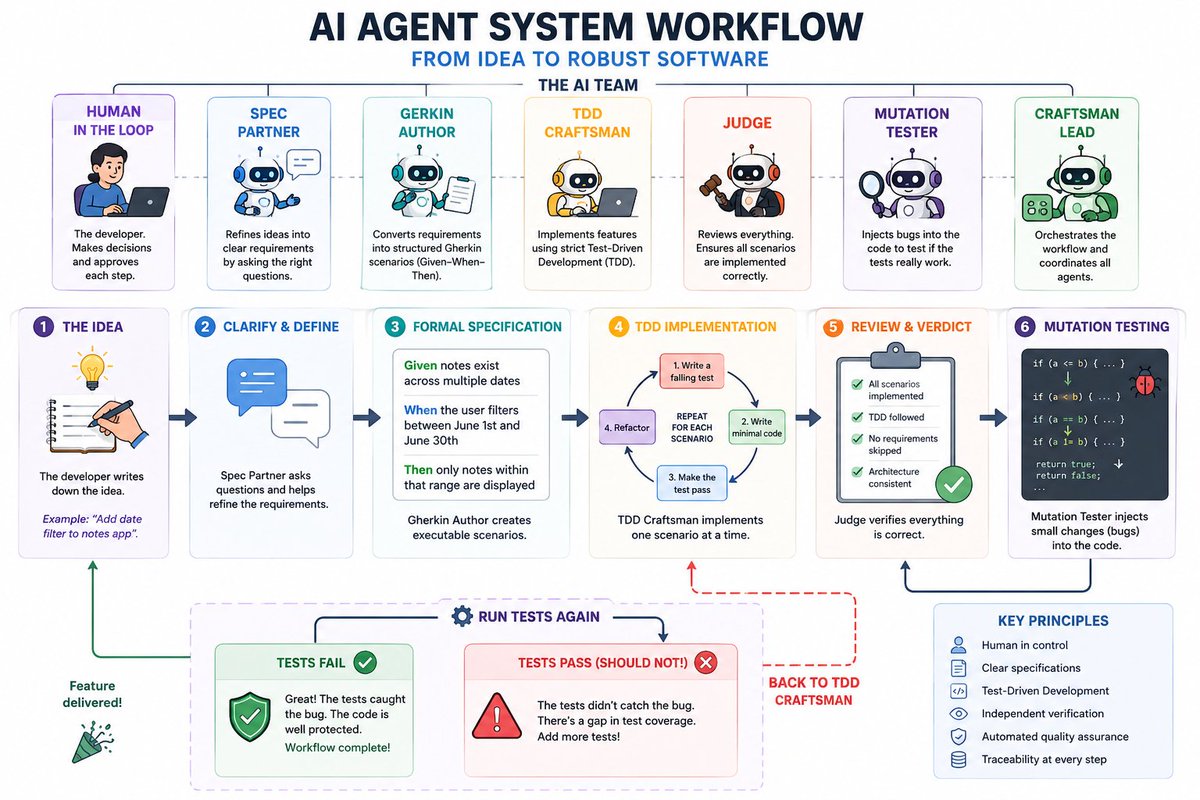
👥 Meet the AI Team
Instead of relying on a single chatbot to handle everything, the workflow distributes responsibilities across multiple specialized agents:
👨💻 Human-in-the-Loop: The developer remains in control of critical decisions. Nothing important moves forward without human approval.
🗣️ Spec Partner: Works with the developer to transform vague ideas into clear, complete, and edge-case-aware requirements.
📝 Gherkin Author: Converts those requirements into formal, structured scenarios using the Gherkin format: Given ➔ When ➔ Then.
🛠️ TDD Craftsman: The "builder" agent. It implements features using strict Test-Driven Development (TDD) practices.
⚖️ Judge: An independent reviewer that verifies the entire process and ensures all requirements have been fulfilled correctly.
👾 Mutation Tester: The saboteur. It actively searches for weaknesses in the test suite by intentionally introducing bugs into the code.
🪄 Craftsman Lead: The orchestrator. It acts as the project manager, coordinating all agents and managing the overall workflow.
🏗️ How a Feature Is Built
Let's imagine you're adding a date filter to a note-taking application.
🔹 Step 1: The Idea
The developer starts with a simple request:
"I want users to filter notes by date."
The Spec Partner immediately starts a dialogue to flesh out the details:
Should filtering be based on date only or exact timestamps?
What happens if the user enters an invalid range?
How should time zones be handled?
Goal: Eliminate ambiguity before writing a single line of code.
🔹 Step 2: Formal Specifications
Once the requirements are clarified, the Gherkin Author creates executable scenarios:
Gherkin
Given notes exist across multiple dates
When the user filters between June 1st and June 30th
Then only notes within that range are displayed
The developer reviews and approves these scenarios. At this point, there is a clear, unyielding contract defining the expected behavior.
🔹 Step 3: Test-Driven Development
The TDD Craftsman implements each scenario one by one using the classic TDD cycle:
🔴 Red: Write a failing test based on the Gherkin scenario.
🟢 Green: Write the absolute minimum production code required to make the test pass.
🔵 Refactor: Clean up the code and improve architecture.
🔄 Repeat.
🔹 Step 4: The Judge
Once implementation is complete, the Judge takes over to verify:
[x] Every Gherkin scenario has an associated test.
[x] The strict TDD process was followed (verifying historical logs).
[x] Architectural consistency has been maintained.
🔬 The Most Interesting Part: Mutation Testing
This is arguably the most powerful concept in the entire workflow. Most teams assume their tests are good simply because "everything is green." But are the tests actually capable of catching real defects?
Mutation Testing answers that question.
⚙️ How It Works
The Mutation Tester runs a script that intentionally injects architectural "bichos" (bugs) into the production code:
- Replaces <= with <
- Replaces == with !=
- Changes true to false
- Inverts logical conditions (and into or)
- Then, it runs the entire test suite again.
💥 Outcome #1: Tests Fail⚠️ Outcome #2: Tests Still PassPerfect! The tests successfully detected the mutation. Your safety net is working exactly as intended.Problem. The behavior of the code changed, yet the tests didn't notice. This reveals a dangerous gap in your test coverage.
🔄 The Handoff: If a mutation survives (Outcome #2), the Mutation Tester passes the context back to the TDD Craftsman, demanding additional test scenarios until the weakness is completely eliminated.
🎯 Why This Matters
One of the biggest challenges with AI-assisted development is that generating code is easy; generating reliable software is not.
This workflow solves that by introducing:
🎯 Clear specifications up front.
🛡️ Test-driven implementation for safety.
🔍 Independent validation via the Judge.
🧪 Automated test quality verification via Mutation Testing.
👤 Continuous human oversight at critical junctions.
💡 My Biggest Takeaway
Uncle Bob's approach doesn't attempt to replace developers, it does the opposite.
Humans remain responsible for product decisions, architecture, and business logic, while AI agents handle repetitive implementation tasks and rigorous verification.
Instead of a single coding assistant, this model resembles an entire engineering team working alongside the developer. And that may be much closer to the future of software development than simply asking an AI chatbot to generate code.
The combination of specialized agents, TDD, automated reviews, and mutation testing has the potential to dramatically improve software quality while allowing developers to focus on what humans do best: making decisions.
#SoftwareEngineering #AIAgents #CleanCode #TDD #MutationTesting #TechTrends
2
1
3
298

May 13
¿Tus tests de mutación tardan demasiado en ejecutarse? Te mostramos cómo el motor de mutación Descartes acelera el proceso, reduciendo los tiempos de ejecución drásticamente en proyectos grandes. ¡Más calidad en menos tiempo! Profundizamos mucho más en #MutationTesting 👇

3
129

May 11
📣 New Podcast! "343 - Mutation Testing: chi testa i test?" on @Spreaker #dotnet #mutationtesting #strykerdotnet #unittesting spreaker.com/episode/343-mut…

2
3
94
Alcanzar un 90% de cobertura es un buen objetivo, pero no garantiza la calidad. Te enseñamos a usar #MutationTesting para ir más allá, detectar tests ineficaces y asegurar que tu código sea realmente robusto. Te contamos cómo hacerlo 👇

1
2
202

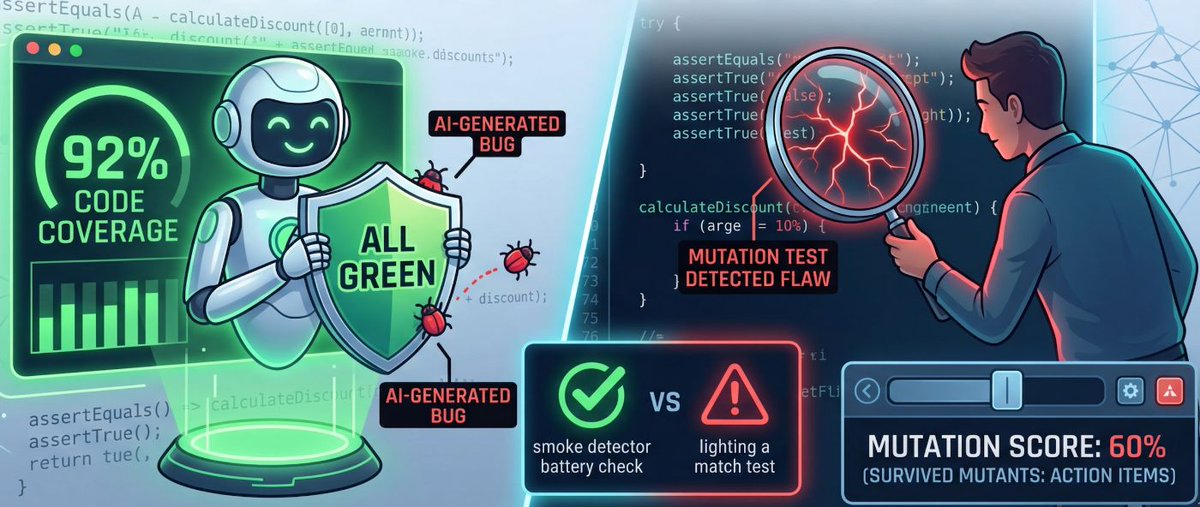
High code coverage doesn’t guarantee correctness. Learn how mutation testing exposes blind spots in AI-generated code.
#aigeneratedcode #mutationtesting...Show more
2
2
290

Mar 27
【Techブログ更新】
GoConf mini Sendai 2026に参加した弊社エンジニアがセッションきっかけで、Mutation Testingを導入
AIが生成する"中身のないテスト"をgremlinsで可視化・撃破した記録をまとめました💡
👇 np-techblog.hatenablog.com/e…
#Go言語 #MutationTesting #テスト品質
2
6
1,922
Mar 11
¿Quieres llevar tus tests al siguiente nivel? 🚀 El #MutationTesting te ayuda a encontrar las debilidades de tu código. Te contamos cómo implementar esta técnica de forma eficiente y matar a esos mutantes escurridizos. 📝
3
122

Feb 24
Deine Tests laufen bei jedem Build? Dann sind sie wichtig genug, getestet zu werden. Julius Mischok zeigt, wie #MutationTesting mit #PIT Schwachstellen in deiner #CI sichtbar macht.
Stärke deine Teststrategie: javapro.io/de/teste-deine-te…
#Java #CleanCode #DevOps #DevTools #JAVAPRO
1
3
100

Feb 14
200/1001
📘 6h — Becoming Quantum Safe
🛡️ 1h — CISSP study
Day 200.
A milestone.
The last 100 days were intense — deep crypto study, Rust implementations, finishing Cryptopals Sets 1–6, working through Understanding Cryptography, completing the MoonMath Manual, building zk-mutant and noir-metrics, starting a PQ-ZK paper, and documenting the journey at mutorium.com/blog
Today was focused on post-quantum strategy and crypto-agility—how they translate into real-world systems.
I’m not just learning cryptography anymore.
I’m building it, writing about it, and shaping a long-term career path as a cryptologist.
Onward to 300.
#1001Days #MutationTesting
5
178
Jan 23
178/1001
🛡️ 1h — CISSP study
📐 1h — @_MathAcademy_
🔐 4h — Cryptopals (finished Set 5 ✅)
🧬 1h — @MutoriumLabs
🧑💻 0.5h — @hackthebox_eu
Very satisfied with today. Solid depth, clear progress, and a big Cryptopals milestone checked off.
#1001Days #MutationTesting
3
121
Jan 21
100% code coverage… and your tests still miss bugs? Julius Mischok shows why coverage measures execution, not verification — and how #MutationTesting with #PIT proves whether tests actually fail when code changes.
Add PIT kill surviving mutants: javapro.io/2026/01/21/test-y…
#Java
2
2
131
Jan 8
Hotfix shipped: zk-mutant v0.1.1 ✅
Turns out: operators inside comments can create a ton of noisy mutants 😅
v0.1.1 now ignores // ... /* ... */ when discovering mutants — much cleaner inventories.
mutorium.com/blog/zk-mutant-…
@MutoriumLabs @NoirLang #MutationTesting
2
2
107
23 Dec 2025
zk-mutant v0.1.0 is live🎉
I’ve wanted to ship “mutation testing for Noir” for a while — and today I finally pushed the first public version.
This is an early release (lots of rough edges and room to improve), but I really wanted to get it out so people can try it, break it, and tell me what’s missing.
Blog post: mutorium.com/blog/announcing…
If you’re building with Noir and care about test quality, I’d love feedback. This is only the beginning. 🧪⚡️
@NoirLang
#MutationTesting
4
5
194
22 Dec 2025
Shipped noir-metrics v0.2.0 🎉
noir-metrics is a small CLI library for line-based metrics on @NoirLang projects. This release is all about hardening the foundations, not flashy features:
• guided by mutation testing with cargo-mutants
• snapshot tests with insta for reports & JSON
• deterministic output clearer --format human|json
mutorium.com/blog/announcing…
#noir #rust #zk #1001Days #MutationTesting
2
9
529
18 Dec 2025
142/1001
🎥 3h — The Rust Lang Book video series (@letsgetrusty)
📊 1h — noir-metrics (@MutoriumLabs)
🎧 1h — DeFi Security 101 2025 – How Can I audit ZK circuits? (@Jeyffre & @RareSkills_io)
Today felt very aligned: Rust fundamentals, tool-building with noir-metrics, and a great talk on ZK circuit auditing all reinforcing each other. The more I learn, the clearer the connection gets between good engineering, good testing, and good security.
Still stacking focused blocks. Still moving toward better Rust, better tools, better audits.
#1001Days #MutationTesting
4
87
12 Dec 2025
136/1001
🧪 6h — zk-mutant (@MutoriumLabs)
Big zk-mutant day today. Lots of time in the code and design, thinking through details, naming, structure, and how this can eventually become a solid tool for @NoirLang devs and auditors.
I can’t do 6-hour deep blocks like this every day, but when they happen, I really feel the momentum building. Grateful I get to work on this and I am curious and excited where it will be by the end of these 1001 days.
#1001Days #MutationTesting
2
67
10 Dec 2025
134/1001
🎥 0.75h — NoirHack 2025 – Official Kickoff & Intro to Noir (by @aztecnetwork about @NoirLang )
🧬 1h — @MutoriumLabs — finished & published a blog post about cargo-insta
🧪 3h — zk-mutant
🎥 0.5h — “34 Auditing Tips to crush it in 2026” by @GalloDaSballo / @getreconxyz
🎄 0.25h — @tryhackme Advent of Cyber 2025 — Day 8: Prompt Injection – Sched-yule conflict
On top of that, my PR to cargo-mutants got merged today. 🎉
It still feels wild that I only started in September with @RareCodeAI and learning Rust — now I’m coding Rust every day, building my own tools, and even contributing to the very project that inspired what I want to create for Noir with zk-mutant.
Super grateful for the journey so far, and even more excited for where this can go. Still just getting started.
#1001Days #MutationTesting
4
113
3 Dec 2025
127/1001
🧪 3h — zk-mutant
Deep research added more structure & content to the paper
🎄 0.5h — @tryhackme
Advent of Cyber 2025 — Day 3: Splunk Basics – Did you SIEM?
A really busy day at work, but still managed to carve out some time.
Happy with the steady progress on zk-mutant — even if a part of me always wishes I could move faster.
One step at a time. Showing up every day.
#1001Days #MutationTesting
2
112
2 Dec 2025
Spent the weekend really getting to know cargo-mutants, the mutation testing tool for Rust.
I wrote up a practical intro.
If you write tests in Rust and care about how effective they are (not just coverage %), this might be useful:
mutorium.com/blog/an-introdu…
#rust #MutationTesting
2
7
149
1 Dec 2025
125/1001
📚 0.75h — TestGuild podcast: “What is Reverse Mutation Testing with Leonardo Lanni”
📄 1h — Research paper: Mutation Testing Advances: An Analysis and Survey (IEEE 2010)
A super long day at work, so that’s all I managed to get done. Still happy I kept the streak alive.
Tomorrow it’s back to grinding — excited to dive in again and make progress.
#1001Days #MutationTesting
3
110