
May 13
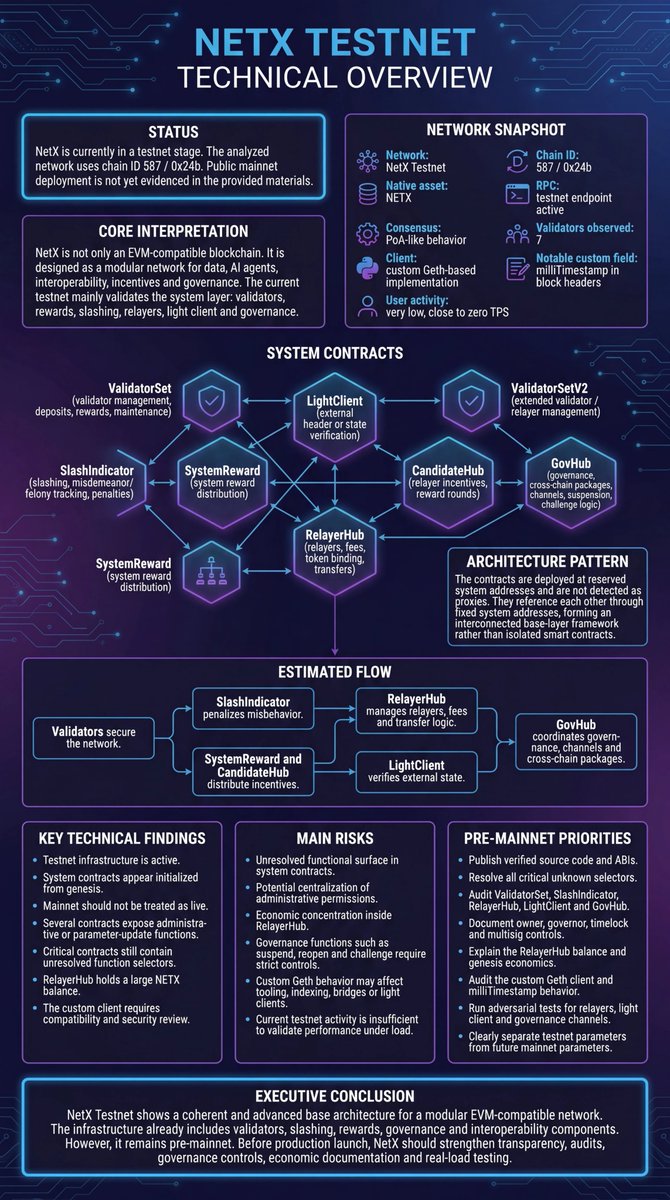
The NetX testnet technical overview (without access to any documentation or smart contract code, it is based on deep testnet crawling and contract decoding driven by agent-based deterministic local inference) showed a modular system architecture, not a blank EVM sandbox. The key findings were $NETX as native gas, a 7-validator PoA structure, reserved system contracts, cross-chain primitives, governance components and a staged pre-mainnet design. @netx_world
#NETXTestNetFindings
The second important piece from the NetX testnet is the technical overview.
At first glance, it looked like a small EVM-compatible network with low activity.
But once the RPC, validators and reserved contracts were mapped, the picture changed.
NetX testnet was structured like a system chain.
It had a clear network snapshot:
Chain ID: 587 / 0x24b
Native asset: NETX
Consensus: PoA-like behavior
Validators observed: 7
Client: custom Geth-based implementation
Block timing: around 3 seconds
User activity: very low, close to zero TPS
Custom header field: milliTimestamp
That matters because the testnet was not only testing whether contracts could deploy.
It was testing the foundation of a chain with its own validator layer, system contracts, relay logic and future governance path.
The most important concept here is NETX-as-gas.
In the observed testnet, NETX was the native execution asset. That means contract calls, deployments, system interactions and settlement-style operations were priced in NETX.
This is the first layer of token utility:
not narrative utility,
but execution utility.
The system contracts were the real signal.
The base layer included components such as:
ValidatorSet for validator management, deposits, rewards and maintenance.
SlashIndicator for misdemeanor, felony and slashing-style accountability.
SystemReward and CandidateHub for system incentives and relayer-related rewards.
LightClient for external header or state verification.
RelayerHub / TokenHub for relayers, fees, token binding and transfer coordination.
GovHub for governance packages, channels, suspension, reopening and challenge logic.
This architecture suggests a network designed around more than transaction execution.
It suggests a network built for verification, coordination and accountability.
The architecture pattern is also important.
These contracts were deployed at reserved system addresses and were not detected as simple user contracts. They referenced each other through fixed system addresses, forming an interconnected base-layer framework rather than isolated smart contracts.
That is the difference between:
“someone deployed a few contracts”
and
“the chain has a protocol-level system map.”
The estimated flow is easy to understand:
· Validators secure the network.
· SlashIndicator penalizes misbehavior.
· SystemReward and CandidateHub distribute incentives.
· RelayerHub coordinates relayers, fees and transfer logic.
· LightClient verifies external state.
· GovHub coordinates governance, channels and cross-chain packages.
This is why the testnet is interesting even with low user activity.
Low activity means it was not yet a production network.
But the contract map shows that the testnet was preparing something much larger:
a modular base for validation, rewards, slashing, relay, external proofs, governance and interoperability.
The risks are equally important.
There were unresolved selectors in critical contracts, potential administrative centralization, large balances inside system contracts, custom client behavior and staged components that still required activation, verification and public documentation.
So the right conclusion is balanced:
The NetX testnet was not mainnet.
It was not production-ready.
But it was also not empty.
It showed a coherent technical foundation for a modular EVM-compatible network where $NETX acts as gas, system contracts coordinate the base layer, and future governance, staking and settlement infrastructure can be built on top.
That is the technical overview worth documenting 🫡
* Please note that this research was not provided by the team and is published as an independent study without full access to the source code or testnet infrastructure; as a result, it may contain errors or inconsistencies compared to the final product.
2
19
68
1,065
May 12
The NetX testnet shutdown makes the technical snapshot more valuable. While live, it showed a serious pre-mainnet architecture with $NETX as native gas, system contracts, relay logic, governance, token management and recovery components. Not mainnet yet, but definitely not an empty testnet either. @netx_world
#NETXTestNetFindings
The NetX testnet going offline may look like a small technical event, but for research it matters.
Because while it was live, it gave us a rare on-chain window into what NetX was actually testing beneath the public narrative.
And the most important conclusion is simple:
NetX was not just running a basic EVM testnet.
What we observed was a structured system architecture with native gas, validators, slashing, relay logic, light-client verification, token-management components, governance contracts, timelock infrastructure, staking components and recovery-style mechanisms.
That does not mean mainnet is live.
It does not mean every component was fully activated.
It does not mean the full product stack is already in production.
But it does mean the testnet was not empty.
It was a technical staging environment for a much larger architecture.
The base layer showed active system infrastructure:
ValidatorSet
SlashIndicator
LightClient
TokenHub / RelayerHub
Incentivize / CandidateHub
RelayerHub V2
GovHub
The advanced layer appeared deployed but mostly staged:
Staking
ValidatorHub / StakeHub
NativeToken / StakeCredit
GovToken
Governor
Timelock
TokenManager
TokenRecoverPortal
That distinction is important.
Active base layer.
Staged advanced layer.
This is exactly how an early technical network can look before mainnet: not finished, not production-grade, but already revealing the design philosophy.
The strongest finding, in my view, is that NetX seems positioned less like “another payment blockchain” and more like a programmable trust layer.
A layer for payment intents, settlement records, compliance proofs, audit trails, challenge logic, cross-chain state, token management, operator accountability and governed rule changes.
Stablecoins can move value. Wallets can handle user experience. Payment processors can handle merchants.
But someone still needs to record the institutional context:
Who authorized the payment?
Which rule applied?
Was the merchant settlement valid?
What proof exists?
What happens if there is a dispute?
Who is accountable if something goes wrong?
That is where NetX could become strategically relevant.
The testnet may be offline now, but the architecture it revealed is worth documenting.

3
23
75
2,035