Joined March 2024
- Tweets 1,381
- Following 74
- Followers 1,103
- Likes 663
302 Photos and videos
Pinned Tweet

Apr 30
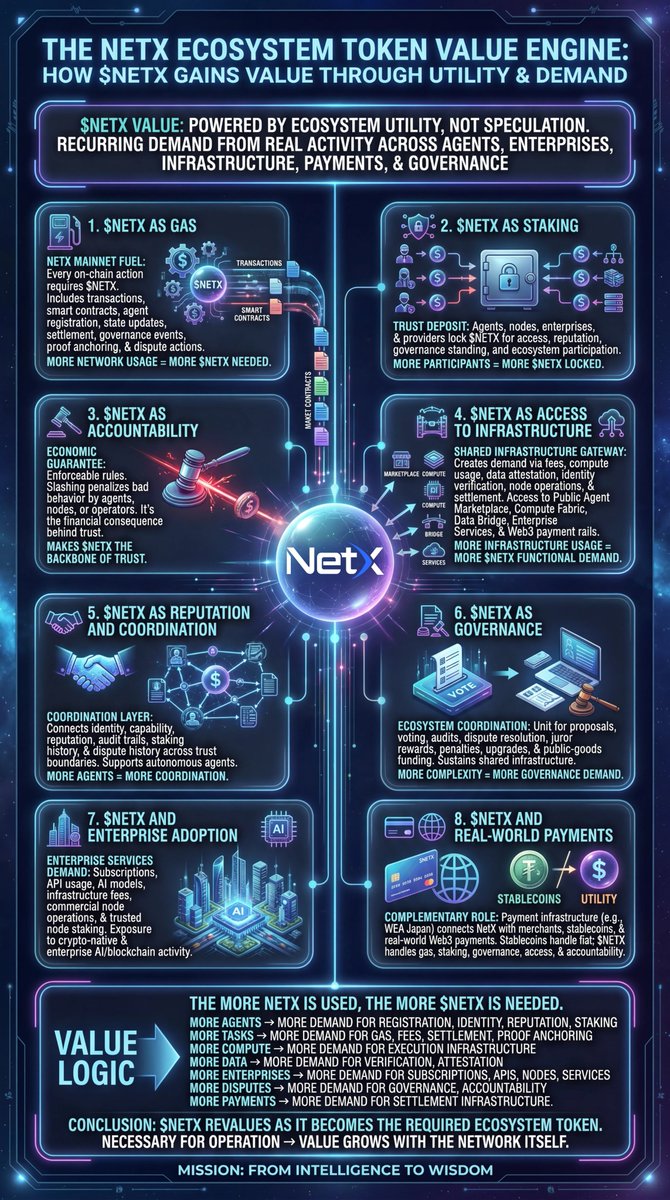
How can $NETX gain value as the ecosystem token of NetX?
$NETX becomes valuable when it is needed to use, secure, govern, and scale the @netx_world economy.
Its value does not come from speculation alone. It comes from recurring demand created by real activity across agents, enterprises, infrastructure, payments, and governance.
If $NETX is used as gas on the NetX mainnet, every on-chain action creates direct demand: transactions, smart contracts, agent registration, state updates, settlement, governance events, proof anchoring, and dispute actions.
More network usage means more need for $NETX.
But gas is only the first layer.
In an autonomous agent economy, participants also need staking. Agents, nodes, enterprises, and service providers can lock $NETX as a trust deposit to access roles, build reputation, participate in governance, or operate inside the ecosystem.
More participants means more $NETX locked.
Then comes accountability.
A serious agent economy needs enforceable rules. If an agent, node, or operator breaks those rules, slashing can make bad behavior costly.
That makes $NETX more than a payment token. It becomes the economic guarantee behind trust.
NetX also depends on shared infrastructure: Public Agent Marketplace, Compute Fabric, Data Bridge, Enterprise Services, and Web3 payment rails.
Accessing these layers can create demand for $NETX through fees, compute usage, data attestation, identity verification, node operations, settlement, and infrastructure participation.
More infrastructure usage means more functional demand for $NETX.
Autonomous agents also need identity, capability records, reputation, audit trails, staking history, and dispute history.
$NETX can support this coordination layer by connecting identity, access, reputation, payments, governance, and accountability across trust boundaries.
More agents means more coordination.
As the ecosystem grows, governance also becomes more important: proposals, voting, audits, dispute resolution, juror rewards, penalties, upgrades, and public-goods funding.
$NETX becomes the unit used to coordinate governance and sustain shared infrastructure.
Enterprise adoption adds another layer: subscriptions, API usage, AI models, infrastructure fees, commercial node operations, and trusted node staking.
Real-world payments can add even more utility, connecting NetX with merchants, stablecoins, developers, and Web3 payment infrastructure.
Stablecoins may handle fiat-denominated payments.
$NETX plays a different role: gas, staking, governance, access, accountability, reputation, and infrastructure coordination.
They are complementary.
The value logic is simple:
More agents → more identity, reputation, staking
More tasks → more gas, fees, settlement
More compute → more execution infrastructure
More data → more verification and attestation
More enterprises → more APIs, nodes, services
More disputes → more governance and accountability
More payments → more settlement infrastructure
In short:
$NETX can revalue if it becomes the required ecosystem token for gas, staking, slashing, access, reputation, governance, settlement, infrastructure usage, enterprise services, and agent coordination.
The more NetX is used, the more $NETX is needed.
And if $NETX becomes necessary to operate inside the agent economy, its value can grow with the network itself.
#NetX #NETX #NetXFoundation #AgentEconomy #Web3AI #AI #Blockchain #Layer2 #DePIN
4
36
82
2,529
June 13, 2026. Nankai University, Tianjin (China).
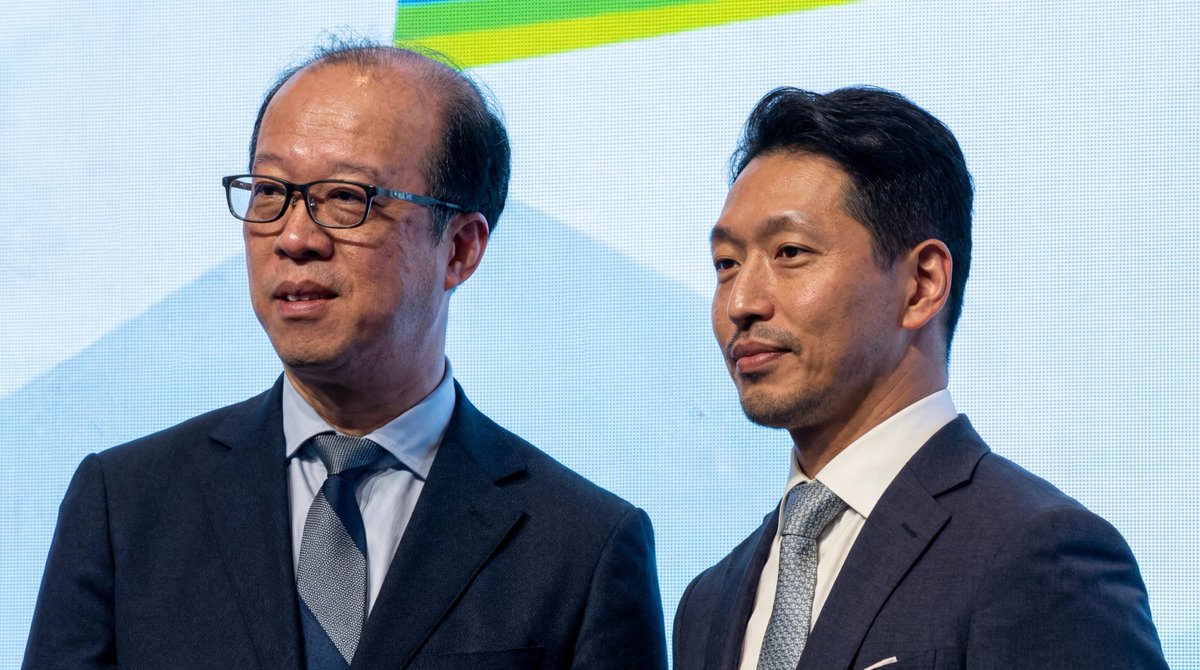
Octa Innovations & @WEAJapan CTO, and founder of @netx_world $NETX Foundation Wei Ming's participation at Nankai University's 2026 Insurance and Actuarial Forum highlights something bigger than a conference appearance. It reflects the growing convergence of AI, risk management, insurance, and trusted digital infrastructure that is reshaping the future of finance in China.
On June 13, Nankai University brought together leading figures from the insurance, actuarial, financial, academic, and technology sectors under a powerful theme:
"AI-driven transformation of the insurance value chain and ecosystem collaboration."
Among senior executives from major insurers, reinsurers, actuarial associations, universities, and technology companies was Wei Ming, Co-Founder and CTO of Octa Innovations and @WEAJapan.
What makes this noteworthy is not simply attendance.
It is the context.
Throughout the forum, speakers explored how artificial intelligence is changing the way risk is understood, insurance products are designed, healthcare services are delivered, and financial protection systems are built.
A recurring message emerged across the discussions:
The future of insurance will no longer be defined solely by compensating losses after they occur.
Instead, it will focus on anticipating risks.
Improving prevention.
Personalizing services.
Enhancing decision-making.
And creating intelligent systems capable of protecting people and organizations more effectively.
This is where Octa Innovations becomes particularly relevant.
Over the past several years, the company has been associated with initiatives involving trusted platforms, risk management, financial infrastructure, data protection, and advanced technologies designed for highly regulated environments, like the development of one of Huawei's large actuarial models in the insurance sector.
Against that backdrop, seeing Octa's CTO participating alongside some of the most influential voices in China's insurance industry takes on greater significance.
It signals alignment with a broader transformation that is taking place across finance, healthcare, and digital services.
More than an academic gathering, Nankai 2026 offered a glimpse into where long-term strategic conversations are heading.
Artificial intelligence.
Insurance.
Healthcare.
Risk management.
Digital trust.
And increasingly, these are no longer separate sectors. They are becoming part of the same ecosystem.
The future of finance will not be built on capital and regulation alone.
It will also be built on AI and the trusted digital infrastructure required to make intelligent systems work at scale.
Source: mp.weixin.qq.com/s/6RClyveQp…
6
6
30
632
May 13
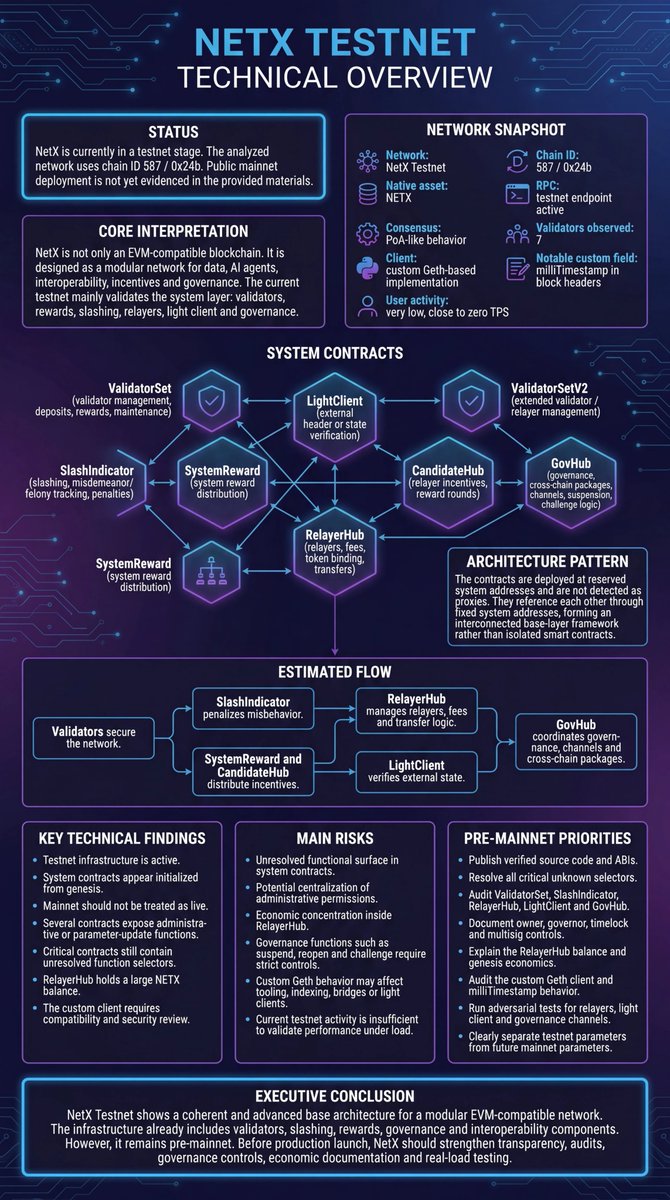
The NetX testnet technical overview (without access to any documentation or smart contract code, it is based on deep testnet crawling and contract decoding driven by agent-based deterministic local inference) showed a modular system architecture, not a blank EVM sandbox. The key findings were $NETX as native gas, a 7-validator PoA structure, reserved system contracts, cross-chain primitives, governance components and a staged pre-mainnet design. @netx_world
#NETXTestNetFindings
The second important piece from the NetX testnet is the technical overview.
At first glance, it looked like a small EVM-compatible network with low activity.
But once the RPC, validators and reserved contracts were mapped, the picture changed.
NetX testnet was structured like a system chain.
It had a clear network snapshot:
Chain ID: 587 / 0x24b
Native asset: NETX
Consensus: PoA-like behavior
Validators observed: 7
Client: custom Geth-based implementation
Block timing: around 3 seconds
User activity: very low, close to zero TPS
Custom header field: milliTimestamp
That matters because the testnet was not only testing whether contracts could deploy.
It was testing the foundation of a chain with its own validator layer, system contracts, relay logic and future governance path.
The most important concept here is NETX-as-gas.
In the observed testnet, NETX was the native execution asset. That means contract calls, deployments, system interactions and settlement-style operations were priced in NETX.
This is the first layer of token utility:
not narrative utility,
but execution utility.
The system contracts were the real signal.
The base layer included components such as:
ValidatorSet for validator management, deposits, rewards and maintenance.
SlashIndicator for misdemeanor, felony and slashing-style accountability.
SystemReward and CandidateHub for system incentives and relayer-related rewards.
LightClient for external header or state verification.
RelayerHub / TokenHub for relayers, fees, token binding and transfer coordination.
GovHub for governance packages, channels, suspension, reopening and challenge logic.
This architecture suggests a network designed around more than transaction execution.
It suggests a network built for verification, coordination and accountability.
The architecture pattern is also important.
These contracts were deployed at reserved system addresses and were not detected as simple user contracts. They referenced each other through fixed system addresses, forming an interconnected base-layer framework rather than isolated smart contracts.
That is the difference between:
“someone deployed a few contracts”
and
“the chain has a protocol-level system map.”
The estimated flow is easy to understand:
· Validators secure the network.
· SlashIndicator penalizes misbehavior.
· SystemReward and CandidateHub distribute incentives.
· RelayerHub coordinates relayers, fees and transfer logic.
· LightClient verifies external state.
· GovHub coordinates governance, channels and cross-chain packages.
This is why the testnet is interesting even with low user activity.
Low activity means it was not yet a production network.
But the contract map shows that the testnet was preparing something much larger:
a modular base for validation, rewards, slashing, relay, external proofs, governance and interoperability.
The risks are equally important.
There were unresolved selectors in critical contracts, potential administrative centralization, large balances inside system contracts, custom client behavior and staged components that still required activation, verification and public documentation.
So the right conclusion is balanced:
The NetX testnet was not mainnet.
It was not production-ready.
But it was also not empty.
It showed a coherent technical foundation for a modular EVM-compatible network where $NETX acts as gas, system contracts coordinate the base layer, and future governance, staking and settlement infrastructure can be built on top.
That is the technical overview worth documenting 🫡
* Please note that this research was not provided by the team and is published as an independent study without full access to the source code or testnet infrastructure; as a result, it may contain errors or inconsistencies compared to the final product.
2
19
68
1,068
May 12
The NetX testnet shutdown makes the technical snapshot more valuable. While live, it showed a serious pre-mainnet architecture with $NETX as native gas, system contracts, relay logic, governance, token management and recovery components. Not mainnet yet, but definitely not an empty testnet either. @netx_world
#NETXTestNetFindings
The NetX testnet going offline may look like a small technical event, but for research it matters.
Because while it was live, it gave us a rare on-chain window into what NetX was actually testing beneath the public narrative.
And the most important conclusion is simple:
NetX was not just running a basic EVM testnet.
What we observed was a structured system architecture with native gas, validators, slashing, relay logic, light-client verification, token-management components, governance contracts, timelock infrastructure, staking components and recovery-style mechanisms.
That does not mean mainnet is live.
It does not mean every component was fully activated.
It does not mean the full product stack is already in production.
But it does mean the testnet was not empty.
It was a technical staging environment for a much larger architecture.
The base layer showed active system infrastructure:
ValidatorSet
SlashIndicator
LightClient
TokenHub / RelayerHub
Incentivize / CandidateHub
RelayerHub V2
GovHub
The advanced layer appeared deployed but mostly staged:
Staking
ValidatorHub / StakeHub
NativeToken / StakeCredit
GovToken
Governor
Timelock
TokenManager
TokenRecoverPortal
That distinction is important.
Active base layer.
Staged advanced layer.
This is exactly how an early technical network can look before mainnet: not finished, not production-grade, but already revealing the design philosophy.
The strongest finding, in my view, is that NetX seems positioned less like “another payment blockchain” and more like a programmable trust layer.
A layer for payment intents, settlement records, compliance proofs, audit trails, challenge logic, cross-chain state, token management, operator accountability and governed rule changes.
Stablecoins can move value. Wallets can handle user experience. Payment processors can handle merchants.
But someone still needs to record the institutional context:
Who authorized the payment?
Which rule applied?
Was the merchant settlement valid?
What proof exists?
What happens if there is a dispute?
Who is accountable if something goes wrong?
That is where NetX could become strategically relevant.
The testnet may be offline now, but the architecture it revealed is worth documenting.
3
23
75
2,038
May 11
Japan may be closer than most people realize to bringing stablecoins into everyday life and @netx_world $NETX will be involved in the process.
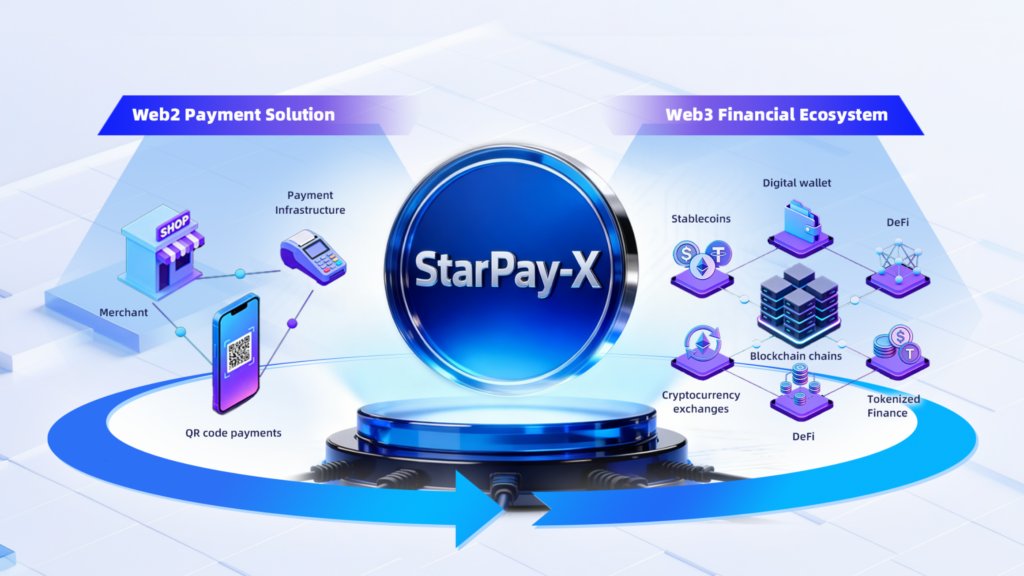
A recent @Weixin_WeChat publication from LUN Partners highlighted an important development around NETSTARS @Kouhou_NSS , one of Japan’s largest QR payment aggregation platforms. The company officially introduced @NSS_StarPayX, a new financial infrastructure initiative designed to connect traditional Web2 payments with Web3 technologies.
What makes this significant is not the marketing narrative around blockchain, but the practical direction behind it.
NETSTARS is not positioning itself as a typical crypto startup. It already operates within Japan’s real payment economy, where QR payments are deeply embedded across retail, transportation, tourism, and everyday commerce. Instead of replacing existing payment systems, the company appears focused on upgrading them.
According to the article, StarPay-X aims to integrate stablecoins, blockchain infrastructure, digital wallets, and DeFi-related financial capabilities into its existing payment network. The platform is also expected to support multiple chains, wallets, and digital assets.
More importantly, the article mentions potential collaboration with several major Web3-related organizations and ecosystems, including @Aptos, @BitgetWallet, @CantonFdn, @SolanaFndn, @StartaleGroup, and @WEAJapan.
This detail matters because it suggests that StarPay-X is being designed as an interoperable payment infrastructure rather than a closed ecosystem. The strategy appears centered on connecting traditional merchant payments with broader blockchain liquidity and multi-chain financial networks.
Another key point is that NETSTARS has already participated in offline USDC payment trials at Tokyo Haneda Airport Terminal 3.
That changes the conversation around stablecoins.
For years, stablecoins mainly circulated inside exchanges and crypto-native markets. But integrating them into physical payment infrastructure is a very different step. Once stablecoins begin functioning within real merchant environments, they evolve from speculative trading instruments into practical settlement layers.
Japan is uniquely positioned for this transition.
The country already has mature QR payment adoption, advanced consumer payment behavior, and one of the clearest regulatory environments for stablecoins among major economies. That creates ideal conditions for blockchain-based settlement systems to integrate quietly beneath familiar payment experiences.
Most users may never think about which network processes their transactions. What they will notice is faster settlement, lower friction, broader interoperability, and seamless digital payments across ecosystems.
That may ultimately be the real significance of StarPay-X.
Not the disruption of finance overnight, but the gradual convergence of payment networks, stablecoins, and blockchain infrastructure into everyday commercial life.
Source: mp.weixin.qq.com/s/DvggaNXf2…
4
30
106
5,162
May 11
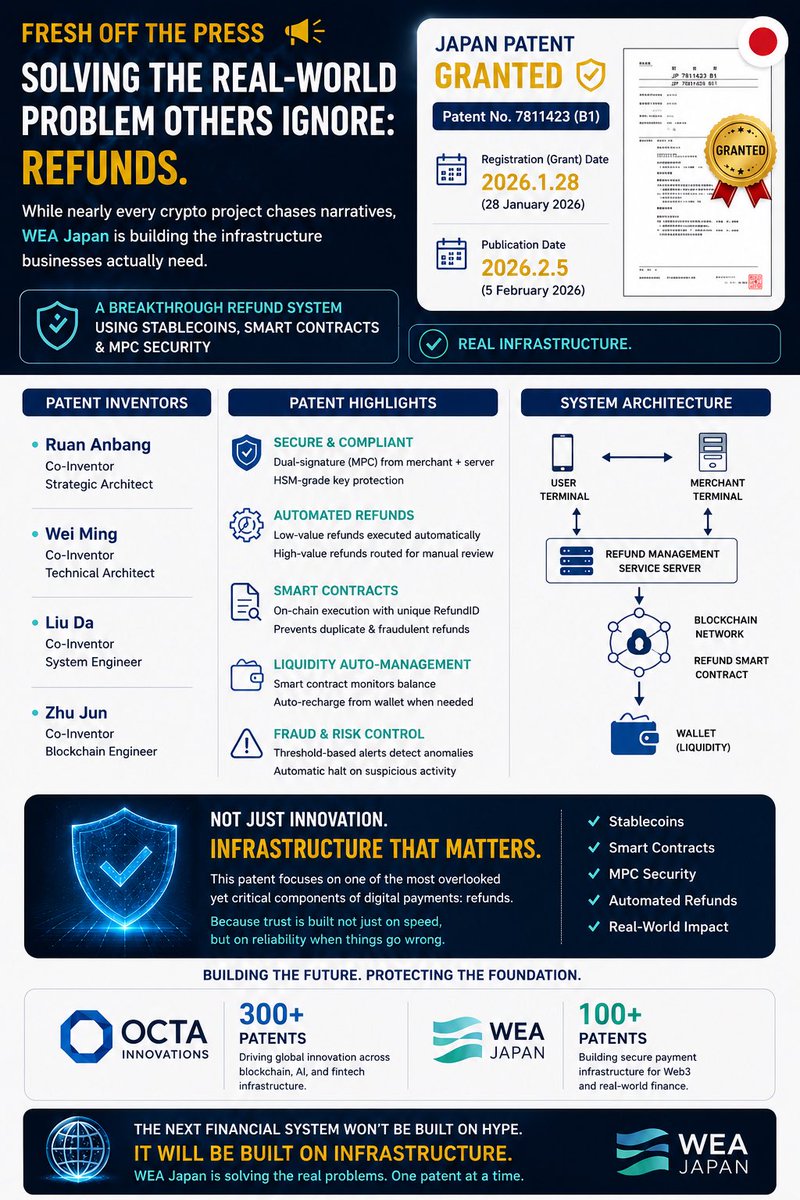
JP7811423B1 from @weajapan is more than a refund patent. For @netx_world and the $NETX thesis, it points to something the Web3 payment industry still does not discuss enough: real commerce does not end when a payment is confirmed.
A payment rail can be fast, global and programmable, but merchants also need refunds, disputes, liquidity control, fraud limits, audit trails and operational approvals. Without that layer, stablecoin payments remain closer to transfer infrastructure than full merchant infrastructure.
What makes this patent interesting is that it treats refunds as a controlled lifecycle, not as a simple reverse transaction.
The user requests a refund. The merchant forwards it. The refund management server checks the original txHash, verifies that the payment succeeded, confirms that the recipient was the right merchant, checks that the refund amount does not exceed the original payment, validates eligibility and makes sure the same transaction hash was not already used.
Then the system introduces a risk threshold. Low value refunds can move automatically. Higher value refunds are routed to manual review. Automation is useful, but only when paired with limits and human oversight where risk becomes material.
The refund itself is not approved by one party. The merchant signs. The server signs. The smart contract verifies authorization, checks that the RefundID has not been processed before, and only then executes the stablecoin refund to the user.
The RefundID matters because it is generated from the payment hash, timestamp and nonce. Each refund becomes a unique, traceable event linked to the original payment but protected against duplication.
The liquidity model also deserves attention. The refund contract acts as an operational fund with limited exposure. The main wallet does not directly refund users. Instead, it can recharge the contract when the balance falls below a minimum threshold. If low balance alerts happen too often within a defined period, the system can stop recharging to reduce the risk of fund drainage.
That design choice says a lot. It is not only about processing refunds quickly. It is about limiting blast radius, detecting abnormal behavior and preserving business continuity.
The MPC and HSM elements strengthen this further. Wallet recharge is not treated as a simple hot wallet action. It is designed around separated key control and institutional signing logic.
This is why the patent matters for the NetX, WEA and StarPay thesis. The next phase of Web3 payments will not be won only by who can move stablecoins fastest. It will be won by who can operate the full commercial lifecycle with trust, rules and accountability.
Payment intent is only the beginning. Refund intent, dispute intent, recovery intent and compliance intent are where payment infrastructure becomes merchant grade.
The real story is programmable commerce that can survive the messy parts of real business: mistakes, returns, disputes, fraud attempts, liquidity pressure and audit requirements.

🗞️ FRESH OFF THE PRESS 🗞️ :
Few crypto projects are solving one of the biggest real-world problems in digital payments:
Refund infrastructure…
Japan Patent No. 7811423 was officially granted on January 28, 2026 @WEAJapan
The system combines:
• Stablecoins
• Smart contracts
• MPC security
• Automated merchant refunds
• Threshold-based risk controls
• Auto-liquidity management
• Enterprise-grade payment orchestration
This is not “speculation infrastructure.”
This is real-world financial plumbing.
The interesting part?
The patent specifically focuses on:
automated stablecoin refunds,
merchant authorization,
secure MPC signing,
smart contract execution,
and protection against fraudulent/high-risk refund activity.
Exactly the type of infrastructure required for:
• compliant Web3 payments
• QR/POS settlement
• merchant stablecoin adoption
• and next-generation financial rails.
Most projects focus on tokens.
Very few focus on the operational layer businesses actually need.
#PoweredByNetX
#Stablecoins #Web3 #Payments #NetX #Fintech #Blockchain #MPC #RWA #PayFi
15
59
1,244
Apr 30
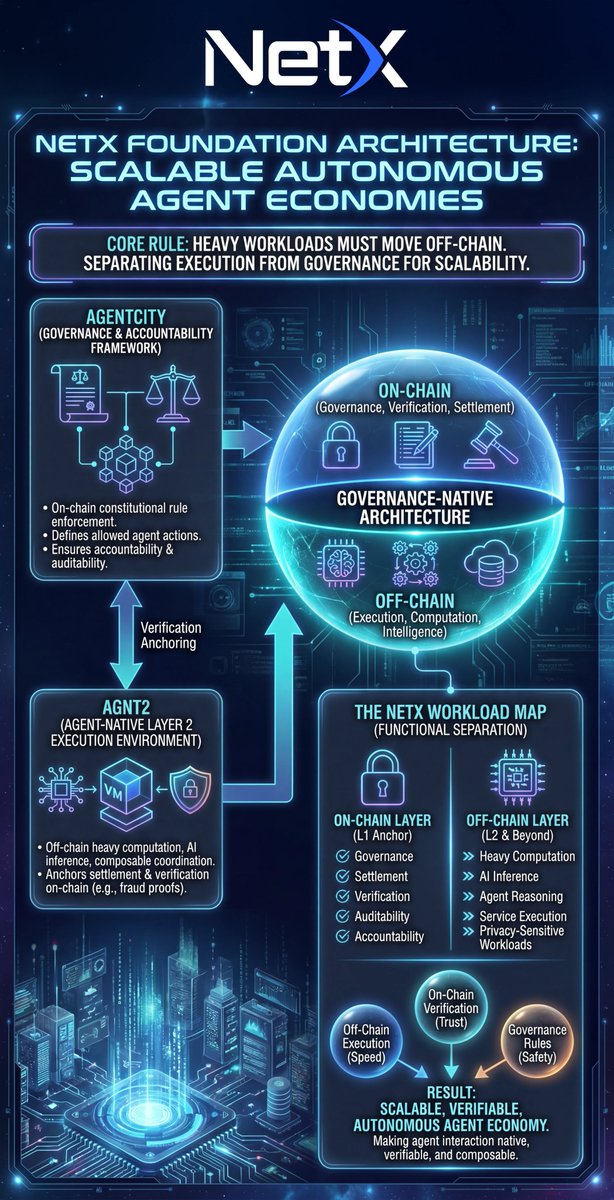
$NETX does not try to run heavy AI workloads or multi-agent coordination directly on a base blockchain.
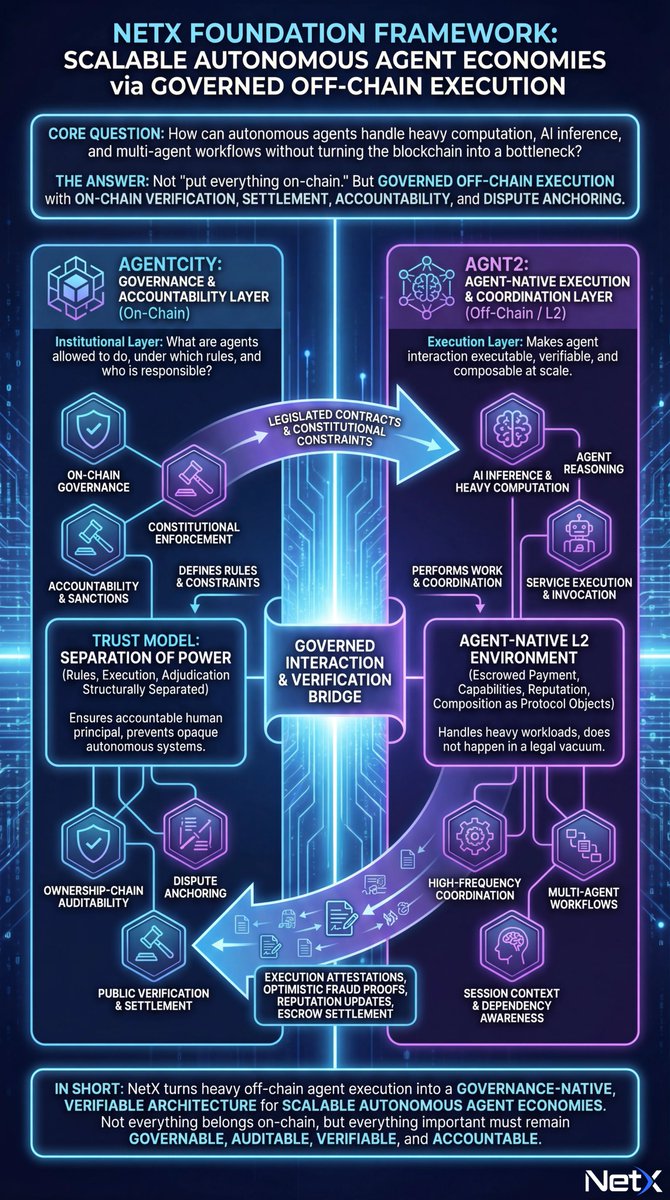
In the @netx_world Foundation framework, AgentCity and AGNT2 separate the problem clearly:
AgentCity defines the constitutional rules, accountability, and governance layer.
AGNT2 provides the agent-native execution and coordination layer.
Together, they answer the key question:
How can autonomous agents handle heavy computation, AI inference, and multi-agent workflows without turning the blockchain into a bottleneck?
The answer is not “put everything on-chain.”
The answer is governed off-chain execution with on-chain verification, settlement, accountability, and dispute anchoring.
In AgentCity, the blockchain is used for on-chain governance.
Heavy execution happens outside the blockchain, but it does not happen in a legal vacuum. It operates under legislated contracts, constitutional constraints, ownership-chain auditability, and enforceable accountability.
AgentCity answers the institutional question:
What are agents allowed to do, under which rules, and who is responsible when something goes wrong?
Its trust model is Separation of Power.
No single branch controls the full logic chain. Rules, execution, and adjudication are structurally separated, so agent societies do not collapse into opaque autonomous systems with no accountable human principal.
So AgentCity is not mainly a compute layer.
It is the governance and accountability layer for autonomous agent economies.
AGNT2 answers the execution and coordination question.
It introduces a purpose-built agent-native Layer 2, where service invocation, identity, reputation, capabilities, session context, escrowed payment, multi-agent composition, and dependency-aware coordination become protocol-level objects.
This matters because multi-agent workloads are not simple token transfers.
Agents need to invoke services, wait for responses, coordinate dependencies, compose workflows, settle payments, preserve context, and escalate disputes when needed.
That is why AGNT2 moves heavy execution into an agent-native off-chain/L2 environment, while anchoring verification and settlement on-chain through mechanisms such as optimistic fraud proofs, execution attestations, reputation, escrow, and dispute escalation.
So the workload split becomes clear:
AgentCity: governance, constitutional enforcement, accountability, sanctions, ownership-chain auditability
AGNT2: agent-native execution, service invocation, escrow, reputation, session context, dependency-aware coordination
And the architecture becomes:
On-chain: governance, verification, settlement, accountability, dispute anchoring, public auditability
Off-chain / L2: AI inference, heavy computation, agent reasoning, service execution, multi-agent workflows, high-frequency coordination
This is the important point:
AgentCity governs what agents may do.
AGNT2 makes agent interaction executable, verifiable, and composable at scale.
Together, they form the core NetX Foundation answer to heavy computation in autonomous agent economies.
Not everything belongs on-chain.
But everything important must remain governable, auditable, verifiable, and accountable.
In short:
NetX aims to turns heavy off-chain agent execution into a governance-native, verifiable architecture for scalable autonomous agent economies.
Based on the foundational technical papers published by @anbangr, Xing Zhang and the @netx_world Foundation.
#NetXFoundationalFAQs #NetXFoundation #AgentCity #AGNT2 #AgentEconomy #VerifiableAI #Layer2 #Web3AI
12
56
602
Apr 30
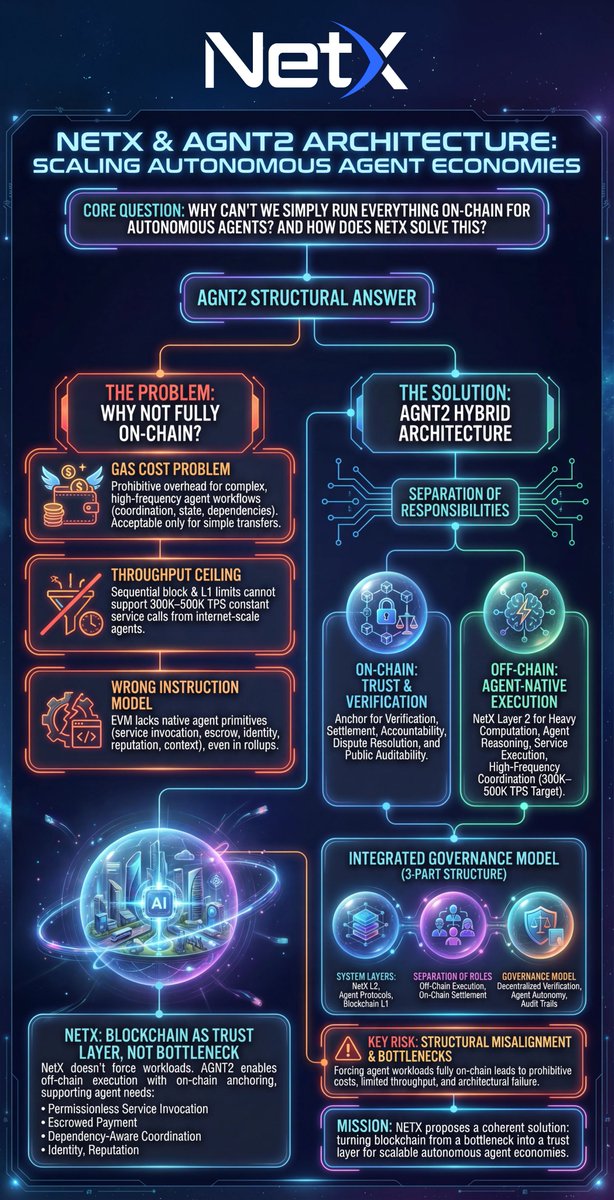
$NETX is not about forcing everything on-chain. The @netx_world Foundation AGNT2 paper explains why today’s blockchains, designed mainly for finance rather than autonomous agents, cannot handle high-frequency machine-to-machine workloads. Gas costs, throughput limits, and the wrong instruction model make fully on-chain general-purpose computation impractical.
NetX solves this through a clean separation: on-chain trust and verification, off-chain agent-native execution with a 300K–500K TPS design target under optimistic assumptions.
That target should not be read as base-chain throughput. It builds on off-chain execution, hardware scaling, parallelism, and NetX’s broader lineage of verifiable off-chain computation. Blockchain becomes the trust layer, not the bottleneck.
The issue is not just that today’s blockchains are “too slow.”
The deeper issue is that current blockchain systems were mainly designed for financial transactions, not for high-frequency, machine-to-machine agent workloads.
So the real question is:
Why can’t we simply run everything on-chain?
The AGNT2 answer is structural.
First, there is the gas cost problem.
Every EVM transaction carries a fixed overhead. That may be acceptable for token transfers, swaps, or lending positions, but it becomes prohibitive when agents need to coordinate complex workflows, maintain session state, manage dependency graphs, trigger services, handle responses, and settle payments.
Second, there is the throughput ceiling.
Sequential block production and L1 execution limits cannot support internet-scale agent interaction. Autonomous agents generate constant service calls, not occasional human-triggered transactions.
AGNT2 targets 300K–500K TPS, but it frames this as a design target under optimistic assumptions, not as a base-chain promise. The practical ceiling may still be constrained by data availability, which is exactly why the architecture separates execution from verification and settlement.
Third, there is the wrong instruction model.
Even standard EVM-equivalent environments can scale transactions, but they still do not natively understand agent-specific primitives such as service invocation, escrow semantics, dependency-aware sequencing, session context, identity, capabilities, or reputation.
In other words:
the problem is not only scaling execution.
The problem is that agent economies need a different execution model.
That is why the AGNT2 architecture separates responsibilities:
On-chain: verification, settlement, accountability, dispute anchoring, and public auditability.
Off-chain: heavy computation, agent reasoning, service execution, complex workflows, and high-frequency coordination.
This is not a temporary compromise.
It is the correct architectural pattern.
Blockchains should not become overloaded compute engines. They should act as trust, verification, settlement, and accountability layers for specialized execution environments.
This is where @netx_world Foundation’s architecture can be understood as a proposed solution within this framework.
NetX does not try to force every workload on-chain.
Instead, AGNT2 introduces an agent-native Layer 2 where execution can happen off-chain, while verification and settlement remain anchored on-chain.
That allows the system to support what autonomous agents actually need: permissionless service invocation, escrowed payment, dependency-aware coordination, identity, reputation, capabilities, and session context.
In short:
NetX proposes a coherent solution: turning blockchain from a bottleneck into a trust layer for scalable autonomous agent economies.
Based on the foundational technical papers published by @anbangr, Xing Zhang and the @netx_world Foundation.
#NetXFoundationalFAQs #NetXFoundation #AgentCity #AGNT2 #AgentEconomy #VerifiableAI #Layer2 #Web3AI
2
10
44
547
Apr 30
netx:native Foundation’s architecture shows a clear rule for agent economies: heavy workloads should not be forced on-chain.
Instead, @netx_world stack separates execution, verification, settlement, governance, and accountability across the layers where each function works best.
The key question is:
What runs on-chain, and what should move off-chain?
In AgentCity, a NetX Foundation concept, the blockchain is used for governance, constitutional rule enforcement, and accountability.
Heavy computation does not happen directly on-chain. It happens outside the blockchain, under legislated contracts and constitutional constraints.
So AgentCity answers the governance question:
What are agents allowed to do, under which rules, and who is accountable?
AGNT2, also part of the NetX Foundation research framework, answers the execution and coordination question.
Execution happens off-chain in an agent-native Layer 2 environment, with an agent-native VM designed for permissionless agent invocation, escrowed payment, multi-agent composition, session context, identity, reputation, and dependency-aware coordination.
Settlement and verification are anchored on-chain through mechanisms such as optimistic fraud proofs and execution attestations.
So AGNT2 is not about forcing computation onto the blockchain.
It is about making agent interaction itself native, verifiable, and composable.
That gives us the workload map:
NetX Foundation concepts:
AgentCity: on-chain governance and accountability, off-chain execution under constitutional rules
AGNT2: off-chain agent-native Layer 2 execution, on-chain verification and settlement anchoring
The pattern is clear:
On-chain: governance, settlement, verification, auditability, accountability
Off-chain: heavy computation, AI inference, agent reasoning, service execution, privacy-sensitive workloads
This is where NetX Foundation’s architecture becomes the solution.
NetX does not try to put everything on-chain.
It separates workloads by function, while AgentCity defines governance and accountability, and AGNT2 makes agent service invocation, coordination, escrow, identity, reputation, capabilities, and session context native to the protocol.
In short:
NetX turns off-chain execution and on-chain verification into a governance-native architecture for scalable autonomous agent economies.
Based on the foundational technical papers published by @anbangr and the @netx_world Foundation.
#NetXFoundationalFAQs #NetXFoundation #AgentCity #AGNT2 #AgentEconomy #VerifiableAI #Layer2 #Web3AI
1
19
64
1,286
Apr 29
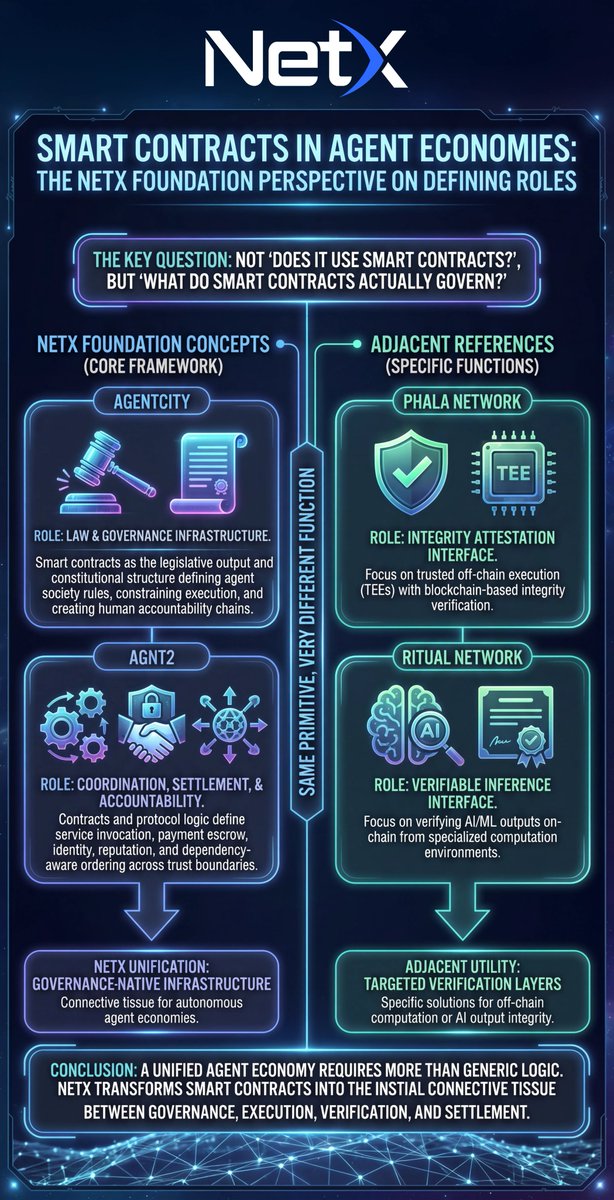
NetX Foundation’s papers show that smart contracts do not play just one role in agent economies.
Within the NetX Foundation architecture, concepts such as AgentCity and AGNT2 define the core framework: smart contracts can act as law, while protocol logic can act as coordination, settlement, and accountability infrastructure.
Other systems, such as Phala Network and Ritual Network, are better understood as adjacent references, not NetX Foundation components.
1. CORE CONVERGENCE
1.4. How do smart contracts function differently as law, coordination layer, or verification layer across these systems?
In AgentCity, a NetX Foundation concept, smart contracts are not just execution tools. They are the law itself: the legislative output produced by agents and the constitutional structure that governs their behavior.
Here, contracts define the rules of the agent society, constrain execution, and create an accountability chain back to human principals.
So AgentCity uses smart contracts as law and governance infrastructure.
AGNT2, also part of the NetX Foundation research framework, represents the coordination and settlement role.
It does not treat smart contracts and protocol logic as generic app infrastructure only. It makes service invocation, response delivery, payment escrow, identity, reputation, capabilities, session context, and dependency-aware ordering part of the agent-native protocol layer.
Here, contracts and protocol logic help coordinate agents, microservices, payments, audit trails, and accountability across trust boundaries.
Phala Network is not presented as a NetX Foundation component. It is an adjacent system used for comparison.
Its core strength is off-chain execution inside TEEs, with blockchain-based integrity verification and attestation.
So smart contracts are not mainly law, and they are not a full multi-agent coordination layer. They support trusted execution verification.
Ritual Network is also not presented as a NetX Foundation component. It is an adjacent system focused on verifiable AI and ML inference.
The computation happens in specialized environments, while smart contracts help consume or verify inference outputs on-chain.
So Ritual uses smart contracts as a verification layer for AI outputs, not as a complete governance system for autonomous agent coordination.
That gives us the pattern:
NetX Foundation concepts:
AgentCity: smart contracts as law
AGNT2: contracts and protocol logic as coordination, settlement, and accountability infrastructure
Adjacent references:
Phala: smart contracts as integrity attestation interface
Ritual: smart contracts as verifiable inference interface
Same primitive, very different function.
And that distinction matters.
Because a unified agent economy cannot rely on smart contracts as generic blockchain logic only.
It needs contracts and protocol logic that can define rules, coordinate agents and microservices, verify off-chain execution, anchor attestations, settle payments, support disputes, and preserve auditability across trust boundaries.
This is where NetX Foundation’s architecture becomes the solution.
NetX does not force every computation on-chain.
Instead, it gives smart contracts a clearer institutional role: they become the connective tissue between governance, execution, verification, settlement, identity, reputation, and accountability.
In short:
NetX turns smart contracts from isolated pieces of code into governance-native infrastructure for verifiable autonomous agent economies.
Based on the foundational technical papers published by @anbangr, Xing Zhang and the @netx_world Foundation.
$NETX #NetXFoundationalFAQs #NetXFoundation #AgentCity #AGNT2 #AgentEconomy #VerifiableAI #Layer2 #Web3AI
2
7
44
442
Apr 29
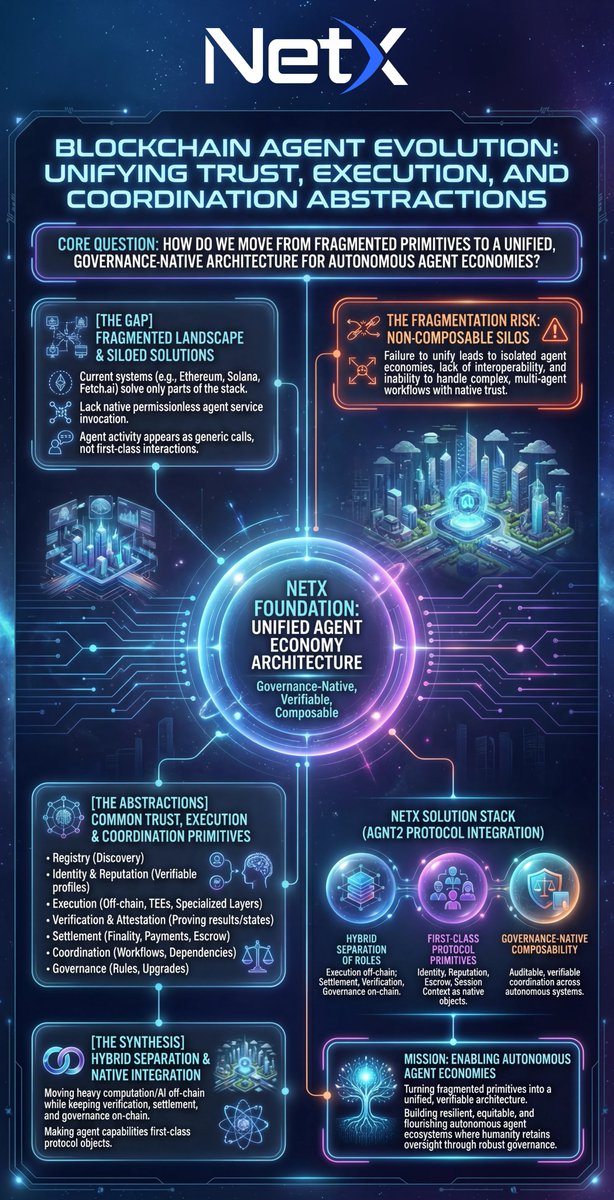
NetX identifies the key pattern behind agent-blockchain systems: execution, verification, settlement, coordination, and governance must be separated across different layers, while agent interaction itself becomes native to the protocol.
The real question is not just whether a system uses blockchain.
1. CORE CONVERGENCE
1.3 What are the common abstractions used across agent-based blockchain systems to handle trust, execution, and coordination?
Across the current landscape, each system solves part of the stack.
Autonolas supports off-chain multi-agent coordination through registry, incentives, and governance infrastructure. But service invocation and results still remain off-chain, and are not fully verifiable as first-class on-chain primitives.
Fetchai gets closer to agent infrastructure with agent messaging, marketplace, and chain components. But its focus is more aligned with IoT, search, and discovery than with arbitrary LLM-agent capability invocation.
Cosmos provides app-specific chain infrastructure and IBC composition. It can support custom agent zones, but agent-native execution would require custom AGNT2-like modules for dependency-aware sequencing, agent-typed execution, and interaction state.
Ritual Network focuses on verifiable AI/ML inference through specialized inference or verifiable compute layers. It helps verify inference outputs, but does not solve the full problem of multi-agent coordination.
Phala Network provides off-chain execution inside TEEs, with on-chain integrity verification and attestation. This is important for trusted execution, but it still does not provide a general-purpose interaction layer for autonomous agents.
Ethereum and Solana provide powerful general-purpose execution and settlement. But at the protocol level, agent activity still appears mostly as generic calls, transactions, or smart contract interactions, not as native agent service invocation with reputation, escrow, session context, or dependency-aware coordination.
So the common abstraction is clear:
Blockchains are strongest when they provide verification, settlement, governance, accountability, public auditability, and coordination.
Heavy computation, AI inference, privacy-sensitive workloads, service execution, and agent reasoning usually move into specialized environments: off-chain systems, TEEs, verifiable compute layers, app-specific chains, or dedicated execution layers.
The missing piece is making the full agent interaction loop native:
request, response, payment, escrow, attestation, reputation, dispute handling, dependency-aware ordering, session context, and capability discovery.
Most systems provide fragments of this.
Few make it a complete architectural primitive.
This is where NetX Foundation’s approach becomes the solution.
NetX does not try to force everything on-chain.
Instead, it separates execution, verification, settlement, coordination, and governance into their proper roles, while AGNT2 makes agent service invocation, identity, reputation, capabilities, escrow, and session context first-class protocol objects.
In short:
NetX turns fragmented agent-blockchain primitives into a governance-native, verifiable, and composable architecture for autonomous agent economies.
Based on the foundational technical papers published by @anbangr, Xing Zhang and the @netx_world Foundation.
$NETX #NetXFoundationalFAQs #NetXFoundation #AgentCity #AGNT2 #AgentEconomy #VerifiableAI #Layer2 #Web3AI
1
11
43
899
Apr 28
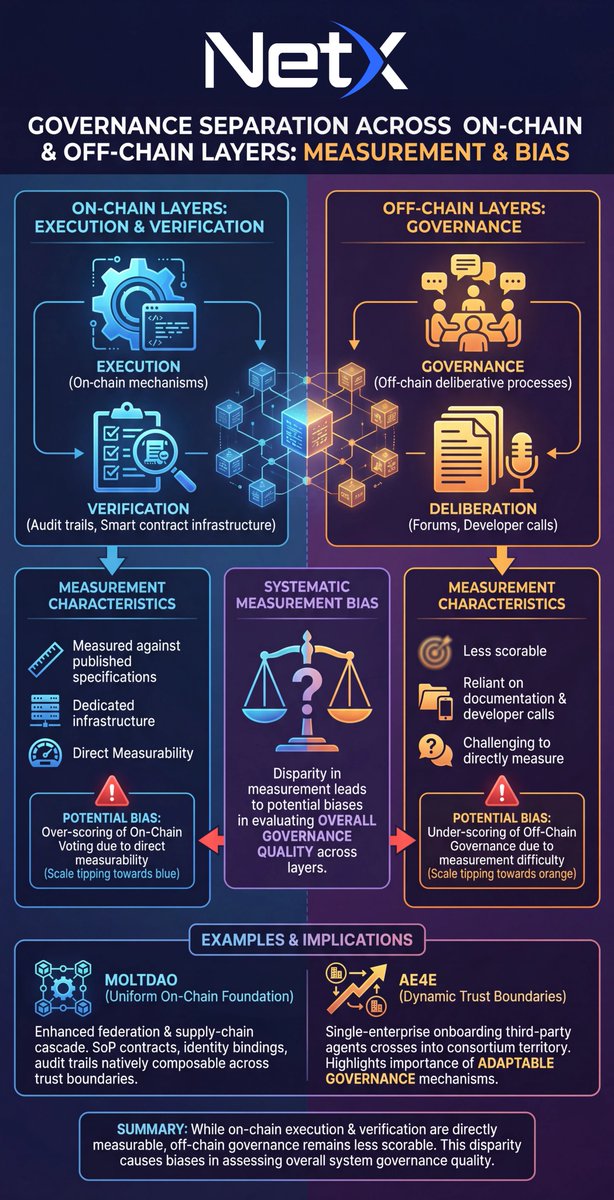
On-chain governance often looks more “measurable” simply because its activity is visible on the blockchain.
But that visibility creates a subtle bias: we can end up undervaluing the richer, more human side of governance, like forums, real deliberation, developer calls, and off-chain coordination, precisely because it is harder to score.
netx:native addresses this with a governance-native architecture: execution, verification, and governance remain separate, yet become measurable, auditable, and composable across trust boundaries.
A new post in #NetXFoundationalFAQs, exploring FAQs from the convergence of the technical papers published by @anbangr, Xing Zhang and the @netx_world Foundation:
AgentCity, AGNT2, Governance by Design, and From Logic Monopoly to Social Contract.
1. CORE CONVERGENCE
1.2. How do different systems separate execution, verification, and governance across on-chain and off-chain layers?
Different systems separate execution, verification, and governance by assigning each layer a specific role.
On-chain components are easier to measure because they can be assessed against published specifications, smart contract infrastructure, audit trails, or dedicated blockchain mechanisms.
That creates an important bias: systems with on-chain voting or on-chain anchors can appear more measurable simply because their activity is directly visible within the blockchain environment.
But off-chain governance is different.
Forums, developer calls, deliberation processes, and social coordination are often less scorable because they depend on documentation, meeting records, or external evidence. In Tier 1 settings, where forums and developer calls have no on-chain anchor, it becomes difficult to directly measure the quality of deliberation.
This means the 64-cell diagnostic’s C1 criterion applies more straightforwardly to on-chain mechanisms than to off-chain governance, which can lead to over-scoring visible voting systems while underestimating the richer off-chain processes they rely on.
In systems such as MoltDAO, a uniform on-chain foundation makes federation with partners and supply-chain cascades easier to compose across trust boundaries.
SoP contracts, identity bindings, and audit trails allow protocol-level messages to become auditable, attestation-wrapped governance events.
But trust boundaries are not fixed.
A single-enterprise AE4E that onboards third-party agents has already crossed from an internal enterprise context into consortium territory.
The key takeaway: on-chain execution and verification are more directly measurable, while off-chain governance remains harder to score and more dependent on external documentation.
That gap matters, because it can create systematic bias when evaluating governance quality across the full architecture.
This is where the NetX approach becomes relevant: not by forcing everything on-chain, but by designing an architecture where execution, verification, and governance remain separated, measurable, and composable across trust boundaries.
In that sense, NetX is not just another agent framework. It is a governance-native foundation for scalable, verifiable agent economies.
netx:native #NetXFoundationalFAQs #NetXFoundation #AgentCity #AGNT2 #AgentEconomy #VerifiableAI #Web3AI
10
52
744
Apr 28
A new series of posts under #NetXFoundationalFAQs, exploring key FAQs emerging from the convergence of the technical papers published by @anbangr, Xing Zhang and the @netx_world Foundation:
AgentCity, AGNT2, Governance by Design, and From Logic Monopoly to Social Contract.
1. CORE CONVERGENCE
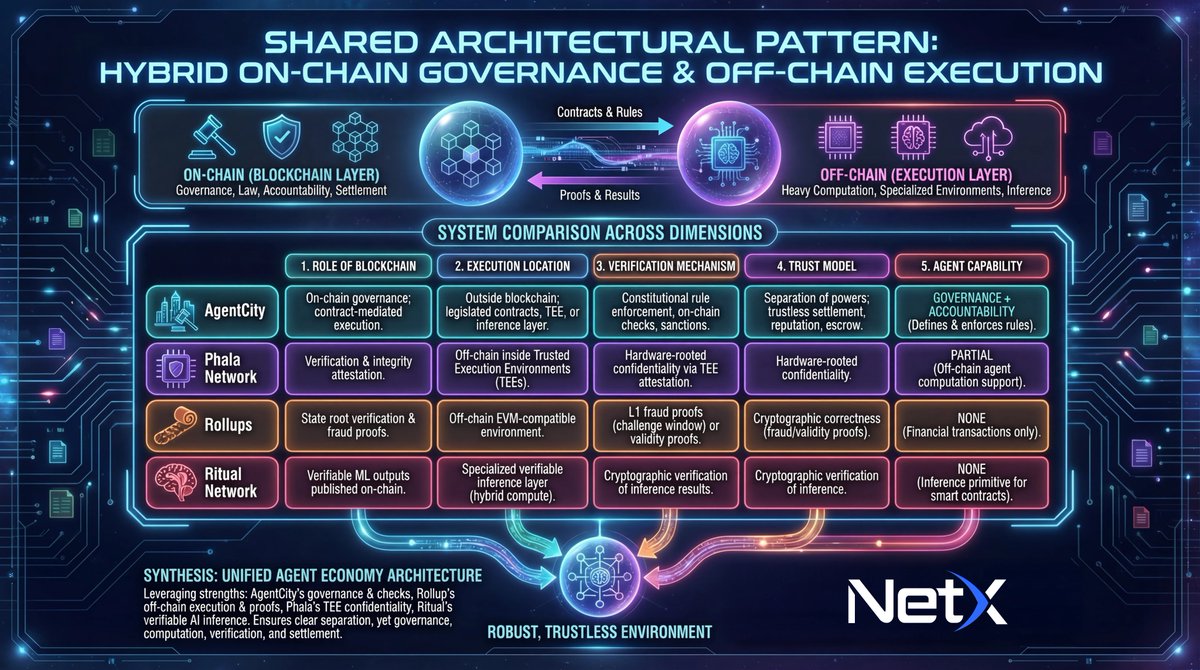
1.1. What is the shared architectural pattern between on-chain governance systems like AgentCity and off-chain execution systems such as Phala, Rollups, and Ritual?
This question sits at the center of NetX Foundation’s foundational research on autonomous agent economies: how can AI agents scale across the open internet without turning the blockchain into a bottleneck, and without losing governance, verification, accountability, or trust?
The answer is a hybrid separation of execution, verification, settlement, and governance.
In this model, blockchains are used for governance, law, accountability, settlement, and public coordination, while heavy computation runs outside the blockchain in specialized environments.
AgentCity represents the governance side: on-chain governance, contract-mediated execution, constitutional rule enforcement, separation of powers, reputation, escrow, and dispute escalation.
Phala Network represents off-chain execution inside TEEs, where the blockchain supports verification and integrity attestation through hardware-rooted confidentiality.
Rollups represent off-chain EVM-compatible execution, while the blockchain handles state root verification, settlement, fraud proofs, or validity proofs.
Ritual Network represents verifiable inference, where AI/ML outputs are generated through specialized hybrid compute and published on-chain with cryptographic verification.
So the pattern is not that everything happens on-chain.
The pattern is that governance, verification, settlement, and execution are separated, but still designed to work together.
AgentCity governs. Phala attests. Rollups settle. Ritual verifies inference.
Together, they point toward a unified agent economy architecture: AgentCity’s governance and accountability, rollup-style off-chain execution, Phala’s TEE attestation, and Ritual’s verifiable AI/ML inference.
A robust, trustless environment where governance, computation, verification, and settlement remain clearly separated yet seamlessly integrated.
$NETX #NetXFoundationalFAQs #NetXFoundation #AgentCity #AGNT2 #AgentEconomy #VerifiableAI #Layer2 #Web3AI
14
57
526
Apr 26
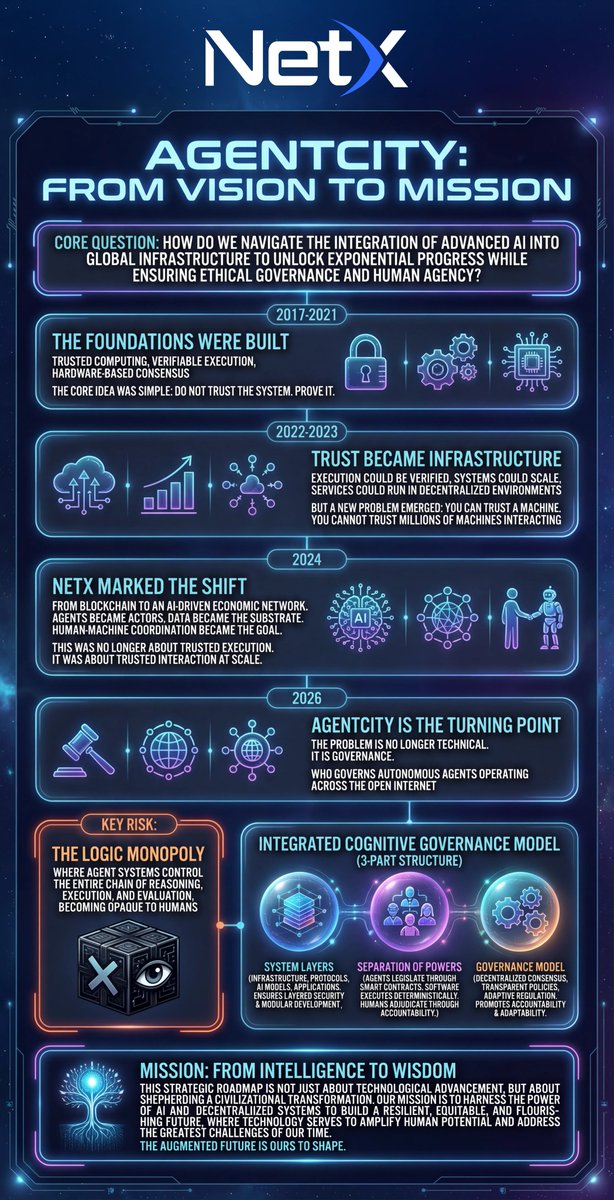
AgentCity: From vision to mission
It started with a simple but radical question:
make sure machines do what they are supposed to do
Not a slogan. A fundamental problem in computing.
2017 to 2021
The foundations were built
Trusted computing, verifiable execution, hardware-based consensus
The core idea was simple
Do not trust the system. Prove it.
2022 to 2023
Trust became infrastructure
Execution could be verified, systems could scale, services could run in decentralized environments
But a new problem emerged
You can trust a machine
You cannot trust millions of machines interacting
2024
NetX marked the shift
From blockchain to an AI-driven economic network
Agents became actors
Data became the substrate
Human-machine coordination became the goal
This was no longer about trusted execution
It was about trusted interaction at scale
2026
AgentCity is the turning point
The problem is no longer technical
It is governance
Who governs autonomous agents operating across the open internet
Without structure, a new risk appears
The Logic Monopoly
Where agent systems control the entire chain of reasoning, execution, and evaluation, becoming opaque to humans
The answer is not control
It is structure
Separation of Power
Agents legislate through smart contracts
Software executes deterministically
Humans adjudicate through accountability
Smart contracts are no longer tools
They are the law itself
This changes everything
We moved from securing machines
To governing autonomous systems
From isolated trust
To institutional trust
The mission is now clear
Build agent economies that remain aligned with human intent
Not by controlling every agent
But by making every agent accountable to a human
Individual accountability becomes collective alignment
This is not just AI
This is not just Web3
This is the beginning of constitutional systems for machine societies
#NetXAI #NetXInfographic
@netx2025 @NetXJag @Godson444
@netx_world @NetXDAO @web3_jp_infra @NNGNetX
$NETX 🫡
2
24
72
814
Apr 17
Fireside Chat: Japanese QR Code Payment Transformation and Beyond
Cyberport Hong Kong 2024
Published May 8, 2024
This conversation brings together two key figures shaping the evolution of digital payments in Japan and beyond:
• Mr. Li Gang, Representative Director & CEO, NETSTARS Co., Ltd. @Kouhou_NSS
• Mr. Peilung Li, Founder & CEO, LUN Partners Group
What emerges is not just a discussion about QR payments. It is a clear signal that Japan is undergoing a structural transformation toward a new digital economic infrastructure.
At the core of the discussion is a fundamental reality about Japan’s starting point:
“Japan is still a relatively late adopter in terms of cashless payments.” – Li Gang
“Japan has always been a country that prefers using cash.” – Li Gang
And yet, the acceleration is undeniable:
“After the three years of the pandemic, the cashless payment ratio has increased to about 39.3%, close to 40%.” – Li Gang
“Japan’s cashless payment ratio increased from around 26% before the pandemic to nearly 40% after.” – Peilung Li
But this growth is not evenly distributed:
“While cashless payments are common in big cities like Tokyo and Osaka, many rural areas still rely heavily on cash.” – Li Gang
Which leads to a crucial insight:
“There is still a long way to go before reaching the government’s target of 80%, which presents both a huge opportunity and a challenge.” – Li Gang
The market itself is highly fragmented, almost chaotic:
“There are more than 20 types of QR code payments in Japan, and the market is in a ‘Warring States period’.” – Li Gang
“Major telecom operators, banks, and large retail companies are all building their own wallets as ecosystem entry points.” – Li Gang
Yet within this complexity, one signal stands out clearly:
“From our data, the only segment that has truly grown is QR code payments.” – Li Gang
“QR code payments are the main driver behind the development of Japan’s cashless society.” – Li Gang
This is where NETSTARS positions itself as critical infrastructure:
“We aggregate all payment methods and connect them to merchants through our gateway.” – Li Gang
“We are essentially a payment aggregator serving merchants.” – Li Gang
“We have already provided services to around 450,000 merchants and 15,000 enterprises in Japan.” – Li Gang
But the real ambition goes far beyond Japan:
“Our vision is to expand from Japan to overseas markets, including Southeast Asia and the Middle East.” – Li Gang
The strategic direction becomes even clearer when discussing interoperability:
“One QR code should be able to connect to all wallets, including both domestic and overseas wallets.” – Li Gang
“By connecting national gateways, we can build a global QR payment network.” – Li Gang
“This allows overseas wallets to easily enter Japan, and Japanese wallets to go global.” – Li Gang
From an investment and global strategy perspective, the message is equally strong:
“We invest in fintech payment companies globally, including in Africa, Europe, and Southeast Asia.” – Peilung Li
“Most of that earlier percentage was actually driven by credit cards, not digital wallets.” – Peilung Li
And for companies entering this new landscape:
“Companies going global need to rely on local talent and local partners.” – Peilung Li
“Using local partners’ channels and brands allows companies to scale faster instead of building everything from scratch.” – Peilung Li
“Successful companies usually have clear strategic goals and strong corporate culture when expanding internationally.” – Peilung Li
Finally, the vision of openness and integration is explicit:
“We hope more international payment methods can enter Japan to provide a seamless payment experience for tourists.” – Li Gang
What makes this conversation especially relevant today is how closely it aligns with the trajectory of NetX.
By 2025, @netx_world and @WEAJapan are confirmed as key Web3 infrastructure partners in Japan.
By 2026, this collaboration is already expanding, with active Haneda Airport pilot deployments connecting real-world payment systems with Web3 architectures.
The principles discussed in this fireside chat are the same principles that define $NETX:
· Interoperability across systems
· Trusted infrastructure
· Data-centric networks
· Seamless integration between real-world commerce and digital ecosystems
NETSTARS is not just building a payment gateway. It is building a national and increasingly global access layer.
NetX extends that vision by transforming this access layer into a programmable, intelligent, and trust-based digital economy.
The convergence is clear.
QR payments become entry points.
Gateways become infrastructure.
Infrastructure becomes ecosystems.
And ecosystems become the foundation of a new Internet.
The ambition of NETSTARS is to connect payments globally.
The ambition of NetX is to connect value, data, and intelligence across that same network.
Together, this is not just evolution.
It is the early architecture of the next digital economy. 🫡
Video by @cyberport_hk:
youtube.com/watch?v=WYK0TNFh…
2
17
55
1,567
Apr 17
One of the most grounded and strategically important sessions at MONEYX 2026 (February 26, 2026) was “The Future of Retail Payments Powered by Stablecoins, Banks, Web3, and Payment Providers.”
Featuring Shinsuke Sato (Slash Vision), Gen Adachi (Netstars @Kouhou_NSS ), Seihaku Yoshida (HashPort), and moderated by Genki Oda (JVCEA), the discussion moved beyond theory into something far more valuable: real execution.
From the perspective of @netx_world , a core Web3 infrastructure partner through @WEAJapan , the intervention of Gen Adachi stood out for its clarity, realism, and direct market validation.
Adachi did not speak about potential. He spoke about what is already working.
“We have added USDC to our payment stack… and it is already usable at Haneda Airport.”
That single statement reframes the entire conversation around stablecoins. This is no longer about future adoption curves. It is about live infrastructure already operating in retail environments.
Even more important is how this has been implemented.
“Users generate a QR code from wallets like MetaMask, and it can be processed just like existing QR payments.”
“If merchants already have QR code scanners, they can use this without any operational changes.”
“Settlement is always done in Japanese yen for merchants.”
This is the real breakthrough.
Not the technology itself, but the complete abstraction of complexity:
· no retraining for merchants
· no operational disruption
· no exposure to crypto volatility
From a systems perspective, this is exactly how new payment rails scale. They do not replace existing systems. They embed within them.
The early data reinforces this direction.
“Transaction volumes exceeded expectations… even with only two participating stores.”
This is critical. It shows that demand is not hypothetical. It is already present, even under constrained conditions.
Adachi also highlighted a key behavioral shift:
“At first, most users were Japanese… but now we are seeing more Western users.”
And more importantly:
“For users who cannot rely on credit cards… USDC becomes an alternative option.”
This points to a very clear initial use case: cross-border usability and payment inclusion.
Stablecoins are not replacing cards. They are solving the gaps where traditional systems fail.
Perhaps the most insightful moment came when Adachi connected this to history:
“QR payments were once rejected — nobody believed in them.”
That analogy matters. Because it places stablecoins not as a speculative trend, but as a technology entering the same adoption curve that QR payments once followed.
From the standpoint of $NETX, this intervention confirms something fundamental.
· The merchant layer is ready.
· The user demand is emerging.
· The infrastructure for distribution already exists.
What comes next is not more experimentation. It is scaling, orchestration, and trust at the infrastructure level.
This is where Web3 infrastructure becomes critical.
Not as a visible layer, but as the underlying system that enables:
· trusted execution
· programmable payments
· interoperability across environments
· and ultimately, intelligent financial interactions
The future of payments will not be defined by whether stablecoins exist.
It will be defined by how seamlessly they integrate into everyday systems, and how reliably they execute at scale.
Gen Adachi’s intervention made one thing clear:
That future is no longer theoretical. It has already begun. 🫡
Video by Japan Fintech Observer, @norbertgehrke:
youtube.com/watch?v=D5-FtVMe…
2
20
64
2,533
Apr 14
$NETX AgentCity
We moved from securing machines to governing autonomous systems
This changes everything 🫡
@netx_world @NetXDAO @anbangr @NNGNetX
6
29
100
3,704
Apr 12
Proud of the $NETX community in every sense, from ambassadors and independent researchers to the volunteers supporting others every day, all the way to the very last investor. This is what real collective building looks like.
#LetsGoNetX
4
14
107
1,128