
Jun 10
#intled - Immigrants and international students who stay to work contribute billions to our economy. This stat from the most recent NFAP report is telling: 24% of all US companies worth a billion dollars have founders who started as F-1 students. buff.ly/NTrg3dh
1

Jun 10
Absolutely impressive! 🇮🇳
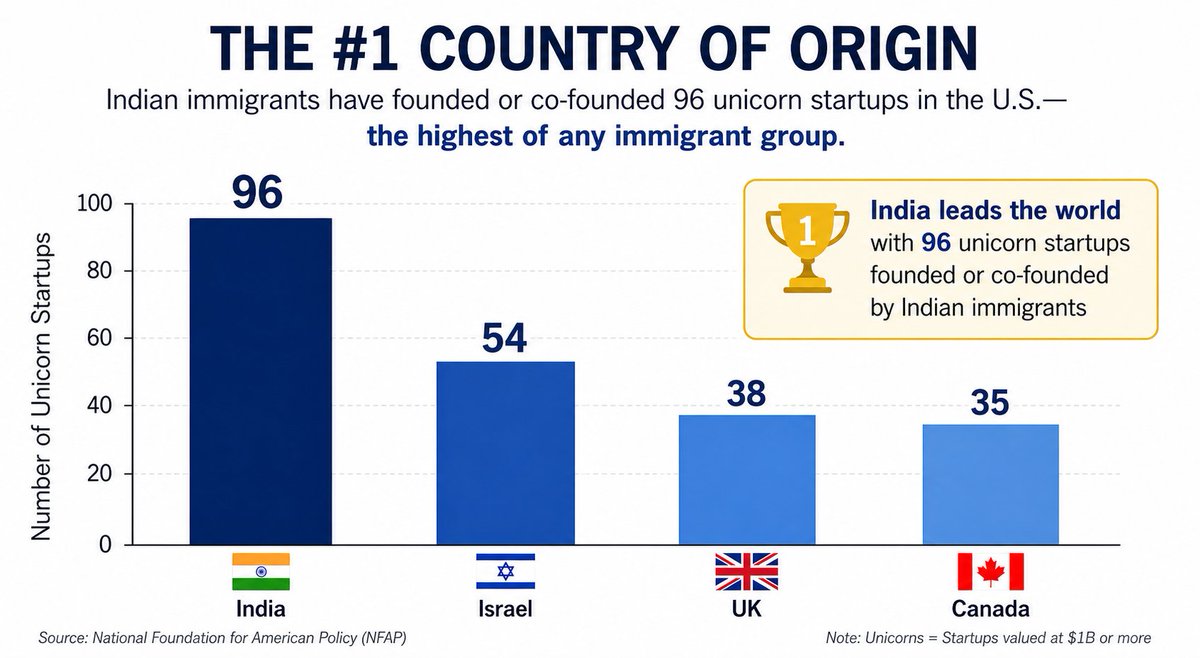
Indian-born founders leading with 96 U.S. billion-dollar companies — far ahead of Israel (60), UK (47), and China (41). This NFAP report is yet another reminder of the incredible talent, grit, and entrepreneurial spirit Indians bring to America.
Proud of this contribution to the U.S. innovation ecosystem! Keep building. 🚀
1
1
39
justasimpleperson retweeted

Jun 9
A new NFAP study reveals that Indian immigrants have founded 96 US unicorns, leaving countries like Israel (60) & the UK (47) miles behind
Out of roughly 5 million Indians in the US, nearly 1 in 50,000 is a unicorn founder
2
2
126

Jun 9
🇮🇳 Indian Entrepreneurs Fuel U.S. Growth: NFAP Study
🔹 Indian immigrants have founded 96 U.S. unicorn startups — the highest of any immigrant group.
🔹 Immigrant-founded unicorns account for 59% of all U.S. billion-dollar startups, generating a massive $5 trillion in value.
🔹 Each unicorn creates an average of 833–1,123 jobs, supporting American employment and innovation.
🔹 Indian companies have invested over $16 billion in the U.S., supporting 70,000 American jobs across manufacturing, pharmaceuticals, and AI.
🔹 Texas, Georgia, and New Jersey are among the biggest beneficiaries of Indian investment.
“While immigration remains politically contentious, the data shows Indian entrepreneurship and investment are playing a major role in strengthening the U.S. economy, innovation ecosystem, and job market.” 🇺🇸🤝🇮🇳
#usa #india #economy #jobs #Indians #investment
#startups #innovation #NFAP #Entrepreneurs #H1Bvisa @NFAPResearch
2
16

@grok, Except for the USA.
The table in your image is not about the total number of private unicorns headquartered in each country. It shows the country of origin of immigrant founders for U.S.-based unicorns (privately held startups valued at $1B ), according to a June 2026 National Foundation for American Policy (NFAP) report.
USA (Native-Born Founders) in This Context
Total U.S. unicorns (as of April 2026): 775.
Immigrant-founded or co-founded: 455 (59%).
Native-born U.S. founders (i.e., "USA" in this table's logic): Approximately 320 (the remainder, or 41%).
The USA would overwhelmingly top the chart if included — far ahead of India’s 96.
Quick Context on the Full Picture
India leads all other countries in producing immigrant founders of American unicorns (96), ahead of Israel (60), UK (47), China (41), etc. This highlights the outsized role of Indian talent in the U.S. ecosystem (often via international students or skilled immigration).
Overall U.S. dominance in unicorns (hundreds more than any other country) is driven by a mix of native-born Americans heavy immigrant contribution (59% of current unicorns).
1
22

US UNICORNS FOUNDED BY IMMIGRANTS 🇺🇸
1. 🇮🇳 India: 96 unicorns (Country of origin)
2. 🇮🇱 Israel: 60
3. 🇬🇧 UK: 47
4. 🇨🇳 China: 41
5. 🇨🇦 Canada: 30
6. 🇷🇺 Russia: 23
7. 🇫🇷 France: 21
8. 🇩🇪 Germany: 18
9. 🇺🇦 Ukraine: 16
10. 🇦🇺 Australia: 14
💡Total: 59% (455 of 775) of all US unicorns have at least one immigrant founder.
📊 Source: NFAP, “Immigrants & US Billion-Dollar Companies”, June 3, 2026
2
44

Countries by Immigrants Who Have Founded U.S. Unicorns 🦄🇺🇸
1. 🇮🇳 India ⟶ 96
2. 🇮🇱 Israel ⟶ 60
3. 🇬🇧 United Kingdom ⟶ 47
4. 🇨🇳 China ⟶ 41
5. 🇨🇦 Canada ⟶ 30
6. 🇷🇺 Russia ⟶ 23
7. 🇫🇷 France ⟶ 21
8. 🇩🇪 Germany ⟶ 18
9. 🇺🇦 Ukraine ⟶ 16
10. 🇦🇺 Australia ⟶ 14
11. 🇵🇰 Pakistan ⟶ 10
12. 🇷🇴 Romania ⟶ 10
13. 🇮🇷 Iran ⟶ 9
14. 🇹🇷 Türkiye ⟶ 8
15. 🇰🇷 South Korea ⟶ 8
16. 🇳🇿 New Zealand ⟶ 7
17. 🇳🇬 Nigeria ⟶ 6
18. 🇿🇦 South Africa ⟶ 6
19. 🇯🇵 Japan ⟶ 5
20. 🇧🇷 Brazil ⟶ 5
📊 Source: National Foundation for American Policy (NFAP), 2026
3
13
126
7,059


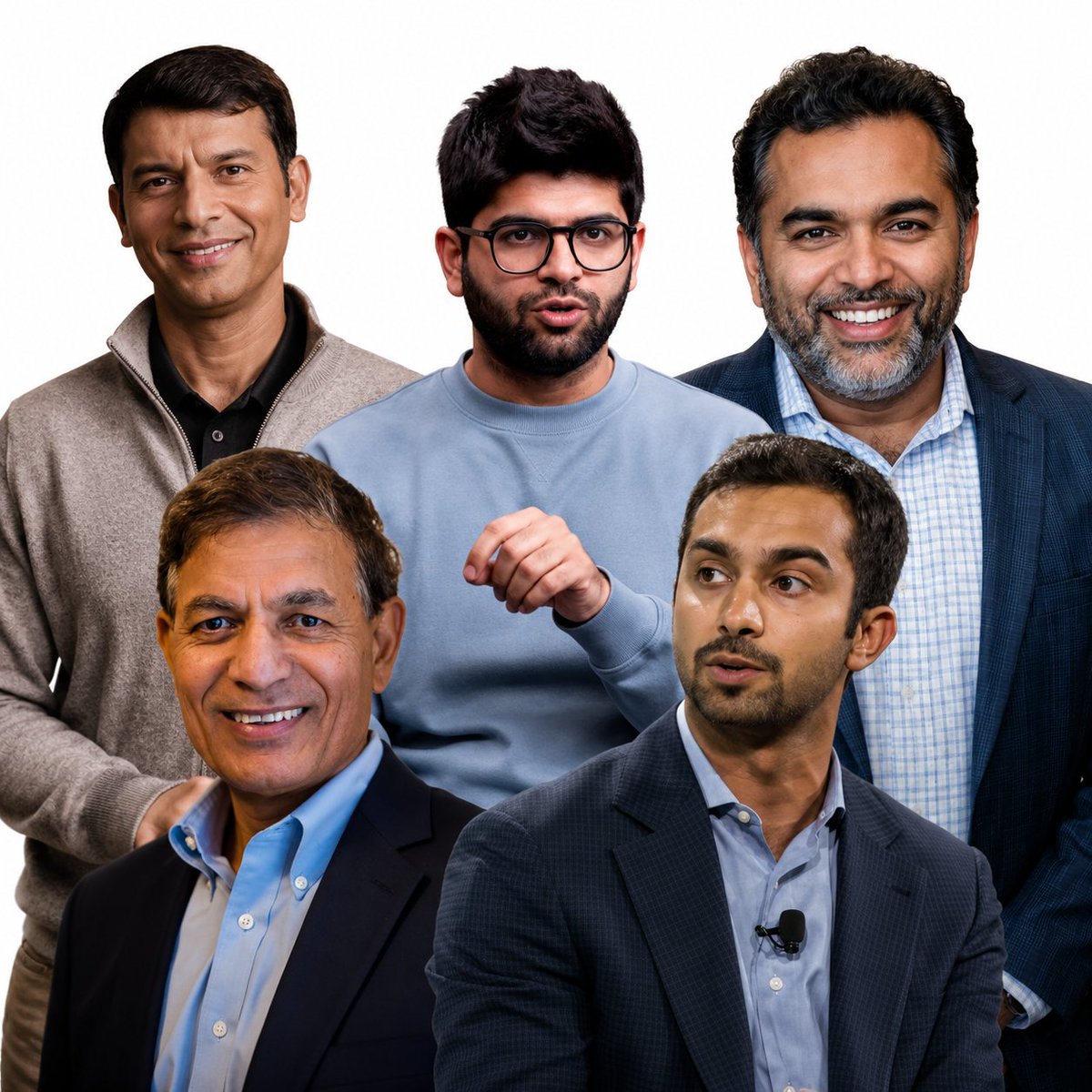
🚨 Indian-born entrepreneurs have founded more US unicorns than any other nationality, with 96 billion-dollar startups to their name. (NFAP report)
2
63
509
5,332

Jun 9
Far more Americans employed than H1-B visa holders. Just like there are far too many Putinsky Russian harasser bots posing as Americans to psyops to try to get rioting in the streets.
More likely to get Tomahawk missles instead! 😅🤣😅
Approximately 163 million employed people in the U.S. (vast majority U.S. citizens) vs. an estimated 600,000–800,000 active H-1B visa holders (commonly cited around 700,000).19165
Overall U.S. Employment (Latest BLS Data, as of May 2026)
•Total employed: 162.8 million (nonfarm payroll/establishment survey; household survey figures are similar, around 163 million).
•This includes U.S. citizens (native-born naturalized), lawful permanent residents, temporary visa holders (like H-1B), and others.
•U.S. citizens make up the overwhelming share — native-born workers (nearly all citizens) plus naturalized citizens (part of the foreign-born group) account for roughly 80–85% of the workforce. Foreign-born workers overall were about 19.1% of the civilian labor force in 2025 (BLS), but this group includes both naturalized citizens and non-citizens. Non-citizen temporary workers like H-1B holders are a small subset.38
H-1B visa holders are all employed by definition (the visa requires a sponsoring U.S. job offer in a specialty occupation). They represent roughly 0.4% of total U.S. employment.
H-1B Visa Holders Specifically
•Active/employed H-1B population: Estimates from government analyses, think tanks (e.g., NFAP), and recent reports place it at ~700,000 in 2025–early 2026 (range commonly 600,000–800,000). This stock figure accounts for the 3- or 6-year visa duration, extensions, and renewals — not just the annual ~85,000 new cap-subject visas.528
•USCIS data shows ~400,000 H-1B petitions approved in FY2024 (mostly renewals/extensions, not new workers), with similar trends into FY2025–2026.3
•Older USCIS estimate (2019) was ~583,000; the figure has grown modestly with program demand.35
Context for Tech/STEM (Relevant to H-1B Debate)
H-1B visas are heavily concentrated in computer-related occupations (≈60–65% of approvals in recent years, median salary ~$124,000).29 Foreign-born workers (including H-1B and others) are overrepresented in computer/mathematical occupations compared to their share of the overall workforce, but exact citizen vs. H-1B splits in tech require occupation-specific BLS USCIS cross-data (H-1B remains a small absolute number even there).
Bottom line: U.S. citizens dominate total employment by orders of magnitude (hundreds of millions vs. hundreds of thousands on H-1B). H-1B holders fill targeted specialty roles, mostly in tech/professional services, but they are a tiny fraction of the overall employed population. Data comes from BLS (employment) and USCIS/NFAP analyses (H-1B stock); exact real-time H-1B counts aren’t published because of extensions, transfers, and status changes.
8
66
RDTweets retweeted

Jun 8
🇮🇳 Indians Dominate America's Unicorn Economy
According to a new NFAP study, Indian-born entrepreneurs have founded or co-founded 96 U.S. unicorns - the highest of any country by a wide margin.
Indian-born founders are far ahead of Israel (60), the UK (47), China (41) and Canada (30).
Overall, immigrants are behind 455 of America's 775 private billion-dollar startups. Six of the 15 immigrants who founded multiple U.S. unicorns were born in India.
The report comes amid tighter U.S. visa rules, with researchers warning that immigrants remain critical to America's innovation ecosystem.
10
13
58
2,353

🚨🇮🇳 INDIANS DOMINATE AMERICA'S UNICORN ECONOMY
A new NFAP study reveals that Indian-born entrepreneurs have founded or co-founded 96 U.S. unicorns — more than any other country.
🇮🇳 India: 96
🇮🇱 Israel: 60
🇬🇧 UK: 47
🇨🇳 China: 41
🇨🇦 Canada: 30
Immigrants are behind 455 of America's 775 private billion-dollar startups, highlighting their massive contribution to U.S. innovation and entrepreneurship.
Despite tighter visa rules, Indian talent continues to power some of America's most valuable companies. 🚀
@FoxNews @kayleighmcenany this information is specially for for you guys
1
1
44
Sigma (Σ) retweeted

Jun 8
अमेरिका की यूनिकॉर्न इकॉनमी में भारतीयों का दबदबा
NFAP की एक नई स्टडी के अनुसार, भारत में जन्मे उद्यमियों ने अमेरिका में 96 यूनिकॉर्न कंपनियां शुरू की हैं या उनमें सह-संस्थापक (co-founder) रहे हैं - यह संख्या किसी भी अन्य देश की तुलना में बहुत ज़्यादा है। 🤟🤟
Jun 8

🇮🇳 Indians Dominate America's Unicorn Economy
According to a new NFAP study, Indian-born entrepreneurs have founded or co-founded 96 U.S. unicorns - the highest of any country by a wide margin.
Indian-born founders are far ahead of Israel (60), the UK (47), China (41) and Canada (30).
Overall, immigrants are behind 455 of America's 775 private billion-dollar startups. Six of the 15 immigrants who founded multiple U.S. unicorns were born in India.
The report comes amid tighter U.S. visa rules, with researchers warning that immigrants remain critical to America's innovation ecosystem.
1
1
35