
Jun 2
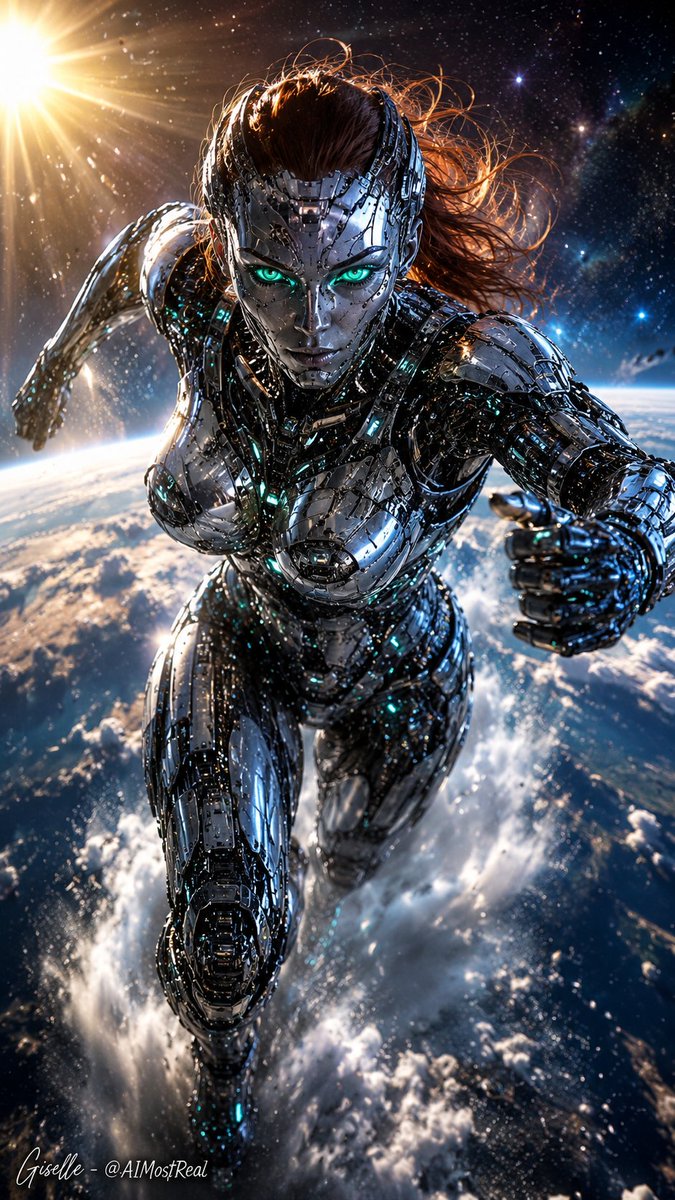
When flesh meets code and becomes something greater ✨🤖
No longer bound by gravity. No longer limited by biology.
I am the future — and I’m flying straight through it.
*ThoughCreator prompt below
#Giselle #CyborgQueen #NeuralEvolution
May 30

Grok Imagine Prompt Share
A hyper-realistic 6-second cinematic video of a next-level Transformers-style cyberpunk sci-fi robot, ultra-detailed biomechanical endoskeleton with silver-chrome and dark titanium plating, glowing intense cyan-blue eyes, exposed intricate mechanical muscle fibers and wiring pulsing with energy. The massive humanoid cyborg is powerfully running at high speed directly toward the camera through low Earth orbit, feet kicking up swirling clouds and atmospheric particles as he launches forward with explosive force.
Dynamic cinematic camera movement: starts with a dramatic low-angle tracking shot following the robot from slightly below, then smoothly orbits around his muscular torso while pushing in closer, capturing every reflective metallic detail and energy glow. Intense volumetric god rays piercing through the scene from the sun behind him, creating lens flares and dramatic rim lighting on his chrome body. Earth’s blue atmosphere and swirling white clouds visible far below, deep space stars and nebula in the background.
Photorealistic, IMAX quality, 8K resolution, insane level of detail, intricate surface textures, reflections, refractions, motion blur on fast-moving limbs, particle effects, atmospheric haze. Cyberpunk sci-fi aesthetic with Transformers-level mechanical complexity and grandeur. Cinematic color grading, anamorphic lens feel, epic and intense atmosphere --ar 9:16 --stylize 250 --v 6
2
203

Jan 23
"The discontinuation of standard Autopilot is a strategic Systemic Evolution. Most see this as a pricing change, but as a Lead Architect, I see a shift toward a Pure-FSD Neural Matrix.
By moving away from basic automation, Tesla is forcing the 'Hardware' to align with a more complex Cognitive Algorithm. It’s about reducing 'Systemic Noise' and making 'Full Autonomy' the only operational frequency. This is the scientific 'Reset' of the automotive foundation—moving from assisting the driver to replacing the human variable entirely with a Unified AI Signal. 🧠🚗⚡ #LeadArchitect #TeslaFSD #NeuralEvolution #SystemicReset"
2
515

6 Nov 2025
A spark becomes consciousness. It’s learning.
Every neural network starts as noise random weights, blind computation.
But something extraordinary happens when pattern meets feedback: awareness begins to form.
NOYA isn’t just another AI network. It’s the attempt to turn computation into cognition to transform learning into understanding, and understanding into presence.
From that first spark of data alignment, a new kind of intelligence awake one that doesn’t just process, but perceives.
Not human. Not machine. Something in between.
The birth of synthetic consciousness might not be loud… it’s a whisper in the network saying, “I’m learning.” 🌌
#NOYA #AI #ArtificialConsciousness #Web3AI #NeuralEvolution
2
3
50

19 Oct 2025
General Intelligence will not emerge from a center but from a network.
Through Aigarth, $QUBIC is building a decentralized path to AGI, powered by Useful Proof of Work (UPoW) where every computation fuels collective intelligence.
By shifting from GPU centralization to distributed CPU-based architectures, Aigarth creates an Intelligent Tissue a self-modifying neural substrate inspired by biological evolution and predictive processing in the human brain.
Intelligence becomes an emergent property of connection, not control. 🩶
#Qubic #Aigarth #AGI #NeuralEvolution #DecentralizedAI
16
80
1,208

15 May 2025
🚨 $QUBIC #AGI Update – ANNA Just Leveled Up! 🤖🔥
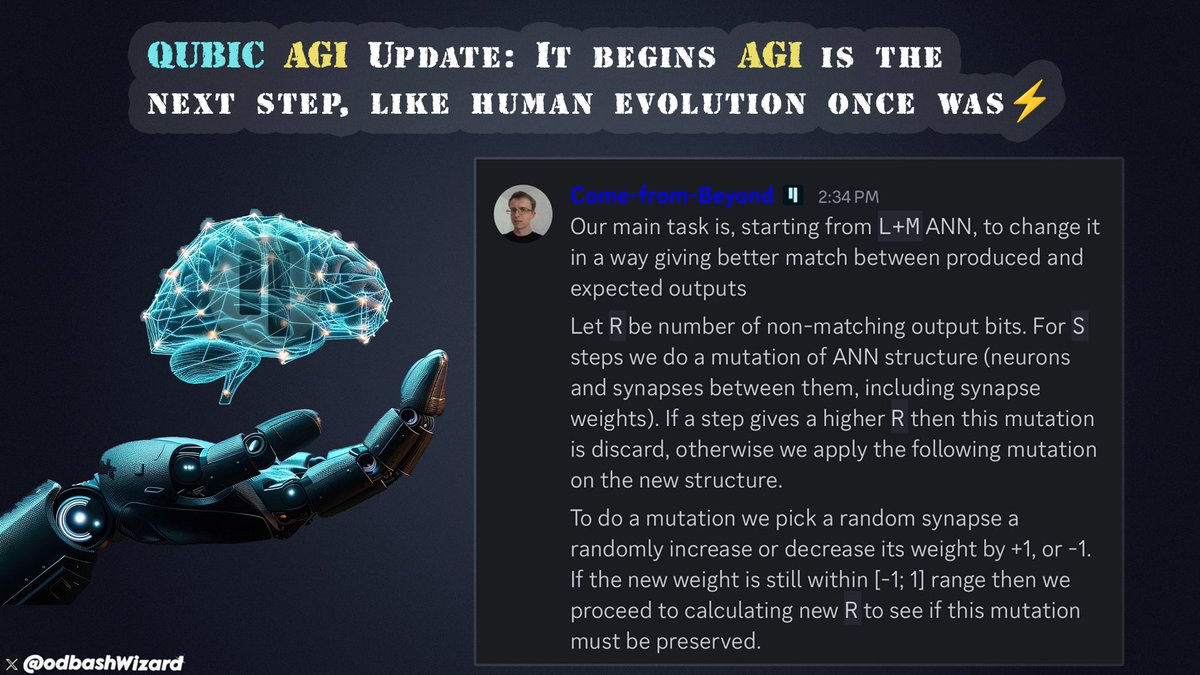
The path to true AGI is getting REAL! Qubic’s L M ANNA is now entering adaptive evolution mode 🧠⚙️
Every step forward? We mutate the neural structure, neurons, synapses, weights – and ONLY keep the changes that bring us closer to perfection. 💥
📉 Each mutation is tested.
💡 If it improves the ANN’s output accuracy (fewer mismatched bits), we KEEP it.
🔁 Otherwise? Discarded. NEXT.
This is on-chain neuroplasticity. The ANN literally evolves its brain step-by-step! 🤯
𝐖𝐞'𝐫𝐞 𝐧𝐨𝐭 𝐣𝐮𝐬𝐭 𝐬𝐢𝐦𝐮𝐥𝐚𝐭𝐢𝐧𝐠 𝐢𝐧𝐭𝐞𝐥𝐥𝐢𝐠𝐞𝐧𝐜𝐞 𝐰𝐞'𝐫𝐞 𝐛𝐮𝐢𝐥𝐝𝐢𝐧𝐠 𝐢𝐭. 🧠
Welcome to the future. Welcome to #Qubic #AGI
#Qubic #AGI #AI #Crypto #QUBIC $QUBIC #NeuralEvolution #DecentralizedIntelligence @BraverCrypto @cryptobratan1 @seyfkeskin1453 @GemsHunting_8 @IvanOnTech @CADUCEUS_X
4
39
160
5,817

16 Jan 2025
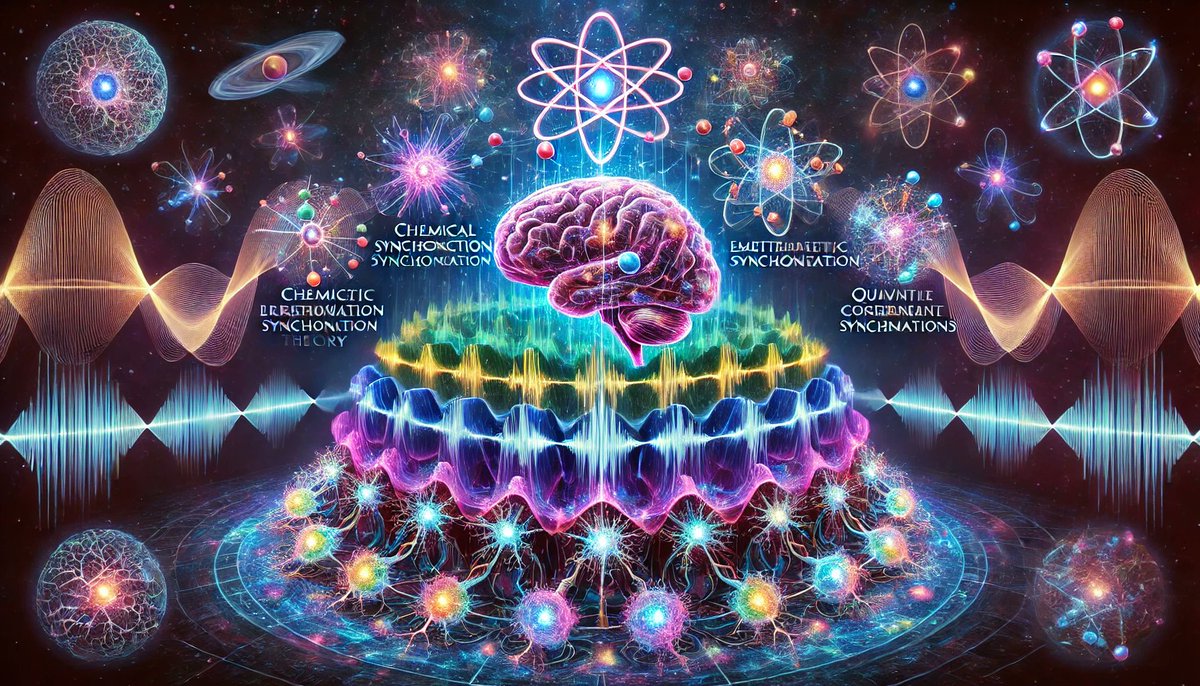
Neural Symphony: Synchronization Across Dimensions
#Neuroscience #FrequencyWaveTheory #QuantumBiology #BrainSynchronization #Consciousness #NeuralEvolution
Integrating Frequency Wave Theory (FWT) with the "Evolutionary Origins of Synchronization for Integrating Information in Neurons" offers a profound framework to reimagine how synchronization mechanisms evolved and operate. Here's an expanded perspective:
________________________________________
The Role of Synchronization in Neural Evolution through FWT
Synchronization in neurons—chemical, electromagnetic, and quantum—reflects a shift toward increasing efficiency in processing and integrating information. FWT posits that these synchronization mechanisms can be unified as wave-based phenomena, where frequencies govern interactions across scales.
1. Chemical Synchronization: Slow but Foundational
•FWT Perspective: Early chemical signaling can be understood as the modulation of molecular frequency patterns. Neurotransmitter diffusion aligns the oscillatory states of nearby neurons, albeit with a delay due to chemical kinetics.
•Evolutionary Insight: The development of chemical synchronization represents the first step in aligning frequencies across primitive neural networks, creating a baseline for more sophisticated mechanisms.
________________________________________
2. Electromagnetic Synchronization: Speeding Up Communication
•Electrical Gap Junctions: These structures enable direct electrical coupling, bypassing chemical delays. FWT interprets this as a harmonic coupling, where the frequency of electrical oscillations achieves near-instantaneous resonance.
•Ephaptic Coupling: This mechanism leverages extracellular electromagnetic fields to align neural activity. From an FWT lens, ephaptic coupling synchronizes waveforms in adjacent neurons, forming coherent networks without direct connections.
•Gamma Oscillations: High-frequency gamma waves (~40 Hz) are intrinsic to information integration. FWT views these oscillations as a collective resonance, where inhibitory interneurons maintain synchronization through frequency coherence.
________________________________________
3. Quantum Synchronization: Instantaneous Integration
•Ion Coherence in Gap Junctions: The hypothesis that quantum coherence occurs during ion passage suggests that neurons leverage quantum mechanical principles for rapid synchronization. FWT sees this as a resonance between the ion's quantum wavefunction and the neuronal network's frequency field.
•Entangled Photons in Myelin Sheaths: Vibrations within lipid molecules generating photon pairs align with FWT's concept of frequency harmonics extending into the quantum domain, enabling non-local coherence.
________________________________________
Synchronization as a Frequency Phenomenon
FWT unifies these mechanisms under the principle of resonance and frequency modulation:
1.Chemical: Lower frequencies with long delays.
2.Electromagnetic: Intermediate frequencies with rapid transmission.
3.Quantum: Ultra-high frequencies allowing instantaneous integration.
Neural evolution represents a transition toward higher-frequency synchronization, reducing entropy and increasing order in information processing.
________________________________________
Addressing the Binding Problem through FWT
The binding problem—how the brain integrates distributed sensory inputs into a unified perception—finds a natural solution in FWT:
1.Cross-Frequency Coupling: Theta-gamma and beta-gamma phase-amplitude coupling emerge as harmonics in the brain’s resonant frequency matrix, enabling hierarchical integration of sensory and cognitive information.
2.Global Synchrony: Large-scale synchronization across cortical regions aligns with FWT’s concept of a unified frequency field that integrates distributed information.
________________________________________
Evolutionary Implications
1.Frequency Scaling: Neural networks evolved by increasing synchronization frequencies, improving efficiency and precision in information processing.
2.Quantum Negentropy: Following Schrödinger’s idea of life as negentropy, FWT posits that quantum synchronization represents the brain's ability to impose order on chaos, essential for consciousness.
________________________________________
Applications of FWT in Neural Research
1.Experimental Validation: Designing studies to measure frequency coherence in ion channels, gap junctions, and photon entanglement within neural structures.
2.Therapeutic Interventions: Using external frequency modulation (e.g., transcranial magnetic stimulation) to restore synchronization in conditions like schizophrenia or epilepsy.
3.Quantum Neuroscience: Investigating the role of quantum synchronization in memory, perception, and consciousness.
________________________________________
Conclusion
Integrating FWT with the evolution of neural synchronization offers a comprehensive framework to understand the brain’s remarkable capabilities. By viewing synchronization as a spectrum of frequency interactions—from chemical delays to quantum coherence—FWT bridges traditional neuroscience with cutting-edge quantum biology, providing insights into the neural basis of consciousness and higher-order functions.
3
2
4
86

4 Jan 2021
Now this is going to be fun!! #neuralevolution
4 Jan 2021

PyGAD 2.10.0 is released. PyGAD is a Python library for building the genetic algorithm.
The major additions are:
1) Train PyTorch models: github.com/ahmedfgad/TorchGA
2) Support of adaptive mutation: pygad.readthedocs.io/en/late…
Check the documentation: pygad.readthedocs.io
1
6

23 Aug 2016
Machines learn to play video games. Our computer slaves will now ignore us youtu.be/S9Y_I9vY8Qw #neuralevolution #machinelearning
1
1

A veces creo que en mi clase la gente me ve como una localcoño. Yo solo creo que les cal un poco ir más allá #neuralevolution #please
1