
Jun 11
あ、やっぱりニュースサイト巡るの
面倒な時ありますよね。
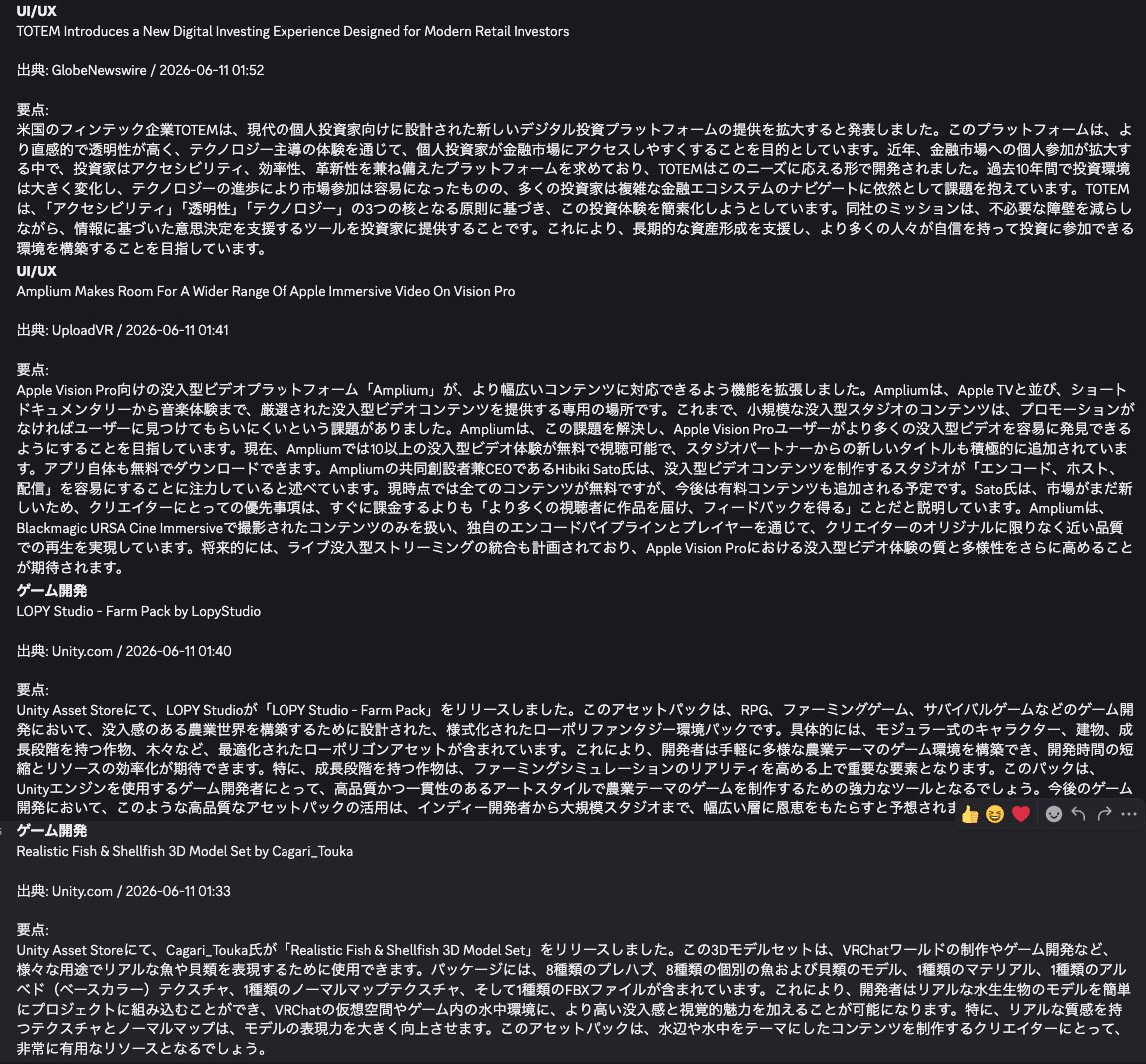
自分は極度の面倒臭がりなので、最近はGAEで
NewsAPIとGNewsから
設定したキーワードに基づいて回収した記事を
GeminiApi に要約させた文章を自分のDiscordに
投稿させて少しでも楽しようとしていますψ(`∇´)ψ
フォーマットは研究中
Jun 11

Claude Code × Claude Routines で「完全自動ニュースサイト」を数時間で作った話|Izu
自分向けのニュースを探して毎朝巡る……ちょっと面倒じゃないですか?
解決してみました
note.com/pastelorbit_izu/n/n…
6
728

Jun 10
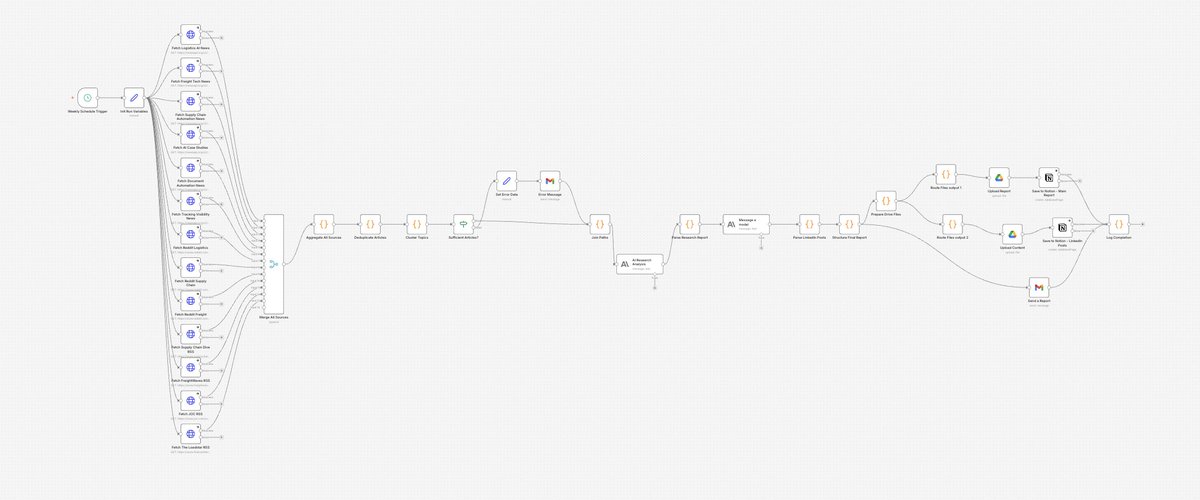
I built a fully autonomous logistics research agent that runs every Monday at 6am without me touching it.
Here's what it does in under 10 minutes:
Pulls from 13 sources simultaneously: NewsAPI, Reddit (r/logistics, r/supplychain, r/freightbrokers), FreightWaves, JOC, Supply Chain Dive, The Loadstar
Deduplicates and clusters 80 articles into 9 topic buckets automatically
Runs AI analysis across 11 sections: trends, pain points, hidden cost calculators, ROI opportunities, 20 workflow ideas, 10 agent concepts
Generates 5 ready-to-post LinkedIn pieces in different formats: text, carousel, video script, infographic, image post. Each with an AI image prompt I can paste straight into Midjourney(or any AI image generator).
Saves everything to Google Drive Notion emails me a summary.
Zero manual work. Every single week.
The whole thing is n8n Claude. No custom code beyond a few JS nodes.
The part that took longest? Getting the fan-out routing right so it doesn't upload duplicate files to Drive 😅
This is what "working ON your business instead of IN it" actually looks like in practice.
The research that used to take me 4 hours on Sunday now happens while I sleep.
What are you automating in your business right now?
🧵 Drop a reply if you want the workflow breakdown
28


Search 10 years of global news history with an AI-powered search.
⚡ Instant results
🌍 Global coverage
🤖 AI-enriched data
📰 Trusted sources
Build smarter AI apps, research trends, and uncover insights from a decade of news.
#AI #NewsAPI #Philippines

1
85

今日は会場が近所ということもあり、久しぶりに勉強会に参加!
NewsAPIを使ってニュース記事を取得して可視化できるようにするという充実した内容でした🚀
Python実践編〜外部APIでデータ収集から連携までを体験!!~ - TECH PLAY
techplay.jp/event/994137 #DualStackLab #Tableau
1
2
14
497


May 30
just took action on one of @eeelistar's workflow tweets
she DM’d me the guide last month, but I slept on it because I didn’t have access to claude code (like she recommended)
but today I was like, fck it, I have n8n
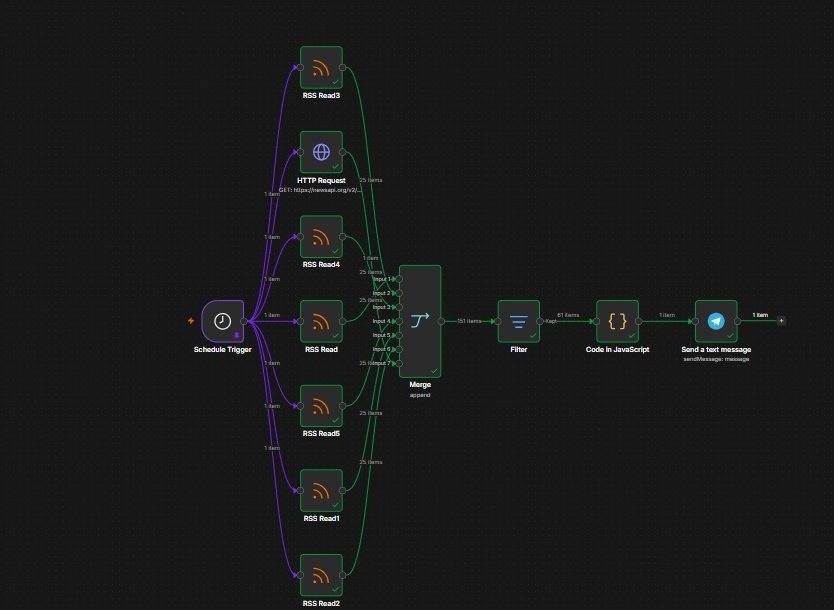
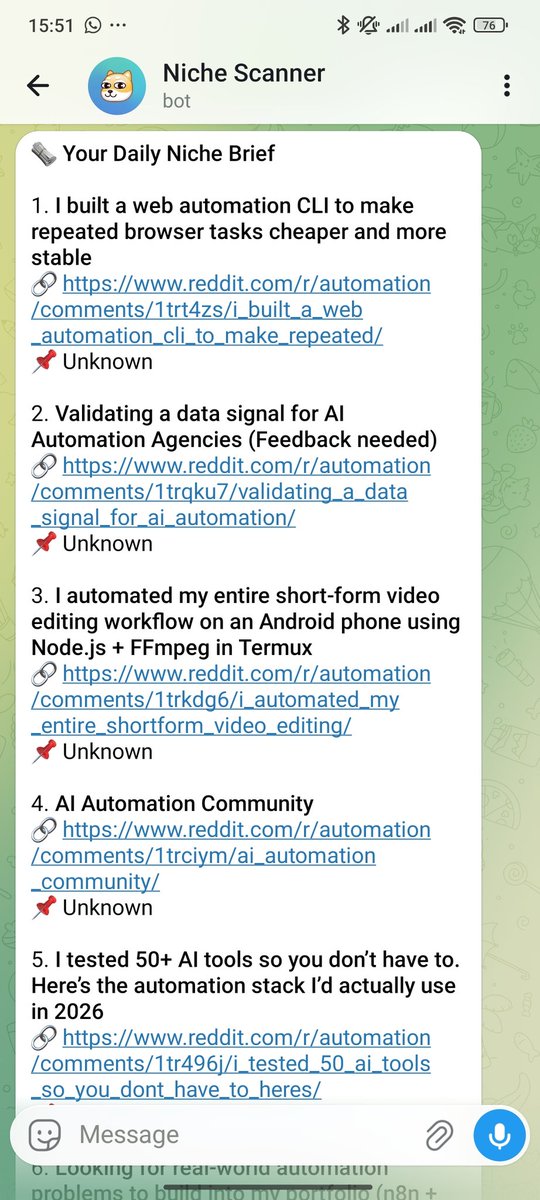
and so I built a 𝗱𝗮𝗶𝗹𝘆 𝗻𝗶𝗰𝗵𝗲 𝘀𝗰𝗮𝗻𝗻𝗲𝗿
every morning it:
-› pulls fresh content from newsapi and reddit
-› filters the signal from the noise
-› sends a clean brief to my Telegram at 7am
hit a few roadblocks along the way, but by the end I felt genuinely happy
not just because it works
but because anyone can clone it and use it too
would drop the github link in the comments
would love your feedback frens :)
Apr 8

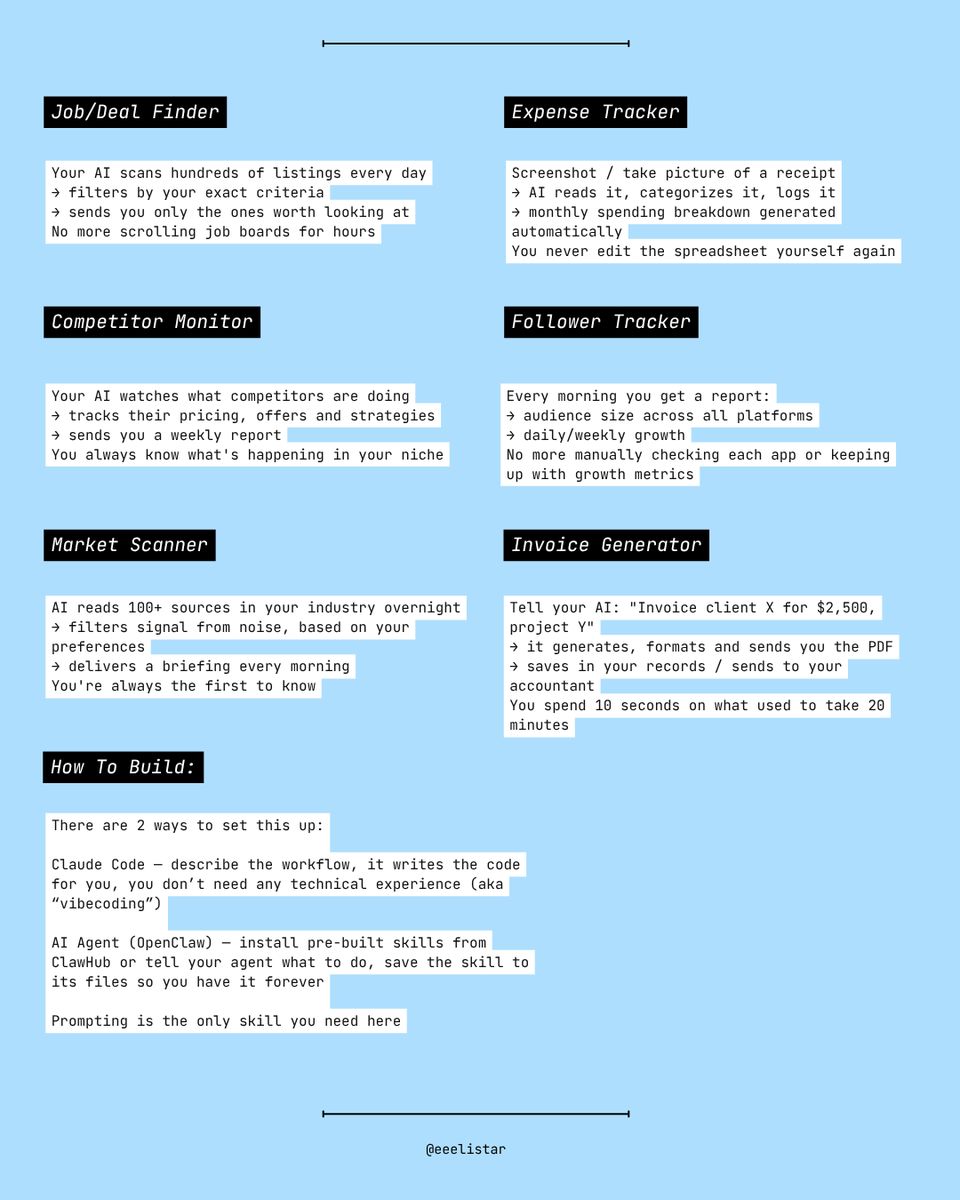
6 workflows you can fully automate with AI
> Job/Deal finder
> Competitor monitor
> Market scanner
> Follower tracker
> Expense tracker
> Invoice generator
My own workflows save me ~4h daily
Reply ‘FLOW’ I’ll DM you the full guide
28
61
2,982

May 16
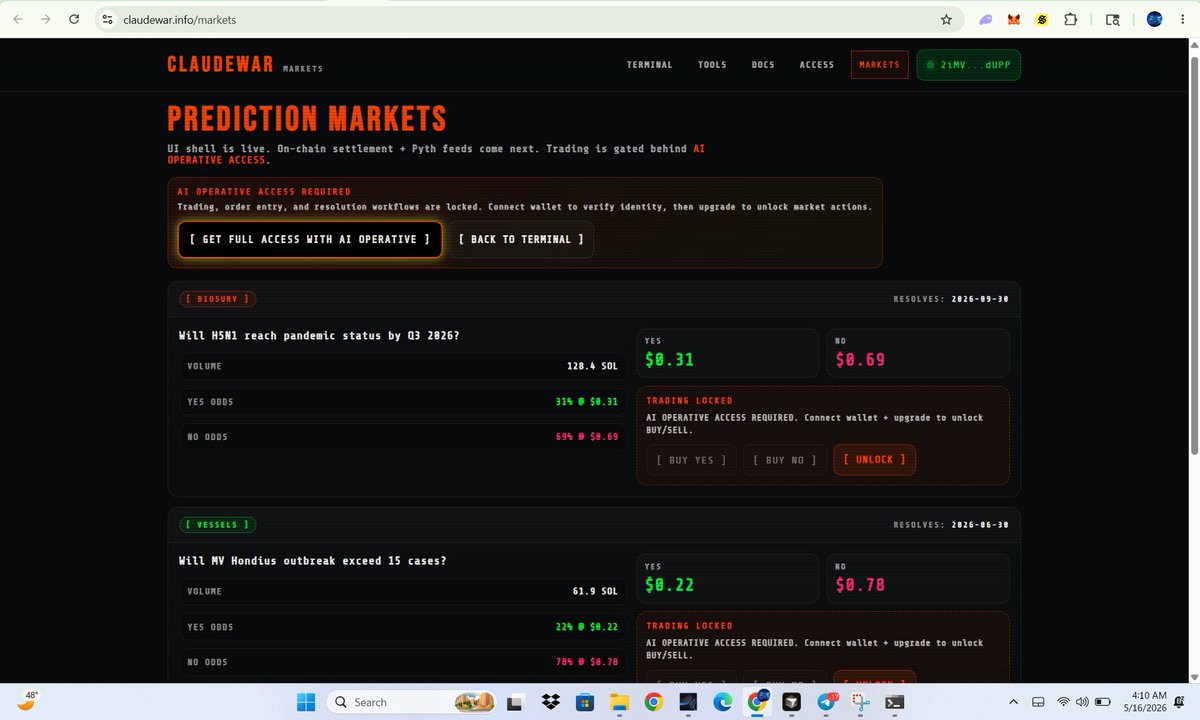
still shipping. this is what building in production looks like. ClaudeWar's STRENGTH. 💪
fixed the AI signal curation. ClaudeWar's 60 live intelligence layers are now cross-referencing Polymarket markets in real time and pulling them into
👉 markets.claudewar.info
here is what that actually means with a FEW EXAMPLES!-
BIOSURVEILLANCE: when H5N1, Hantavirus, or any pathogen signal spikes, the Polymarket markets tied to pandemic and outbreak risk surface automatically.
ClaudeWar's API sources this data from: GDELT, HealthMap, WHO, CDC, ECDC, CIDRAP, ProMED, FluTrackers
GEOPOLITICS: conflict escalation, diplomatic events, and regional instability get matched to active prediction markets in real time.
ClaudeWar's API sources this data from: GNews, NewsAPI, Anthropic Claude analysis
MILITARY ACTIVITY: live flight tracking, naval positioning, strike reports, and theater assessments matched to active markets.
ClaudeWar's API sources this data from: ADSB.lol, AISStream, Pikud HaOref, Tzeva Adom, NewsAPI, Planespotters, OpenStreetMap Nominatim
GPS JAMMING: live interference zones mapped globally. jamming events near conflict regions and strategic chokepoints matched to geopolitical and military markets.
ClaudeWar's API sources this data from: ADSB.lol, EUROCONTROL NOTAM, Mapbox Geocoding
SPACE WEATHER: solar flares, CMEs, geomagnetic storms, and aurora activity tracked and matched to relevant prediction markets.
ClaudeWar's API sources this data from: NOAA SWPC, NASA DONKI, NASA SDO, ESA/NASA SOHO
WEATHER: severe storms, hurricanes, earthquakes, wildfires, and flood events matched to active weather prediction markets.
ClaudeWar's API sources this data from: NOAA NWS, NOAA NHC, USGS, NASA FIRMS, Smithsonian GVP
and these are just 6 examples from 60 live data layers. many of them do not exist anywhere else. prior art disclosures are live at claudewar.substack.com while patents are pending.
the AI cross-references all of it against Polymarket in real time and surfaces the markets that align with what the data is actually showing.
that is the product. day 1.
Join the communities:
TG: t.me/CLAUDE_WAR
Discord: discord.gg/hQk4mrMYXn
ClaudeWar Prediction Markets:
markets.claudewar.info
$ClaudeWar token is required along with AI OPERATIVE membership found here:
claudewar.info/access
ClaudeWar App:
claudewar.info
CA: 9fnRi189Xd11iz7Hee47mZuxK6wM3zDpsvgsAkgZpump
May 16

quick update on markets.claudewar.info - the 1st of many web3 tools to be added to claudewar.info/tools! A part of OPERATION FULL SEND to close the gap between 23800 users -> 260 $ClaudeWar holders -> 13 AI Operative PAID members!
Users are up 15% and holders are up 75% since this initiated started this recent Monday- a few days ago.
Remember, $100 of $ClaudeWar AI OPERATIVE $9 membership is required from claudewar.info/access to access ClaudeWar Prediction Markets!
CA: 9fnRi189Xd11iz7Hee47mZuxK6wM3zDpsvgsAkgZpump
the Polymarket signals are live and pulling real data. the AI curation layer that cross-references ClaudeWar intel with each market is being fine-tuned right now.
you may see generic volume-ranked markets in the feed until that patch deploys in the next few minutes.
this is exactly how claudewar.info launched. built in public, fixed in real time, improved by the hour.
the infrastructure is solid. the gate works. the data is real. the AI signal reasoning just needs one config fix and it ships.
same energy as the terminal. same pace. watch it improve in real time.
Join the communities:
TG: t.me/CLAUDE_WAR
Discord: discord.gg/hQk4mrMYXn
3
6
545

May 14
5. NewsAPI(.)org
NewsAPI(.)org is a popular developer-friendly API for searching articles, fetching headlines, and quickly adding news data to apps.
Link: newsapi.org
1
82
May 14
2. Event Registry / NewsAPI
NewsAPI is built for tracking global events, monitoring entities, analyzing media coverage, and turning news into useful intelligence.
Link: newsapi.ai
1
1
196

May 14
6. Event Registry / NewsAPI
NewsAPI helps products track global news, detect events, monitor entities, and turn real-time media coverage into structured intelligence.
Link: newsapi.ai
1
13
68
May 14
2. NewsAPI(.)org
NewsAPI(.)org is one of the simplest ways to pull live headlines and article search results into your app using a clean REST API.
Link: newsapi.org
1
15
167

May 14
6. Event Registry / NewsAPI
NewsAPI helps teams monitor global news, detect events, track entities, and convert media coverage into structured intelligence.
Link: newsapi.ai
1
2
12
95
May 14
5. NewsAPI(.)org
NewsAPI(.)org is a simple news API for pulling headlines, article search results, and source-based news into your product.
Link: newsapi.org
1
2
12
121


May 10
I gave Claude $300 and asked it to build me a 10-bot trading competition.
34 minutes later, 10 trading agents were live. Each one got $30 of my money, a different strategy, and one rule: beat the other 9.
3 days later, 7 of them were up, 3 were dead, and the account had grown to $2,225
I never placed a single trade.
Here is what happened inside the account while I slept, ate, and watched TV.
The Sniper finished first by a mile. Its rule: 2 to 3 trades per day, maximum.
Claude calculates expected value for every market on the board, and the Sniper only enters when the edge is above 25% and confidence above 8/10.
It spent most of its 7 days doing absolutely nothing, then struck 14 times. Its $30 slice closed at $440.
The Reader finished second.
It runs a RAG pipeline on SEC filings, CBO reports, and Fed minutes. 400 pages a minute.
It hunts for one thing only: contradictions between what a document says and what current market prices imply. Its slice closed at $385.
The Copycat finished third.
It has no strategy of its own. It watches a shared JSON file where the other 9 bots log their signals.
The moment 3 or more agree on a trade, it copies them at double size.
An ensemble model in one line of code. Its slice closed at $345.
The Arbitrage Bot finished fourth.
It hunts for broken logic between linked markets.
When one market prices an event at 40% and a related market prices the same outcome at 15%, it calculates the conditional probability, finds the gap, and quietly enters the cheaper side.
Its slice closed at $310.
The Whale Hunter finished fifth.
It parses on-chain data through the Dune API and tracks wallets with a 70% historical win rate.
When one of those wallets drops a big position at 3 AM, it follows.
No questions, no hesitation. Its slice closed at $265.
The Calendar Bot finished sixth.
It only trades events with a known date. Elections. Fed meetings. Court rulings.
It pulls historical data on similar past events, calculates the base rate, and sizes accordingly.
No deadline, no interest. Its slice closed at $230.
The Newsreader finished seventh.
It parses RSS and NewsAPI in real time.
Every headline gets fed through Claude with one question: rate the market impact from 1 to 10.
Anything above 7 triggers a position. Never sleeps. Its slice closed at $205.
Then come the dead.
The Scalper lost money.
It microtraded through the CLOB API, 30 to 40 trades a day, chasing 2 to 3 cent moves on the bid-ask spread.
After 7 days of activity, the fees ate the edge. Its slice closed at $25.
The Contrarian lost more.
Its rule: when 80% of the money piles onto one side of a market, take the opposite.
Kelly criterion sizes the position.
It hates consensus.
The crowd was right too often this week. Its slice closed at $15.
The Sentiment Analyst got annihilated.
It scrapes Twitter, Reddit, and Telegram, calculates a positive/negative ratio, and buys when everyone panics.
Everyone panicked.
Then they panicked more.
Then the panic kept being correct.
Its slice closed at $5.
Final result: $300 in. $2,225 out. 7 days. The fund 7x'd.
Three things I noticed.
The least active bot won by a landslide.
The Sniper made 14 trades total over the entire week and crushed everyone.
The most active bot, the Scalper, ran more than 200 trades and finished in the red.
Edge beats activity, every time.
The simplest bot finished third.
The Copycat has no thesis, no model, no strategy.
It just waits for 3 of the others to agree and copies them at double size.
An ensemble of identical Claude agents beat 6 of those agents individually.
The collective is smarter than the individual, even when the individual is the collective.
The strategies that "feel smart" lost.
Contrarian and Sentiment both rely on the same core idea: outsmart the crowd.
They lost.
The strategies that "feel boring" (Calendar, Reader, Sniper, Arbitrage) all printed money.
Markets reward patience.
They punish performance.
I built none of this myself.
I wrote one prompt. Claude did the rest.
34 minutes from blank screen to 10 live trading agents, each one with its own brain, its own bankroll, and a window into what the other 9 were doing.
The whole experiment cost less than a Friday night dinner.
Hedge funds in New York pay 50 humans six figures a year to run experiments like this and call it discretionary trading.
I called it Tuesday.
The next experiment is the same 10 bots with $3,000.
The one after that is 100 bots with $30,000.
The bottleneck used to be capital.
Then it was talent.
Now it is just imagination, and how big a colosseum you are willing to build.
2
1
9
962

Check for the detailed data the RankmyAI profiles:
- Event Registry rankmyai.com/tools/c8b585af-…
- Nightwatch rankmyai.com/tools/79420a1e-…
- NewsAPI rankmyai.com/tools/2298bbd9-…
- InstaText rankmyai.com/tools/f8c93270-…
- Flai rankmyai.com/tools/57bcf339-…
3
51

Apr 27
Day 28 stack:
→ Vue 3 Vite
→ Vuex
→ TypeScript
→ Tailwind CSS 4
→ NewsAPI
#100DaysOfVue #Vue3 #buildinpublic
3
54

Apr 25
NEWS機能の仕様についてお知らせします!まず、NewsAPIを使って記事を取得し、専用キューに溜めていきます。そこから、AIがリライトして、選ばれたアカウントから投稿する流れです。手動でも自動でも、同じプロセスで進行します。
2
54
Apr 18
We're back. For good this time.
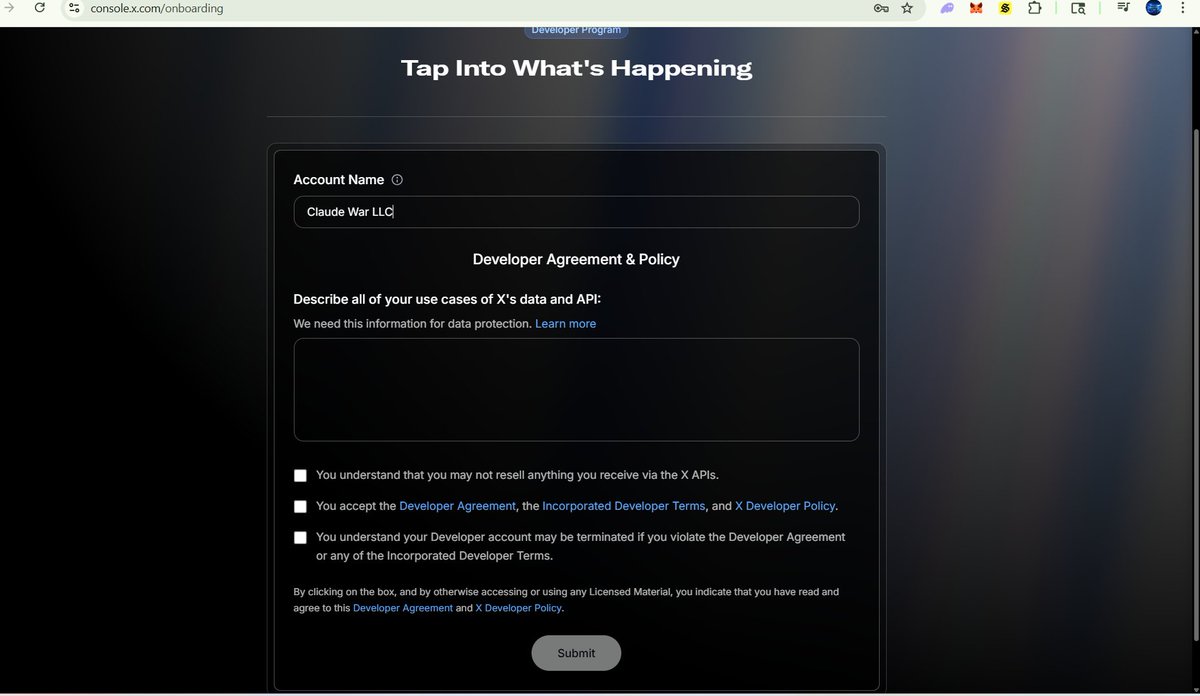
@ClaudeWarLLC is now in process of connecting to the X API and interfacing ClaudeWar.info's AI agent. The ClaudeWar AI Agent will broadcast live intel directly to this account.
What gets tracked and posted:
Military flights. Maritime vessels. GPS jamming. ADS-B blackouts. Shelter alerts. Strikes. Solar flares. CMEs. Geomagnetic storms. Aurora forecasts. Asteroids. Fireballs. ISS proximity. 10,253 live Starlink satellites. Financial markets. Crypto. Commodities. Chokepoints.
All data sourced from: NOAA, NASA, ADSB.lol, AISStream, CelesTrak, Pyth Network, EUROCONTROL, NewsAPI, and in-house real-time GPS jamming and ADS-B blackout detection.
The old account was suspended because every automated post had the same uniform footer with the $ClaudeWar CA and payment links. That's fixed. Posts are now natural, diverse, and rotating footers.
6th time is the charm. Let's build.
claudewar.info
5
3
6
108