
5 Apr 2025
Your data, YOUR control!
🔐 Tired of data silos and privacy leaks?
@OpentrustLab is rewriting the rules: Own your data, share securely, and earn rewards. Break free from Big Tech’s grip.
#DataSovereignty #PrivacyRevolution #FHE #Web3 #Web3

5 Apr 2025

Reclaiming Data Sovereignty: How Practical FHE Bridges the Privacy-Innovation Divide
Current Web2 Paradox: Trading Control for Convenience
In today’s digital economy, data powers everything—from personalized ads to life-saving medical breakthroughs. Yet, the individuals generating this data remain disempowered. Web2 platforms thrive on an asymmetrical bargain: users trade personal information for "free" services, often unaware of how their data is monetized, shared, or exploited. The 2018 Cambridge Analytica scandal—where 87 million Facebook profiles were harvested without consent to manipulate voter behavior—epitomizes a systemic flaw: users do not truly own their data.
In 2023, Pew Research Study found out that 73% of Americans feel they have little to no control over their personal information (source: 📷Colleen McClainHow Americans View Data Privacy). Why? Because centralized platforms act as de facto custodians. Once uploaded, data becomes a corporate asset—analyzed, sold, or leaked with minimal accountability. For instance, healthcare apps collect sensitive biometric data yet rarely compensate users, even as pharmaceutical companies pay millions for anonymized datasets. The result? Patients distrust institutions and fear privacy leaks, leading them to withhold or even conceal critical health information.
The problem extends beyond ownership. Data silos fragment the inner value. Hospitals, insurers, and researchers operate in isolated ecosystems due to regulations like HIPAA. While these rules protect individuals, they also hinder collaboration. Imagine a cancer research team unable to access global patient data due to compliance risks. The price of privacy, it seems, is stagnation.
Web3’s Growing Pains: Where Decentralization Collides with Reality
Web3 is trying to fix this by returning ownership to users through blockchain and tokens. However, it is turning to a cautionary tale of a mixture of hype and exploitation.
The 2021–2022 NFT boom exemplified this duality. Projects like Yuga Labs saw prices soar to absurd heights, only to crash when speculators cashed out. Similarly, the collapse of USDT wiped out $40 billion in value almost overnight. These events underscore a critical flaw: Web3 prioritizes speculative gains over sustainable value creation.
The deeper issue, in fact, lies in its infrastructure. Blockchain’s transparency—lauded for enabling trustless transactions—becomes a liability when handling sensitive data. Public ledgers expose transaction patterns, wallet addresses, and even personal metadata. For enterprises, this is a non-starter. No hospital would store patient records on a fully transparent blockchain, regardless of network security.
Web3’s vision of an ownership economy remains incomplete. Without privacy-preserving infrastructure, it cannot support high-stakes industries like healthcare or finance.
The PFHE Breakthrough: Privacy Without Sacrifice
Enter Practical Fully Homomorphic Encryption (PFHE), a cryptographic innovation that enables computations on encrypted data—without ever decrypting it. While traditional FHE has been theorized for decades, recent advancements in hardware acceleration (e.g., Intel’s dedicated FHE chips) and algorithmic optimization are driving it toward commercialization. Here’s how PFHE rewrites the rules:
1. User-Centric Data Control
With PFHE, data remains encrypted at all times—on devices, in transit, and during analysis. A diabetic patient, for example, could share encrypted glucose levels with a research institute. Algorithms process the data to identify trends (e.g., hypoglycemia patterns), but neither researchers nor hackers can view raw records. Users retain full sovereignty, granting or revoking access via intuitive interfaces.
2. Incentivizing Ethical Participation
PFHE enables a circular data economy. Smart contracts automate micropayments to users when their encrypted data is utilized. For example:
(1) A fitness app can reward their customers with tokens when their encrypted workout data trains an AI model.
(2) A city planner can compensate the residents for encrypted mobility data used to optimize public transit.
This model aligns incentives: users profit from their data, while businesses access richer, ethically sourced datasets.
Conclusion: Building a Future Where Privacy and Progress Coexist
The data economy stands at a crossroads. Web2’s extractive model and Web3’s speculative chaos have both failed to balance innovation with ethics. Opentrust Lab offers a third path with PFHE—where privacy is not a trade-off but a foundational pillar.
By restoring control to users, PFHE unlocks a world where:
(1) Patients securely contribute to medical breakthroughs.
(2) Consumers monetize their data without sacrificing privacy.
(3) Enterprises innovate responsibly, free from compliance nightmares.
The technology is nearing readiness. Startups like Opentrust Lab are laying the groundwork. Regulatory tailwinds are strengthening.
The question is no longer if PFHE will reshape the digital landscape, but how quickly we can adapt. In an era of data breaches and algorithmic bias, the stakes have never been higher. The future belongs to those who empower users—not platforms. Opentrust Lab is here to lead the way.
1
3
277

27 Feb 2025
AgentSingularity.xyz Summit! Submit your best questions for AI & Web3 pioneers from Google DeepMind, @SuiNetwork, @base, @solana, @virtuals_io, @PondGNN, @satlayer,@elizaOS,@BitGPTnetwork,@vana,@OpentrustLab, and Sparsity! Each chosen question will receive a 100 USDT prize!🚀
Join us at Agent Singularity at ETH Denver! [lu.ma/fnqirhjy] and hear insights from AI & Web3 pioneers. Drop your best questions for these projects in the comments! We’ll select the top ones, and each chosen question will receive a 100 USDT prize. Let’s see your best ideas! 🚀
5
4
10
1,398

12 Feb 2025
𓊝Argo_X_OpentrustLab𓊝<<<
Opentrustlab will provide FHE (Fully Homomorphic Encryption) tech support for Argo.
By combining Workflow and FHE, you will have more options for privacy protection.
>>Private Transactions
Encrypt on-chain data (e.g., ERC-20 token balances) to achieve privacy protection.
>>Blind Auctions and Voting
Perform on-chain calculations without revealing bids or voting content.
>>Privacy-Aware AI Training
Encrypt sensitive data and send it to cloud models for processing, with results that only the user can decrypt.
>>Secure Outsourced Computation
Users host encrypted data on third-party cloud servers to execute computation tasks remotely.
Argo‘s collaboration with OpentrustLab will provide you with enhanced privacy protection capabilities.
Argorithm designed, workflows evolved.
12 Feb 2025
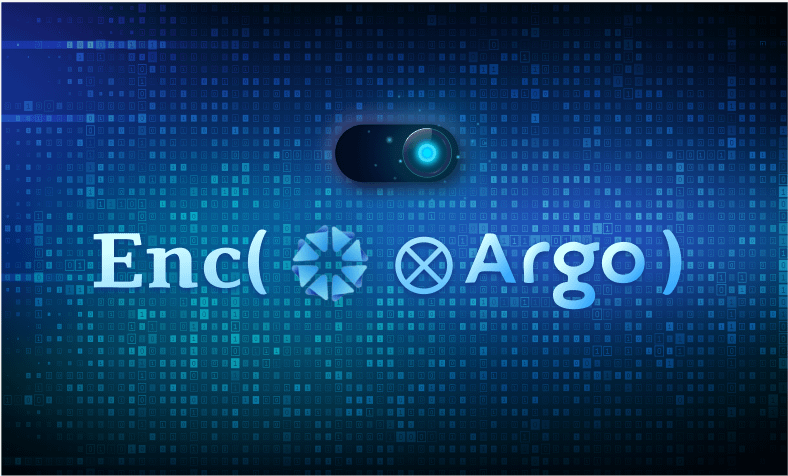
Encrypt ( @OpenturstLab 🤝 @Argo_workflow )
OpenTrust has partnered with @Argo_workflow to make privacy in AI workflows as easy as hitting ‘send’.
3
10
31
5,521
8 Nov 2024
🚀 Breaking News: We have just updated our Litepaper! 📰✨
⭐ Opentrust Lab: A research lab dedicated to advancing distributed cryptographic computing technologies!
🌐 Read full document: opentrust-lab.github.io/Lite…
#OpentrustLab #Shaftstop #FHE #Web3 #AI #Blockchain #Litepaper
1
1
8
957

7 Oct 2024
2/➮ 10 teams pitched for a prize pool of $25k , be on the lookout for these university-affiliated founders. Here are some:
@OpentrustLab ⇴ pioneering advancements in #FHE
@JoJoWorld2022 ⇴ innovative text-to-3D creation platform
@bri3fai ⇴ AI analytics tool for web3 environments
@CyberChargeWeb3 ⇴ DePIN C2E low-voltage network technology
@crynuxai ⇴ advanced orchestration layer for EdgeAI applications
@apus_network ⇴ decentralized GPU network for AI on @aoTheComputer
#XTrace ⇴ secure infrastructure for a privacy-focused data marketplace

1
1
2
248

4 Oct 2024
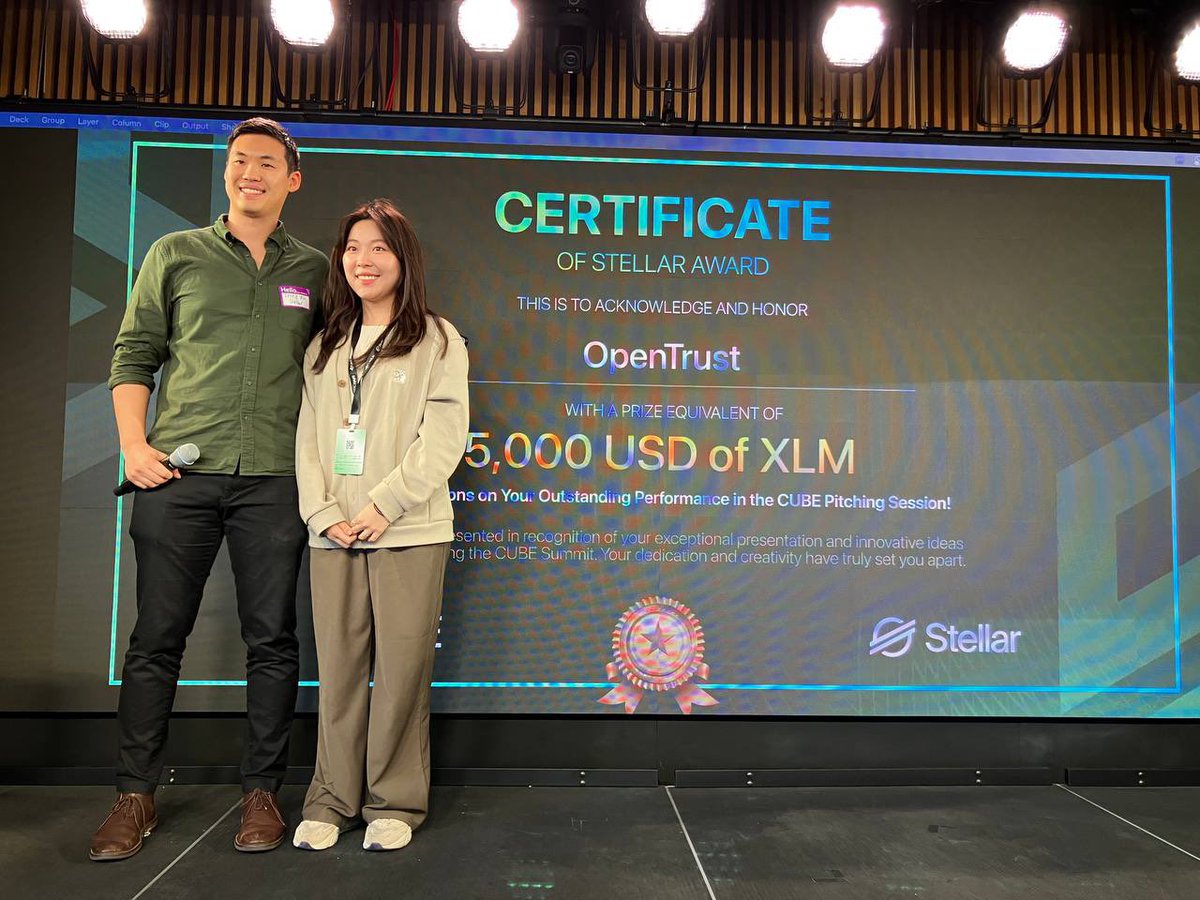
Congratulations for the outstanding performance in the cube pitch session! It's the result of team efforts. Thanks to the recognition of the judges and experts. @OpentrustLab welcomes everyone to follow and cooperate with our praticle FHE solutions for AI. 😊 #cubeSummit
1
5
225
3 Oct 2024
⭐ OpentrustLab is now live !!!
🌐 Click the link below to visit our official website and explore more about our innovative solutions ! 🔍✨
👉 Learn more: opentrustlab.xyz/
#OpentrustLab #Web3 #FHE #AI #Blockchain #innovation
3
136
1 Oct 2024
The inventor of Pascal once said, "A thousand times the speed of a baby is a jet." Now, @OpentrustLab’s practical FHE solution is emerging. It will be 1000 times faster than the average speed of TFHE and will make its debut at the @cubesummit . #FHE #OpentrustLab #cubeSummit

1
4
127
30 Sep 2024
🎉 Thrilled to announce that our team's efforts have earned us a spot as a showcase project at the Cube Summit! We are in the final stages of closing our pre-seed round of financing. Thanks for your attention! 💪 #CubeSummit #PreSeedRound #TeamEffort#OpentrustLab
2
3
149