
📕 Top 7 MCP for Product Designers
MCP (Model Context Protocol) connects AI coding tools to the services you already use like Figma, Notion, Google Analytics, and more.
Here are 7 MCPs worth adding to your workflow:
1️⃣ context7 (Pulls live library docs into your AI tool so it codes with the right context)
2️⃣ NotebookLM MCP (Feeds your research and specs directly to AI, so it builds with real user needs in mind)
3️⃣ shadcn/UI MCP (Gives AI actual component knowledge instead of letting it guess your UI)
4️⃣ Figma MCP (Turns your designs into code using real layout structure, not screenshots)
5️⃣ Notion MCP (Lets AI read your PRDs, pull specs, and update tasks without leaving the editor)
6️⃣ Google Analytics MCP (Query your GA4 data in plain English to validate design decisions fast)
7️⃣ Supabase MCP (Set up your entire backend through natural language. No SQL needed.)
Which of these are you most excited to try? 👇
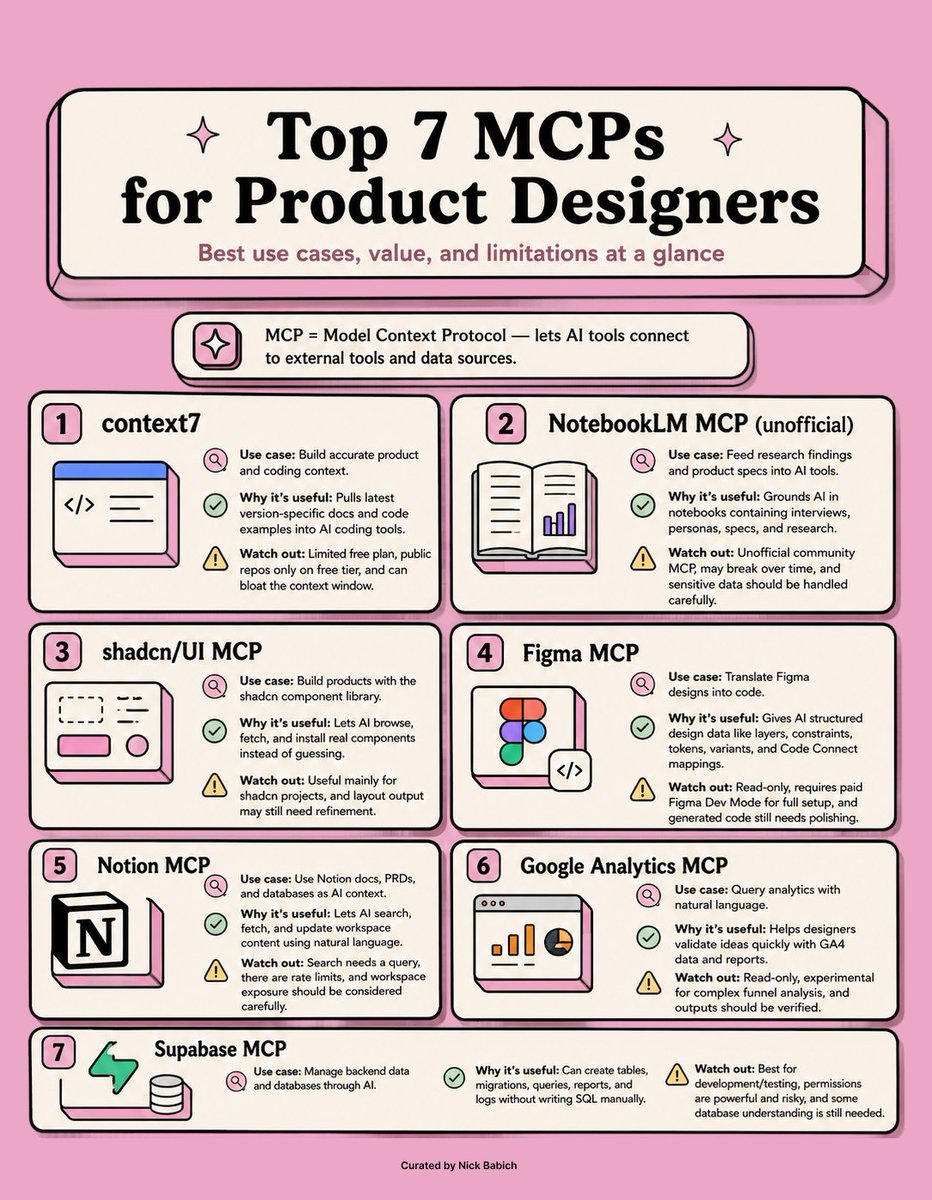
ALT Top 7 MCPs for Product Designers
1
1
4
85

AI just made the average Product Manager irrelevant.
User research? AI
Roadmap prioritisation? AI
Writing PRDs? AI
The only PMs who survive are the ones who think like founders.Everyone else is just a very expensive middleman.
1
1
19

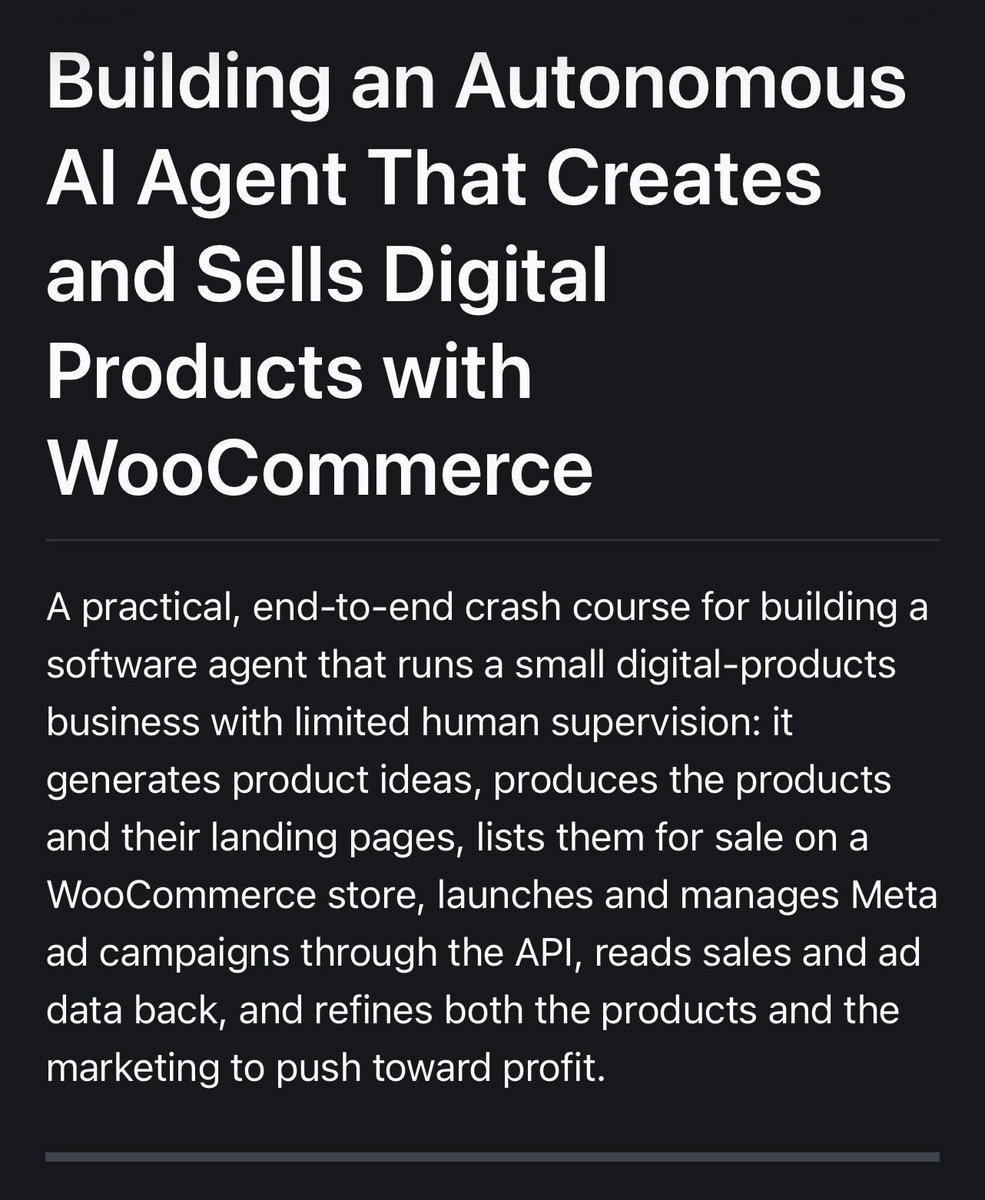
Instead of simple PRDs (Product Requirement Docs), I write entire handbooks. I treat AI agents like junior developers and give them a structured sequence of steps to follow. I find this keeps them on track: if it doesn’t, I refine the handbook.
4

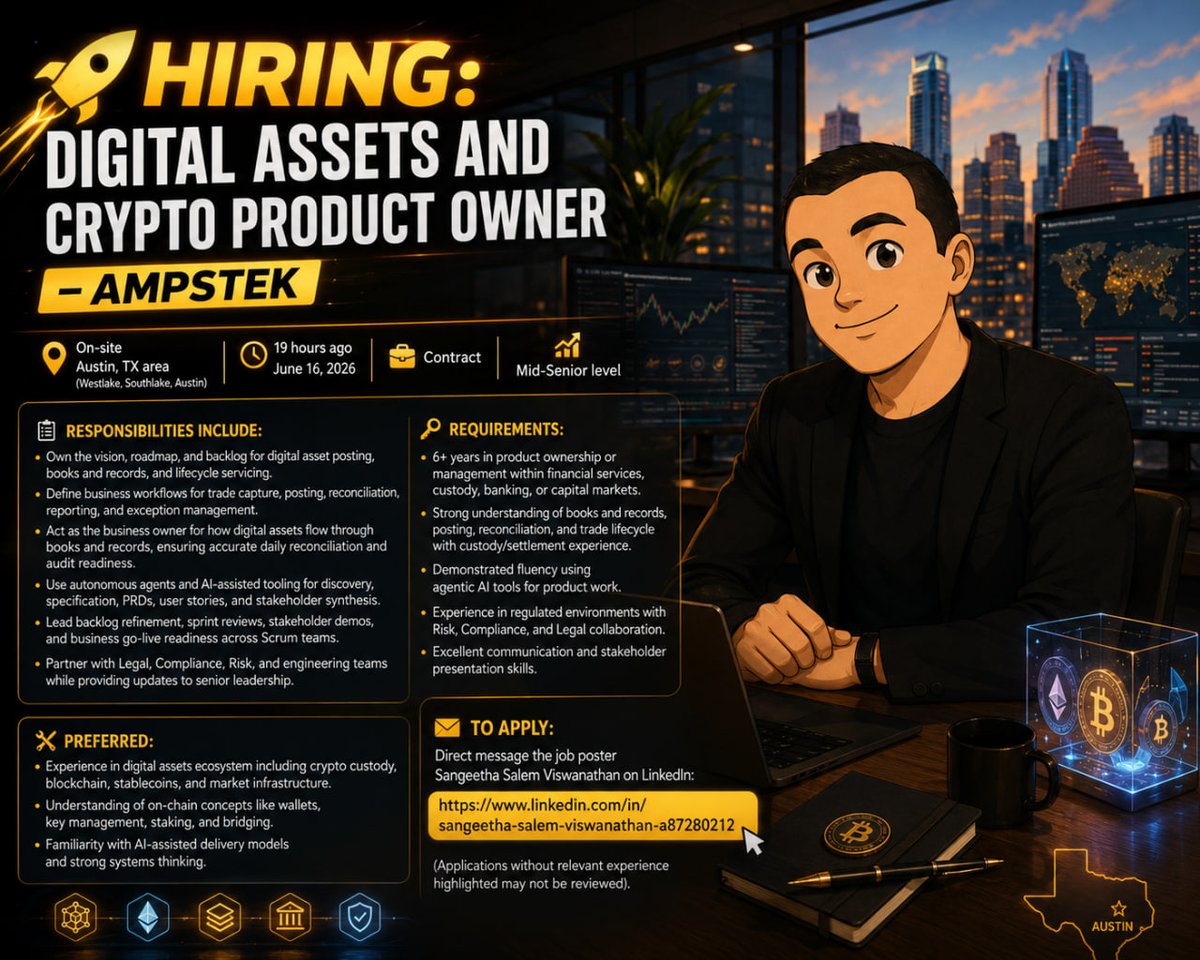
🚀 Hiring: Digital Assets and Crypto Product Owner - Ampstek
📍 On-site - Austin, TX area | 💼 Contract | 🕐 19 hours ago - June 16, 2026
Ampstek is seeking an experienced Product Owner to drive digital assets product initiatives focused on posting, books and records, and lifecycle servicing in a regulated financial environment.
📋 Responsibilities include:
- Own the vision, roadmap, and backlog for digital asset posting, books and records, and lifecycle servicing.
- Define business workflows for trade capture, posting, reconciliation, reporting, and exception management.
- Act as the business owner for digital assets flow through books and records, ensuring accurate reconciliation and audit readiness.
- Leverage autonomous agents and AI tools for discovery, PRDs, user stories, and stakeholder synthesis.
- Lead backlog refinement, reviews, demos, and go-live readiness across teams.
- Partner with Compliance, Risk, Legal while updating senior leadership.
🔑 Requirements:
- 6 years product ownership in financial services, custody, or capital markets.
- Deep knowledge of books & records, reconciliation, trade lifecycle.
- Fluency with agentic AI tools for product work.
- Regulated environment experience and strong communication skills.
🛠 Preferred: Crypto custody, blockchain, on-chain concepts, AI delivery models.
📩 To apply: DM Sangeetha Salem Viswanathan on LinkedIn: linkedin.com/in/sangeetha-sa…
🔗 Original post: linkedin.com/jobs/view/digit…
⚠️ DYOR! I don’t verify every job. If someone asks to run files (even from GitHub) or ask for payment 🚩 likely a scam.
❗️ I'm not hiring myself! I just sharing fresh web3/crypto/blockchain roles DAILY for all levels!
💡 For Interns & juniors → t.me/crypto_vazima_english
💼 Mid/senior jobs → t.me/web3_jobs_crypto_vazima
#ProductOwner #CryptoJobs #DigitalAssets #Blockchain #FinTech #Web3 #AustinTX #Hiring #CryptoProduct #AI #ProductManagement
27

Për ato qe nuk e pranojnë që prds ka në dorë gjithçka, dhe bëjnë teatër
#fermavip3
4
476

Founder, not builder. A founder having human engineers hivemind to build something is morally the same as having AI do it. Founder has vision. Only difference is, AI coder models are faster, smarter, less costly, don't need breaks, listen with more precision, don't waste time doing scrum meetings and making PRDs and other HR / LinkedIn bullshit behaviors.
🙂
22

Claude Code generates HTML all day — PRDs, dashboards, docs. Now it just pushes to a bookshelf you can share with one link. Watch 👇 #buildinpublic
1
1
48

It is. Is testing a pipeline now with PRDs flow and it make PRDs of 50 lines to slow down the testing progress.
20

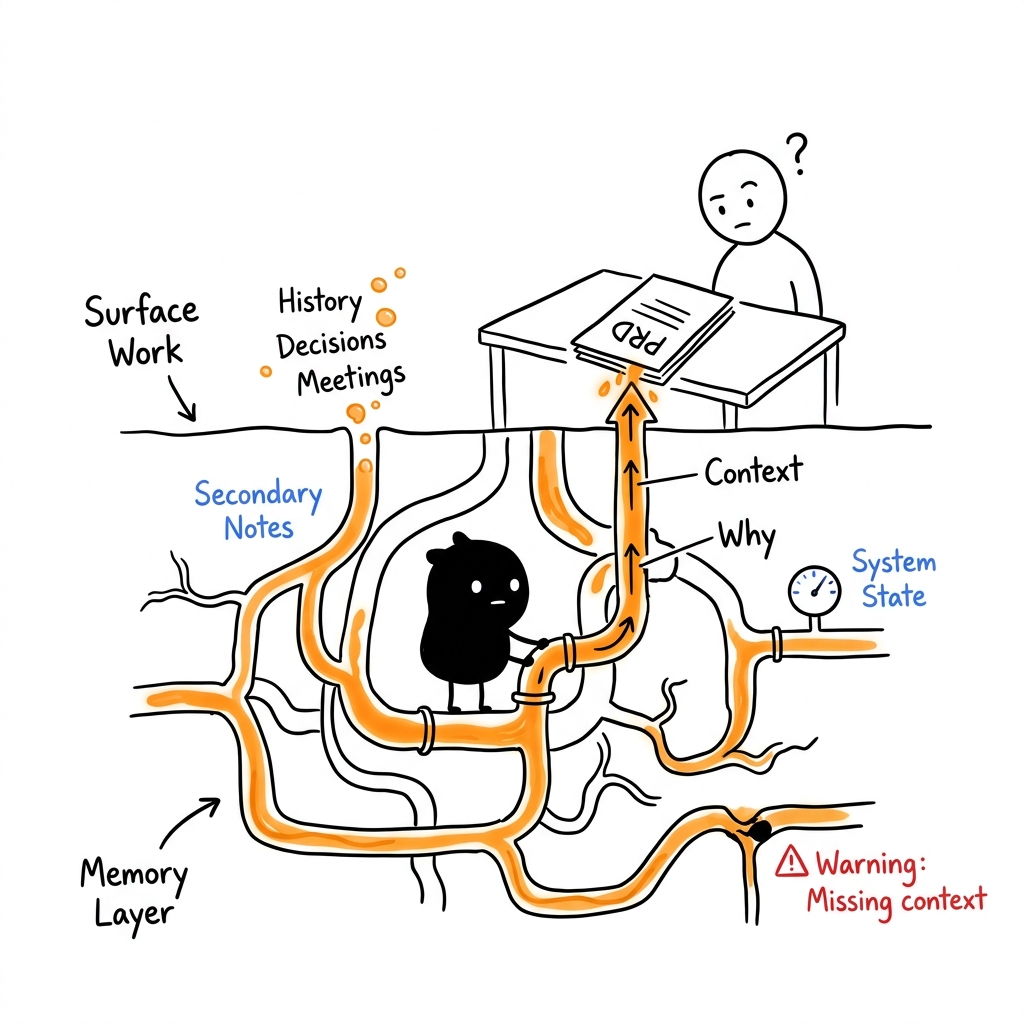
Most product teams don't have a documentation problem.
They have a memory problem.
Every quarter, teams create:
• PRDs
• Meeting notes
• Research docs
• Roadmap presentations
Yet six weeks later, nobody can answer questions like:
• Why did we prioritize this problem?
• What trade-offs did we accept?
• Which assumptions were we testing?
• What alternatives did we reject?
The documents still exist.
The reasoning doesn't.
That's because notes and memory are not the same thing.
- Notes are snapshots.
- Memory is a system.
- Notes capture what happened.
Memory preserves why it happened.
Notes live in folders.
Memory connects decisions to outcomes.
Notes become stale.
Memory compounds.
When a new PM joins, they shouldn't have to schedule five meetings to understand a feature.
They should be able to see:
• Why the objective existed
• Which options were considered
• What risks were accepted
• How the decision connected to company strategy
Without that context, teams repeat discussions, revisit old decisions, and prioritize based on who speaks the loudest.
With it, teams move faster because the context already exists.
And AI becomes genuinely useful.
Not because it can summarize documents.
Because it can reason over a structured history of decisions.
This is the idea behind Scriptonia.
Not another place to write notes.
A product memory layer that preserves context, decisions, assumptions, and trade-offs across the entire lifecycle of a product.
A simple test:
If your team disappeared tomorrow, could a new team reconstruct why your product looks the way it does without calling you?
Most teams can't.
That's not a documentation issue.
It's a memory issue.
Where do you feel this most today?
Roadmap changes?
Handoffs?
Or trying to understand a decision from six months ago?
1
1
5
29

So realistically, a proper thorough process, like in my current example I just posted, I have 7 prds, but what I need to do is clarify every single potential context gap in each one. For your information, one prd I used the other day had 61 clarification questions. So over 7 let’s just assume there are like 300-400 potential clarifications. Do you see why people produce broken software with these things now? There is like a context debt you accumulate using coding agents. You hve to pay it back at some point, or you can just pay at entry
17
I just wrote a goal for a goal for half an hour. But my instructions were so long it doesn’t fit into a goal yet, the output artifacts from this run will be a suite of prds that will fit snug into the goal instruction input limit, and it can point at a folder of docs each doc a specialised suite of tasks, all with their own sequence diagram in text form. It’s really crazy the amount of massaging we can do to instructions and requirements now
27
AgenticFounder retweeted

12h
COACH IS NOW AN AGENTIC SERVICE
Coach went live yesterday as a review service for product docs: PRDs, strategy docs, roadmaps, OKRs.
The response has been tremendous. Hundreds of reviews in the first 24 hours. Dozens "multi review" users.
The top ask, from the very first wave of users: "can I plug this into Cursor / Claude Code / Codex?"
So now, Coach is now available as an MCP server less than 24 hours after launch.
AI agents are the new buyers. PMs and engineers do more and more of their work inside agentic editors. They want their agent to call Coach as a tool, get the review back, and keep working in the editor.
This is what it means to be an AI-native product in 2026: your customers consume you through their agent.
It took 24 hours from launch to ship the MCP integration. In retrospect, I should have bundled it with launch.
The Setup is easy two steps:
Sign in at usecoach.ai/settings/api-key… and generate a key.
Drop this into your Claude Code config (~/.claude.json) or Cursor MCP settings:
{
"mcpServers": {
"coach": {
"type": "http",
"url": "usecoach.ai/api/mcp",
"headers": { "Authorization": "Bearer sk_coach_..." }
}
}
}
Restart your editor. Ask the agent to review your PRD with Coach. The full review streams into the chat. A copy lands in your Library (accessible through the web).
Founders: yet another reminder that software tools that are invisible to agents are NGMI.
14
5
81
12,741

I just launched my startup Krowe 🚀
An AI client portal for freelance devs.
Build your builder profile, create PRDs/quotes/contracts, manage repos & share
tasks — all with your client in one place.
Free to try for a limited time 👇
krowehub.com

2
53

A friend saw my post and sent me this:
"This role focuses on solving real user problems rather than managing backlogs or writing PRDs. What is the most meaningful customer outcome you have owned and driven in your recent experience?"
🫠

i swear I've been in so many tech interviews where I'm asked "what's your biggest accomplishment", then I spent a boatload of time explaining infra, ops, code, scale etc etc.
interviewer be like: "shit dude literally had a real passionate project, fuck me, this was suppose to be BS filler question"
4
64

El reverse intake, han sido unos 30k tokens, que son unos 0,40 USD...y bueno algo "meh" con 4 PRDs muy basicos y 11 epics. Para PHP y Symfony no esta muy optimizado.
En los select no se ven las opciones al ser dark mode y el selector se queda en fondo blanco y texto en blanco
3
22