

The PRTF also included Airmen from the 355th Aircraft Maintenance Squadron, which received its own presidential unit citation award on Jan. 16, 2026.
#DavisMonthanAFB #StaffSgtKahdijaSlaughter
aerotechnews.com/blog/2026/0…
17


May 17
To ale není lidský přístup ale robotický, tímhle pohledem je blbost kupovat si dražší vše, než clovek realne potrebuje. Od ponozek po jidlo. Co je blbost a není má kazdý jinak. Je to blbost podle kalkulacky, to je vse. Ten clovek se muze cely zivot citit lepe nez s prtf v akciich
3
47

True re selling, but I’m on the buying side.
In very specific cases you get a free ride with a superinvestor. Do they get everything right? Has mimicking Buffett’s prtf for longer than a Q made anyone rich?
I think it can defo be great for (buying) idea generation - sometimes.
3
211

Irene Fernando, Jeff Lunde & Leah Kaiser:
Minnesota DHS has now issued a Temporary Immediate Suspension against Nexus East Bethel PRTF (License #1119782), citing “imminent risk of harm” to children served.
According to the order, DHS found issues including:
• failure to protect residents’ rights
• unreported maltreatment allegations
• unsafe medication administration
• inadequate staffing and supervision
This raises even more urgent questions for Commissioner Jeff Lunde, Leah Kaiser, and Hennepin leadership regarding the Youth Stabilization Center partnership with Nexus.
If HCMC finances are truly in crisis and taxpayers are being asked to absorb cuts and rising costs:Why is this contract structure not being publicly reevaluated immediately?
How did a $1M RFP become a reported $21M agreement?What due diligence occurred regarding repeated licensing actions?Were commissioners fully briefed on the enforcement history?
Children and taxpayers both deserve accountability.
#MNPol #HennepinCounty #Transparency
@HennepinD2
3
30
120
4,259

May 10
MUSIC VIDEO DIRECTOR OF THE YEAR
TGMA 2026 🏴☠️🔥
S/o to God and my team at #PRTF
#27TGMA #PUTAMONGOD

2
14
376

Apr 30
This is actually funny. Gavin Newsom’s @GovPressOffice didn’t read my article.
They based their response on my email requesting comment, in which I linked to a @ManhattanInst report, “School-Based Mental Health Initiatives: Challenges and Considerations for Policymakers,” summarizing peer-reviewed research on school-based mental health initiatives that found weak evidence for them.
My article was not based on that report, though the report itself is excellent: incredibly well researched and written by my colleague, mental health policy expert
@CarolynGorman_.
At no point in my article do I argue that we should wait until a child is in severe crisis to intervene. Had they read it, they would know that.
In 2004, I was a child experiencing severe mental health crises, and California’s response then, as it is today, was to repeatedly offer short-term interventions. This only reinforced the cycle of crisis. Over a 10-month period in California, I was placed in emergency rooms, psychiatric hospitals, group homes, and outpatient programs. I had to go out of state to get the care I needed: a psychiatric residential treatment facility (PRTF) in Utah.
PRTFs are secure facilities capable of providing care for a length of time determined by medical need, not an arbitrary time limit. California didn’t even license PRTFs until 2022, and the state is building only eight of them, totaling 158 beds for the whole state. None are currently open, and many are years out from opening.
After deadline, I received the most unhinged, and revealing, response from @GavinNewsom's administration to my request for comment. They referred to PRTFs as “cruel policies like keeping kids away from their parents and locking them in mental hospitals.”
Calling lifesaving psychiatric residential care “cruel” only reinforces my reporting. It shows they know nothing about the mental health needs of children with severe psychiatric issues and are willing to gamble with their lives.
The investment in secure youth psychiatric residential care falls far short of what is needed. If they had consulted with hospital leaders who see children repeatedly cycling through crisis care and traveling hundreds of miles to access it, as I did for this article, they would know that.
Dousing all children in mental health messaging and programming is a bad strategy. Leaving youth with severe issues to cycle through a revolving door of short-term care is neglectful.
Also, I’m not “MAGA.” I’m a former liberal and former California resident. I left the state because of its bad policies, and I am often reassured when I do deep dives into California state policy that I made the right decision.
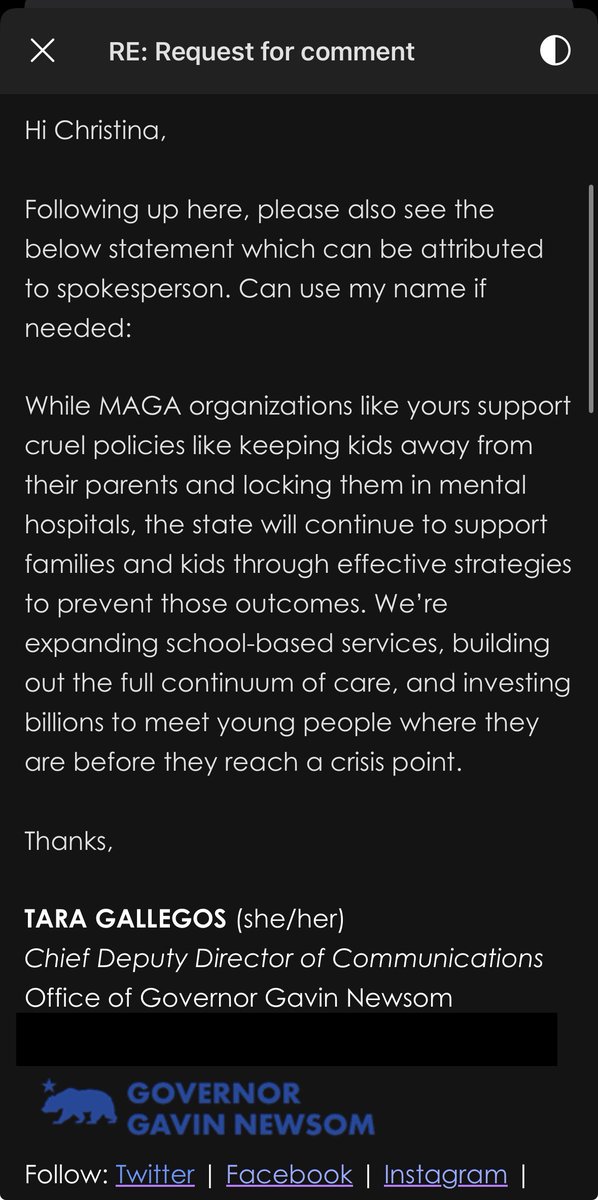

The latest misleading effort by a MAGA-aligned institute masquerading as a news outlet is citing their OWN REPORT as the basis for this “news” … a report that has not been peer-reviewed nor one that looks comprehensively at the program — for instance, this is not limited to just schools (something they claim).
FACT: It goes against research and best practices to wait until a child is in a severe crisis to intervene – and providing children with mental health tools helps prevent these crises.
FACT: Early intervention is only one piece of the state’s strategy. It is NOT the only strategy.
FACT: Most young people can and do receive care successfully in less restrictive settings based on their individual clinical needs.
FACT: Behavioral Health Continuum Infrastructure Program (BHCIP)-funded projects for youth are only ONE component of a much broader statewide transformation to address youth behavioral health needs.
FACT: The Children Youth Behavioral Health Initiative (CYBHI) supplements broader support through separate but coordinated efforts including Proposition 1, which is closing the decades-long gap in mental health services and treatment.
FACT: Proposition 1 is funding one of the most significant behavioral health infrastructure expansions California has ever undertaken.
FACT: Thanks to Prop 1, the state is building new treatment facilities, expanding crisis and residential care, and adding thousands of behavioral health beds and outpatient treatment slots across every region. Rounds 1 and 2 alone fund 177 projects across 333 facilities, adding 6,919 new beds and 27,561 outpatient slots, surpassing Proposition 1’s capacity goals.
FACT: Since 2021, BHCIP investments have supported 437 projects to expand 546 facilities, creating 9,553 new beds and more than 47,000 outpatient slots that will serve over 5.4 million Californians each year.
14
68
263
39,661

Apr 30
Sarkodie performing 'Odo Pa' featuring Kweku Flick'. (C) 2026. Sarkcess Music / Eagle Plug / PRTF
Stream/Download 'Odo Pa' - ditto.fm/odopa
#Sarkodie #KwekuFlick #OdoPa
Video directed by David Duncan
Keep streaming JAMZ on all stores: ziikimedia.lnk.to/jamz
3
243

Apr 25
no because it actually hits close to home..😭 i was at a prtf and i remember me and this girl used to purge together.. distinct memory of us splitting an icecream cone at the bathroom
16
1,215

The V-22 Osprey was born from lessons learned in 1980 during Operation Eagle Claw. Today, the Personnel Recovery Task Force (PRTF) at @CSOJTF_Central uses its speed and vertical landing to ensure distance is never a barrier to bring them home.
6
24
86
4,026

Apr 15
Budes nam nekde rozvijet to long prtf co delas pritelkyni ? :)
1
7
1,340

13/ Największy wpływ na wybór metody i konfigurację sił (light/medium/heavy PRTF).
Risk vs. Benefit / Risk vs. Gain — czy warto ryzykować dodatkowe siły i życie ratowników? Dowódcy ważą prawdopodobieństwo sukcesu przeciwko potencjalnej stracie („expenditure of scarce assets”).
1
1
21
644



Apr 5
Żadne europejskie państwo nie ma takich sił w pełni samodzielnie (no może Francja). Jesteśmy w sojuszu i w razie potrzeby zapewne mieszany PRTF byłby ustanowiony.
7
123