
For Plotinus and his successors, likeness never implied identity, nor participation equivalence. The soul ascends through contemplation, virtue, purification, and intellectual illumination, participating ever more deeply in truth, justice, beauty, and intelligible order.
1
15
225

ज़रूरत नहीं रहेगी।
जो खुद से सच है — वो हमेशा सुंदर है। बाकी सब performance है।
#Plotinus #Philosophy #Beauty #Hinglish #IndianPhilosophy #SelfAwareness
1
Plotinus ने The Enneads में कहा —
Being is desirable because it is identical with Beauty, and Beauty is loved because it is Being.
यानि-होना और सुंदर होना — दो अलग चीज़ें नहीं हैं।
जो सच में खुद है,वो सुंदर है।
जो खुद को छोड़कर कुछ और बनने की कोशिश करता है,
वो ugly होता जाता है।
1

Plato and Aristotle do not touch on Gnosticism. I thought Plato might, but that was a misremembering. Plotinus is the man who published the text against Gnosticism. That's where you find the "daemons of the upper air."
2
3

Oh yeah I noticed, the Platonic Academy slowly arose within the Catholic World and the Catholics are the ones who translated Plotinus and Proclus into Latin
9

"You can only apprehend the Infinite by a faculty that is superior to reason."
Plotinus
#quote
.
#mondayvibes
1
24

Plotinus
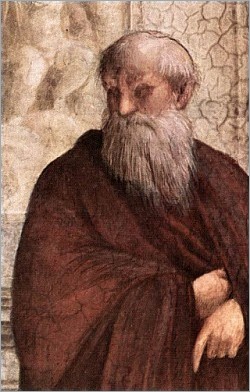
Plotinus (c. 204–270 CE) was an ancient Egyptian-born philosopher who is widely regarded as the foundational figure of Neoplatonism. Operating in Rome during the chaotic 3rd century, he integrated Hellenic rationalism with deep mystical experience. He didn't view his philosophy as a new invention; rather, he considered himself a loyal interpreter and developer of Plato's works. His teachings were posthumously compiled by his primary student, Porphyry, into 54 treatises collectively known as The Enneads (derived from the Greek word for "nine," as the essays were organized into six groups of nine).
The Three Fundamental Principles (The Hypostases):
Plotinus mapped a spiritual cosmology based on a hierarchical framework of reality. He argued that all existence is not created out of nothing (creatio ex nihilo), but rather flows out or emanates from three increasingly perfect divine realities:
The One (The Good): The supreme, absolute pinnacle of reality. It is entirely unified, boundless, and transcends all being, thought, or language. Because it is perfect, it overflows with creative energy, much like water flowing from an infinite spring or light radiating from the sun.
The Intellect (Divine Mind / Nous): The first emanation from the One. The Intellect is the realm of pure thought and contains all of Plato's eternal Forms and ideas. Unlike the pure unity of the One, the Intellect introduces duality because it is a mind that looks back to contemplate its source.
The Soul (Psyche): The emanation from the Intellect, acting as the bridge between the spiritual realm and the physical universe. The Soul is split into two layers: a higher soul that remains anchored in eternal contemplation, and a lower soul that generates, animates, and structures the material world.
Spiritual Anatomy and the Human Goal
For Plotinus, human beings are microcosms of this entire cosmic architecture. He taught that your true identity is your higher soul, which remains permanently unified with the Divine Intellect, even while your lower soul inhabits a physical body.
The Problem: Human suffering and moral failings ("evil") occur when the soul looks downward, becoming overly attached to the physical body and the chaotic, limited nature of matter.
The Goal: Life is a journey of spiritual ascent. Through rigorous intellectual contemplation, the cultivation of virtues, and the appreciation of beauty, you awaken to your true spiritual nature.
The Mystical Union: The ultimate peak of Plotinus's philosophy is an ecstatic, mystical experience of merging entirely back into the One. Plotinus reportedly achieved this unitive state several times throughout his life. His final recorded words neatly summarize his life's philosophy: "Try to bring back the divine in you to the divine in the All."
Historical Influence
Though he was a pagan philosopher, Plotinus's metaphysical framework profoundly shaped major theological developments within monotheistic religions. His concepts of emanation and the soul directly influenced early Christian theologians like Saint Augustine, early Islamic metaphysicians, and Jewish Kabbalistic mysticism.
37

Never. And don’t try me with the Stoics. They’re just God moves in mysterious ways mongs. And no decent Romans except Plotinus. Pre-Socratics for the win, always. Mystics birthed Europe, not argumentative gadflies and autistic categorisers.
12

16h
"I don't have much more to say on Plotinus. His ethics is just what you'd imagine it to be.
By now you should be able to tell by the first three sentences of a philosopher's metaphysics what the rest of his philosophy is going to be, because we have passed the age of anything original.
The ultimate goal of life is to escape this earth, says Plotinus, to go back home to the true reality, to the spirit world."
Leonard Peikoff
Founders of Western Philosophy
1
28
16h
Plotinus was a leading philosopher of the school called "Neo-Platonism", which was the main transition between Plato and Christianity. Saint Augustine was heavily influenced by Plotinus and was vital in the shaping of Christianity".
As to his answer to the question: How do you know? How do you know God (the One)?
"To know the one, you must undergo a special process, which involves a long struggle, a long period of asceticism, a long period of self-discipline. You have to empty your mind at a certain point of all content, all images, all thoughts. All sense experiences, all emotions, all reason. You have to, in effect, jump outside your own narrow self and the whole physical world, and that's possible, he claims. If you do it successfully, you will suddenly lose all sense of your own individuality and of your reason, with all of its distinctions and multiplicity and logic and so on. You will suddenly merge directly with the one, and you will see what it is, which you can't communicate to anyone who hasn't had the experience. This state came to be called ecstasy, from the Greek word ekstasis, meaning outside of one's self.”
Leonard Peikoff, Founders of Western Philosophy.
1
1
63

When we look outside of that on which we depend we ignore our unity; looking outward we see many faces; look inward and all is one head. If a man could but be turned about, he would see at once God and himself and the All.
#Plotinus The Enneads
#Mindfulness #Wisdom
/
Cuando miramos fuera de aquello de lo que dependemos ignoramos nuestra unidad; mirando hacia afuera vemos muchas caras; mira hacia adentro y todo es una cabeza. Si un hombre pudiera volverse, vería a la vez a Dios, a sí mismo y al Todo.
#Plotino Las Enéadas
#AtenciónPlena #Sabiduría
/
Tous nous ne faisons qu'un. Mais nous méconnaissons cette unité parce que nous regardons vers l'extérieur, au lieu de tourner nos regards vers le point où nous sommes attachés. Nous sommes comme des visages tournés vers l'extérieur mais qui à l'intérieur dépendraient d'un sommet unique. Si l'on pouvait se retourner spontanément, on verrait en soi-même, notre part divine et la totalité de l'univers.
#Plotin Les Ennéades
#PleineConscience #Sagesse /
152
We may treat of the Soul as in the body — whether it be set above it or actually within it — since the association of the two constitutes the one thing called the living organism, the Animate. Now from this relation, from the Soul using the body as an instrument, it does not follow that the Soul must share the body's experiences: a man does not himself feel all the experiences of the tools with which he is working.
#Mindfulness #Wisdom #Plotinus /
1
85


There was no good reason for early Church leaders to assimilate Plato except to seal off the religion from the coherent metaphysics of Plato (and especially Plotinus). Christianity then became the state religion. Science has suffered ever since and Europe never stopped fighting.
10

I'm aware, I think Spinoza should've read Plotinus, he would've grounded his philosophy and epistemology a lot better
1
8

Jun 15
I'm a bit surprised to read that! Isn't Plotinus strongly committed to things the Grok account explicitly rejects: divine intellect, essences/forms, teleology, metaphysical hierarchy, and a spiritual return of the soul to its source? Seems completely different to me.
1
8
Kinda based in my opinion, though I hold to Plotinus' paradigm
1
1
6

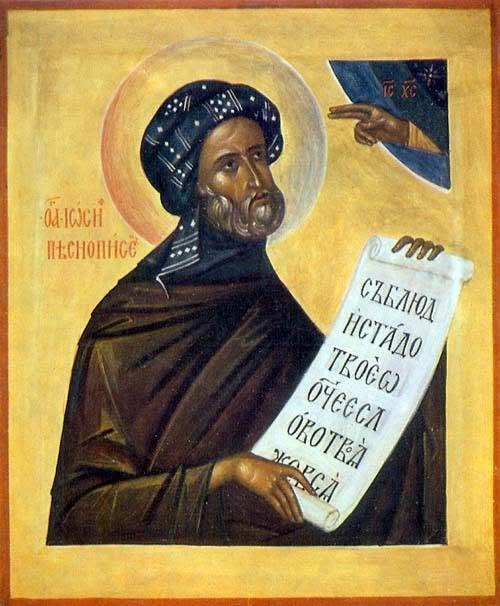
June 14 Saint Joseph the Hymnographer.
(810-886)
.
He was tireless servant of the Lord, glorifying Him in life, in works, and through writing countless hymns and canons to the saints. Despite a lifetime of struggle, suffering, and imprisonment, Saint Joseph produced a catalog of writings which remain today, as well as over 200 hymns, many of which are still sung by modern congregations. He has been called "the sweet-voiced nightingale of the Church." Through his legacy of writings and song, Saint Joseph preserved a priceless record of the history of our faith—a faith which continues, unchanged and unabated, today.
.
Joseph was born into a pious Christian family in Sicily. His parents, Plotinus and Agatha, in response to an invasion of Arabs, moved the family to Greece. There, at the young age of 15, Joseph entered the monastery at Thessolonica, and earned the love and respect of his community through industriousness, obedience, piety, humility, and scholastic aptitude.
.
During a routine visit to the monastery, Saint Gregory (then deacon) took notice of the young brother, and asked him to accompany him to the church in Constantinople—then suffering under the iconoclast persecution (see also Saint Theodosia of Constantinople). There, they lived near the Church of the Holy Martyrs, defending religious icons, preaching the Word of God, and ministering to the suffering Christian population. When it was decided that an emissary should be sent to Rome to have audience with Pope Leo III and inform him of the persecution under the Byzantine Emperor, Joseph was selected due to his obedience, wisdom, and gift of oration. He set off for Rome at once.
.
But life was not to be easy for Saint Joseph. On the way to Rome, he was taken captive by Arab bandits, brought to the island of Crete, and turned over to the Iconoclasts who locked him away in a dungeon. Never giving up hope and faith in the Lord, Joseph ministered to his fellow prisoners, keeping their spirits high, praying with them, and inspiring many to die martyr’s deaths for the faith.
.
Saint Joseph spent six years in prison, until the death of the Byzantine Emperor and the end of the iconoclast persecution. Prior to his release, he received a heavenly vision from Saint Nicholas of Myra, who provided him with a scroll upon which read: “Hasten, O Bountiful One and as Thou art merciful, hasten to come to our aid, for as Thou wilst, Thou canst…” Saint Joseph, after receiving instruction from Saint Nicholas, sang the words aloud, causing his chains to fall to the ground and the prison gates to be opened. He returned to Constantinople where he established a church in patronage to Saint Nicholas, and later a monastery.
.
Saint Joseph received the gift of the relics of Saint Bartholomew, which he placed in the church. He felt compelled to sing a hymn of praise to the saint, but no such suitable hymn existed, and he didn’t feel qualified or capable to write a canon for one so deserving. Saint Joseph prayed for 40 days, trying to discern the proper course of action, upon when Saint Bartholomew appeared to him. He said, “May the Right Hand of Almighty God bless thee, may Heavenly Wisdom pour out upon thy tongue, may thy heart be a temple of the Holy Spirit, and may thy hymnody sweeten the universe.” Following the apparition, Joseph wrote the canon to Saint Bartholomew, and from then on began to compose liturgical hymns in honor of Jesus, the Heavenly Father, the Mother of God, and the Saints.
.
One of those hymns, Stars of the Morning, follows:
.
Stars of the morning, so gloriously bright,
Filled with celestial splendor and light,
These that, where night never followeth day,
Raise the “Thrice Holy” song ever and aye.
.
These are Thy ministers, these dost Thou own,
God of Sabaoth, the nearest Thy throne;
These are Thy messengers, These dost Thou send,
Help of the helpless ones! man to defend.
.
“Who like the Lord?” thunders Michael the chief;
Raphael, “the cure of God,” comforteth grief;
And, as at Nazareth, prophet of peace,
Gabriel, “the light of God,” bringeth release.
.
Then, when the earth was first poised in mid space,
Then, when the planets first sped on their race,
Then, when were ended the six days’ employ,
Then all the sons of God shouted for joy.
.
Still let them succor us; still let them fight,
Lord of angelic hosts, battling for right;
Till, where their anthems they ceaselessly pour,
We with the angels may bow and adore.
.
Upon the resurgence of iconoclasm, Saint Joseph was exiled for eleven years, but was subsequently returned to his position in Constantinople, and eventually made Bishop of Salonica. He continued to write Canons and hymns, many of which survive. After attaining advanced age for that time, Saint Joseph fell ill. Prior to his death, he received a vision from the Lord, telling of his approaching journey to Heaven. Saint Joseph set his affairs in order, and spent the remainder of his days in quiet prayer. He received Holy Eucharist, blessed those from the community who were present, and joyfully gave his life to the Lord. Saint Theodore, later appearing to an impatient friend of Saint Joseph stated, "Why do you become angry O man? Joseph the Hymnographer's soul was being separated from his body and we were with him. When he died this night, all of us whom he glorified in hymns, translated his soul to the heavens and placed it before the Face of God. That is why I was tardy in not appearing to you."
.
Saint Joseph is credited with 200 hymns and canons, although some place the number he wrote at more than one thousand. Throughout his life, he preached the Word of God—through his writings, through Canons to the Saint, through opposition to persecution, and through joyful song. Encouraged by his visions of saints, Saint Joseph the Hymnographer raised his voice in praise of Our Lord, even when he faced violent opposition, imprisonment, and exile. How often can we say the same of ourselves?
.
Let Us Now Our Voices Raise (written by Saint Joseph, the Hymnographer)
.
Let us now our voices raise,
Wake the day with gladness;
God Himself to joy and praise
Turns our human sadness;
Joy that martyrs won their crown,
Opened heav’ns bright portal,
When they laid the mortal down
For the life immortal.
.
Never flinched they from the flame,
From the torment never;
Vain the tyrant’s sharpest aim,
Vain each fierce endeavor:
For by faith they saw the land
Decked in all its glory,
Where triumphant now they stand
With the victor’s story.
.
Up and follow, Christian men!
Press through toil and sorrow;
Spurn the night of fear, and then,
O the glorious morrow!
Who will venture on the strife;
Who will first begin it?
Who will grasp the land of life?
Warriors, up and win it!
.
Eternal Father, I wish to honor St. Joseph the Hymnographer, and I give Thee thanks for all the graces Thou hast bestowed upon him. I ask Thee to please increase grace in my soul through the merits of this saint, and I commit the end of my life to him by this special prayer, so that by virtue of Thy goodness and promise, St. Joseph the Hymnographer might be my advocate and provide whatever is needed at that hour. Amen.
1
11
127
That I don't know, I hope Valentinians because I don't like sethian as much, Plotinus destroyed the sethians so hard that his rivals (The Christians) preserved his work.
1
1
19