
8 Aug 2024
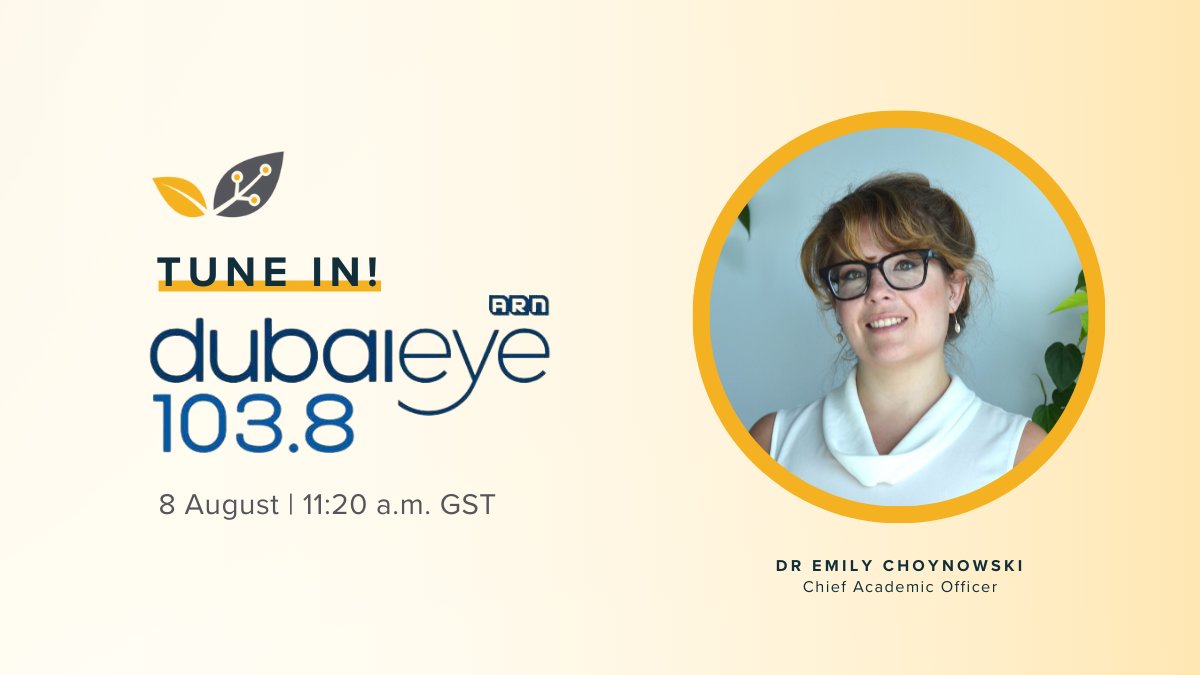
Our Chief Academic Officer, @EPatersonMorgan, will be sharing her insights about #PredatoryConferences on @DubaiEye1038FM today at 11:20 a.m. GST!
Tune in to hear from an expert in the #AcademicPublishing industry.
#AcademicTwitter #AMoreKnowledgeableWorld
108

20 Jul 2024
How big a problem are #PredatoryConferences in cryptology? nature.com/articles/d41586-0…
3
210

27 Jun 2024
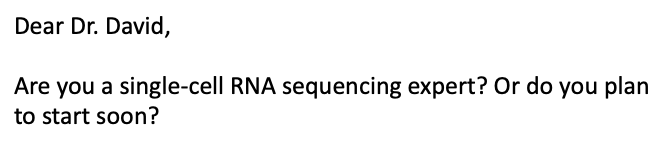
Not sure what gave you that idea as I can barely distinguish RNA from DNA without counting strands.
#PredatoryConferences
1
1
3
232

8 Apr 2024
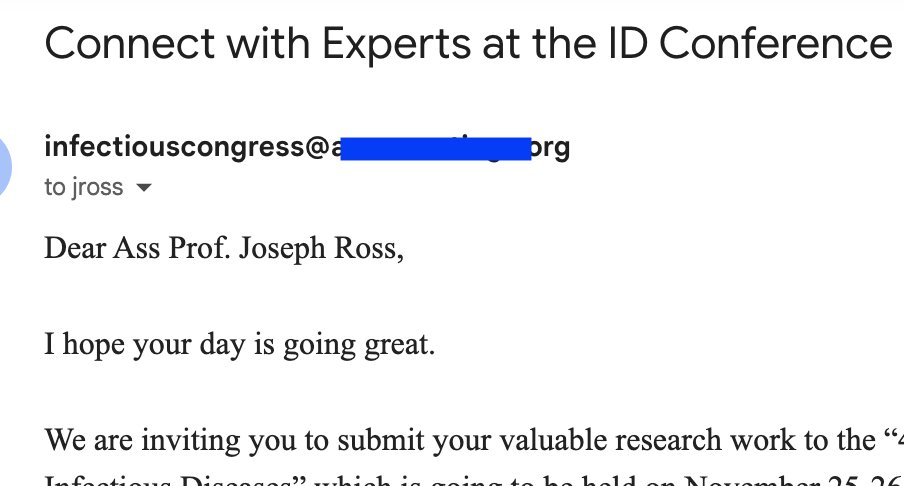
Just arrived in my inbox. No thanks: I prefer not to attend your Infectious Congress (ew?) #predatoryconferences
1
1
545

20 Dec 2023
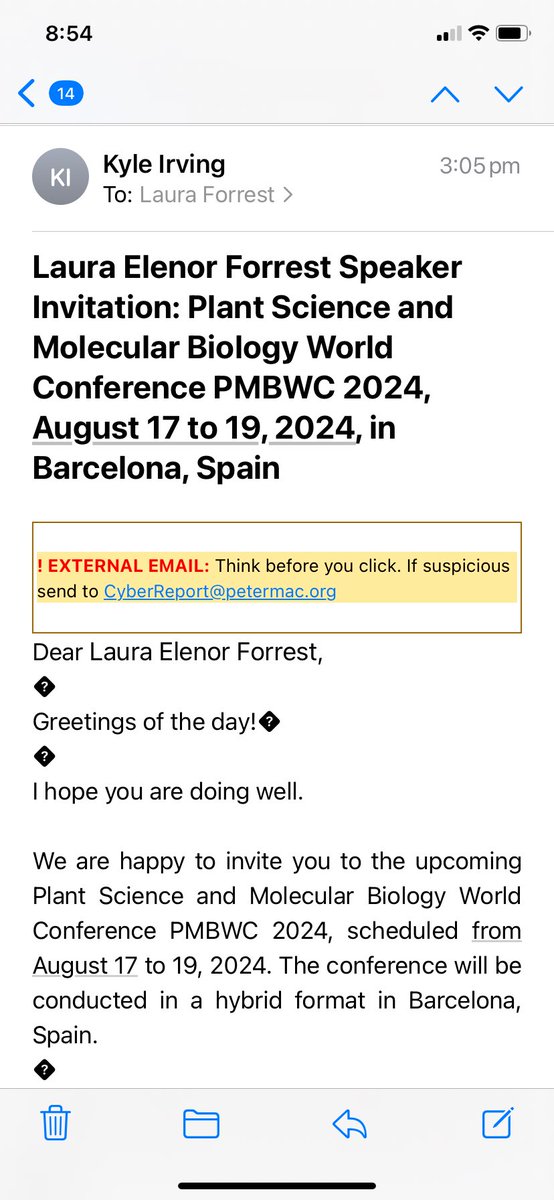
A laughable “greetings of the day” email…
It’s fair to say that 🪴 plant 🌱 science is not my forte.
My closest appreciation of plant sciences are liquids distilled from juniper berries and fermented 🍇
#predatoryconferences
@AcademicChatter
publicationethics.org/predat…
4
222

30 Jul 2023
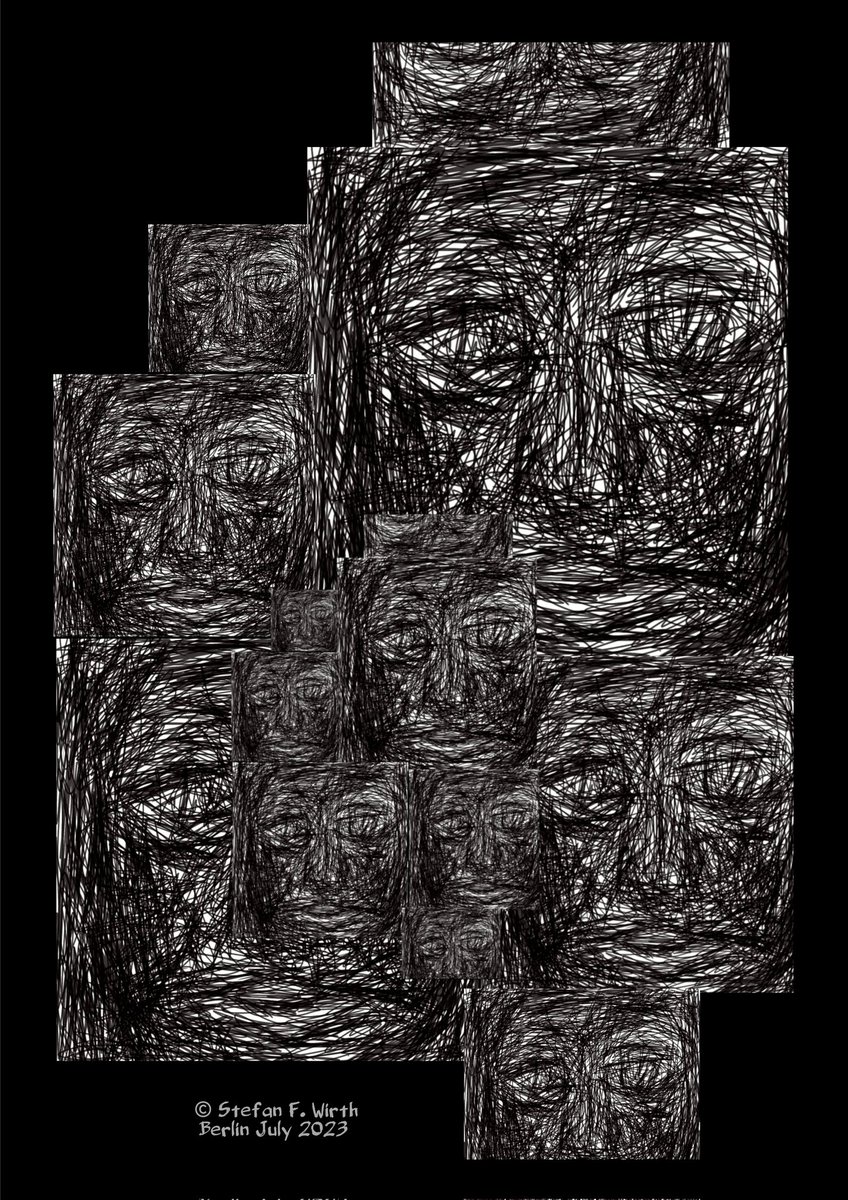
This is how I imagine the face of such #organizations, which serious scientists call #predatory. They organize #conferences or #publish scientific papers, but not with the aim of supporting research, but to enrich themselves economically with #malicious intentions. Beware of #predatoryconferences and publishers!
I want to focus on predatory conferences. It is often said that younger scientists tend to fall victim to dubious scientific conferences because they are more dependent on attracting the scientific world's attention. But even #experienced #scientists may not have any suspicions at first, or at least no serious #suspicions.
For example, I was recently invited to a conference that one can #attend in person or virtually and that was thematically related to an area in which I had already presented my research in a serious environment before. The conference website exists, photos from previous conferences are presented, the conference committee has a good reputation in some cases. The list of recent participants is long and made a good impression on me. The conference #fees were initially not visible. From experience, I pressed the "register" button, and indeed, then they appeared. Clearly unusual, if not #ultraexpensive.
However, the problem of the conference fees was easy and uncomplicated to solve. I pointed out that after all I had been explicitly invited via email and that I couldn't afford the fees. As a result, these were actually waived, possibly because a German name on the list of participants was considered effective in #advertising.
However, the required abstract was bound to a specific form, which, in addition to the actual summary, also required answers to questions about the significance of my #scientificwork. And it was these questions that puzzled me, as they made little sense, and seemed intentionally general enough to fit any congress, whatever the theme. I then researched information about the responsible organization. It turned out that their #headquarters are not in the USA, as claimed, but in #India and were described as predatory on several websites. I was also able to find out that the September conference was being held at the same location at the same time as several other conferences led by the same organization. Very #typicalfeatures of a predatory conference as I learned via research. I immediately canceled my participation.
I knew that there were obviously dubious invitations to conferences. I've always called conferences like this fake. But I didn't know that there were also variants that gave the impression of writing to me individually and then responding to queries in an apparently serious manner. Apparently my contact address was taken from information from a conference I attended a year ago and then brazenly used for a predatory conference of similar content. I have now learned the term "predatory" for conferences and publishers and would like to #warn against such machinations. By the way, I also learned through research that there are predatory conferences that don't actually take place at all, but there are also those that do take place, but with #poororganization and a small number of participants. Apparently I was dealing with the latter version.
There is a general mentality here within natural sciences that stipulates that scientists have to do many activities for free, for example #reviewing or publishing, often also holding university lectures, or even have to pay extra: moderate conference fees are always required, journals can also charge fees if the author wants colored illustrations or open access, for example. If an independent publishing researcher is not affiliated with any official research institution, wants to read a paper that was not published in open access and he can't afford to subscribe a journal, he has to pay for it individually, sometimes to a considerable extent. This at all mentality opens the door to greedy scammers.
© #StefanFWirth Berlin 2023
1
6
78
801

25 Jul 2023
Costly invite? Scientists hit with massive bills after speaking at COVID-19 ‘webinars’ | Science | AAAS #PredatoryConferences #Ethics science.org/content/article/…
1
6
5
1,413

27 Apr 2023
Después de los #PredatoryJournals y #PredatoryConferences, han llegado los…
#PredatoryPodcasts!!
Hilo 👇
3
21
53
15,232

28 Mar 2023
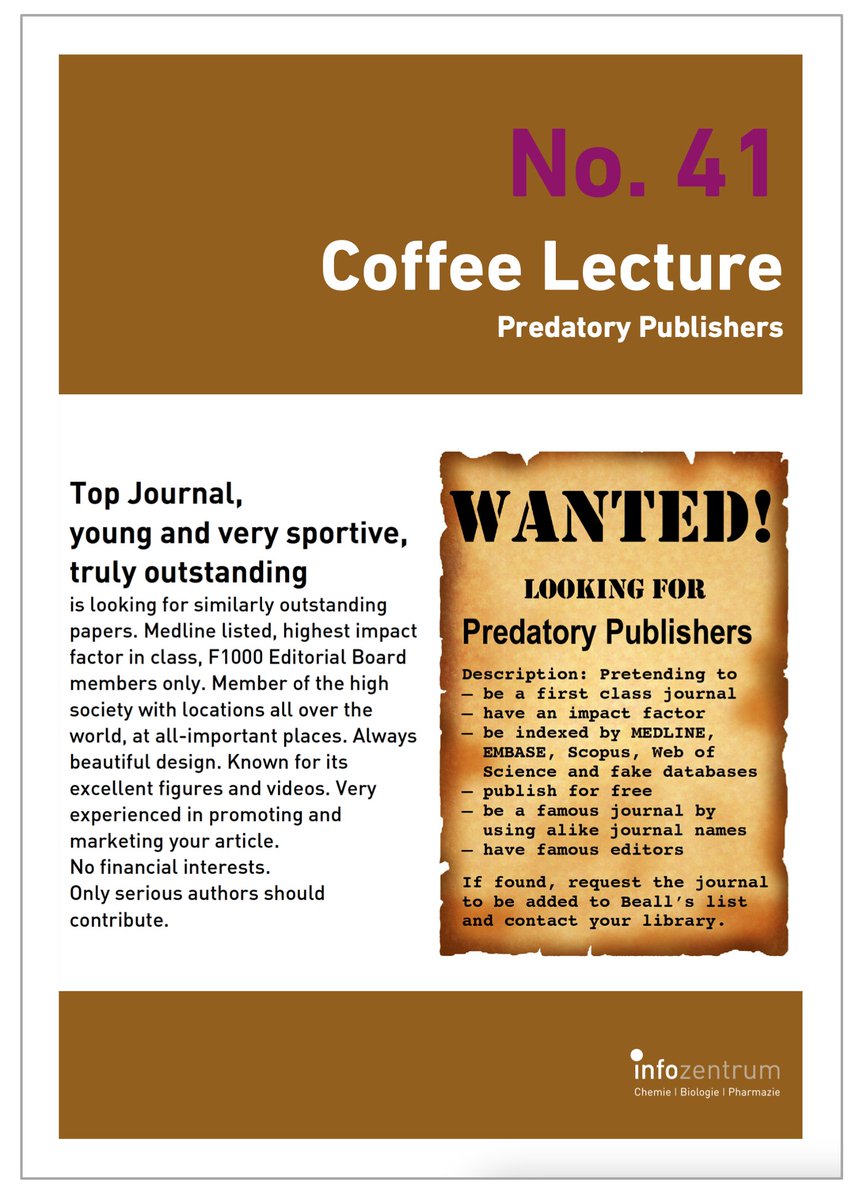
#Predatoryconferences and #predatoryjournals organizers spam mailboxes with invitations while providing limited services. Get to know more through #CoffeeLecture No. 41 tomorrow, March 29, 2023, 13:00, via Zoom ethz.zoom.us/j/63020946312 or HCI G2 by @OLRENN. Guests welcome.
2
5
1,078

14 Mar 2023
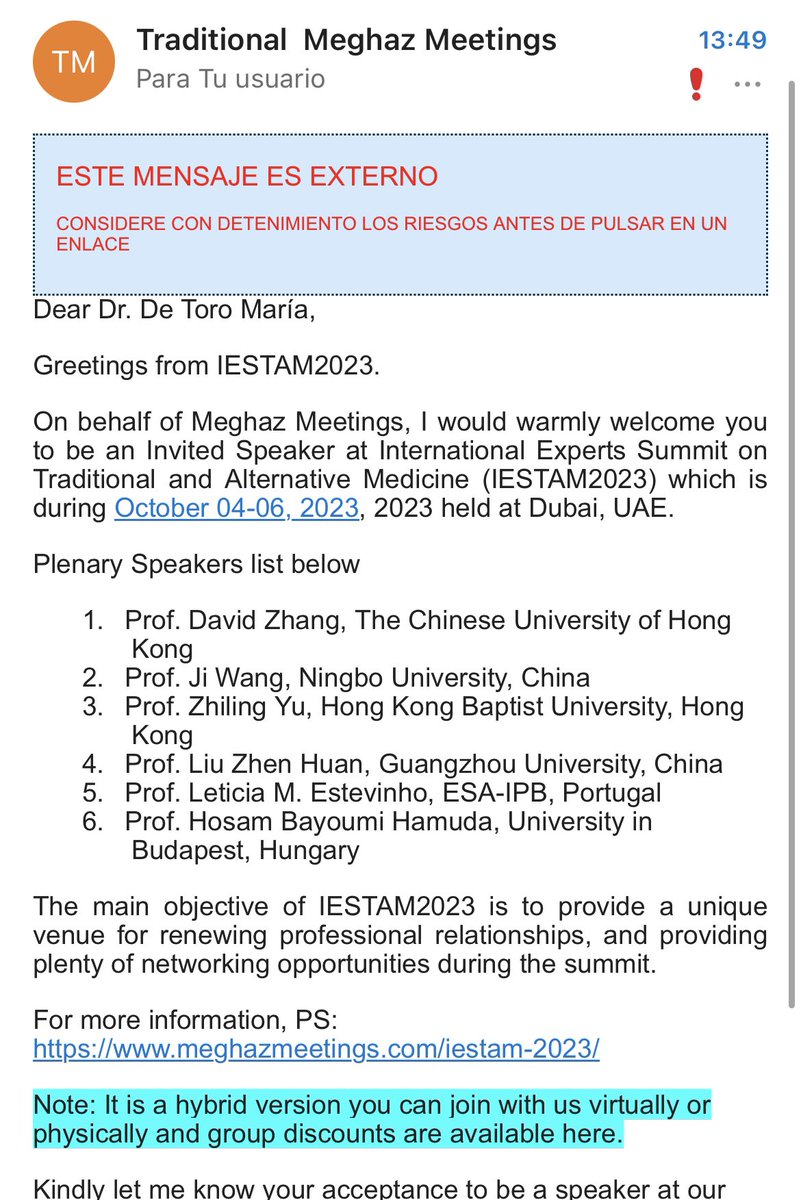
No es que yo sea muy de medicina tradicional y alternativa… no me suena muy a lo mío, pero es en Dubái 🤔 #predatoryConferences
2
3
1,276

Für #PredatoryConferences haben wir mal einen Aufschlag für "halbwegs objektive Kriterien" gemacht. Ist natürlich nicht 1 zu 1 auf #predatoryJournals übertragbar.
blogs.tib.eu/wp/tib/2022/11/…
1
We have published a blog article describing our assessment workflow that we employ in order to stay clear of #PredatoryConferences 🐺🛑🐺.
blogs.tib.eu/wp/tib/2022/11/…
5
7


17 Jun 2022
Понад 80% респондентів вважають, що хижацькі практики вже є серйозною проблемою в їхній країні, і є великий ризик того, що ці практики підірвуть всю дослідницьку систему, якщо з ними не боротися doi.org/10.1002/leap.1458 #predatoryjournals #predatoryconferences @LearnedPublish
1
4

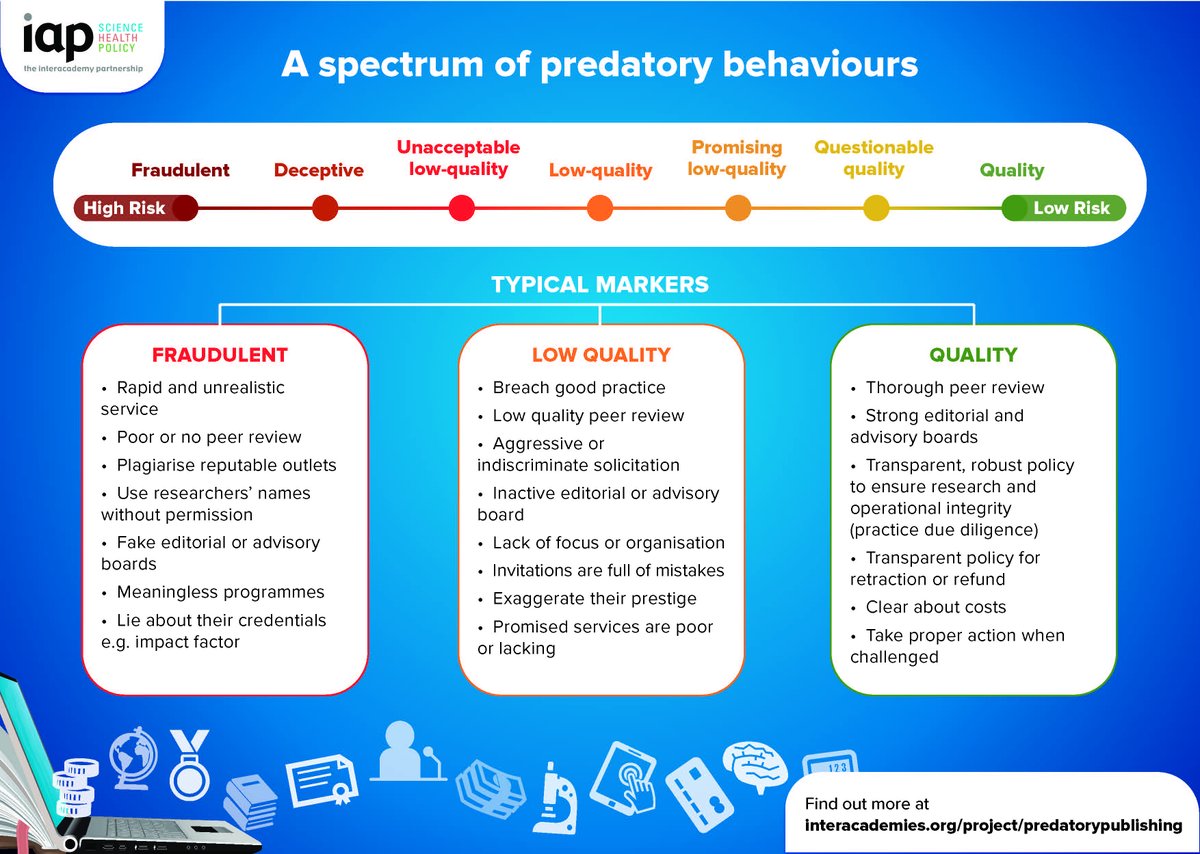
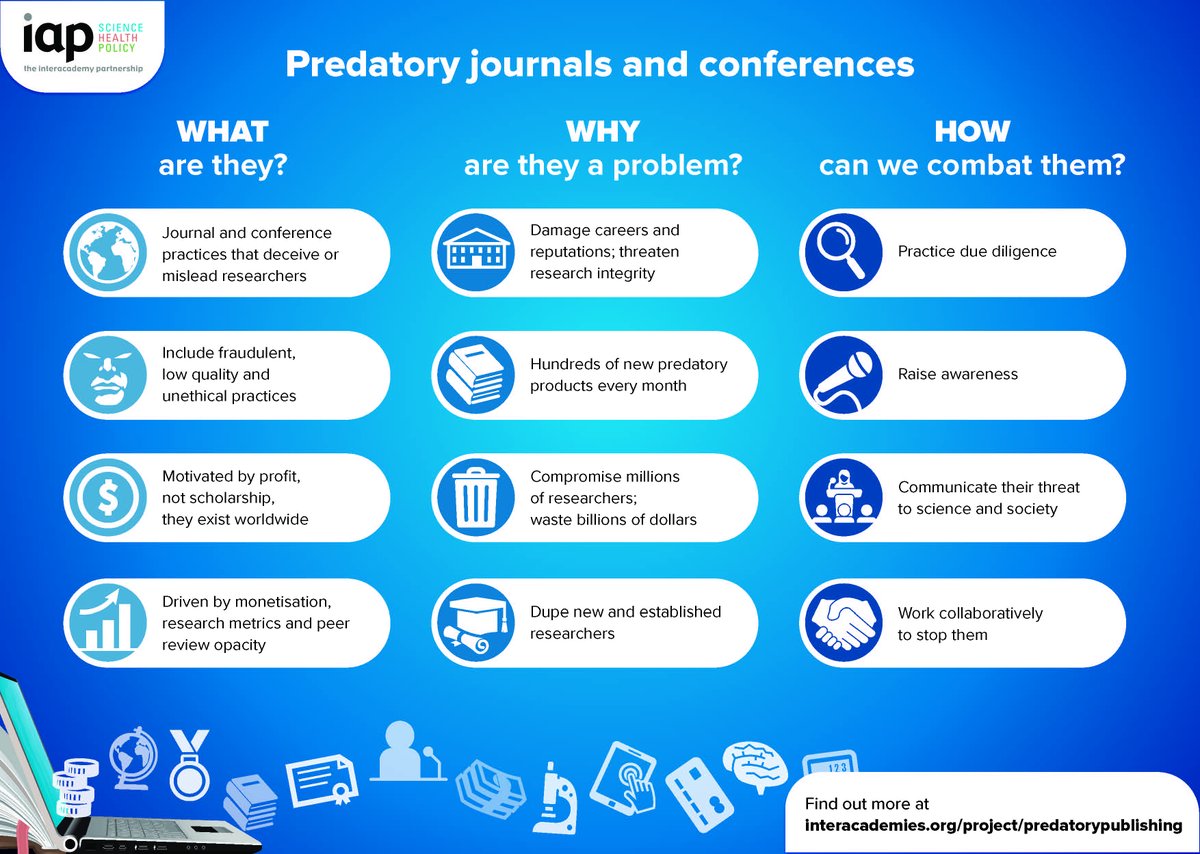
Still have some questions about #predatoryjournals and #predatoryconferences? Find the answers in the new FAQs tinyurl.com/predpracticesfaq, with more detail in the IAP report at tinyurl.com/predatoryreport!
3
5

29 Apr 2022
Whenever I receive an invitation to a conference, I check their registration fees. If the registration fees are different for oral presentation, poster presentation, participation etc. I spam the sender.
Maybe I am wrong but I see this in #PredatoryConferences too often.
4

25 Apr 2022
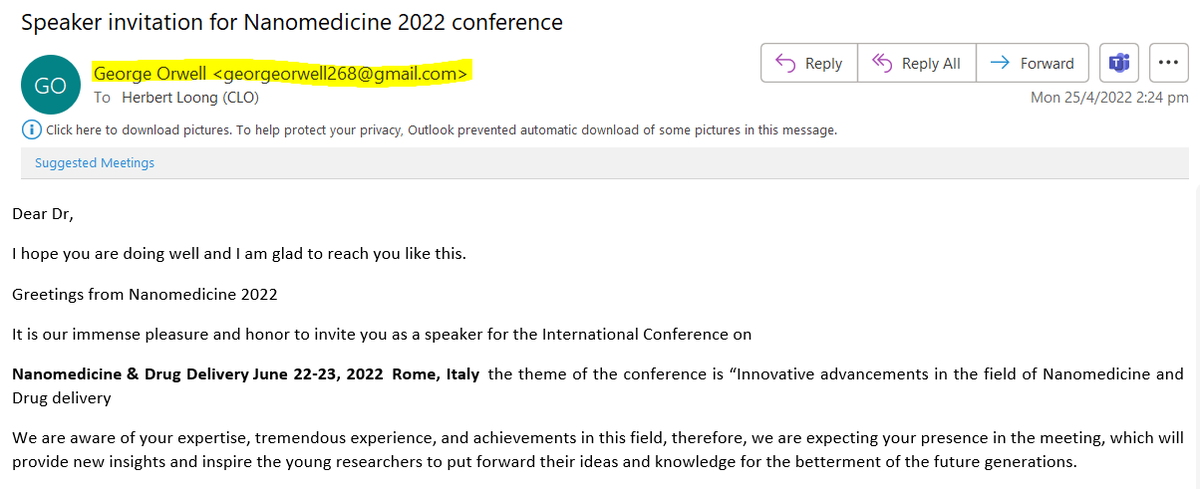
I don't know how I should feel when #GeorgeOrwell comes back from his grave and asks me to contribute to his upcoming #utopian conference. I don't recall any mention of #nanomedicine in #1984, but maybe it's time to read the classic again! 🤣#predatoryconferences #spam
9

6 Apr 2022
From the archive: Think. Check. Attend. Your guide to avoiding predatory conferences
#PhDchat #PredatoryConferences wp.me/p4m9em-90v
2

21 Mar 2022
How can we combat predatory publishing? For example, see p. 11 for a broad guidance for researchers. One of the working group members behind the report is Stefan Eriksson from @UU_University #PeerReview #predatorypublishing #predatoryjournals #predatoryconferences

🔵World academies call for concerted action to combat predatory journals and conferences: read the new @IAPartnership report
➡️interacademies.org/project/p…

3
5

19 Mar 2022
#TWASPartners - #ICYMI: Our colleagues at @IAPartnership have produced an impressive new report on fighting #PredatoryJournals and #PredatoryConferences in science. Download the full report at the link. Summaries available in seven languages! interacademies.org/project/p…
🔵World academies call for concerted action to combat predatory journals and conferences: read the new @IAPartnership report
➡️interacademies.org/project/p…
1
4