
How do creators manage #recurring #memberships? They use @SubscriptionFL to automate billing, recover failed payments, and track MRR. No manual chaos.
DEMO → bit.ly/4flKHvT
#AutomateBilling #CreatorTools #PredictableRevenue
#SaaS

57

#AHORA "Arquitectura de revenue: el sistema detrás del crecimiento B2B predecible"
Alelí Sánchez Méndez
(México)
CEO & Founder, CasandraSoft
#RevenueOperations #B2BGrowth #PredictableRevenue
1
46

Jun 1
The biggest problem in modern marketing isn't bad marketers.
It's that most organizations have fundamentally misunderstood what marketing was supposed to do.
Marketing was never supposed to be a lead factory.
It was supposed to be creative department from live captured market intelligence.
Somewhere along the way, marketing became trapped inside a measurement framework that rewarded activity over commercial viability.
MQLs.
Downloads.
Registrations.
Form fills.
Clicks.
Traffic.
And because human beings naturally optimize for the metrics they're measured against, marketing teams did exactly what organizations asked them to do.
Generate more leads.
The problem is that revenue doesn't come from leads.
Revenue comes from commercial alignment.
This is where one of the biggest fractures in modern go to market strategy emerged.
Marketing
"We generated 5,000 leads."
Sales
"None of them were ready to buy."
Marketing
"We hit our target."
Sales
"We missed ours."
And the cycle repeats.
Not because either team is incompetent.
But because they are operating inside different systems of measurement.
One is rewarded for creating activity.
The other is rewarded for creating revenue.
That is not a performance problem.
That is an architectural problem.
The irony is that most marketers already know this.
Most marketing leaders don't want to spend their budgets chasing contact details for the sake of contact details.
They want to
build category authority
shape buyer perception
create market preference
establish trust
generate demand
influence future buying decisions
They want the market to remember the brand at the exact moment the buyer enters a change event.
#GTMLeadership #closedcircuitselling #PredictableRevenue #ChiefRevenueOfficer #NewYork #London #LosAngeles #Sydney #coudounaris #manderovic #Melbourne #salestips
1
1
15
May 22
MQL Factory is DEAD..
Behind that is, one of the most hidden problems in GTM, fragmented incentives producing fragmented behaviours.
And over time, those fragmented behaviors slowly fracture the commercial system itself.
This is why so many organizations today feel operationally exhausted despite having
more software
more data
more dashboards
more specialists
more automation
and more reporting
than ever before.
Because the underlying architecture is disconnected.
Take one of the clearest examples:
Marketing hits MQL targets.
Sales hits activity targets.
CS hits retention targets.
RevOps hits reporting targets.
Finance hits forecast targets.
And yet somehow…
the business still struggles to create commercially efficient growth.
Why?
Because every department is optimizing locally while the customer experiences the organization systemically.
That is the fracture.
And the consequences become enormous.
Marketing teams, for example, are often forced into impossible situations.
If sales and marketing tightly align around a real addressable market…
…eventually the low hanging fruit compresses.
Which means marketing cannot infinitely produce cheap form fills from the exact same audience forever.
But because compensation structures are still tied to MQL production volume…
…marketing teams often get pushed into adjacent or lower-fit markets simply to maintain target velocity.
Not because it improves commercial viability.
But because the measurement system demands it.
Ironically, everyone inside the organization can still appear “successful” individually while the commercial system itself becomes less coherent.
Revenue problems are rarely isolated departmental performance problems.
They are usually system coherence problems.
And one of the deepest examples of this is how modern GTM misunderstands market validation itself.
Today, many organizations treat “market validation” as
a sample size
a split test
a founder assumption
a survey response
a pilot campaign
or a handful of hypothetical interviews
But true market validation was never supposed to be static.
It was supposed to be continuous.
Living.
Evergreen.
Longitudinal.
Systemized.
Because once you begin systematically cataloguing
who buyers currently use
what they like
what they dislike
operational frustrations
switching conditions
contract timing
organizational maturity
roadmap gaps
buying triggers
expansion potential
serviceability risks
and relationship pathways
…you stop operating on assumptions.
And start operating on live commercial intelligence.
That intelligence then becomes usable across the entire organization
marketing
sales
customer success
product
finance
operations
leadership
All synchronized around the same evolving market reality.
This is why Closed Circuit Selling™ is ultimately a first-principles solution.
Because CCS™ does not begin with:
funnels,
campaigns,
sequences,
MQLs,
or stage progression.
#GTMLeadership #closedcircuitselling #PredictableRevenue #ChiefRevenueOfficer #NewYork #London #LosAngeles #Sydney #coudounaris #manderovic #Melbourne #salestips
1
1
17
May 22
One of the dumbest thing about modern SaaS and venture backed GTM
Is entire organizations will abandon the modelling that got them there, once the check is written..
Funding arrives.. and instead of continuing to validate the market deeply…
…organizations fall back into
doing more dumb stuff faster.
More outbound. But abandoning the model that go them there??
More SDRs.
More ad spend.
More funnel pressure.
More tooling.
More pipeline optics.
More activity.
Some companies now operate with CAC payback periods approaching the entire lifecycle length of the customer itself.
Think about how insane that is structurally.
If your CAC payback period is
24 months…
30 months…
36 months…
…and the average customer lifecycle is roughly the same duration…
…you have effectively built a system where the customer pays back acquisition costs right before they churn.
That is not scalable growth.
That is delayed commercial fragility.
And yet many organizations continue scaling these systems aggressively because low interest rate environments normalized the idea that growth could temporarily outrun operational reality.
The result?
Entire GTM ecosystems became optimized around
velocity
optics
top line growth narratives
and funding momentum
Instead of
commercial efficiency
viability
serviceability
retention quality
expansion
referral compounding
and timing intelligence
This is where Closed Circuit Selling™ returns to first principles.
Because CCS™ fundamentally asks a very simple question:
Why scale inefficiency before validating the market properly?
Why hire:
more SDRs
more marketers
more CS headcount
more RevOps
more outbound tooling
…to support a structurally broken acquisition model?
Especially when the irony is doing things properly upfront is often dramatically cheaper long term.
That is the part many organizations miss.
They believe “market validation takes too long.” But without considering the operational inefficiency is far greater?
So they optimize for short term speed…
…while accidentally creating long term commercial drag.
This is why one of the deepest principles inside Closed Circuit Selling™ is
measure twice, cut once.
Because if you
validate the category correctly
understand timing properly
catalogue the market continuously
align serviceability early
build around customer conditions
and synchronize the revenue system end to end
…you often need
fewer people
less burn
lower acquisition pressure
fewer handoff failures
lower churn
and dramatically less organizational friction
Meanwhile
retention improves
expansion improves
referrals improve
customer trust compounds
and the commercial system becomes increasingly efficient over time
#GTMLeadership #closedcircuitselling #PredictableRevenue #ChiefRevenueOfficer #NewYork #London #LosAngeles #Sydney #coudounaris #manderovic #Melbourne #salestips
1
1
12
May 21
One of the biggest structural problems in modern GTM...
Most leadership teams today have never actually seen what fully integrated commercial architecture looks like.
They inherited fragmented systems.
And because fragmentation became normalized across SaaS, many leaders mistakenly believe the fractures are the operating model.
That matters more than people realize.
Because most modern sales methodologies are designed to optimize a moment inside the revenue journey.
Not the entire commercial ecosystem surrounding it.
Some are very good at
qualification
objection handling
discovery
negotiation
pipeline management
forecasting
outbound sequencing
But those systems largely operate after the commercial environment already exists.
What Closed Circuit Selling™ (CCS™) focuses on is something much earlier
The architecture that determines whether the opportunity becomes commercially viable in the first place.
That is a fundamentally different layer.
Because if your entire system is optimized only around the 3% actively ready to buy today…
…you are often unintentionally damaging relationships with the remaining 97% of the market.
And that creates downstream commercial consequences most organizations never properly account for.
When timing intelligence is missing
marketing gets reduced to lead generation volume
sales becomes activity compression
customer success becomes reactive retention
and leadership loses visibility into actual market conditions
So what happens?
The organization compensates structurally.
More lead-gen marketers.
More SDRs.
More outbound tooling.
More pipeline pressure.
More reactivation campaigns.
More customer success headcount trying to repair trust and churn downstream.
Why?
Because the system is leaking intelligence at every stage.
This is one of the central first principles insights inside Closed Circuit Selling™
Revenue inefficiency is often not a performance problem.
It is an architectural coherence problem.
Historically, mature commercial systems had connective layers that modern SaaS quietly removed.
There used to be operational bridges between
acquisition
implementation
delivery
expansion
and long-term account viability
For example
Between the AE and the CSM there was often a structured commercial transition layer:
communication plans
serviceability planning
operational expectation mapping
expansion alignment
stakeholder continuity
delivery feasibility review
Ensure the customer could not only buy successfully…
…but become commercially viable long term for both parties.
#GTMLeadership #closedcircuitselling #PredictableRevenue #ChiefRevenueOfficer #NewYork #London #LosAngeles #Sydney #coudounaris #manderovic #Melbourne #salestips
3
1
17

May 2
If you want to build a predictable revenue generating machine build an authoritative brand.
#AuthoritativeBrand #BrandAuthority #PersonalBranding #PredictableRevenue #BuildYourBrand #DigitalMarketing #EntrepreneurMindset #BrandStrategy #OnlineBusiness #ContentMarketing
4

Apr 23
Did you know?
Implemento.ai provides a predictable pipeline with AI-powered lead generation and outreach. Get qualified meetings, consistently. #BusinessGrowth #PredictableRevenue #Consulting
73

How do we find high-intent buyers? We build a filter. Our qualification flows ask hard questions: credit and urgency: before they ever book. You're paying for a vetted pipeline, not just traffic. No pass, no time. #LeadQualification #SMG #PredictableRevenue

9

Predictable pipeline is not a myth. It’s the natural output of a well-governed revenue system.
If your pipeline is unpredictable, it’s because your system is unpredictable.
#PredictableRevenue #SalesForecasting #RevOps
10

Mar 24
Predictable recurring revenue improves valuation multiples by up to 1.5x compared to volatile revenue spikes. Investors favor stability.
#PredictableRevenue #iGaming
1
7

Mar 19
Want predictable revenue and stronger community ties? See how nonprofit newsletter sponsorships benefit your org and local businesses. ow.ly/Gv2G50Yn2Vq
#NonprofitMarketing #NewsletterSponsorship #CommunityEngagement #PredictableRevenue
85
AI isn’t for writing better emails.
It’s for exposing where your deals are dying.
If time-in-stage is drifting, your system is leaking.
Use AI to diagnose friction — not just automate noise.
Velocity beats volume.
#SystemsOverHustle #SalesAI #PredictableRevenue #BusinessSystems

8
AI isn’t for writing better emails.
It’s for exposing where your deals are dying.
If time-in-stage is drifting, your system is leaking.
Use AI to diagnose friction — not just automate noise.
Velocity beats volume.
#SystemsOverHustle #SalesAI #PredictableRevenue #BusinessSystems

9
Most digital marketing campaigns don’t fail because of creatives.
They fail because there’s no revenue architecture behind them.
rsunbeatsoftware.com/why-dig…
#MarketingROI #GrowthSystems #PredictableRevenue #AIinBusiness
1
3

Celebration is the outcome.
Performance is the system behind it.
We build marketing engines for measurable, scalable growth.
Serious about compounding revenue?
rapidroardigital.com
#PerformanceMarketing #GrowthStrategy #PredictableRevenue #RapidRoarDigital
29
AI isn’t for writing better emails.
It’s for exposing where your deals are dying.
If time-in-stage is drifting, your system is leaking.
Use AI to diagnose friction — not just automate noise.
Velocity beats volume.
#SystemsOverHustle #SalesAI #PredictableRevenue #BusinessSystems

16

Feb 27
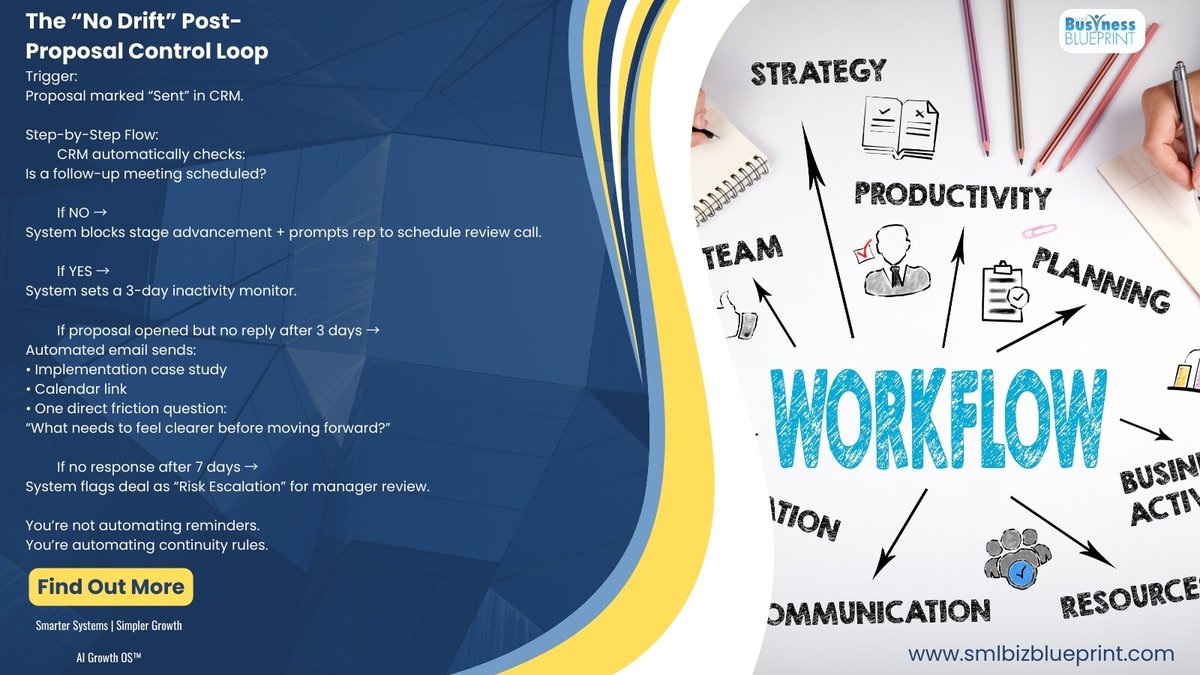
Most deals don’t die.
They drift.
Install a “No Proposal Without Next Step” automation rule.
Silence should trigger structure — not hope.
Systems over hustle.
#SalesAutomation #PredictableRevenue #CRMSystems #SystemsOverHustle #B2BGrowth
12

Feb 27
Revenue up. Revenue down.
It’s rarely the market.
It’s broken revenue architecture.
If growth depends on spikes, volatility is built in.
Is your revenue designed or reactive?
rsunbeatsoftware.com/revenue…
#PredictableRevenue #BusinessSystems #SaaSGrowth #StartupScaling
1
4
Feb 26
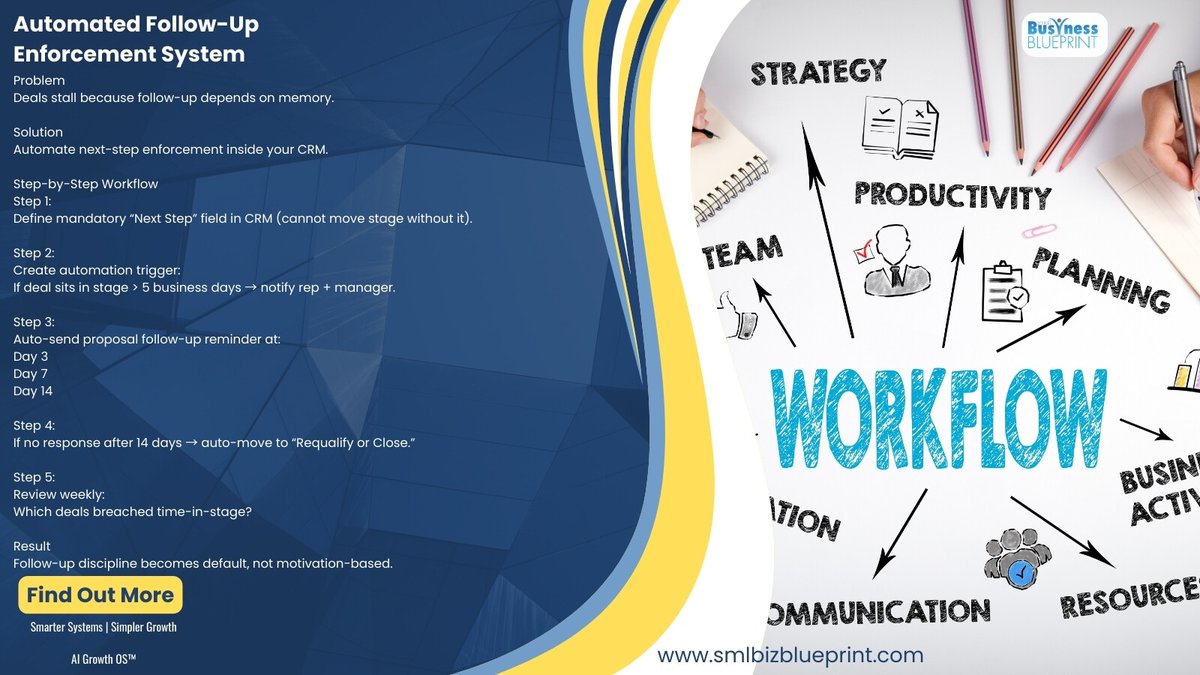
If follow-up depends on memory, you don’t have a system.
You have hope.
Automate next steps. Enforce time-in-stage.
Progression should be default — not effort.
#SystemsOverHustle #SalesProcess #PredictableRevenue #BusinessSystems
1