
May 5
What can probabilistic computing do for the formidable memory wall in AI inference?
In our recently accepted #ICML2026 paper, on the arXiv tonight, we develop a series of stochastic algorithms showing that much of the memory movement behind every token we generate is, in a precise sense, redundant.
We call our method SANTA: Stochastic Additive No-mulT Attention. SANTA sparsifies value-cache access by sampling a small set of indices from the post-softmax distribution and aggregating only those value rows.
Multiply-accumulates become gather-and-add. We measure end-to-end speedups over optimized kernels on present day GPUs, however, most of the advantage lies in developing the right Stochastic Processing Units to do the job.
We also introduce Bernoulli qK^T sampling to sparsify the score stage using stochastic ternary queries. Both techniques are orthogonal to ternary quantization, low-rank projections, and KV-cache compression.
The bigger picture: these algorithms point toward sparse, multiplier-free inference, exactly the regime where probabilistic, near-memory, and in-memory compute hardware can deliver order-of-magnitude energy gains over general-purpose GPUs.
Big congrats to lead author, our superstar NSF Fellow Kyle Lee and the team: Corentin Delacour, Kevin Callahan-Coray, Kyle Jiang, Can Yaras, @SametOymac Oymak, @Tathagata02
#ICML2026 #ProbabilisticComputing #AIInference #LLM #MachineLearning #UCSB
2
3
12
2,021

24 Jul 2025
Beyond Classical & Quantum: The Rise of Probabilistic Computing
.@alex and @extropic CEO Gill Verdon examine the fascinating middle ground between today’s deterministic computers and tomorrow’s quantum machines—known as “probabilistic computing.”
Deterministic = 0s and 1s, strict states, zero uncertainty
Quantum = superpositions, noise-sensitive, ultra-complex
Probabilistic = embraces natural electron “jitter” to shape uncertainty into useful machine learning algorithms
This means energy-based models—more data- and parameter-efficient AI with massive potential
Could probabilistic computing power the next AI leap?
#AI #MachineLearning #ProbabilisticComputing #EnergyBasedModels #DeepLearning #TWIST #Startups #FutureOfCompute
2
2
16
1,165

17 Apr 2024
Researchers have developed a probabilistic computer prototype that utilizes a complementary metal-oxide semiconductor circuit with a limited number of stochastic nanomagnets.
#ProbabilisticComputing #Spintronics #TohokuUniversity
bit.ly/4aA9oCt
2
8
697
27 Mar 2024
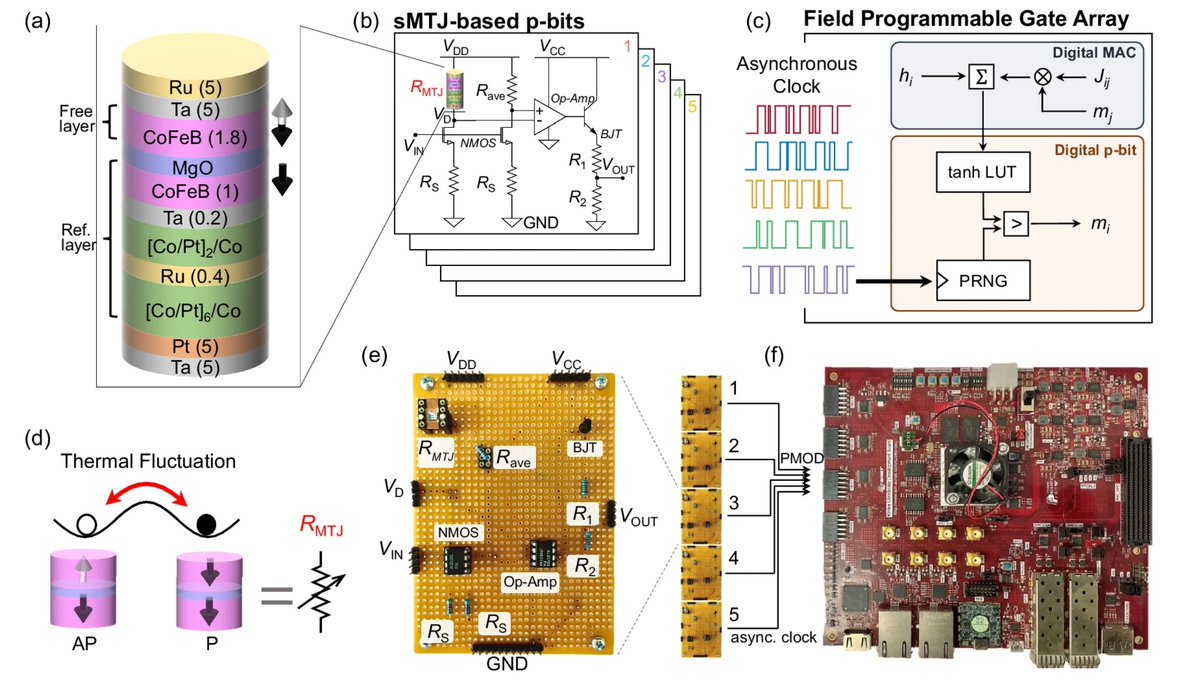
Happy to share our work on CMOS stochastic Magnetic Tunnel Junctions (sMTJ) for probabilistic inference & learning just published in Nature Communications (@NatureComms)
We show:
Creatively integrating stochastic MTJs with CMOS circuits can
(a) enhance the quality of randomness found in inexpensive and compact random number generators,
(b) perform energy-efficient inference and training for deep generative energy-based models in variation-tolerant asynchronous architectures,
(c) displace more than 10,000 digital transistors per building block.
This work was led by the talented Nihal Singh and in collaboration with Prof.'s Shunsuke Fukami and Hideo Ohno.
Our table-top demonstration proves that CMOS X can be greater than CMOS alone and it is a stepping stone for bigger and better models.
#ProbabilisticComputing #pbits, #stochasticMTJs #CMOSplusX
Link to paper below 👇
5
8
46
14,768

19 Jul 2023
At the intersection of photonics and a new kind of information called the p-bit, @MIT researchers are harnessing randomness to explore a new computing frontier. #ProbabilisticComputing #QuantumComputing #Photonics spectrum.ieee.org/probabilis…
1
3
13
2,806
30 Mar 2023
🚀Seeking a talented postdoc for probabilistic computing: expertise in FPGA and/or CMOS design, digital/analog design, testing, characterization & algorithm development needed. Join our team & push p-computing further. Email for details #Postdoc #ProbabilisticComputing #UCSB
14
6,395

22 Feb 2023
Advancing #probabilisticcomputing has major implications for improved #AI deployments across different domains. @Intel is prioritizing research into uncertainty qualification and calibration to further the evolution of AI and its role in the workplace. intel.ly/3JteaHu
4
13
766

19 Oct 2022
Can #QuantumComputing compete with #ProbabilisticComputing? @analyticsindiam takes a look at a new #mathematical model that will deduce solutions to complex problems, and ponders whether it will overshadow #quantum computing: bit.ly/3KX5vM7

1
7
8 Sep 2022
Can #QuantumComputing compete with #ProbabilisticComputing? @analyticsindiam takes a look at a new #mathematical model that will deduce solutions to complex problems, and ponders whether it will overshadow #quantum computing: bit.ly/3KX5vM7

3
5

18 Feb 2022
Researchers use tiny #MagneticSwirls to generate true #RandomNumbers
#Skyrmions, tiny #MagneticAnomalies that arise in two-dimensional materials,
can be used to generate true random numbers useful in #cryptography and #ProbabilisticComputing.
brown.edu/news/2022-02-07/sk…
4
6

Are you a motivated postdoctoral researcher with expertise in the area of #spiking #neuralnetworks and an interest in #probabilisticcomputing? Then check out this open post doc position!
cwi.nl/jobs/vacancies/878076
@SanderBohte

3
3

7 Apr 2021
Quantum Computing Revolution: Is it the next big thing?
bit.ly/2Otc8Nf
#QuantumComputing #QuantumComputingMeaning #PurdueUniversity #ProbabilisticComputing

4
3
2 Apr 2021
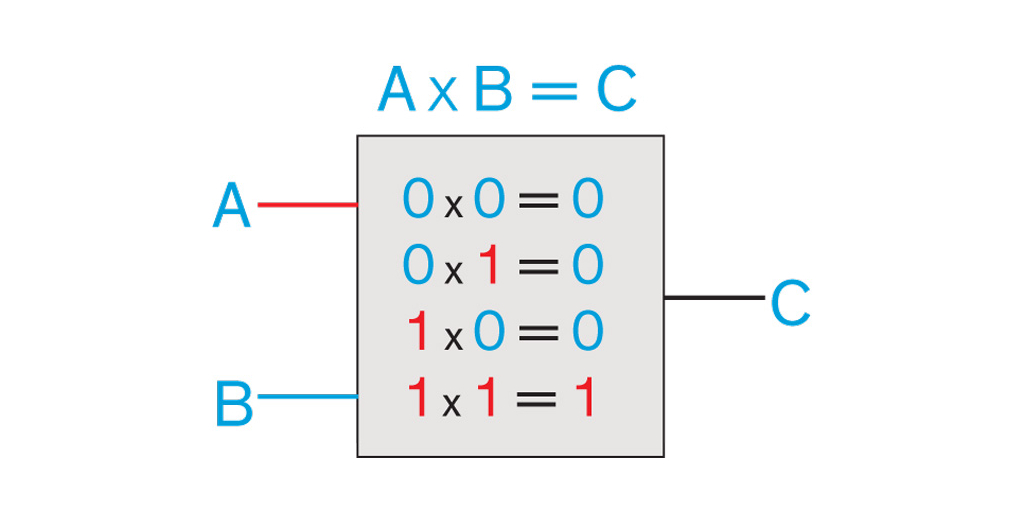
If you're impatiently awaiting the day #QuantumComputing becomes ubiquitous, why not bide your time checking out #ProbabilisticComputing? Our @IEEESpectrum colleagues have an interesting piece about building a probabilistic computer using "p-bits": bit.ly/2OiZ7pC
7

28 Oct 2020
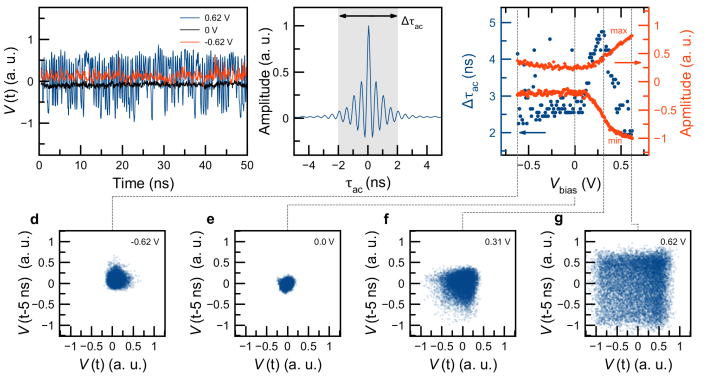
Experimental studies of fluctuations processes in #EasyPlaneMagneticTunnelJunctions show autocorrelation times as low as 5 nanoseconds. This means these circular MTJs have great potential for future #ProbabilisticComputing devices. @IBMResearch @PurdueECE arxiv.org/abs/2010.14393
3
4

15 May 2018
Intel Starts R&D Effort in #ProbabilisticComputing for #AI - IEEE Spectrum ow.ly/KJEt30k0A8J #NeuralNetworks
1