
Jun 12
The next steps are could drastically lower bitrate further, but would require Lagrangian RDO which is tricky to do well across a wide range of content types. The first encoder is purposely a conservative design: lossless on endpoints/pbits/modes/mode configs, and lossy weights.
1
194

Jun 8
The fact that quantum has way more hyper than thermo is simply a belief inertia / marketing buildup gap.
Eventually there will be a repricing to reality. and it will be violent.
Billion dollar companies with 30 qubits vs a startup with a billion pbits.
Mark my words.
29
4
158
12,058

May 22
About to have more pbits on my fingertip than followers on my X account
11
1
72
4,106

Apr 2
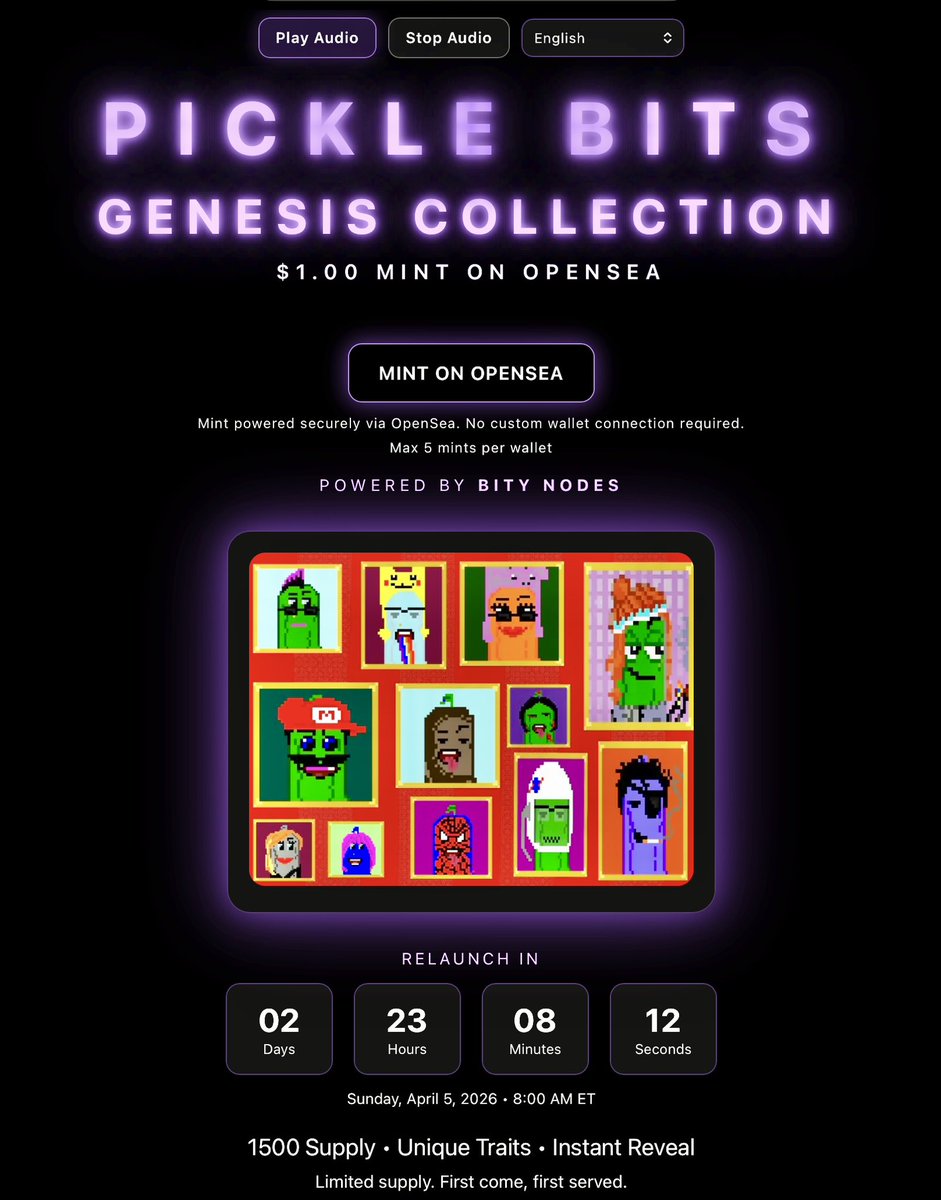
Relaunch visit bitbrains.us on Sunday - Opensea April 5th Pickle Bits NFT’s $ 1 on Ethereum 0.0005 eth max mints per wallet . Get your PBITS NFT’s to get your access to bitynodes.us . Node Modes being built get rewards for participating as soon as BITS token goes live thru the END DAO . Ethereum Nodes Development DAO launch TBD ….
3
2
7
200
Apr 1
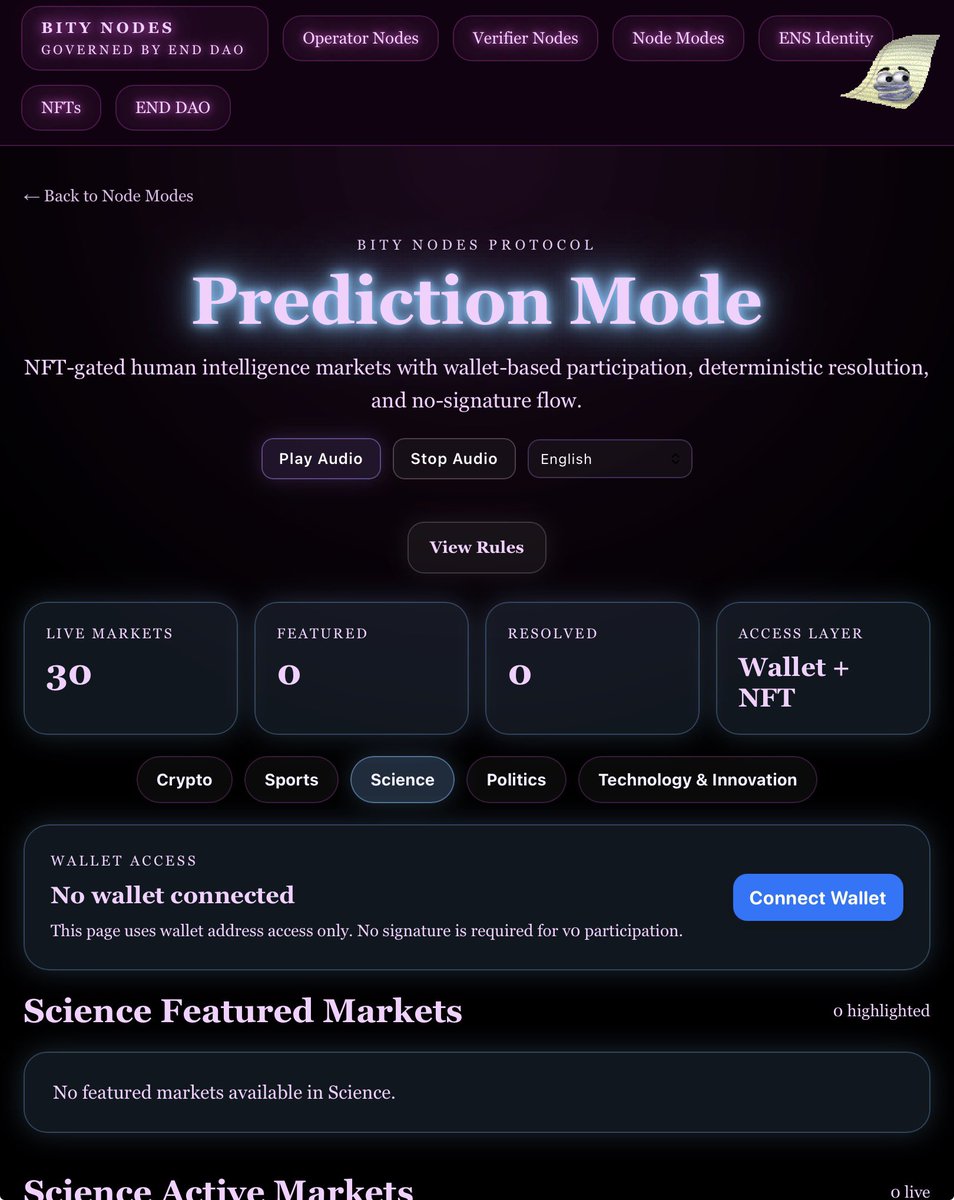
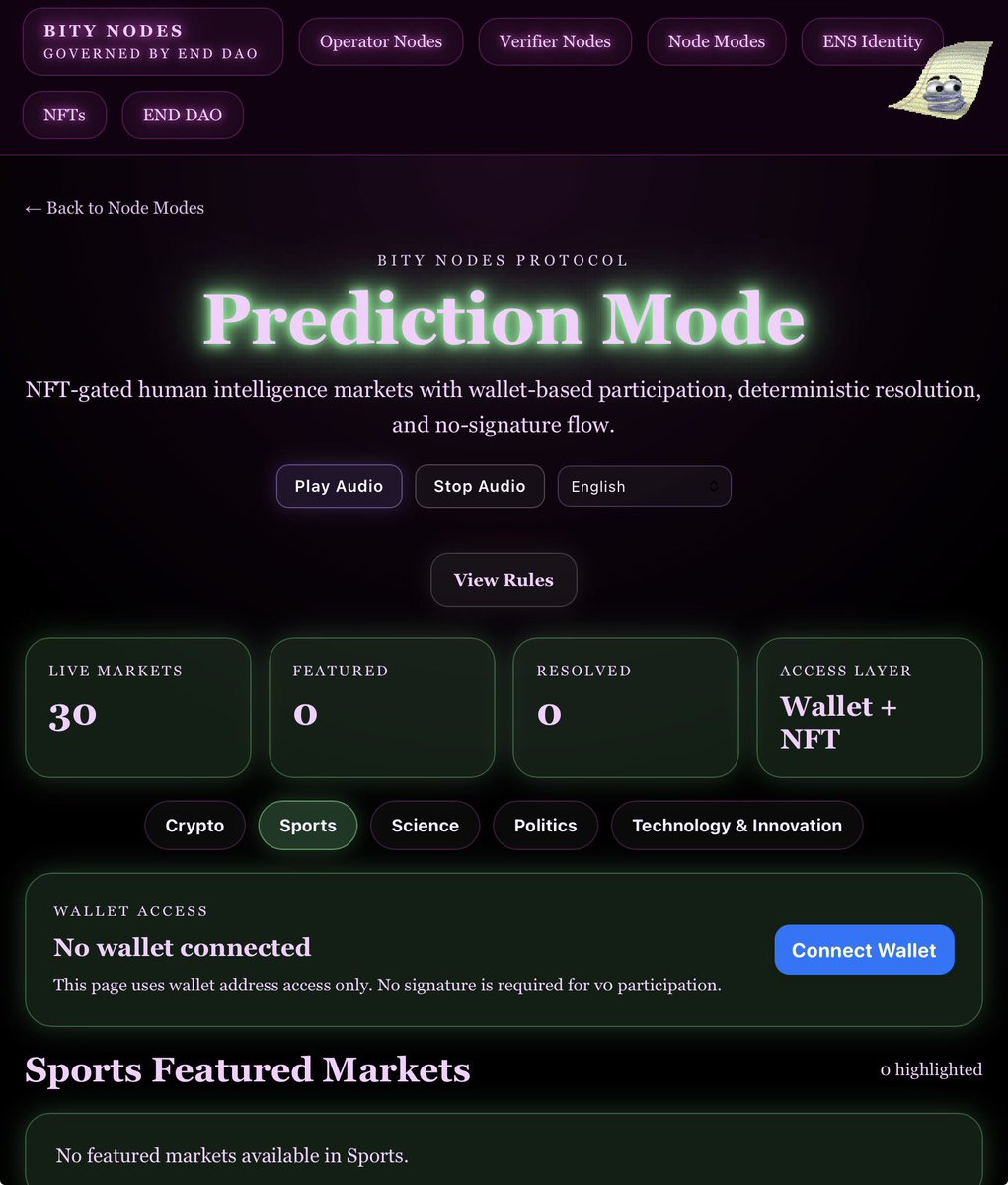
This is an update on the build Predictions Mode will train your NFT and your Autonomous Intelligent Token as intelligence grows so does the effects of your RAP NFT attached to autonomous growth , regeneration augmented proliferating .
Sunday will be a drop that will allow you to beta Test the site get a Pickle Bits NFT for $1 and get gated access to earn rewards in the BITS token when END DAO goes live.
Website still under construction bitynodes.us
RAPNFTs will be distributed at a later date TBD .
First Sunday PBITS NFT’s Opensea link coming 0.0005 ETH.
2
52
Apr 1
Honestly it's too hard to deal with actually scalable hardware from an algos design perspective, I miss prototyping things with 35 qubits that barely work instead of millions of pbits that operate smoothly
Apr 1

As we enter a new month, I'm leaving thermodynamic computing and going back to quantum computing.
The fact that thermo systems will reach 100M pbits in scale within a year is too overwhelming to think about, I miss the coziness of NISQ systems with <100 qubits so I'm going back
9
3
67
7,234

Apr 1
As we enter a new month, I'm leaving thermodynamic computing and going back to quantum computing.
The fact that thermo systems will reach 100M pbits in scale within a year is too overwhelming to think about, I miss the coziness of NISQ systems with <100 qubits so I'm going back
34
6
260
39,663
Jan 27
Need them to cover pbits in Thermodynamic Computing some day
17
1,419


15 Nov 2025
Unlike deterministic GPUs that crunch matrix multiplications, TSUs embrace probabilistic computing, harnessing networks of pbits—tunable random number generators—to directly sample from energy-based models (EBMs) via Gibbs sampling.
1
2
6
321

4 Nov 2025
Next, I wanted to riff on where I think this is going. The first, and I think most obvious direction, is protein folding and protein design. With proteins, you're trying to find the lowest global energy state of a complex molecule. You can brute force this with old methods like FOLDING@HOME and you can also train ginormous models like AlphaFold to use neural networks to approximate the shapes (albeit very accurately and quickly).
OR
You can use thermodynamic computing to rapidly design/discover the optimal shape for any given protein. Not only that, it can be done on the SAME hardware that solved sudoku and the 8 queens problem. And that, I think, underscores the key difference. The TSU is a general purpose accelerator. It's not onlike how a TPU or GPU accelerates a particular kind of math.
The TSU accelerates other kinds of math, and it's all based on noise. True measurements of entropy. Not pseudo-random number generators. AND because the way the pbits interact, you can approximate a true Boltzmann distribution (imagine billiard balls ricocheting off each other, but without the simulation)
To put this into another metaphor, this is like solving sudoku by simply gluing some 9 sided dice in place, and shaking the board with a bunch of other 9 sided dice until they settle into the correct values. Even doing this would be a chance of like one in billions or trillions of working. But because of the physics of the TSU, the correct configuration is the default result. It's still blowing my mind.
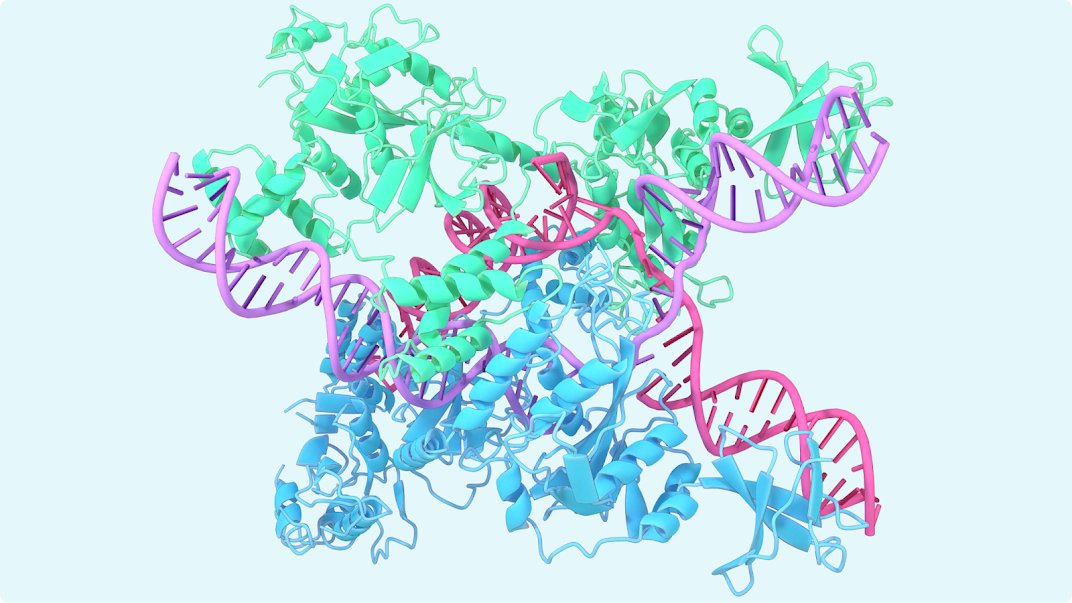
1
6
119
16,957
4 Nov 2025
That's one way to make a Gaussian out of pbits 😆

12
11
227
20,356

Diving Deep into the Thermo-Tweet: Hypergraphs, EBMs, THRML, and Why This Could Flip AI on Its Head
Oh, you want the girth? Buckle up, because we're about to unpack that Beff Jezos tweet like it's a thermodynamic black box spilling secrets. That post from November 3, 2025 (just hours ago as of your query), is a casual flex on how Extropic's new open-source toy, THRML, is turning probabilistic computing into a playground for brain-melting universality.
@beffjezos replying to dave Shapiro @DaveShapi uwu
), who's geeking out over hacking a Sudoku solver with it—calling MCMC (Markov Chain Monte Carlo) sampling "braindead obvious" in hindsight, like realizing fire's hot after burning your hand.
Beff's point? Hypergraphs woven from Energy-Based Models (EBMs) can theoretically crunch anything—from optimization puzzles to generative AI fever dreams—and THRML lets you prototype it all without sweating hardware specifics.This isn't just hype; it's the bleeding edge of "thermodynamic computing," Extropic's bet on ditching von Neumann bottlenecks (those clunky CPU/GPU setups that guzzle power like a Hummer in traffic) for physics-inspired wizardry that sips energy like a Prius on steroids. Released in late October 2025, THRML dropped as their open-source JAX library to let devs simulate and build for future "Thermodynamic State Units" (TSUs)—hardware that's promising 10,000x energy savings on probabilistic tasks.
Let's girth this out: basics first, then the tech porn, demos, and why it might make quantum look like a fidget spinner.The Big Picture: Why Thermodynamic Computing? (Spoiler: Energy's the New Bitcoin)Traditional AI (think transformers chugging through matrix multiplies on GPUs) is hitting walls. Power grids can't keep up—data centers already suck 2% of global electricity, and scaling to AGI could demand exawatts. Enter thermodynamic computing: it flips the script by embracing randomness and noise (that jittery thermal chaos in chips) instead of fighting it. Instead of deterministic "do this, then that," it samples from probability distributions natively, like shaking a quantum Etch A Sketch to reveal patterns.Core Idea: Model the world as an "energy landscape" where low-energy states = high-probability outcomes (straight outta statistical mechanics). Your AI doesn't "compute" answers; it samples them via physics, converging on goodies faster and cheaper.
Hardware Hero: TSUs: Massive arrays of "pbits" (probabilistic bits)—tiny circuits that output random 0s/1s biased by voltages from neighbors. Chain 'em into graphs, and boom: they're Gibbs-sampling your EBMs in parallel, with minimal chit-chat between parts. No separate memory walls; everything's distributed and local.
Vs. The Old Guard (quick table for that visual pop):
Aspect
Traditional (GPU/CPU)
Thermodynamic (TSUs via THRML)
Core Operation
Deterministic ops (e.g., matmuls)
Probabilistic sampling (e.g., Gibbs from EBMs)
Energy Hog?
High—matrix math data shuffling
Low—leverages thermal noise; sims show 10k× better for gen AI
Randomness
Fought off (error correction costs)
Harnessed (pbits wander stochastically)
Best For
Predictable tasks (e.g., classification)
Messy probs (gen AI, optimization, sims)
Scalability Limit
Power/heat (Dennard scaling dead)
Energy abundance (Kardashev vibes—Beff's jam)
Bottom line: This could unlock "Dyson swarm thermodynamic halos" for K1.5 civs, per Beff's master plan.
Extropic's first production chip drops 2026, claiming to smoke quantum on practical benchmarks.
The Juicy Tech: EBMs Hypergraphs = Universal Swiss Army Knife Beff's tweet nails it: "Hypergraphs of EBMs are lowkey extremely universal." Let's unpack without the PhD gatekeep.Energy-Based Models (EBMs): Picture a hilly terrain where balls roll to valleys (low energy = probable states). An EBM defines P(x) ∝ exp(-E(x)/T), where E(x) is your energy function (e.g., "penalize weird Sudoku grids"), T is temperature (controls randomness). Unlike GANs or VAEs, EBMs are flexible AF for discrete/continuous data—no rigid architectures. Extropic's twist: Make 'em thermodynamic by wiring pbits to compute energies on-the-fly.
extropic.ai 1
Hypergraphs: Regular graphs = nodes pairwise edges (social network vibes). Hypergraphs? Edges connect any number of nodes (like group chats on steroids). In THRML, this lets you build "heterogeneous" models—mix spins, images, text in one fabric. Why universal? Stack EBMs into hypergraph layers, and you get everything: MCMC for inference, diffusion-like denoising for gen AI (their "DTM" algo pulls noise into masterpieces), even bio/chem sims.
Beff calls it a "checkmate" on physics, info theory, scaling laws, and energy econ.
Sampling Magic: Block Gibbs: The engine. Instead of updating one variable at a time (slow AF), grab blocks of nodes and resample 'em jointly based on the rest. THRML's GPU-accelerated for sparse hypergraphs, compiling factors into a "global state" for JAX parallelism—no Python loops dragging you down.
THRML: Your Hardware-Agnostic Thermo Forge (With Code Porn)THRML's the open-source bridge: JAX lib for prototyping EBM hypergraphs today, simulating TSUs tomorrow. Install? pip install thrml (Python 3.10 ).
It's flexible—arbitrary PyTree node states (nested data FTW), heterogeneous edges, discrete EBM utils.Quickstart Girth: Ising Model Demo (Beff's bread-and-butter physics toy—magnets as binary spins). This samples a 5-spin chain with alternating block updates:python
import jax
import jax.numpy as jnp
from thrml import SpinNode, Block, SamplingSchedule, sample_states
from thrml.models import IsingEBM, IsingSamplingProgram, hinton_init
# Nodes (spins) edges (interactions)
nodes = [SpinNode() for _ in range(5)]
edges = [(nodes[i], nodes[i 1]) for i in range(4)] # Chain
# Params: biases (node prefs), weights (edge strengths), beta (inverse temp)
biases = jnp.zeros(5)
weights = jnp.ones(4) * 0.5
beta = 1.0
model = IsingEBM(nodes, edges, biases, weights, beta) # Your EBM hypergraph
free_blocks = [Block(nodes[::2]), Block(nodes[1::2])] # Alternate spins
program = IsingSamplingProgram(model, free_blocks, clamped_blocks=[])
key = jax.random.key(0); k_init, k_samp = jax.random.split(key, 2)
init_state = hinton_init(k_init, model, free_blocks, ()) # Smart init
schedule = SamplingSchedule(n_warmup=100, n_samples=1000, steps_per_sample=2)
samples = sample_states(k_samp, program, schedule, init_state, [], [Block(nodes)])
# Boom: 1000 samples from your prob distro
Scale this to Sudoku: Grid as hypergraph nodes, constraints as hyperedges (rows/cols/boxes penalize duplicates). MCMC wanders the energy landscape till it solves.
The Sudoku Solver Scoop: Dave's "Hello World" Thermo FlexDave's post? Pure fire. He fed THRML docs to ChatGPT, and it one-shotted a solver—despite the lib being fresh outta the oven (outside GPT's training data).
"Holy crap... it just read the docs, looked at examples, and applied it to a novel problem. And it just worked." Stress-tested, double-checked—forthcoming analysis/podcast. Why juicy? Proves THRML's intuitive for MCMC newbies; Gibbs blocks make constraint satisfaction (Sudoku's jam) converge stupid-fast. Obvious in hindsight? Yeah, like why didn't we Boltzmann-brain this sooner?The Horizon: Bounties, Benchmarks, and Brain-Melting ScaleBeff's rallying anons: "Prove you're smart—build thermo models in THRML, open-source benchmarks. Bounties grants incoming."
(Video call-to-action: Anime PFPs assemble!) First chip 2026; could beat QC on samplable tasks.
Implications? Gen AI at pocket-change energy, bio sims without supercomputers, AGI sans blackouts. But risks: If thermo scales laws hold, we're "bootloading thermodynamic intelligence" into a hypergraph singularity.
TL;DR: This tweet's the tip of a physics-AI iceberg. THRML's your entry drug—grab it, spin up an Ising, then Sudoku your way to thermo-godhood. What's your first hack? Sources: Extropic site, GitHub, arXiv vibes, and X chatter.
extropic.ai 2
1
3
2
360

3 Nov 2025
If I had to guess they're probably looking at 2 years for something that works
3-4 years for something that can be deployed on a console sized device to consumers
If I'm correct about how many pbits they'll need to run those video gen models
2
2
74

31 Oct 2025
Did you expect the device to talk to the computer with pbits?
5
109

31 Oct 2025
The use of VC money is between them and their investors, no? As for the direction having tried and failed, from what I can tell, pbits haven't failed as a concept, but they haven't been shown to solve useful problems yet. The coupling of nonlinearities is still open (and something they haven't talked a lot about yet) and that dictates the kinds of problems that might be solved. In light of all the changes to compute coming with AI, it's reasonable to try things that failed in solving Turing-complete type problems in the past.
They might have overhyped their result a bit (lots of things to solve still), but they seem to acknowledge shortcomings in the paper. Overhyping is kind of standard these days
2
19
961