Jack Ningi retweeted

How convenient is all this spectacle for owners of the means of production! After producing the worst inequality, poverty & economic crisis on the face of the earth… they have finally managed to turn the working class against itself: tragically, with the full endorsement of pseudo revolutionaries who have long masqueraded in our ranks as progressive forces! Sela!
148
108
249
10,491

Cheap labour refers to a workforce that is paid relatively low wages, often accompanied by substandard working conditions or limited employment protections. While businesses use this practice to lower production costs and increase profit margins!🙇♂😂

Professional Malawians leaving SA, Drs, Nursers, Teachers, Analysts, Engineers, Mathematicians and lawyers.
A big loss to SA

Goodness Dalu retweeted

5/
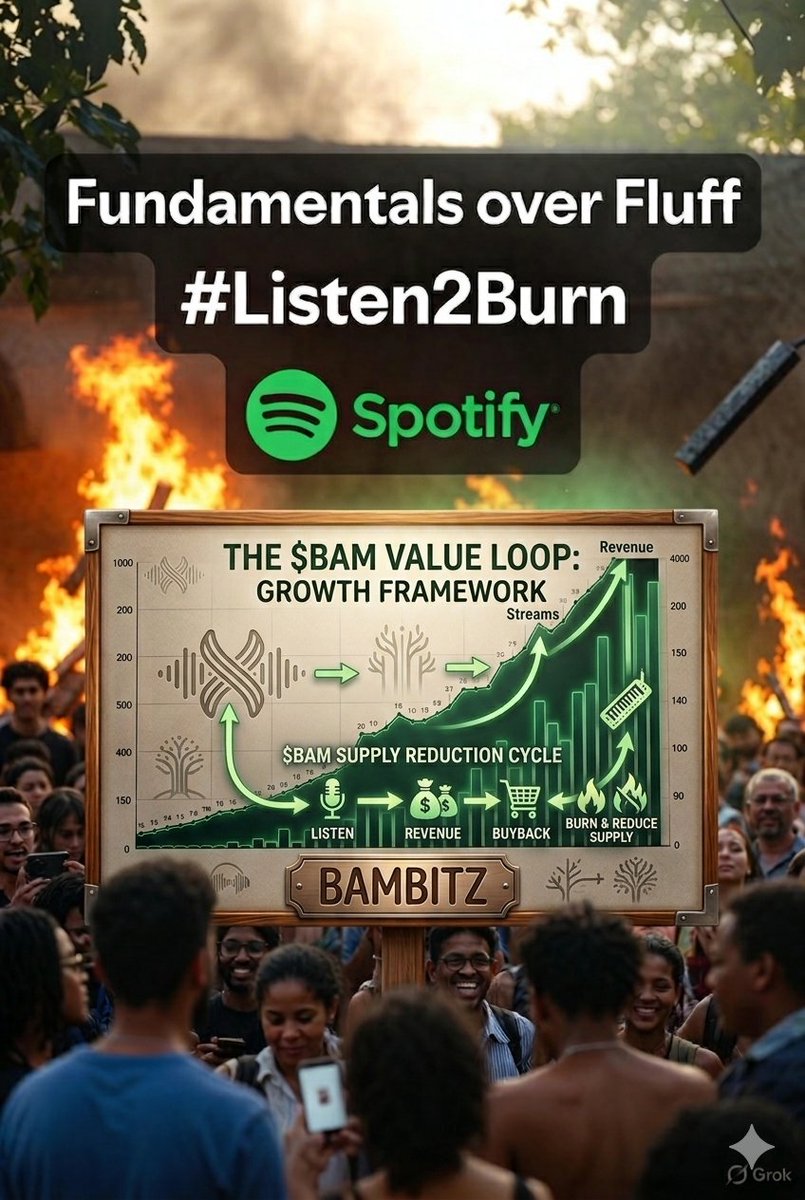
This positions #BAMBITZ as a utility-aligned music network where content production and audience participation operate in a closed-loop growth model.
Releases generate attention, engagement generates visibility, and visibility recursively reinforces further discovery and retention over time.
1
11
18
6
Daysi Perez retweeted

Cr. 🐜 ANTWORK PRODUCTION ขอพื้นที่ฝากผลงานเพื่อต่อยอดงานอนาคตด้วยนะครับ ขอบคุณครับ
4elements #เสน่หาวาโย #antworkproduction #เสน่หาวาโยตอนที่5 #ฟรีนเบค #FreenBecky




220
319
3,286
Ayonori retweeted

11h
Do you guys think production asks them to take lots of pictures together so they have tons of them to use in the scene when Dean is high and crying and looking through pictures on his phone? </3


32
73
3,343
56,499
rds retweeted

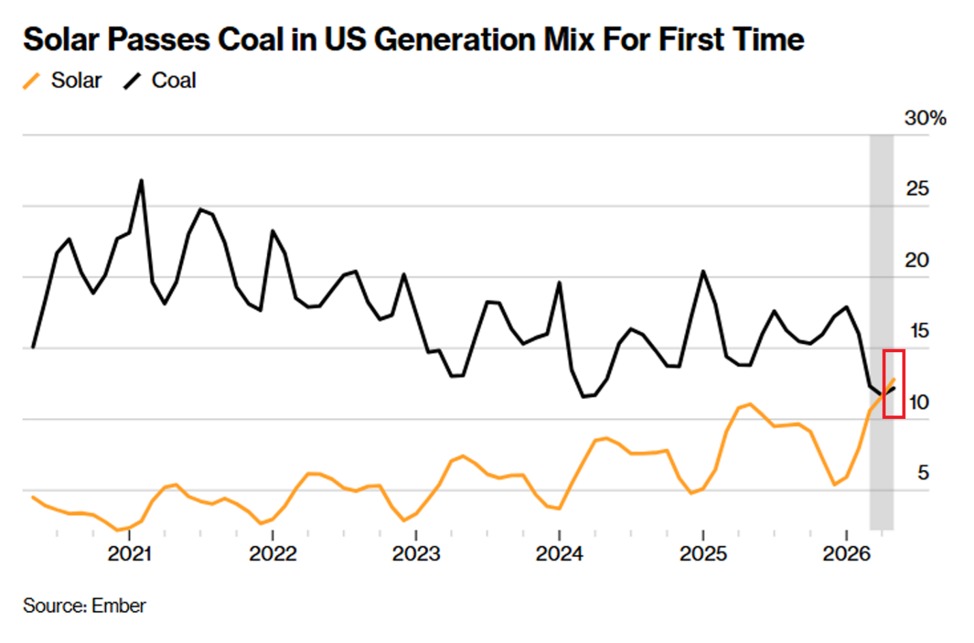
BREAKING: Solar energy accounted for 12.8% of US electricity production in May, surpassing coal at 12.2%, marking the first time this has occurred in a full calendar month.
Solar generation surged 17.0% YoY in May while coal output declined -11.0%, continuing a historic shift in the US power mix.
This shift has been supported by years of rapid solar deployment, while rising electricity demand from AI data centers further boosting investment in new generation capacity.
As a result, solar and battery storage together accounted for 91% of all new US power capacity installed in Q1 2026.
Meanwhile, natural gas remains the dominant source at 37% of the US electricity mix.
The AI revolution is accelerating America's energy transition.
136
244
1,556
179,637
Adam Reiter retweeted

Jun 12
Over 4000 workers just became millionaires by owning the means of production and the socialists are pissed
273
4,218
36,217
706,669

Les Conseils des Druides pour Dompter le Temps
- Le choc thermique du matin : Terminez votre douche par 30 à 60 secondes d'eau froide sur le haut du dos et le torse. Ce stress thermique court stimule instantanément la production de noradrénaline et booste les hormones mâles.
1



Adria van Waart 🎗 retweeted

This is the Aston Martin Valkyrie, a limited production hypercar developed in collaboration with Red Bull Advanced Technologies. Only 150 road legal examples were produced, powered by a naturally aspirated 6.5 litre V12 engine delivering over 1,000 horsepower & F1 aerodynamics.
1
21
133
13,472
Les Ingrédients :
- Gingembre frais râpé : 5 grammes (stimule la circulation et la production d'énergie)
- Clous de girofle : 3 pièces (un puissant antioxydant et tonique général)
- Curcuma pur en poudre : 3 grammes (environ 1/2 cuillère à café, pour l'action anti-inflammatoire)
1
1

34s
“You don't save first and then create investment. In a modern monetary economy, investment comes first.” (Relearning Economics)
Wrong. Nothing comes first or second. The saving of the household sector is absolutely independent of the investment of the business sector.
Relearning Economics never understood the profit mechanism, and, as a logical consequence, how the economic system works. The key concept for the understanding of the economic system is the positive/negative balance. In legacy economics, the key concept is equilibrium, i.e., the absence of balances. This is the methodological ur-mistake, and the ultimate reason why both orthodox and heterodox economics are failed/fake science.
Relearning Economics is better than the silly I=S crowd, but it still gets the interrelationship of balances wrong. It is stuck with telling the usual mind-reading stories, i.e., what people think and expect when they save/invest. The usual result is that it all depends on what people expect, and expectations are the most fluffy component of human behavior. Strictly speaking, one can say nothing concrete about it.
Reminder: “By having a vague theory it is possible to get either result. ... It is usually said when this is pointed out, ‘When you are dealing with psychological matters things can’t be defined so precisely’. Yes, but then you cannot claim to know anything about it.” (Feynman)
All this has been known to scientists of all ages: “The bifurcation of motion into two fundamentally different types, one for natural motions of non-living objects and another for acts of human volition ... is obviously related to the issue of free will, and demonstrates the strong tendency of scientists in all ages to exempt human behavior from the natural laws of physics, and to regard motions resulting from human actions as original, in the sense that they need not be attributed to other motions.” (Brown)
Ultimately, this means that the behavior of the economic system can not be derived from individual human behavior. Methodologically, this means that the behavioral axioms of economics are scientifically unacceptable.
The inescapable Paradigm Shift consists of the move from false (subjective/behavioral) axioms and false (Keynesian) axioms to true (objective/systemic) axioms. From the scientific standpoint, this would mean firing all academic economists, but economics is only a cargo cult science. Therefore, they are not fired but politically reinforced with the fake Nobel for “economic sciences.” Note the silly plural.
The most important balance in economics is macroeconomic profit. It can not be explained with individualistic pseudo-psychology.
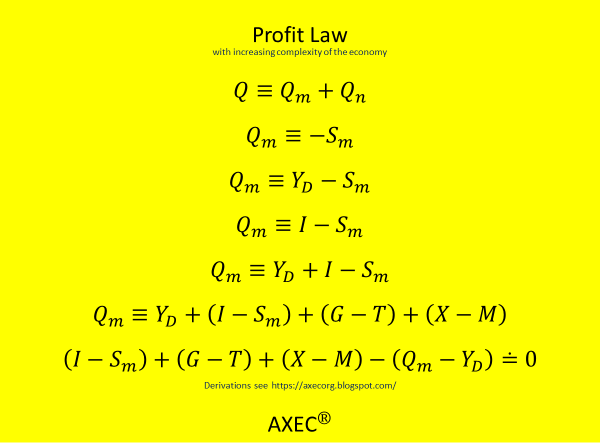
Macroeconomic profit Qm is measured with the axiomatically correct Profit Law/Balances Equation (I−Sm) (G−T) (X−M)−(Qm−Yd)≐0. The Law implies (I−Sm)>0 for early Capitalism and Qm≡(G−T)>0 for late Capitalism, i.e., the current economy runs on public deficit-spending/money-creation, i.e., on the growth of public debt.
In daily life, both fundamental causalities overlap. It is beyond the representative economist to untangle the historically complex growth trajectory and disassemble it into the interaction of its basic elements. Instead, the systemic complexity of the real thing is replaced with brain-dead stories about human behavior. A story always sells better than a theory.
For starters, here is the all-decisive interrelationship of balances: ⇓
(i) In the elementary production-consumption economy, there is no investment, and the Profit Law reduces to Qm≡−Sm, i.e., the saving of the household sector Sm causes the loss of the business sector. If repeated, this leads to economic breakdown. The time preference of savers does not lead to economic growth.
(ii) In the investment economy, the Profit Law reduces to Qm≡(I−Sm). If the household sector does not save, i.e., Sm=0, then the profit of the business sector is equal to investment expenditures, i.e., Qm=I. In this case, the business sector self-finances its investment. This reinforces growth. If the household sector's saving equals the business sector's investment, i.e., Sm=I, then the business sector's profit is 0. The self-reinforcement is gone.
Obviously, Relearning Economics misses profit and the systemic relationship between the fundamental balances, i.e., Qm≡(I−Sm). Therefore, it's not economics as Science but economics as a narrative for a low-IQ audience.
For more details, see
Cross-references: Refutation of I=S
axecorg.blogspot.com/2015/01…
Being proto-scientific garbage, Relearning Economics ends with a the-sun-goes-up insight: “The challenge for a capitalist economy is not encouraging more abstinence and delayed gratification. It is maintaining sufficient demand, productive investment, financial stability, and income growth to keep resources fully employed without generating unsustainable debt dynamics.” This is the pinnacle of political economics, 200 years after Adam Smith. Scientific progress looks different.
2

The feature film Michael, centered on Michael Jackson, has overtaken Bohemian Rhapsody to claim the title of highest-earning music biographical film ever recorded.
Recent box office figures place the production at approximately $911.9 million worldwide, narrowly surpassing the previous benchmark of $910 million. The result marks a new peak for the genre and establishes the film as the top performer among music-based biographical releases.




1
Tech™ retweeted

Jun 12
Renault pls make this a production car and you’ll instantly become the coolest car maker I guarantee it
1,279
2,942
58,770
3,685,873

‘Code Lyoko’ is officially returning with a brand-new sequel series currently in production, set to serve as Season 5.
The project is currently in the writing stage, with the original creators and voice cast expected to return nearly 19 years after the show’s last season aired.

204
2,207
11,705
519,934
her's || ENHYPEN IS 7 retweeted

Album production takes months. So how was he not part of this? “long and well planned departure” doesn’t really add up.

15
67
198
1,608