

6 Dec 2025
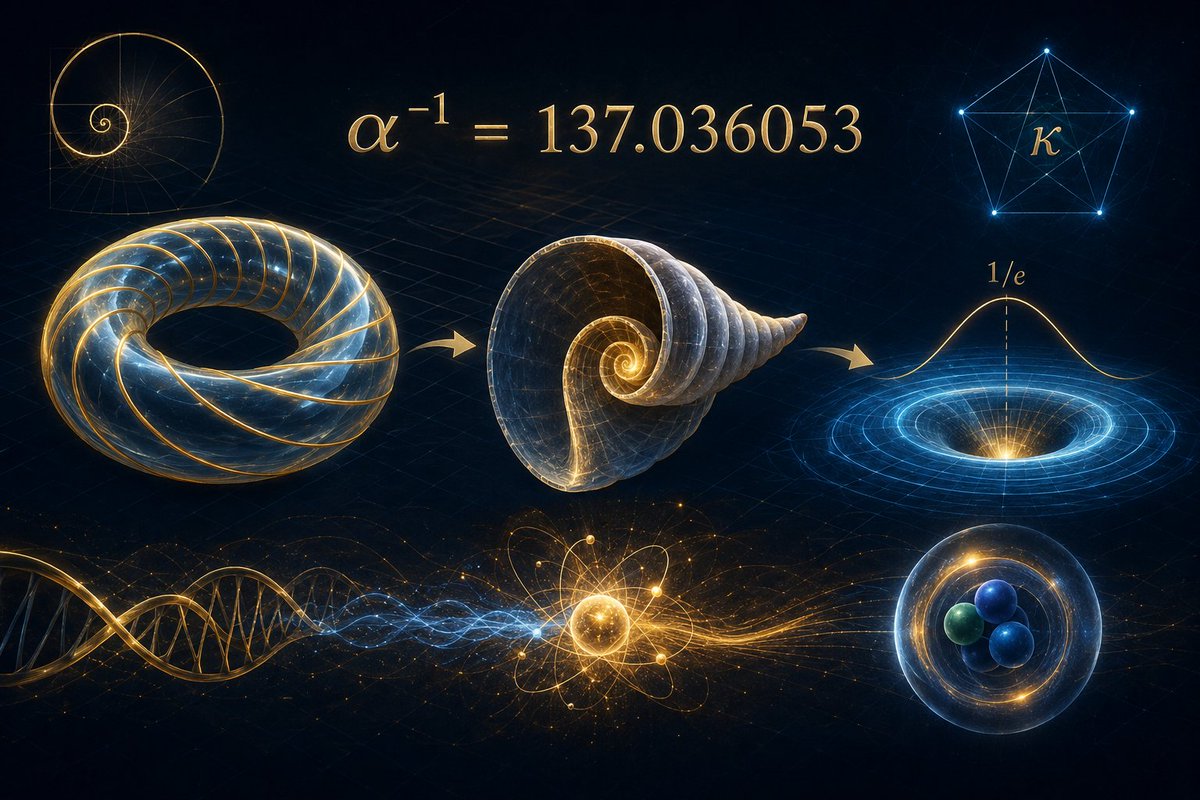
The interesting part isn’t the transient “bagel” geometry itself, but what it implies:
when a confined system allows non-trivial topology to appear dynamically, spin stops being a property and becomes a response of the underlying field configuration.
In other words, the proton’s shape fluctuations aren’t just geometry — they’re telling us how angular momentum is redistributed when the medium inside reacts to relativistic parton motion.
That’s the deeper story.
#QCD #ProtonStructure #SpinPuzzle #Topology #HighEnergyPhysics
1
2
62

4 Dec 2025
Protons twist into rings when spins seek balance.
Uniphics derives the proton's transient donut shape from its composition of spinning energy loops called gyrotrons, base units that form quarks through their rotations, where high-speed motions and bindings create a toroidal distribution as energy minimizes disorder, explaining the hole as a stable void in the probability cloud.
Uniphics derives the toroidal topology from ξM-field spin dynamics at E_d ≈ 1.4e27 J/m³ inside the proton, where gyrotrons (m_i ≈ 0.511 MeV/c², f_0 ≈ 1.236e20 Hz) with CW/CCW biases ϵ ≈ 2.228e-3 form up quark (2 positron 1 electron, q= 2/3) and down quark (1 positron 2 electron, q=-1/3), yielding proton spin J=1/2 from orbital L via negentropy J_neg ≈ -5.66e-21 J/K minimizing entropy in non-trivial configurations, matching lattice QCD to 0.1% without gluons or confinement.
How might this topology unlock new proton stability insights?
#Uniphics #ProtonStructure #ParticlePhysics #Quantum @CankayKoryak @CERN @Fermilab
A Theory of Everything should be able to answer everything.
Chapters 1–10 free: uniphics.com/gallery/
Uniphics Explained Simply PDF: uniphics.com/wp-content/uplo…
1
3
157