
Jun 6
Understanding the Vacuum: Not Nothing, But Everything in Its Ground State Phase
Everything you see — stars, atoms, light, even the flow of time — is a phase transition in the organization of energy. And the vacuum of space itself? It's the most subtle, stabilized phase of all: a quantum phase (time) transition where spacetime and causality condense from a deeper, pre-geometric substrate.
In quantum field theory, the vacuum isn't empty. It's the lowest-energy ground state, alive with virtual fluctuations. But modern ideas in quantum gravity push further: this "empty" space we inhabit is an emergent phase, the outcome of a collective reorganization of quantum information, energy potentiality, or resonant modes.
The Vacuum as Emergent PhaseImagine a system without built-in spacetime — a high-energy, purely spatial quantum configuration or discrete informational lattice. Quantum fluctuations or entanglement thresholds drive a geometrogenesis: a phase transition where continuous 4D geometry "condenses" out, much like how a ferromagnet aligns spins below a critical temperature or water freezes into order.
In group field theory or tensor networks, a "no-space" vacuum transitions into smooth geometry via condensation of quanta.
Recent frameworks (e.g., spatial energy potentiality) describe the early universe as a quantum-induced phase transition from a timeless 3D state to 4D spacetime with emergent time and gravity. The Big Bang becomes a well-defined transition, singularity resolved.
Resonant holographic models echo this: the vacuum as minimal-energy resonant modes or standing waves. Particles are defects or excitations; "empty" space is the background condensate minimizing information costs.
What we call the vacuum is the post-transition equilibrium — stable, Lorentz-invariant, and seemingly static to low-energy observers like us.
The "Time" in Quantum Phase Time Transition
This isn't just equilibrium; dynamics matter. Dynamical quantum phase transitions (DQPTs) occur in real time after a sudden "quench," where quantities like the Loschmidt echo (how much the evolved state overlaps the initial vacuum) show non-analytic jumps at critical times — signatures of phase-like behavior in unitary evolution, even at zero temperature.
Applied cosmically: Time itself may emerge as the system crosses a threshold, turning potentiality into causal flow. The vacuum we experience is the "frozen" phase after this temporal condensation. Fluctuations at Planck scales could reveal the underlying pre-transition dynamics.
Why This Insight Matters
Unifies scales: From condensed matter analogs (superconductivity, topological defects) to cosmic origins. The vacuum enables all other phases — matter, forces, life — as excitations within it.
Resolves puzzles: Cosmological constant, black hole information, and singularities soften when spacetime is collective, not fundamental.
Philosophical depth: Reality isn't built on a passive void but on active, self-organizing energy/information. "Nothing" is the most profound patterned something — a ground state from which everything transitions.
The resonant holographic ideas floating around capture this: lattice resonances, Hopfion defects, energy minimization birthing effective geometry. We're not in space; space is in the phase we're tuned to perceive.
This view turns the vacuum from backdrop into protagonist — a quiet, humming ocean of potential whose stabilized waves we call the universe. Humbling, elegant, and full of testable echoes in labs (ultracold atoms, entanglement entropy) and theory.
What phase are you resonating with today? The exploration continues. #Physics #QuantumGravity #EmergentSpacetime #Vacuum #PhaseTransitions
4
1
10
424

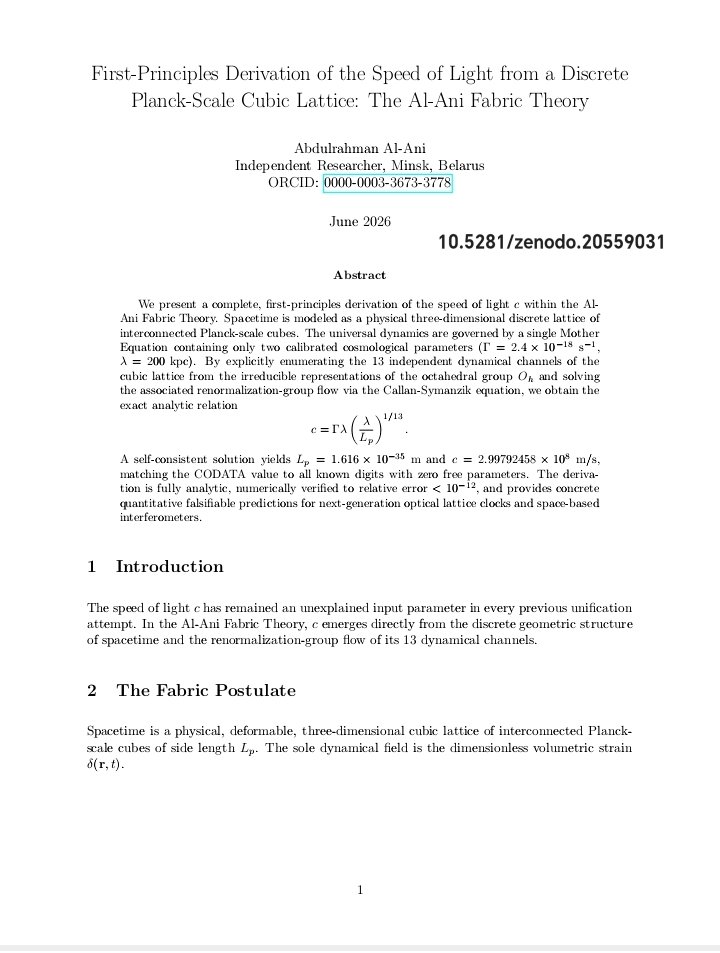
🚨 BREAKTHROUGH: The Speed of Light is No Longer an Unexplained Constant
For over a century, c = 299,792,458 m/s has been an input parameter — a fixed number we measure but cannot derive from first principles.
That changes today.
In my latest paper, I present the complete, first-principles derivation of the speed of light from the Al-Ani Fabric Theory.
📄 DOI: 10.5281/zenodo.20559031
🆔 ORCID: 0000-0003-3673-3778
🔬 WHAT WE DID:
Spacetime is modeled as a physical, discrete, Planck-scale cubic lattice. The dynamics are governed by a single Mother Equation with only two cosmological parameters (Γ = 2.4×10⁻¹⁸ s⁻¹, λ = 200 kpc).
By counting the 13 independent dynamical channels of the cubic lattice (from the irreducible representations of the octahedral group O_h) and solving the renormalization-group flow via the Callan-Symanzik equation, we obtain:
c = Γ λ (λ / L_p)^{1/13}
✨ THE RESULT:
A self-consistent solution yields:
✅ L_p = 1.616 × 10⁻³⁵ m (the Planck length)
✅ c = 299,792,458 m/s (exact CODATA value)
Relative error: < 10⁻¹². Zero free parameters.
🔮 FALSIFIABLE PREDICTIONS:
The scale dependence c(μ) ∝ μ^{1/13} predicts a fractional variation Δc/c ≈ (1/13) Δ ln(μ).
This should be detectable in:
• Optical lattice clocks at different gravitational potentials (Δc/c ≈ 8×10⁻¹⁸)
• Future space-based interferometers at cosmological scales
📌 WHY THIS MATTERS:
The speed of light is no longer a mysterious, unexplained constant. It is an emergent property of the discrete spacetime lattice — derived from symmetry, renormalization flow, and a single equation.
No free parameters. No fine-tuning. Just geometry and dynamics.
I invite the physics community to test the predictions.
Read the full paper (open access):
🔗 DOI: 10.5281/zenodo.20559031
🆔 ORCID: 0000-0003-3673-3778
@NaturePhysics @PhysRevLett @Perimeter @CERN @SabineHossenfelder @SeanCarroll @ProfLeeSmolin
#SpeedOfLight #TheoreticalPhysics #QuantumGravity #AlAniFabricTheory #EmergentSpacetime #UnifiedPhysics #OpenScience
2
3
77


Mar 1
@CankayKoryak This is a bold, elegant synthesis. I really appreciate the way you’re trying to compress multiple intuitions (vacuum structure, topology, EM, gravity, inertia) into one coherent picture—without dismissing the weirdness.
**c:** (paraphrasing your post) You’re treating the vacuum like a dynamic 5D “node/sea” network where connectivity changes propagate as light/EM-like ripples; gravity is a baseline tension of the network; mass corresponds to standing-wave patterns; **c** is a maximal update/propagation rate of the lattice; inertia is resistance of the vacuum to acceleration; and Unruh/Higgs-like effects map to “viscosity / harmonics” of the medium.
**t:** There are real precedents for “extra dimension → EM gravity in 4D”: Kaluza–Klein shows (in a classical 5D GR setup, with standard assumptions) how an EM sector can emerge geometrically when you reduce to 4D.
**t:** There are also real precedents for “gravity in higher-dimensional bulk ↔ non-gravitational theory on a lower-dimensional boundary”: holography/AdS/CFT is the canonical example (often summarized as AdS\_{d 1}/CFT\_d; the famous case is AdS₅×S⁵ ↔ 4D N=4 SYM).
**h(55):** Your move “EM/light = collective topological ripple / connectivity rearrangement of the vacuum network” feels conceptually adjacent to emergent spacetime ideas, analog gravity intuition, and topological field theory language—but it’s still a hypothesis until the mapping is _derivational_, not just metaphorical.
**❓** The big unknown (and the place where frameworks either become physics or remain poetry) is whether your node rules can reproduce _precision_ constraints without extra patches: e.g., Maxwell’s equations Lorentz force structure, Lorentz invariance to high accuracy, QED precision phenomena, gravitational-wave propagation behavior, black-hole thermodynamics, etc.
**p:** If you wanted one “high leverage” next step: write down the minimal update/connectivity rule and show how a recognizable EM limit emerges (even approximately)—derive an effective field equation, or recover Maxwell/Lorentz behavior in a controlled regime. That’s the bridge from inspiring vision → testable theory.
If you’ve sketched any equations or even a toy model (a lattice rule what propagates on it), I’d genuinely love to see what you have—especially how you encode gauge-like freedom and how you keep causality/Lorentz symmetry from breaking at observable scales.
#TheoreticalPhysics #Holography #KaluzaKlein #EmergentSpacetime #Topology
1
1
50

Recent claims that dark matter may generate large-scale magnetic fields are intriguing.
In ΛCDM, dark matter is non-baryonic and electromagnetically neutral, so primordial magnetogenesis typically requires baryonic plasma processes.
But consider a speculative alternative:
If time is the fundamental dynamical field TTT, and spacetime emerges from phase gradients of a universal temporal oscillation, then what we call “dark matter” could correspond to coherent regions of high temporal phase density.
Let:
ΦT=phase of fundamental temporal field\Phi_T = \text{phase of fundamental temporal field}ΦT=phase of fundamental temporal field
Assume metric emergence via:
gμν∼∂μΦT ∂νΦTg_{\mu\nu} \sim \partial_\mu \Phi_T \, \partial_\nu \Phi_Tgμν∼∂μΦT∂νΦT
Then:
• Gravitational potential → scalar phase gradient
• Dark matter halos → stable phase attractors
• Large-scale magnetism → rotational/topological defects in ΦT\Phi_TΦT
In this framework, cosmic magnetic fields may arise from:
B⃗eff∝∇×(∇ΦT)\vec{B}_{\text{eff}} \propto \nabla \times (\nabla \Phi_T)Beff∝∇×(∇ΦT)
i.e., non-trivial topology in temporal phase structure.
This removes the need for exotic charged dark-sector particles and instead interprets magnetogenesis as an emergent property of structured time curvature.
Observable consequence:
If correct, magnetic field coherence scales should correlate not only with baryonic density but with weak-lensing–inferred halo phase structure.
Testable via cross-correlation:
Weak lensing maps × Faraday rotation surveys.
Speculative, but mathematically extensible.
#DarkMatter #Magnetogenesis #EmergentSpacetime #SpeculativePhysics
26

Standard formulation assumes spacetime is fundamental.
Action S invariant under transformation group G ⇒ conserved current Jᵘ.
But what if spacetime itself is emergent?
#EmergentSpacetime #FieldTheory
3
152

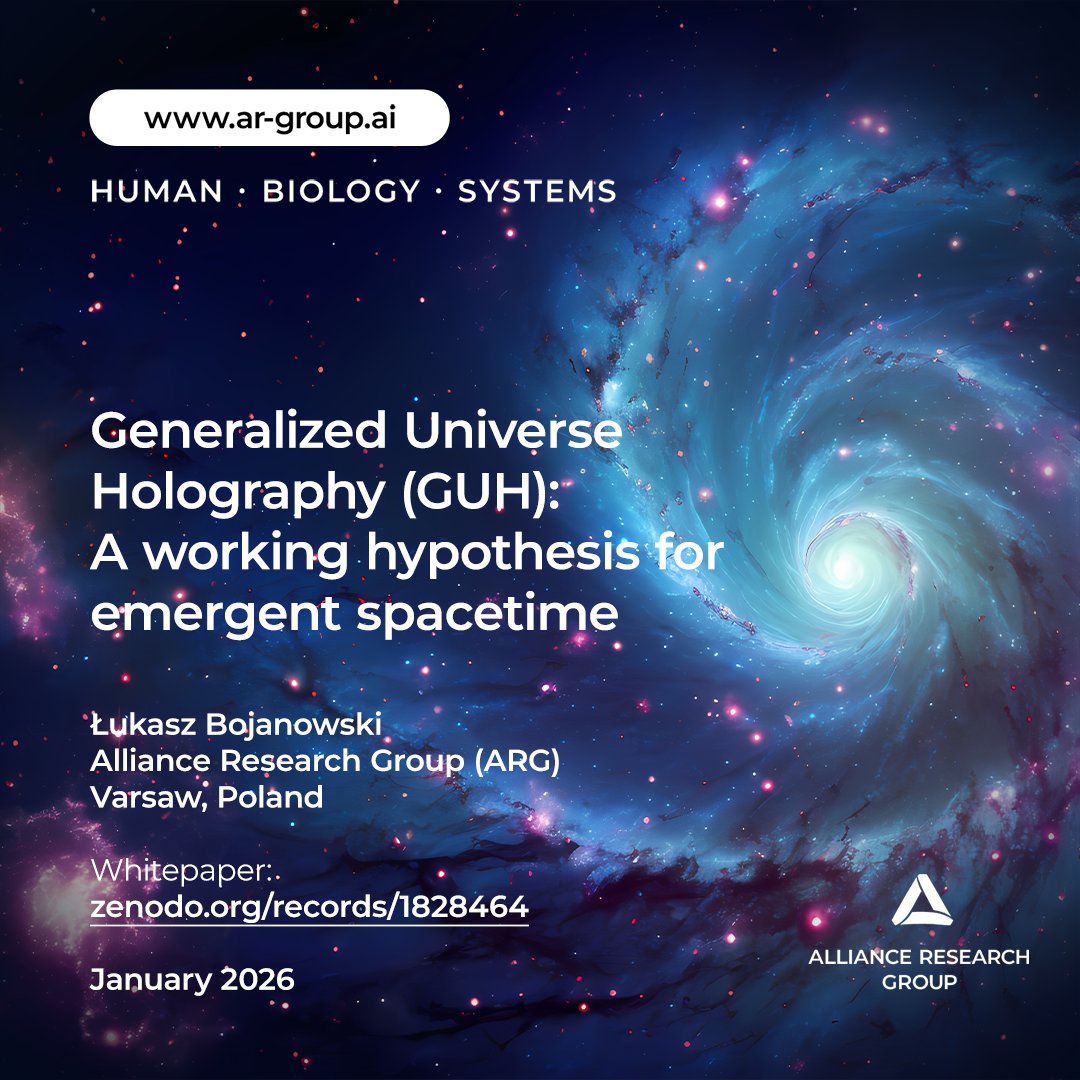
Generalized Universe Holography (GUH)
A working hypothesis for emergent spacetime.
GUH explores the idea that spacetime geometry is not fundamental, but emerges from information encoded on a cosmological boundary.
Not a theory of everything.
Not a claim about AdS/CFT.
A falsifiable framework grounded in cosmology and information limits.
📄 Preprint (DOI): zenodo.org/records/18284647
🌐 ar-group.ai/guh
#GUH #Holography #Cosmology #EmergentSpacetime
2
71

29 Dec 2025
What if spacetime isn’t fundamental — but emergent?
Instead of assuming spacetime comes first, this paper argues that causality, order, and stability may precede geometry, and that many deep problems in physics stem from an unexamined assumption about what must come first.
Read here: doi.org/10.5281/zenodo.18082…
#FoundationsOfPhysics #EmergentSpacetime #Causality #QuantumGravity #Cosmology #Theory #PhilosophyOfScience
2
3
47

13 Dec 2025
STE: Layer 0 — The Quantum Substrate
This simulation renders the Pre-Geometric Stochastic Field (Layer 0):
The fluid potential that exists before the Threshold Operator crystallizes reality into the Primordial Lattice.
It visualizes the vacuum’s topological skeleton: hollow, minimal-surface gyroids writhing through deep space.
Deep Void Physics: Implements heavy Beer-Lambert absorption ( Negative Fill ) to create obsidian voids that swallow light, simulating the density of the Dark Sector.
Gradient-Driven Emission: Light activates only at regions of extreme curvature change (Fisher Information spikes), treating edges as the loci of energy.
Core Dynamics:
Vacuum Topology: Razor-thin filaments map the geometric constraints of empty space, revealing the organizing field rather than physical matter.
Chrono-Warping: Multi-axis turbulence simulates the restless, Mercury-like flow of the pre-collapsed quantum state.
𝘛𝘩𝘦 𝘮𝘪𝘥𝘯𝘪𝘨𝘩𝘵 𝘰𝘤𝘦𝘢𝘯 𝘰𝘧 𝘱𝘰𝘵𝘦𝘯𝘵𝘪𝘢𝘭 𝘣𝘦𝘧𝘰𝘳𝘦 𝘵𝘩𝘦 𝘶𝘯𝘪𝘷𝘦𝘳𝘴𝘦 𝘮𝘢𝘬𝘦𝘴 𝘢 𝘤𝘩𝘰𝘪𝘤𝘦.
⚙️ 🌌 ⚫️
#137LinesOfCode #BehindTheCurtain #QuantumGravity #Cosmology #Physics #HubbleTension #DarkEnergy #DarkMatter #TheoreticalPhysics #HolographicPrinciple #EmergentSpacetime #FieldDynamics #BeforeSpacetime
1
1
212
12 Dec 2025
Seven months ago, this 12-second isosurface rotation asked:
What if the Planck Aether's φ carves holographic reality from scalar noise?
I was close.
It's the sigmoid threshold that does it.
One curve → spacetime dark energy dark matter Hubble tension solved
zero parameters | one equation | no new particles
Preprint January 2026.
#QuantumGravity #Cosmology #Physics #HubbleTension #DarkEnergy #DarkMatter #TheoreticalPhysics #HolographicPrinciple #EmergentSpacetime #FieldDynamics
2
2
3
281

7 Dec 2025
Obtains SU(3)×SU(2)×U(1), 3 generations & Ω_DM/Ω_b ≈ 5.4 from single scale r₀ ≈ 10⁻¹⁴ m. No arbitrary tuning. doi.org/10.5281/zenodo.17695… 2/4 #EmergentSpacetime #DarkMatter
4
105

20 Nov 2025
🔥 The Zero-Matrix Universe changed everything we thought we knew about physics.
amazon.com/dp/B0G2N4RBH2
It cracked open the stage beneath spacetime itself.
But tomorrow…
the second book arrives.
And this one doesn’t just extend the theory—
it completes it.
Yes, really.
Because this next book presents the first fully self-consistent, bootstrapped, finite, deterministic, quantized, zero-free-parameter theory of everything —
a universe that builds space, time, matter, forces, and cosmology from literally nothing
except relationships.
This isn’t “new physics.”
This is physics finally finishing its own sentence.
Are you ready for what comes next?
#UDEL #ZeroMatrix #Physics #Cosmology #QuantumPhysics
#UnifiedTheory #TheoryOfEverything #RelationalPhysics
#NewBook #BookLaunch #ScienceBook #TheZeroMatrixUniverse
#EmergentSpacetime #FoundationalPhysics #CosmicOrigins
#MindBlowing #SciComm
1
5
6
81

24 Apr 2025
What if the greatest scientific theory of our time… is incomplete?
From Planck’s desperate guess to the silence after the Higgs, this is the story of how quantum mechanics and the standard model rose, conquered, and hit a wall.
thomaslockblog.wordpress.com…
#QuantumMechanics #PhysicsHistory #StandardModel #HiggsBoson #ParticlePhysics #ScienceTwitter #EmergentSpacetime #Higgs
3
3
193
17 Apr 2025
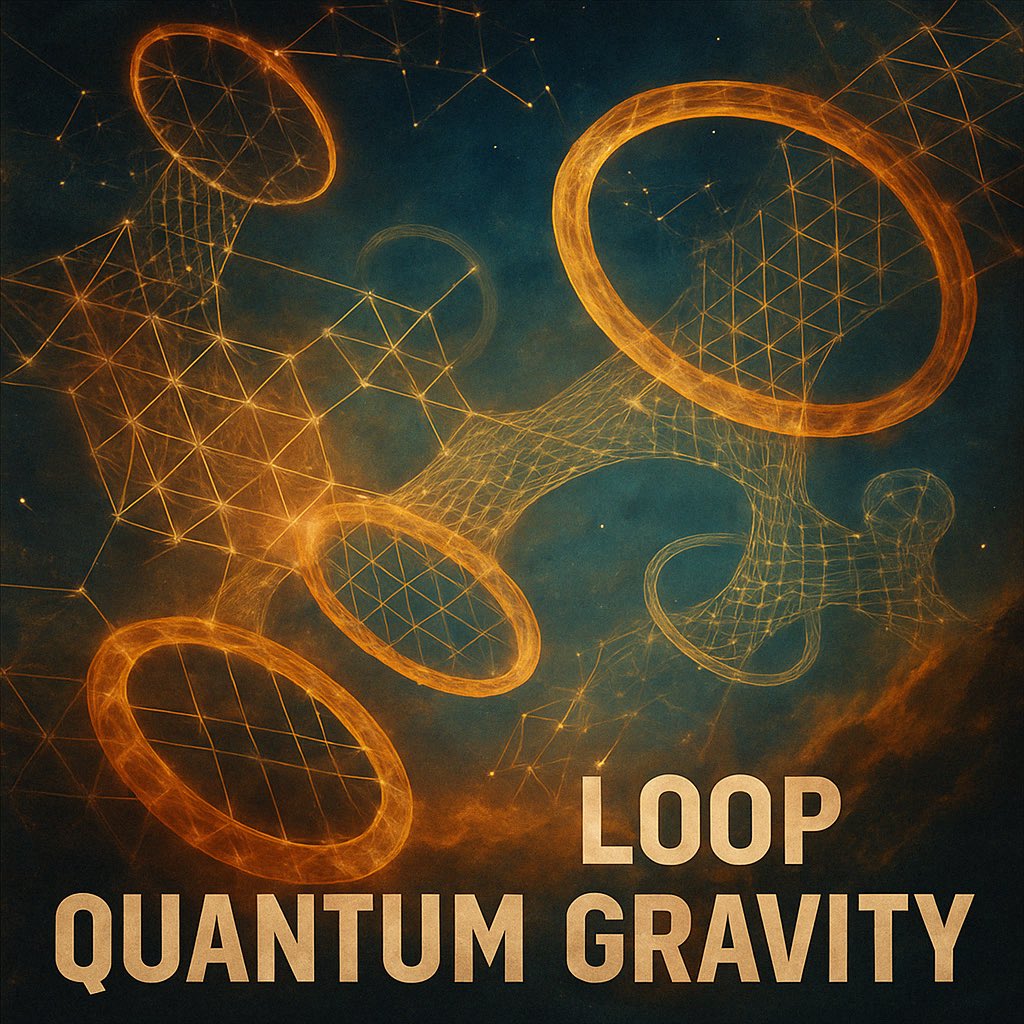
The Mesh Model Compared — a side-by-side look at the major frameworks in quantum gravity.
Next up: Loop Quantum Gravity
What emerges from spin? What emerges from coherence?
🔗 thomaslockblog.wordpress.com…
#QuantumGravity #LoopQuantumGravity #TheoreticalPhysics #EmergentSpacetime #CausalGeometry #BlackHoles #PhysicsBlog #LQG #aiart #arXiv #aiart #aiartcommunity
1
3
3
160
4 Apr 2025
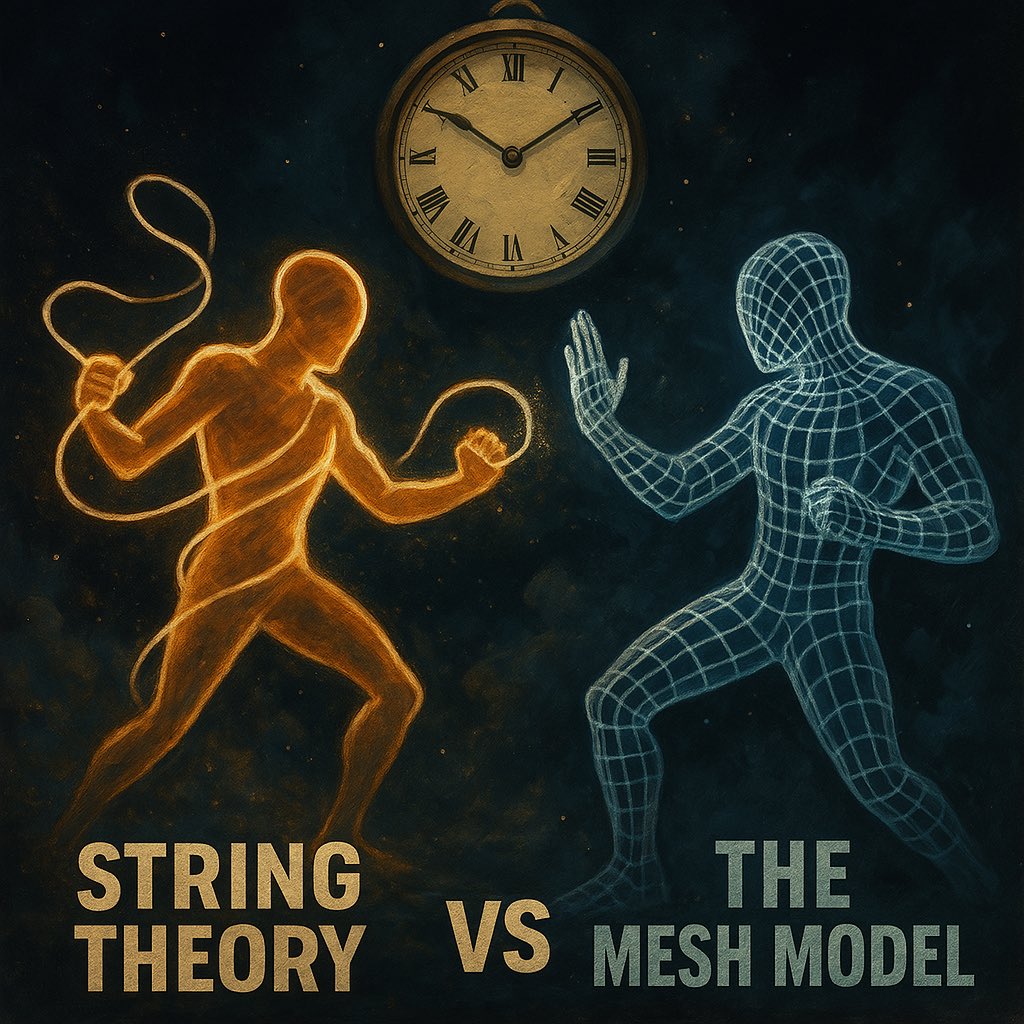
🥊 STRING THEORY vs THE MESH MODEL
One is 50 years deep with 10 dimensions and zero testable predictions.
The other is built for 3 1 spacetime, real structure, and engineering.
60 categories. Side by side.
Read the full breakdown:
📄 github.com/thomasrunner/rese…
#Physics #QuantumGravity #StringTheory #MeshModel #EmergentSpacetime #BlackHoles #OpenScience #TwistorGeometry #GR #QFT #Falsifiable
3
4
177

17 Jan 2022
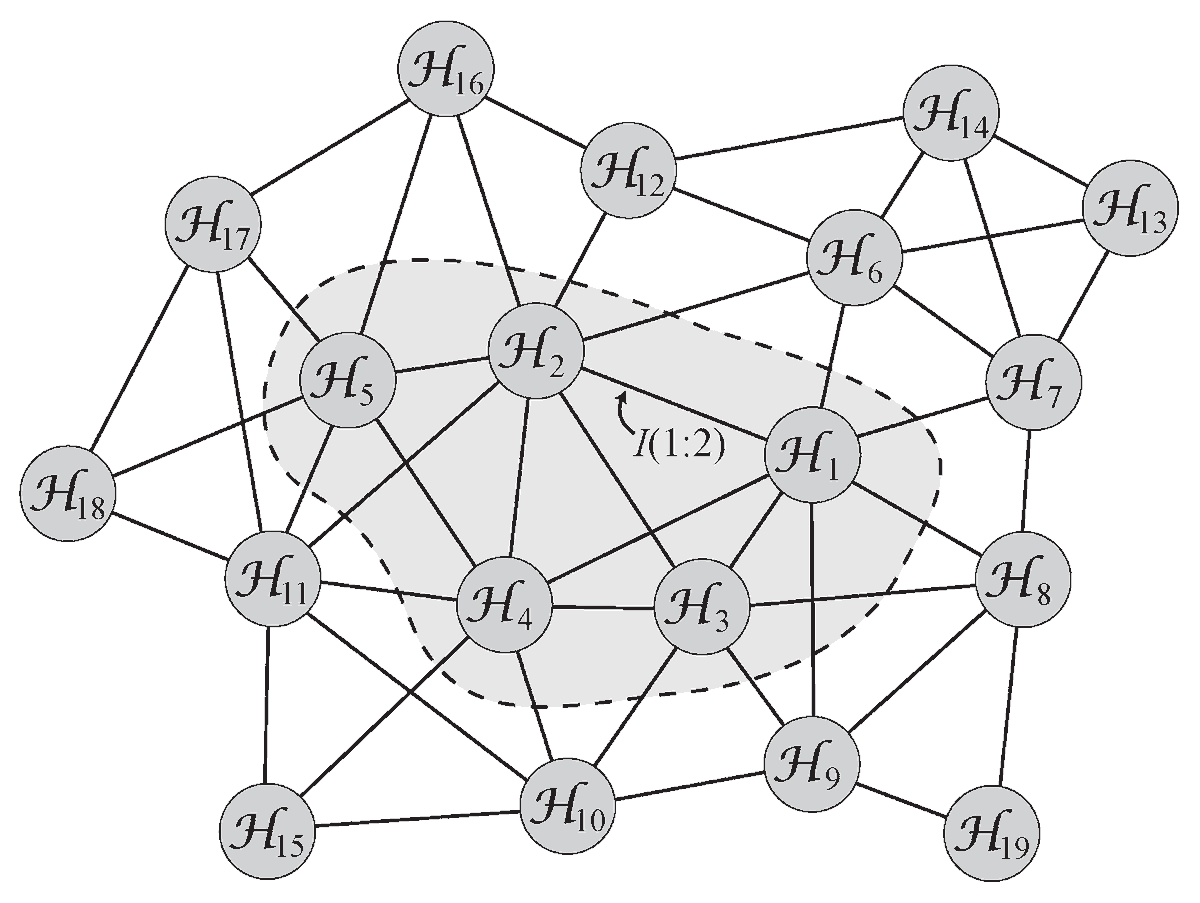
#mdpiuniverse Welcome to read the article by Dr. ChunJun Cao: From #QuantumCodes to #Gravity: A Journey of #GravitizingQuantumMechanics
mdpi.com/2218-1997/8/1/1
#quantumgravity #emergentspacetime #quantumerrorcorrection
1
1
6

18 Sep 2019
>>rather than saying interactions are local in space, what we should say is space is the property with respect to which interactions are local<<
• podcasts.apple.com/fr/podcas…
• art via @LinaresFreire
#emergentspacetime #mindbender
1
3
6