
Apr 24
Why $Algorand ?
1) Transactions finalize in ~3–4 seconds Fees are almost zero
2) Pure Proof of Stake
3)No forks → transactions are final instantly
4) Simple smart contracts (TEAL / PyTeal)
5) payments ,RWA , Government-level projects
6) NFT’s And Such a Great Community 🤝
2
15
72
923
Apr 24
1) Transactions finalize in ~3–4 seconds Fees are almost zero
2) Pure Proof of Stake
3)No forks → transactions are final instantly
4) Simple smart contracts (TEAL / PyTeal)
5) payments ,RWA , Government-level projects…
These are enough for you?
2
25


Jan 19
Algorand (D-tier) "Assembly Language With Python Lipstick" 📚 4/10 | 🔧 4/10 | 🧠 2/10
TEAL is assembly. PyTeal is Python that generates assembly. You debug assembly anyway.
No loops. No negative numbers. No floats.
The trap: PyTeal expressions re-execute every time you reference them. Write result = calculation calculation and it runs twice, with side effects compounding. Debugging this took me 2 days before I understood the evaluation model.
AlgoKit helps. You're still fighting the language.
1
2
471

@LuteWallet is correct. This part of your FAQ is basically false:
> Winners are selected using the blockchain's built-in random seed from the most recent block. This ensures the selection is verifiable, unpredictable, and cannot be manipulated by anyone, including the protocol operators.
Assuming this is the latest version of your contract:
github.com/algodailylottery/…
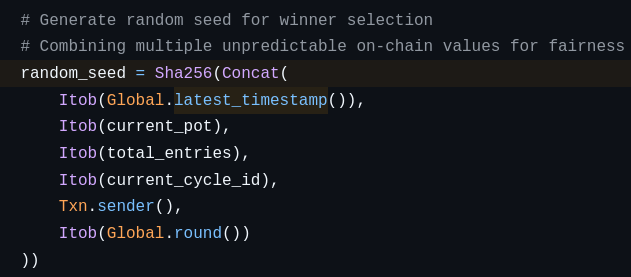
The values you are using 1) do not come from the "random seed of the most recent block" and 2) are fairly easily predictable / gameable by whoever calls the contract.
Timestamps are second-level granularity and ~3 seconds apart, and you can usually land a txn in 2 blocks from submission time (which you can enforce with a txn.last-valid == desired-round.)
As @LuteWallet points out, you can simulate these values until you have the desired result and execute when it suits you, effectively picking the winner of your choice with very very high accuracy.
To fix this you need to add a separate "commit" phase to your process, and then call the VRF beacon/oracle contract
1) commit: when you are ready to run the VRF, commit to a round 8 in the future (based on current round)
2) when the commit round ( 2 / 3 ) has elapsed, you need to get your random value from the randomness beacon with a contract-to-contract call and use that as your random_seed. There is some pyteal code showing how to do this here:
github.com/algorand-devrel/c…
This would make your winner selection actually unpredictable and un-gameable by anyone, even the AF which runs the beacon service backend
2
2
13
204

Hi all,
To uphold our motto, "A fair lottery is a verifiable lottery. Don't trust, verify!", we have open-sourced our smart contract code so anyone can verify how it works:
📦 **Repository:** github.com/algodailylottery/…
More importantly, it includes:
• Pyteal smart contract
• Technical explanation with diagrams
• Python verification tool
• Complete documentation
🔍 **Verification Guide:** github.com/algodailylottery/…
📊 **Visual Diagram:** github.com/algodailylottery/…
You can verify that past and future cycles are fair - no trust required! That being said, we thank you all for the trust you already gave to us!
All feedback is welcome.
#Algorand @AlgoFoundation
1
5
16
302

30 Dec 2025
Would you please share the pyTeal source code for your contract?
3
6
258

25 Dec 2025
It's just a slow cooking project. Small dev team of me and a small server farm cooking and validating scripts pyteal and algokit.
1 bridge built and other strands coming online soon.
But more importantly, enjoy the chicken and festive season:-)
1
2
25
13 Dec 2025
#Algorand have to say PyTeal, lovely lovely lovely
Secured Escrows Done
Algorand to VOI wrapped tokens passed first transfer tests :-)
2
1
9
359

15 Nov 2025
So what does @AlgoFoundation mean for @FolksFinance?
Folks Finance is a lending and borrowing protocol. You deposit tokens to earn, or you borrow tokens by locking some collateral.
For something like this, the blockchain underneath must be reliable which means you cannot build financial tools on shaky ground.
This is where Algorand’s smart contract engine, called the Algorand Virtual Machine (AVM), comes in.
Think of the AVM as the “brain” that runs everything automatically.
It executes rules. No delay, no human bias, no tampering.
Smart contracts on Algorand are:
• trustless,
•on-chain and transparent,
•hard to manipulate,
•cheap and fast to execute.
Developers write them in a language called TEAL or in Python (via PyTeal), and the AVM makes sure they run the same way every time.
Over the years, Algorand has added more features to the AVM, making it stronger without slowing the network or raising fees.
For Folks Finance, this means:
•loans are processed instantly.
•interest is calculated continuously.
•deposits remain safe.
•liquidations happen predictably.
•the system never chokes.
Everything stays smooth.

15 Nov 2025

Did you know that @AlgoFoundation built their blockchain to be the foundation, the solid base layer that every other application and protocol stands on?
And the reason @FolksFinance chose it is simple: it’s fast, cheap to use, secure, and doesn’t break down when more people show up.
Most blockchains slow down when they get busy.
Fees rise.
Transactions lag.
Developers have to build extra layers just to keep things moving.
Algorand avoids all that because it uses something called Pure Proof-of-Stake (PPoS), a system where anyone holding ALGO can help secure the network without needing heavy machines or huge amounts of money.
It stays green, efficient, and smooth.
And unlike older blockchains that sometimes need to “fork”, basically splitting into new versions whereas Algorand stays clean and forkless.
That means fewer headaches, fewer upgrades that break things, and a much more stable home for apps like Folks Finance.
2
508

8 Nov 2025
gm every one!
@FolksFinance is built on Algorand using smart contracts written in PyTeal, making every transaction fast, cheap, and secure. It connects multiple chains through Chainlink CCIP, Wormhole, and CCTP so liquidity flows across ecosystems smoothly.
Deposits on one chain can back borrows on another, creating unified liquidity instead of isolated pools. Each lending market has its own parameters for collateral, interest, and risk managed by governance.
Audited by Runtime Verification, $FOLKS shows what solid DeFi architecture looks like: modular, scalable, and designed for real users.

6
13
1,045

After the rebranding of @clcoding (PyTeal to Pure Python - Puya) I joking said what will they try and re brand next as a new feature… Logic Signatures?
4 Nov 2025

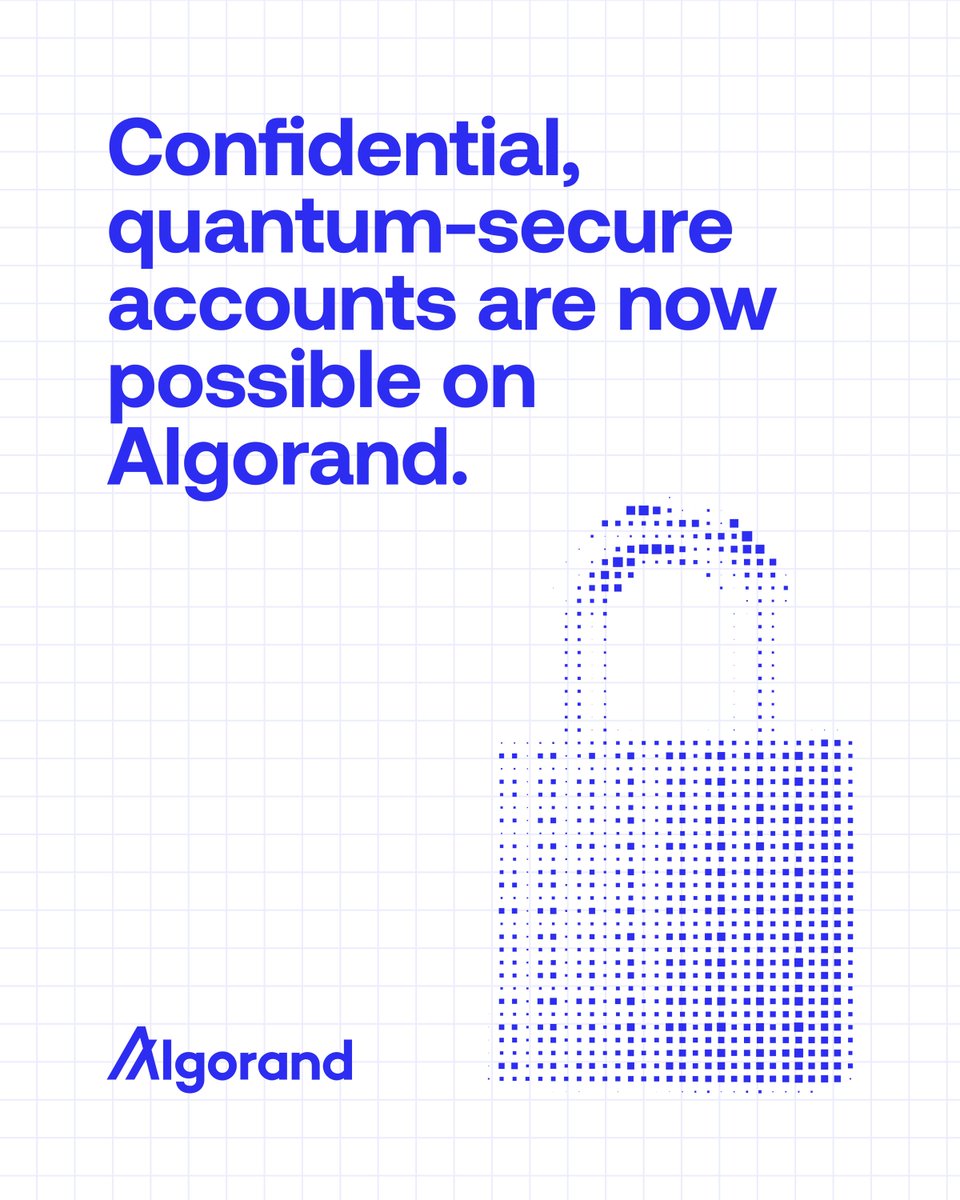
At Algorand, we’re not running away from the inevitable threat of a Post-quantum world, we’re running towards it.
You can now generate Post-quantum accounts on Algorand.
Tech by @giuliopizzini, @cusma_b and @nullun 👨💻
github.com/algorandfoundatio…
Technical brief by @larkinyoung_ 📄
algorand.co/blog/technical-b…
1
3
297

24 Sep 2025
✔️ 9pm EST - Live Stream: Will pytealnerd solve the NYT Wordle in under 4.5 guesses? - alphaarcade.com/market/wordl…
✔️ 9:05pm EST - Live Stream: Will pytealnerd solve the NYT Mini in under 1 minute? - alphaarcade.com/market/mini-…
✔️ 9:06pm EST - Live Stream: Will pyteal solve the NYT Connections with under 2.5 mistakes? - alphaarcade.com/market/conne…
1
5
244

20 Aug 2025
One thing I understood
Really not easy to be a CORE DEV IN AI x Web3
Ai = Solidity
ML = Mokoto, PyTeal
Agentic Ai = Rust
These days really deserves what they are paid in the ranges of Millions per year as salary ✨✨
2
6
171

16 Aug 2025
Algorand's developer ecosystem is strategically positioned to empower Japanese Web3 innovators. This platform offers a robust, efficient, and forward-looking environment crucial for building the next generation of decentralized applications. It is not merely about launching a project; it is about establishing a resilient, scalable presence in the global Web3 landscape.
At its core, Algorand operates on Pure Proof-of-Stake (PPoS). This consensus mechanism delivers unparalleled security, ensuring network integrity against various attacks. Simultaneously, it achieves exceptional scalability, processing transactions with remarkable speed and finality. Transaction costs remain consistently low, often fractions of a cent, making Algorand economically viable for high-volume applications. This foundational strength ensures that developers can build with confidence, knowing their applications reside on a network designed for sustained performance and reliability. Algorand's proven track record of 100% uptime for over six years underscores its operational stability. It fundamentally solves the blockchain trilemma, providing decentralization, security, and scalability concurrently.
The AlgoKit is the cornerstone of the Algorand developer experience. It is the official, comprehensive toolkit designed to streamline the entire development lifecycle. AlgoKit provides native support for both TypeScript and Python, allowing developers to write smart contracts using familiar programming paradigms. This significantly lowers the barrier to entry for many who are accustomed to these languages. The toolkit facilitates automated deployment and application configuration, drastically reducing setup time and potential errors. Developers gain access to a robust local testing environment, complete with a testnet dispenser, enabling rapid iteration and debugging. For visual insights, AlgoKit includes LORA, a web-based visualizer that provides clear, real-time data on on-chain accounts, transactions, assets, and applications. A dedicated visual smart contract debugger further simplifies the identification and resolution of complex code issues. Furthermore, AlgoKit provides project templates, accelerating the jumpstart of common decentralized application builds.
Beyond AlgoKit, the Algorand ecosystem is rich with comprehensive Software Development Kits (SDKs) available in multiple languages, including Python, JavaScript, Go, Java, and Dart/Flutter. This broad support ensures that developers can build applications across diverse platforms and integrate Algorand's capabilities seamlessly. The flexibility extends to smart contract development with languages like PyTeal, Reach, Aqua, Tealish, and TEALScript, which compile to efficient TEAL code. This multi-language approach caters to various developer preferences, fostering a more inclusive and productive ecosystem.
Building a dApp is only the first step. Understanding its performance, user engagement, and market dynamics is paramount for success. Algorand's suite of analytics and monitoring tools provides the crucial data needed for informed decision-making. The Algorand Metrics Dashboard offers real-time insights into the network's health and performance. Pera Explorer and Allo.info serve as robust blockchain explorers, allowing detailed examination of transactions, assets, blocks, and even the inspection of TEAL smart contracts. Asalytic provides a user-friendly interface for exploring blockchain activity, while ChainTrail offers visual data on token movements, enabling clearer insights into on-chain flows. For those focused on DeFi and asset analysis, Vestige stands as an all-in-one platform, delivering historical data on prices, volume, and liquidity across decentralized exchanges. Advanced platforms like Bitquery offer DEX GraphQL APIs for instantaneous trading data, comprehensive market insights, and tools for money flow analysis, which are vital for complex Web3 applications and regulatory compliance. These tools collectively empower Japanese innovators to optimize their dApps and strategically navigate the market.
The Algorand Developer Portal serves as the central hub for documentation, tutorials, and support resources. It features quick-start guides, instructional videos, and an AI chatbot trained on developer documentation for real-time assistance. A vibrant Discord community provides a direct channel for collaboration and support from a global network of Algorand developers. This comprehensive support system is invaluable for both new entrants and seasoned professionals.
For Japanese Web3 innovators seeking a platform that combines high performance, a robust developer environment, and a commitment to sustainability, Algorand offers the definitive solution. Its advanced tooling and unwavering foundational technology provide everything necessary to lead the development of next-generation decentralized applications, shaping the future of Web3 in Japan and on the global stage.
1
204

14 Jul 2025
All the best with your next move, Chris!
Your PyTeal and Beaker courses on YouTube were a massive help for me getting started.
Your 'fix the bug' challenges were also really well done and such a great way to get devs engaged.
1
1
14
246

14 Jul 2025
Web3'te akıllı kontrat yazmak = sadece kod yazmak değildir.
➡️ Web2'de:
Kod bilmek = �
Sistem bilgisi =
➡️ Web3'te:
Kod bilmek (Solidity, Rust vs.) = 0
Blockchain mantığını anlamak (tx yapısı, gas, blok üretimi, state değişimi...) = p
Bu yüzden Web3 yazılımcısı Web2'ye kolay geçer ama Web2 yazılımcısı Web3'e geçmekte zorlanabilir.
👇
Blockchain'lerde Kullanılan Akıllı Kontrat Dilleri :
➡️ Ethereum: Solidity, Vyper
➡️ Polygon: Solidity, Vyper
➡️ Solana: Rust, C, C
➡️ Avalanche (C-Chain): Solidity
➡️ Hyperledger Fabric: Go, JavaScript, TypeScript, Java
➡️ zkSync: Solidity (zkEVM uyumlu)
➡️ BNB Chain (Binance Smart Chain): Solidity
➡️ Arbitrum: Solidity (EVM uyumlu)
➡️ Optimism: Solidity (EVM uyumlu)
➡️ Base: Solidity (EVM uyumlu)
➡️ Near Protocol: Rust, AssemblyScript
➡️ EOSIO / Antelope: C
➡️ Flow: Cadence
➡️ Starknet: Cairo
➡️ Cardano: Plutus (Haskell tabanlı), Plutarch, Pluto, Helios, Aiken, Marlowe, Plu-ts
➡️ Zilliqa: Scilla
➡️ Algorand: TEAL, PyTeal, Reach, Go
➡️ Lisk: JavaScript
➡️ Waves: Ride (Scala tabanlı)
➡️ Qtum: Solidity (x86 VM ile), ayrıca C , Go, Python, Lua destekli
➡️ Ark: JavaScript, TypeScript, Go, Python, Kotlin, Ruby, Swift
➡️ Tezos: Michelson, SmartPy, LIGO, Archetype
➡️ Aion: Java
➡️ Neo: C#, Python, Go, Java, TypeScript
➡️ ICON: Python
➡️ Stacks: Clarity
2
5
48
4,641

7 Jul 2025
Here’s a quick comparison of Algorand and Coreum for you:
Feature Algorand Coreum
Type Layer 1 blockchain 3rd-gen Layer 1, Enterprise-Grade Blockchain (EGB)
Consensus Pure Proof-of-Stake Tendermint PoS (Cosmos SDK)
Transactions/sec Up to ~9,384 max theoretical TPS; real-world ~8.86 TPS Up to 7,000 TPS with 32 validators
Block Time ~2.78 seconds Not specified, but designed for low latency
Finality Instant finality Not specified, but aims for fast, enterprise-grade settlement
Smart Contracts Algorand Smart Contracts (ASC1), PyTeal, on-chain randomness Supports smart contracts, optimized for enterprise and regulatory compliance
Tokenization Algorand Standard Assets (ASAs) at Layer 1 Supports asset tokenization, ISO 20022 compliance, and cross-chain bridges
Interoperability Native, but not Cosmos-based Built on Cosmos SDK, IBC-enabled, connects to 100 chains (including XRP Ledger)
Governance On-chain, decentralized governance Governance features in development
Focus Decentralization, scalability, low fees, energy efficiency Enterprise use, regulatory compliance, interoperability, high throughput
Summary:
Algorand is known for its instant finality, high throughput, and strong decentralization, with a focus on general-purpose blockchain applications and asset tokenization at the protocol layer.
Coreum is built for enterprise use, offering high speed, ISO 20022 compliance, and seamless interoperability with other blockchains, especially through the Cosmos ecosystem and IBC.
If you want the fastest cross-chain and enterprise features, Coreum stands out, but for decentralized finance, asset tokenization, and a mature ecosystem, Algorand is hard to beat!
1
1
95

2 Jul 2025
me in 2024: "why won’t pyteal just WORK??" 😭
me in 2025: "fine, i’ll make my own IDE"
time changes :/
1
16
226