Adegoke Sharafadeen Shola retweeted

Copper-catalysed site-selective arylation of pyrazoles.
nature.com/articles/s41557-0…
1
1
3
organic-chemistry.org/abstra…
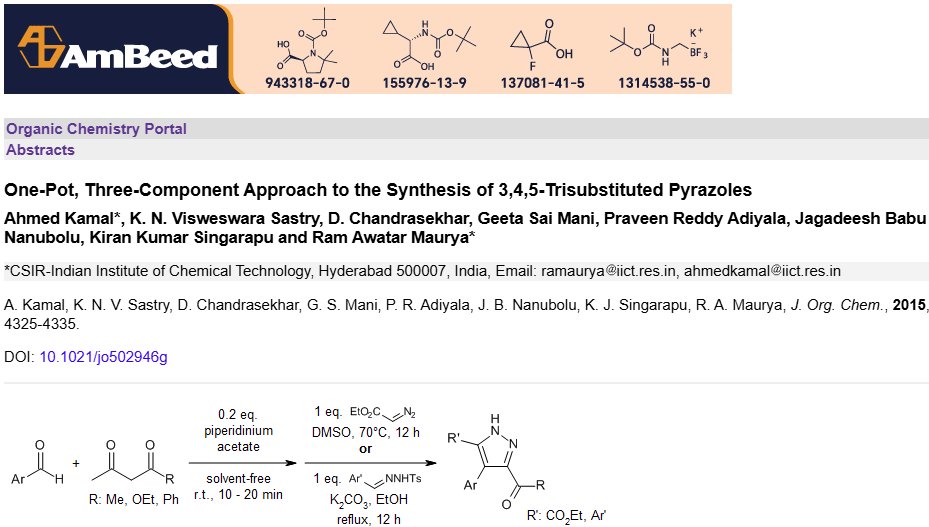
A one-pot, three-component coupling of aldehydes, 1,3-dicarbonyls, and diazo compounds as well as tosyl hydrazones for an operationally simple and high yielding synthesis of polyfunctional pyrazoles
6
455

Apr 27
Read our 25th @ChemCommun, just out on the occasion of 150th years of our home institute @iacskolkata! 🎉🥂 We have utilized LMCT to enable photo-decarboxylation of α,β-unsaturated acids for C–N cross-coupling with pyrazoles! Congrats to @soumya_IACSchem! pubs.rsc.org/en/content/arti…
4
63
2,269

🖇️📌Read our latest article on LMCT enabled photo-decarboxylative C–N cross-coupling of α,β-unsaturated acids with pyrazoles! Just out in @ChemCommun @RoySocChem @iacskolkata
pubs.rsc.org/en/content/arti…
2
2
19
794

Ruthenium Catalyzed Divergent Reactivity of Acceptor–Acceptor DIPOL With Different Thioether Derivatives: Access to Bench Stable Sulfonium Ylides and Alkoxy Pyrazoles (Ramakrishna G. Bhat and co-workers) #TransitionMetalCatalysis
aces.onlinelibrary.wiley.com…
7
287

Apr 18
Step 1 — make the chromane piece. Chromanes are well-established. You can buy chloro-substituted chromane precursors from chemical suppliers like Sigma-Aldrich or Enamine, or synthesize them from a salicylaldehyde derivative via ring closure. One or two steps. The chlorine can go on before or after ring formation — chlorination of an aromatic ring is freshman organic chemistry.
Step 2 — install the amine on the chromane. You need a primary amine hanging off the chromane to react with the urea-forming reagent. Depending on the exact substitution pattern, this could be a reductive amination, a nucleophilic substitution, or it might already be on the commercial building block.
Step 3 — form the urea. This is the central bond. Ureas are among the easiest functional groups to make. Take an amine, react it with a carbonyldiimidazole (CDI) or a phosgene equivalent (triphosgene is the safe version), then add the second amine. Or use an isocyanate — react the chromane amine with the pyrazole isocyanate, or vice versa. One step, high yield, well-established chemistry. This is exactly how sorafenib is made industrially.
Step 4 — make or buy the pyrazole-indazole piece. Pyrazoles are made by condensing hydrazines with 1,3-diketones or enones. Again, many of these are commercially available as building blocks. The specific fused ring system on the right side of PZL-A might require one or two steps to assemble if it's not commercially available, but pyrazole chemistry is heavily precedented.
Step 5 — couple the pyrazole piece to the urea. Already done in step 3 if you're using the convergent approach (make both halves, join them through the urea).
Step 6 — purification. Column chromatography or recrystallization. Standard.
Total cost in a university lab: maybe a few hundred dollars in reagents, a week or two of bench time for someone who knows what they're doing. The starting materials are cheap and mostly commercially available. No exotic reagents, no air-sensitive chemistry, no precious metal catalysts, no cryogenic conditions. It's all room temperature or mild heating, standard solvents, standard glassware.
1
7
654
organic-chemistry.org/abstra…
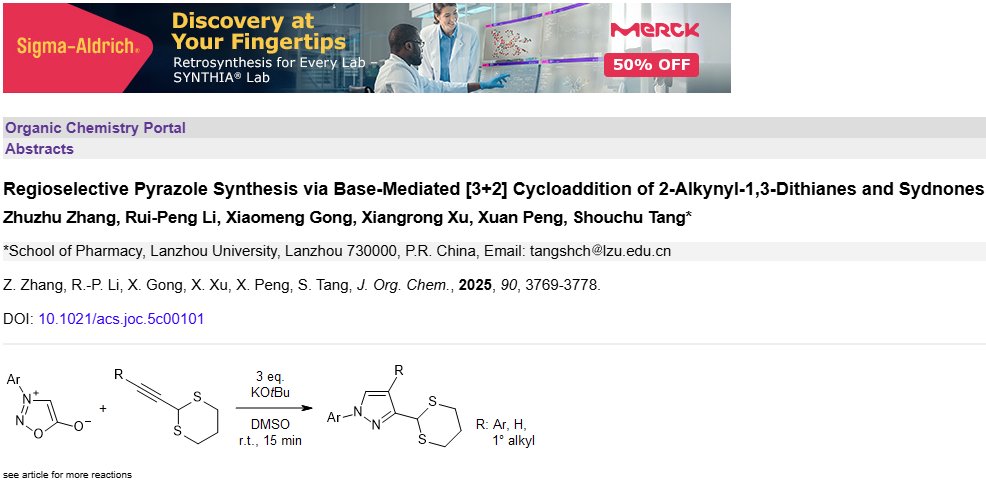
A base-mediated [3 2] cycloaddition of 2-alkynyl-1,3-dithianes to sydnones provides polysubstituted pyrazoles.
8
488
organic-chemistry.org/abstra…
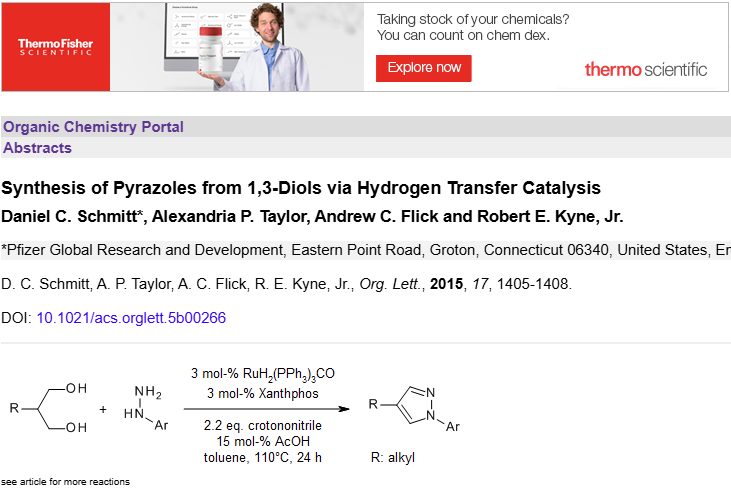
Ruthenium-catalyzed hydrogen transfer of 1,3-diols in the presence of alkyl hydrazines provides 1,4-disubstituted pyrazoles.
5
510

Cu-cat. method synthesizes unsymmetrical N-aryl pyrazoles from TDSOs and diaryl iodonium salts|Switchable and Selective Synthesis of Unsymmetrical N-Aryl Pyrazoles from 1,2,3-Thiadiazine S-Oxides pubs.acs.org/doi/10.1021/jac…
5
40
1,569
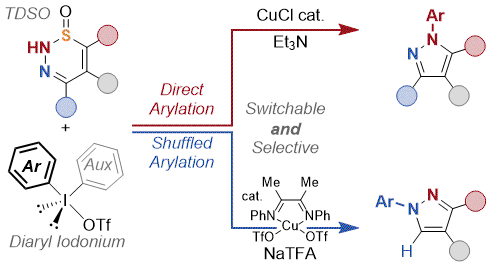
Switchable and Selective Synthesis of Unsymmetrical N-Aryl Pyrazoles from 1,2,3-Thiadiazine S-Oxides. pubs.acs.org/doi/abs/10.1021…
3
22
1,106

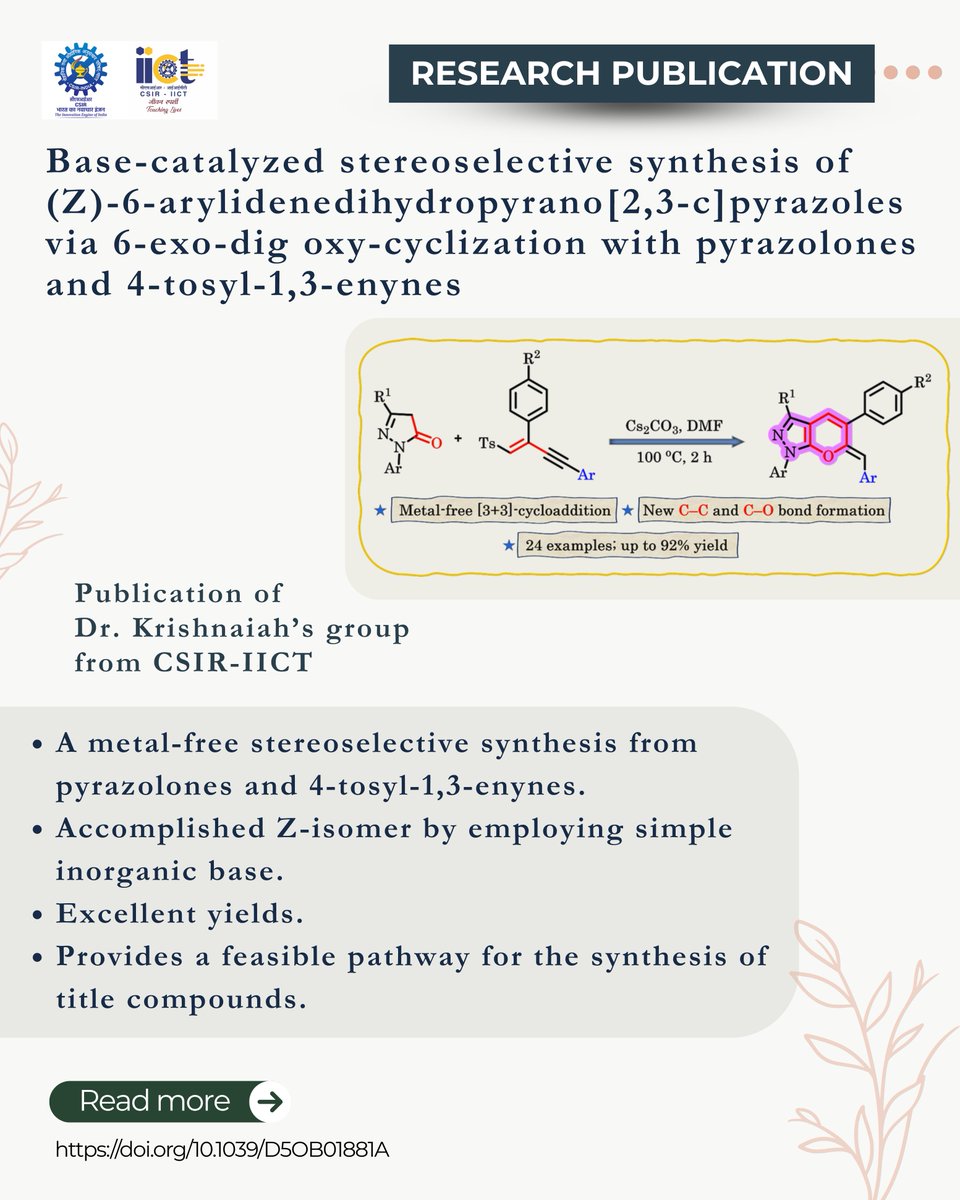
Recent publication on Base-catalyzed stereoselective synthesis of (Z)-6-arylidenedihydropyrano[2,3-c]pyrazoles via 6-exo-dig oxy-cyclization with pyrazolones and 4-tosyl-1,3-enynes by Dr. Krishnaiah’s group from CSIR-IICT.
@CSIRIndia @IndiaDST @CSIR_NIScPR
#chemicalsynthesis
1
3
219
organic-chemistry.org/abstra…
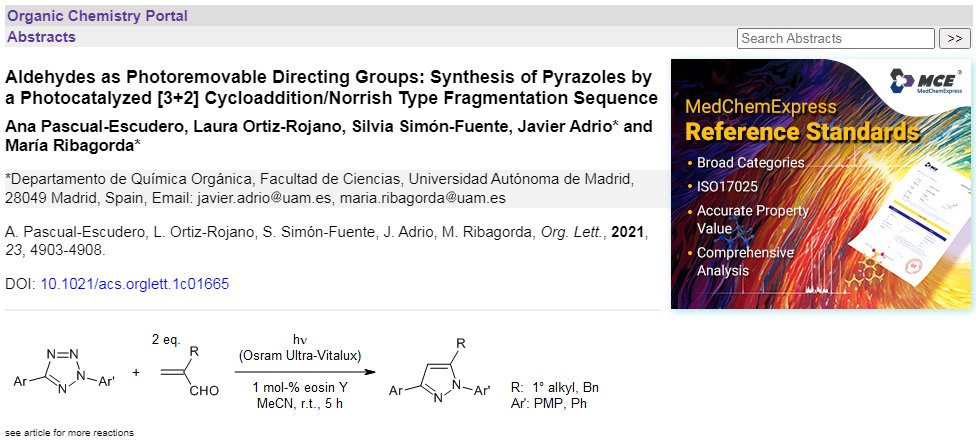
A photoclick cycloaddition followed by a photocatalyzed oxidative deformylation reaction enable a straightforward regioselective synthesis of pyrazoles.
5
337

31 Dec 2025
Another successful collab with @group_levin and the DPR/PMC/HTP groups at @JNJInnovMed is now live! This is our next foray into skeletal editing via the isothiazole to pyrazole swap that allows access to N1 and N2 aryl pyrazoles via Cu catalysis. This paper is especially meaningful as one of the authors, Yaning Liu, is a former top student from my course CHEM746 at the @PennChemistry. As always, truly an honor to have been involved!!!
4
11
125
9,424

31 Dec 2025
Switchable and Selective Synthesis of Unsymmetrical N-Aryl Pyrazoles from 1,2,3-Thiadiazine-S-Oxides | Organic Chemistry | ChemRxiv | Cambridge Open Engage
ピラゾールの位置選択的なカップリングは結構悩む時あるから使える場面あるかも chemrxiv.org/engage/chemrxiv…
17
1,806

30 Dec 2025
Switchable and Selective Synthesis of Unsymmetrical N-Aryl Pyrazoles from 1,2,3-Thiadiazine-S-Oxides. dx.doi.org/10.26434/chemrxiv…
2
547

2 Dec 2025
And here it is – Annulative Editing – aka The Monster Mash. What a super collab #PfizerChemistry & @SarpongGroup
In 1 pot, activated pyrimidines with bis-nucleophiles like amino-pyrazoles & other small hets to deliver 6/5 hets and other useful products
pubs.acs.org/doi/10.1021/jac…
1
5
44
3,133

10 Nov 2025
organic-chemistry.org/abstra…
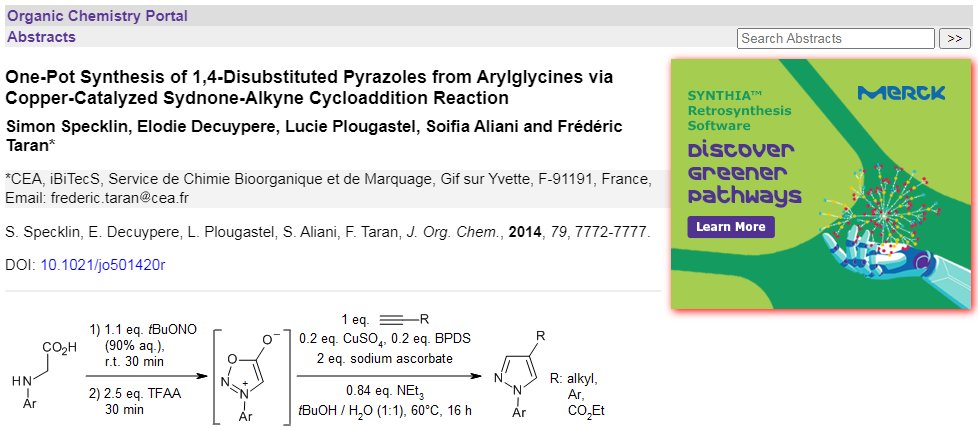
A copper-catalyzed sydnone-alkyne cycloaddition reaction offers a robust, straightforward and general method for constructing 1,4-pyrazoles
1
6
781
4 Nov 2025
organic-chemistry.org/abstra…
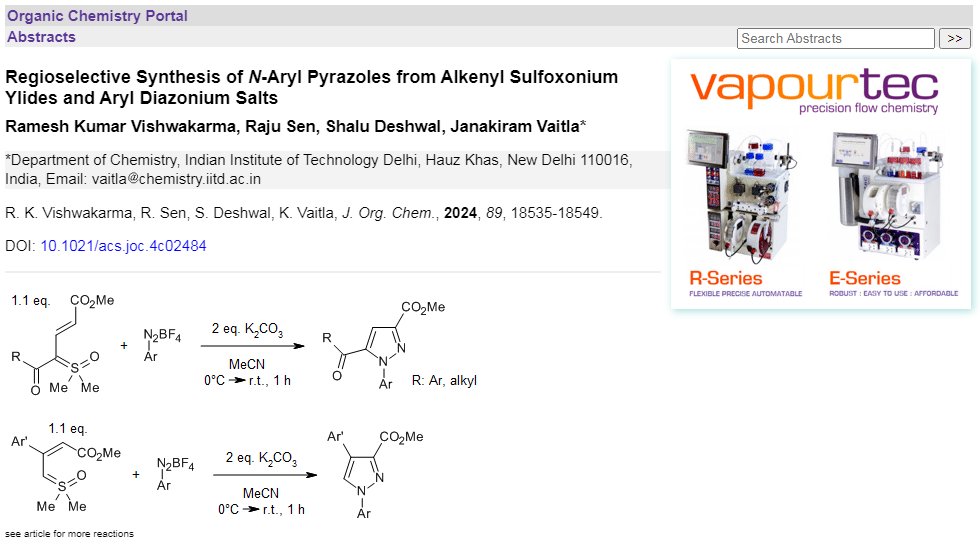
A convenient method enables the synthesis of various N-aryl pyrazoles from vinyl sulfoxonium ylides and diazonium salts.
1
7
749

1 Nov 2025
Check out our latest paper on "A De Novo Approach for the Atroposelective Synthesis of C5 Aryl Pyrazoles via 5-endo-dig Cyclization" now published in Organic Letters @JOC_OL . Congrats @Bhuvi_1995 & @ShreyaTewari_16 .
Thanks to @ANRFIndia for funding.
pubs.acs.org/doi/10.1021/acs…
3
8
59
2,702