
Fud is everywhere. Means nothing, what you just said.
Here’s some good stuff:
Standalone Pyth Network Discussion Summary
Pyth Network Overview
Pyth is a decentralized oracle network specializing in high-frequency, real-time price feeds (crypto, equities, FX, commodities, etc.). It aggregates data from 125 institutional first-party publishers and delivers it across 50 blockchains.
Pyth’s Wormhole Integration (Pre-Upgrade)
• Prices aggregate on Pythnet (Solana-based).
• Pythnet emits Wormhole messages with Merkle roots of price updates.
• Wormhole Guardians (19 nodes, 13/19 quorum) produce signed VAAs.
• Hermes relay service combines VAAs with price data Merkle proofs.
• Consumers fetch from Hermes and submit to on-chain Pyth contracts for verification via Wormhole proofs.
• This enabled broad cross-chain distribution in a “pull” model.
Pyth Pro Upgrade (July 31, 2026)
• Replaces legacy Pythnet Wormhole guardians with Pyth Pro infrastructure.
• 5 independent routers instead of 19 guardians.
• 3-of-5 signatures quorum.
• Backward-compatible APIs/ABIs; DAO auto-upgrades contracts on major chains.
• Introduces paid subscription tiers for Hermes API access (Starter ~$500/mo, higher Pro plans).
• Benefits: Lower latency, broader assets, higher frequencies, sustainable revenue model.
Pyth Pro Router Mechanics
• Part of a five-service pipeline: Publishers → Relayers → Message Queue → Routers → History Service.
• Routers independently:
• Consume ordered updates.
• Run deterministic aggregation (median price, IQR confidence intervals, bid/ask, etc.).
• Distribute via WebSocket (real-time or fixed-rate), HTTP, and on-chain payloads.
• High availability with geographic distribution and circuit breakers.
Pyth Pro Merkle Tree Construction
• Routers aggregate prices first.
• Create leaves using Pythnet-compatible serialization format.
• Build a standard binary Merkle tree:
• Hash individual leaves.
• Pairwise hash parent nodes up to the single Merkle root.
• Handle odd nodes via standard padding.
• Each of the 5 routers signs the root.
• Consumers provide: root 3/5 signatures Merkle proof for specific feeds.
• On-chain contracts verify quorum recompute root from leaf proof.
Key Advantages Post-Upgrade:
• Self-sovereign (less reliance on external guardians).
• Maintains efficiency (O(log N) proofs, low gas).
• Institutional-grade performance while staying compatible.
Official Resources:
• Docs: docs.pyth.network
• Upgrade Guide: Pyth Core Upgrade
• Pyth Pro: How Pyth Pro Works
• Terminal: app.pyth.com/plans
1
37

Jun 13
. @PythNetwork is one of the largest and fastest decentralized first-party oracle networks in the blockchain ecosystem.
It is designed to safely and transparently bridge real-world financial data (such as crypto, equities, FX, and commodities) with smart contracts across dozens of blockchain networks.
1. Core Purpose & Value Proposition
Smart contracts are deterministic, meaning they cannot inherently look outside their native blockchain to fetch external real-world information. Oracles solve this "oracle problem."
Pyth Network distinguishes itself through two main innovations:
First-Party Data: Traditional oracles often rely on third-party scrapers or node operators to aggregate data from public websites.
Pyth aggregates data directly from major, primary sources such as global exchanges, market makers, and institutional trading firms (e.g., Binance, Cboe, Jump Trading). Because these publishers own the data, it is faster, highly accurate, and manipulation-resistant.
The "Pull" Oracle Model: Rather than constantly "pushing" data updates onto a blockchain at fixed intervals (which wastes gas and causes latency issues), Pyth stores its price feeds off-chain or on its specialized appchain.
When a decentralized application (dApp) actually needs a price such as during a trade or a collateral liquidation it "pulls" the latest cryptographic signed price directly onto the destination blockchain, significantly reducing network congestion and cost.
2. Architecture & How It Works
The protocol is split into a streamlined multi-tier architectural process:
Publishers: Over 120 institutional financial data providers sign and submit their proprietary, real-time price data into the network.
Pythnet: A dedicated application-specific blockchain (appchain) built on the Solana Virtual Machine (SVM).
Pythnet serves as the foundational computation layer where data from all these individual publishers is collected and combined using a stake-weighted aggregation algorithm into a single reference price and confidence interval.
Hermes & Cross-Chain Communication: Once aggregated on Pythnet, the data is pushed out via cross-chain messaging solutions like the Wormhole protocol.
An off-chain price service called Hermes acts as a gateway, allowing web applications and smart contracts to fetch these verified, signed price update messages seamlessly.
Consumers: The end users primarily decentralized finance (DeFi) protocols, lending apps, and derivatives platforms who pay a nominal fee to inject the signed updates into their native smart contracts.
The Data Structure
Every Pyth price feed includes more than just a number. It consists of:
Price: The current value of the asset.
Confidence Interval (±): A unique feature representing the statistical spread or uncertainty of the price across multiple exchanges, heavily protecting DeFi apps during moments of high market volatility.
Exponent: The scaling factor for the price decimal point.
Publish Time: A strict Unix timestamp to guarantee data freshness.
3. Core Product Ecosystem
Pyth has diversified its infrastructure into three prominent layers:
Pyth Core: The main decentralized price feeds. It supports an update frequency of roughly 400ms across over 100 blockchains. It covers hundreds of asset tickers across crypto, FX, equities, and ETFs.
Pyth Pro: A premium, subscription-based service catering to institutional and advanced enterprise use cases. It offers customized low-latency channels and dedicated API access.
Pyth Entropy: A secure, verifiable on-chain Random Number Generator (RNG) used extensively by gaming protocols, NFT mints, and lottery dApps on EVM-compatible chains.
Pyth Benchmarks: A historical price database that allows users and developers to look up past cryptographic prices for backtesting trading strategies or calculating retrospective finance metrics.
4. The $PYTH Token & Governance
The native cryptocurrency of the network is PYTH, an SPL token (native to Solana) that serves several crucial purposes:
Governance: PYTH holders can stake their tokens to participate in the Pyth DAO. Governance votes dictate critical parameters such as network fee models, listing criteria for new assets, how data publisher rewards are distributed, and overall software upgrades.
Value Accrual & The PYTH Reserve: Part of the protocol's revenue (including enterprise fees generated via Pyth Pro) is directed toward economic sustainability mechanisms. The Pyth DAO governs capital allocations to incentivize data providers and secure the infrastructure layer.
Official Channels & Web Resources
To stay updated, interact with the developer kits, or dive deeper into their source code, you can use the official links:
Official Website: pyth.network
Developer Hub & Documentation: docs.pyth.network
X (formerly Twitter): @PythNetwork
GitHub Repository: github.com/pyth-network

3
1
19
194
Mhimey | BRE3 | $EDM retweeted

Jun 11
A market without good data is like a GPS without location.
It exists… but good luck getting where you’re going 😂
@PythNetwork
2
6
23
GODWIN 💎 retweeted

Jun 11
Most people think Pyth is a crypto oracle, but what if I told you it’s quietly becoming something much bigger?
@PythNetwork isn’t building for crypto anymore, at least not ONLY for crypto.
The latest asset expansion makes that very clear 🔮✨
12
6
26
373


Dude actually did it
Somebody just tattooed their forehead for a $10 bounty on the new pumpfun feature to force big @PythNetwork week
Was it worth it? Be honest
Jun 8

Big week 🕐⏰♾🔄
5
2
24
359
bigbob retweeted

Jun 8
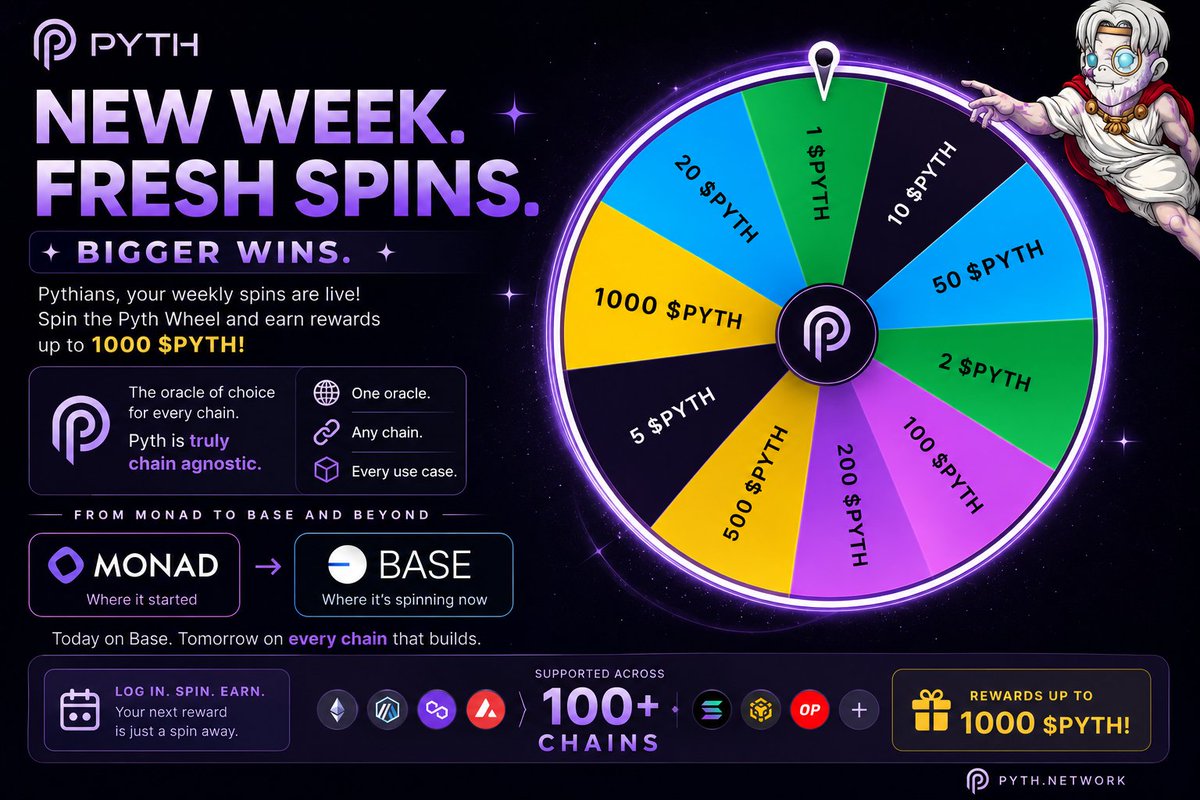
New week. New spins for the Pythians 🌄
Monad yesterday. Base today.
Tomorrow? Anywhere. 🗺️
That's the power of @PythNetwork 🔮
One oracle. 100 chains. Infinite possibilities. ⚡
5
1
18
363

Jun 4
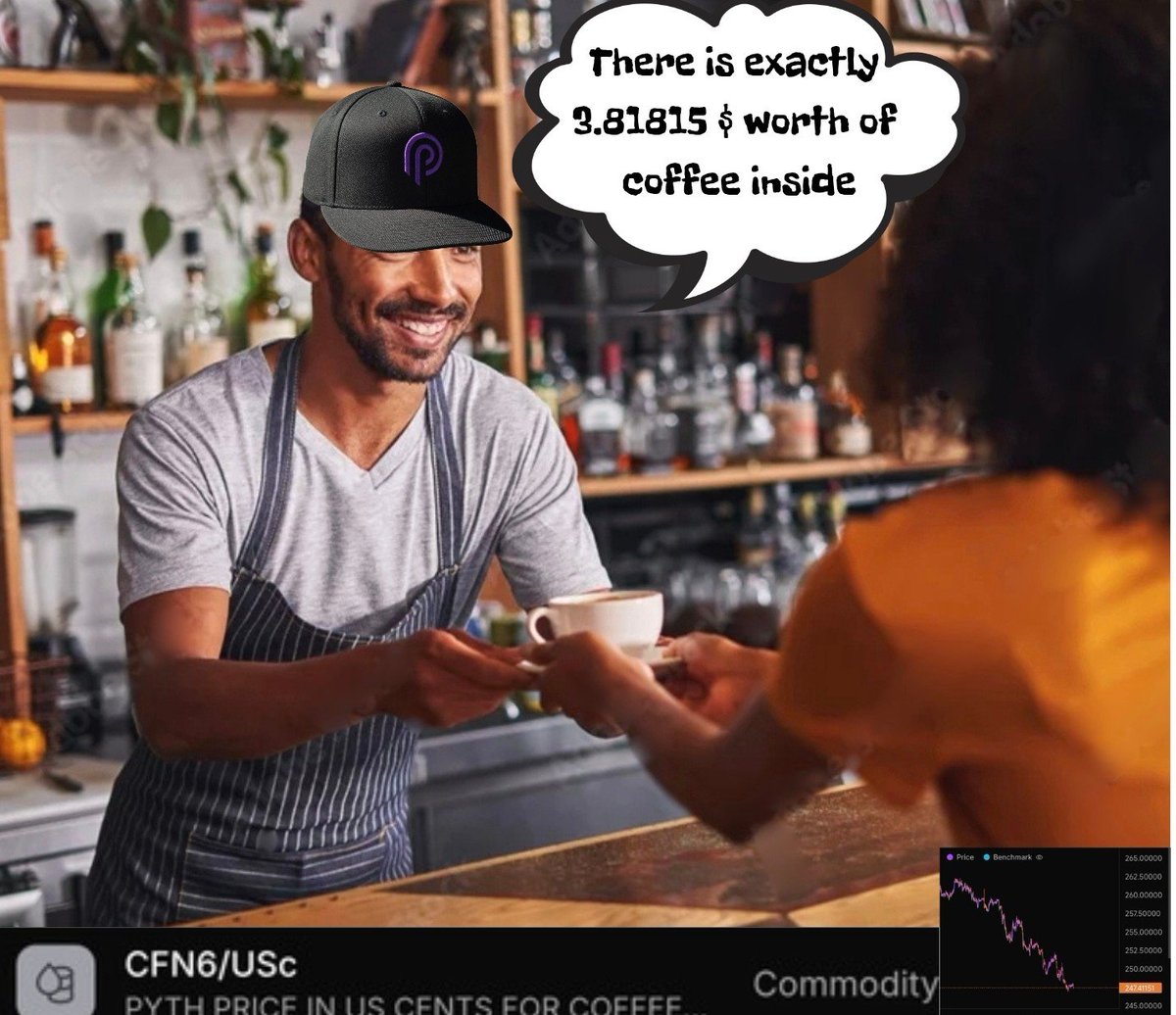
The @PythNetwork Terminal is your home for exploring price feeds and managing your Pyth Pro API access 🏛️
Scroll throug 3,000 feeds across crypto, FX, equities and commodities ⛓️
See the data 👀🫱🏽🫲🏽
compare the prices 🤏🏽👌🏽
pick the Tier that fits 🫵🏽
Now you 🚢 it with ease 🔮
How
Off-Chain Fetching ⏬ Querying real-time prices like the COFFE\USD or any other asset via the public Hermes AP 🔥
The price_service/client directory provides an SDK for interacting with Hermes.
What is SDKHermes:
an off-chain service which constantly observes Pythnet and the Wormhole network watching for price updates emitted from the $PYTH contract 🪽
It exposes all observed attestations via a public API over HTTPS/WSS which can be consumed by client-side applications that wish to use Pyth pricing data 😇
Awesome 🙌🏽
Like you will ever use anything else 😏
May 20
The Pyth Terminal is live.
The new interface to explore live price feeds, compare them against benchmarks, and sign up for Pyth Pro.
Free to access. Open to the public 🧵
2
1
8
225

Jun 2
Another month. Another stack of @PythNetwork updates
Kraken lists PYTHOIL - First major CEX to list a Pyth Index product, bringing 24/7 oil exposure to retail.
70 Hong Kong equities live - Comprehensive HK stock coverage now available on Pyth Pro.
Pyth Core/Pythnet sunset announced - Legacy infrastructure to be deprecated by end of July 2026.
IPO day-one support - CRBS listed on Pyth within hours of IPO.
BitMEX launches FX perpetuals powered by Pyth Pro.
Cardano Foundation integrates Pyth Pro.

5
1
18
323

They built Pythnet to handle all of this.
It's basically a purpose built blockchain where all these publishers submit price data constantly every 400 milliseconds.
Then an algorithm combines everything into one price, plus a confidence interval showing how certain that number is.
1
3
18


May 31
The Day the Drum stops
Let me tell you about the day LUNA collapsed.
May 2022 if you were in crypto then, you remember the spiral.
The algorithmic stablecoin UST lost its peg.
LUNA went into freefall.
Prices moved so fast that most systems could not keep up.
I was watching a Discord channel where developers were troubleshooting in real time.
One protocol after another was reporting wrong prices
Their oracle had frozen.
Not because the market stopped.
But because their oracle had a circuit breaker.
It stopped publishing when LUNA dropped below ten cents.
So if you held LUNA, the system thought you still had most of your money. But You did not.
Here is what happened.
Chainlink hit a floor. Their system simply refused to update below a threshold.
This sounds like safety, It is not.
It is a lie.
Your smart contract is now acting on data that is hours old.
In a crash like that, hours is an eternity.
Now here is what I found interesting.
@PythNetwork kept tracking LUNA through the whole thing.
No freeze. No circuit breaker,Why?
Because Pyth does not use third-party relayers to fetch prices.
Pyth publishers are exchanges and market makers.
These people were still trading LUNA.
They were still publishing real-time data.
Pyth was pulling that data directly.
I want to explain the pull model because this is the part that confused me at first.
Think of it like this.
Most oracles work like a news alert on your phone.
The alert pushes to you whether you need it or not.
It might arrive at the wrong time. It might be outdated. You did not ask for it.
Pyth works like Google search.
You pull the data when you need it.
The data sits on chain ready for you.
You query it. You get your answer. You move on.
The pull model has three advantages I want you to understand.
First, speed. You get data when you ask for it. No waiting for the next scheduled push.
Second, cost. You only pay when you pull. No wasted updates. No paying for data nobody used.
Third, accuracy. The data on chain is the data that was published. It reflects real market conditions at publish time.
Let me walk through how Pyth actually works.
Step one is publishers.
Exchanges and market makers push price data to Pyth.
These are the same firms that execute real trades.
Their data is not an estimate. It is what they are actually quoting.
Step two is aggregation.
Pyth combines data from multiple publishers.
It does not just average them. It weights them by reliability and volume.
Then it outputs a price with a confidence interval.
That confidence interval is brilliant.
Let me say it again because most people skip over this.
@PythNetwork does not just tell you the price. It tells you how certain it is.
A price of $60,000 with a confidence interval of plus or minus fifty cents tells you the price is very tight.
A price of $60,000 with a confidence interval of plus or minus fifty dollars tells you there is some uncertainty.
For liquidations and leveraged positions, that difference is everything.
Step three is storage
Pythnet holds the aggregated data.
Pythnet is Pyth's own blockchain built on Solana.
Fast finality. Low fees. High throughput.
This is where the data lives while applications pull it.
Step four is delivery
Wormhole bridges the data across chains.
Solana, Ethereum, Arbitrum, Polygon, and thirty-plus others.
One data source. Forty-plus destinations.
Now think about what this enables.
Perpetual DEXs need sub-second price updates.
If your oracle is slow, traders get front run.
Their orders sit pending while the price moves against them.
Drift Protocol figured this out.
They built on Solana for speed. They partnered with Pyth for data.
Together they created one of the fastest perp platforms in DeFi.
I want you to take something from this.
Oracle choice is not a technicality.
It is a fundamental decision that affects every trade your users make.
Slow data costs traders money
Pyth learned from these failures The architecture reflects real scars from real disasters.
May 30

The Problem No one Was Talking About
I remember the first time I tried to build something on Ethereum.
I had this idea for a simple lending contract. User deposits collateral, borrows against it. Basic stuff.
Except I hit a wall almost immediately.
My smart contract had no idea what ETH was worth.
It could not fetch the price from anywhere.
The blockchain is sealed off from the outside world. It has no eyes. It has no ears.
That was when I first understood what oracles actually do.
An oracle is the bridge between a blockchain and reality.
Without one, your DeFi app is flying blind.
I see people still confused about this today. They hear the word oracle and think of ancient Greek priests.
The oracle problem is simple.
Blockchains are deterministic. They agree on everything inside the system.
But what about data that lives outside the system?
Like asset prices. Interest rates. Weather data. Anything that changes in real time.
Think about it this way.
A smart contract is a deal written in code.
The code executes automatically when conditions are met.
But who tells the code what those conditions actually are?
If your lending app needs to know if ETH dropped below $1,500, somebody has to feed that number on chain.
That somebody is an oracle.
I watched a lot of DeFi projects fail in the early days.
Most of them did not fail because of bad code.
They failed because they trusted the wrong price feeds.
A protocol would use a single data source.
That source would glitch. Or get manipulated. Or just stop updating.
Suddenly the whole system breaks.
Millions lost in minutes.
That is when I started paying attention to oracle design.
I found @PythNetwork about a year after it launched.
What caught my eye was not the marketing.
It was a conversation in a Discord server.
A developer was explaining how Pyth aggregates price data.
He said something that stuck with me.
He said most oracles give you an answer. Pyth gives you an answer and tells you how sure it is about that answer.
That is the confidence interval thing.
I had never heard another oracle talk like that.
Here is what impressed me most about Pyth.
The data comes from actual market participants.
Not nodes running scripts.
Not third-party aggregators pulling from APIs.
Real exchanges. Real market makers. Real trading firms.
These are the people with skin in the game.
They are already trading these assets.
Their data reflects actual supply and demand.
I started digging into how many blockchains Pyth supports.
Forty-plus at the time. More now.
That was surprising.
Most oracles start on Ethereum and expand slowly.
@PythNetwork was everywhere at once.
Cross-chain was built into the model from day one.
That told me something about the ambition here.
I ran the numbers on usage.
$1 billion secured. $100 billion in trading volume. Hundreds of integrations.
This was not a science project anymore.
This was infrastructure.
Real money flowing through Pyth price feeds every single day.
That is when I knew I had to understand this deeply.
So that is the setup.
Blockchains are blind. Oracles give them sight.
Most oracles are slow, indirect, and use secondhand data.
@PythNetwork is fast, direct, and pulls from the source.
Tomorrow I will show you exactly how the pull model works.
This is the part that took me a while to fully grasp.
But once it clicks, everything makes sense.
2
5
460