
🐍 Make It Pythonic
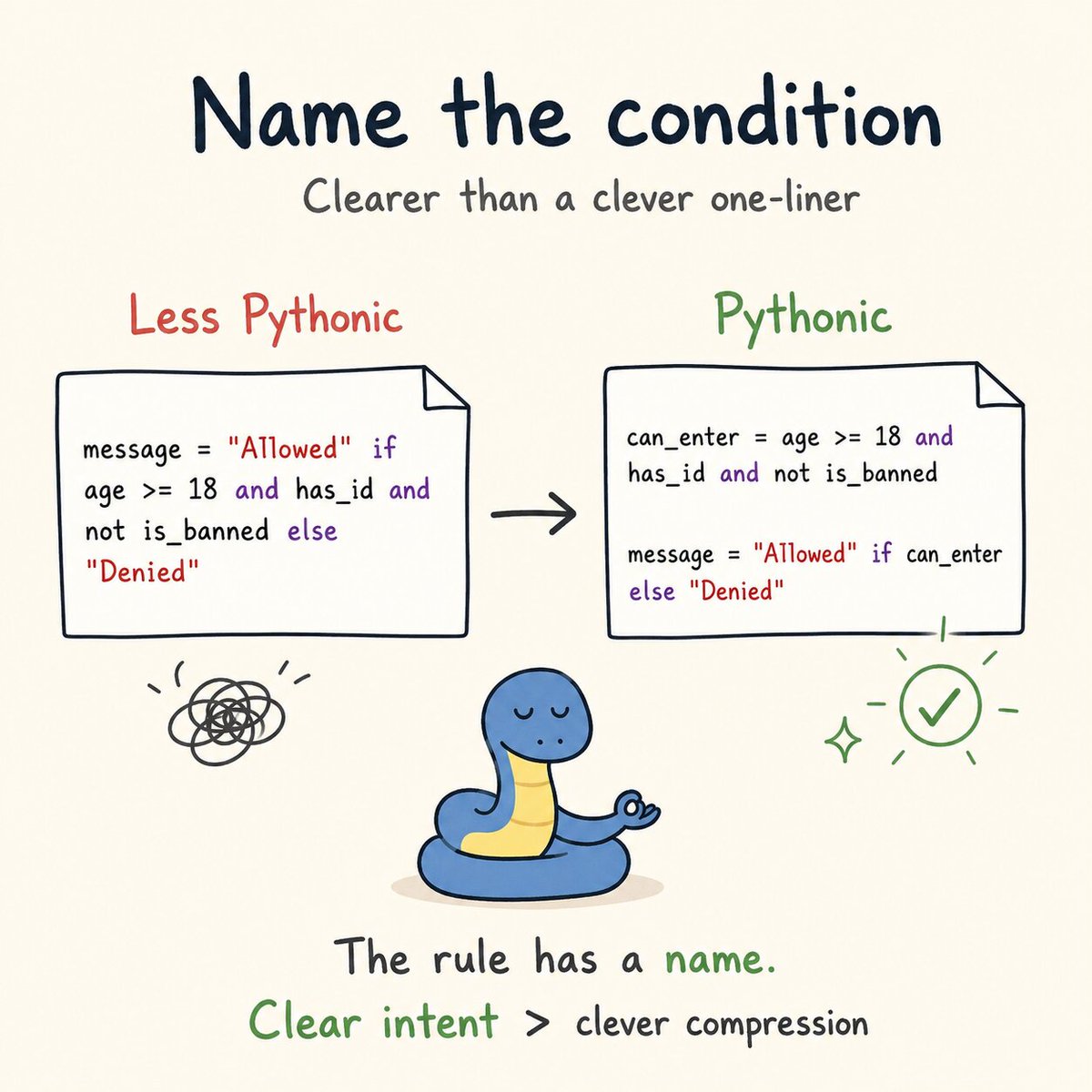
A one-liner can look smart… until you come back next week and ask:
“What was I trying to do here?” 😅
Instead of writing:
message = "Allowed" if age >= 18 and has_id and not is_banned else "Denied"
✨ Write it the Pythonic way:
can_enter = age >= 18 and has_id and not is_banned
message = "Allowed" if can_enter else "Denied"
The condition is now named.
So the code tells the reader what the rule means, not just how it works.
One line is enough only when one line is clear.
#Python #PythonCode #Coding #Programming #CodeNewbie #100DaysOfCode #Developer #AI #PythonTips
13

Quick Python tip for data analysts:
Instead of looping through rows to calculate totals, use:
df.groupby('category')['sales'].sum()
One line. Faster. Cleaner.
Want 49 more exercises like this? 👇
jacobisah.selar.com/50python…
#PythonTips #DataAnalyst

11
🐍 Make It Pythonic
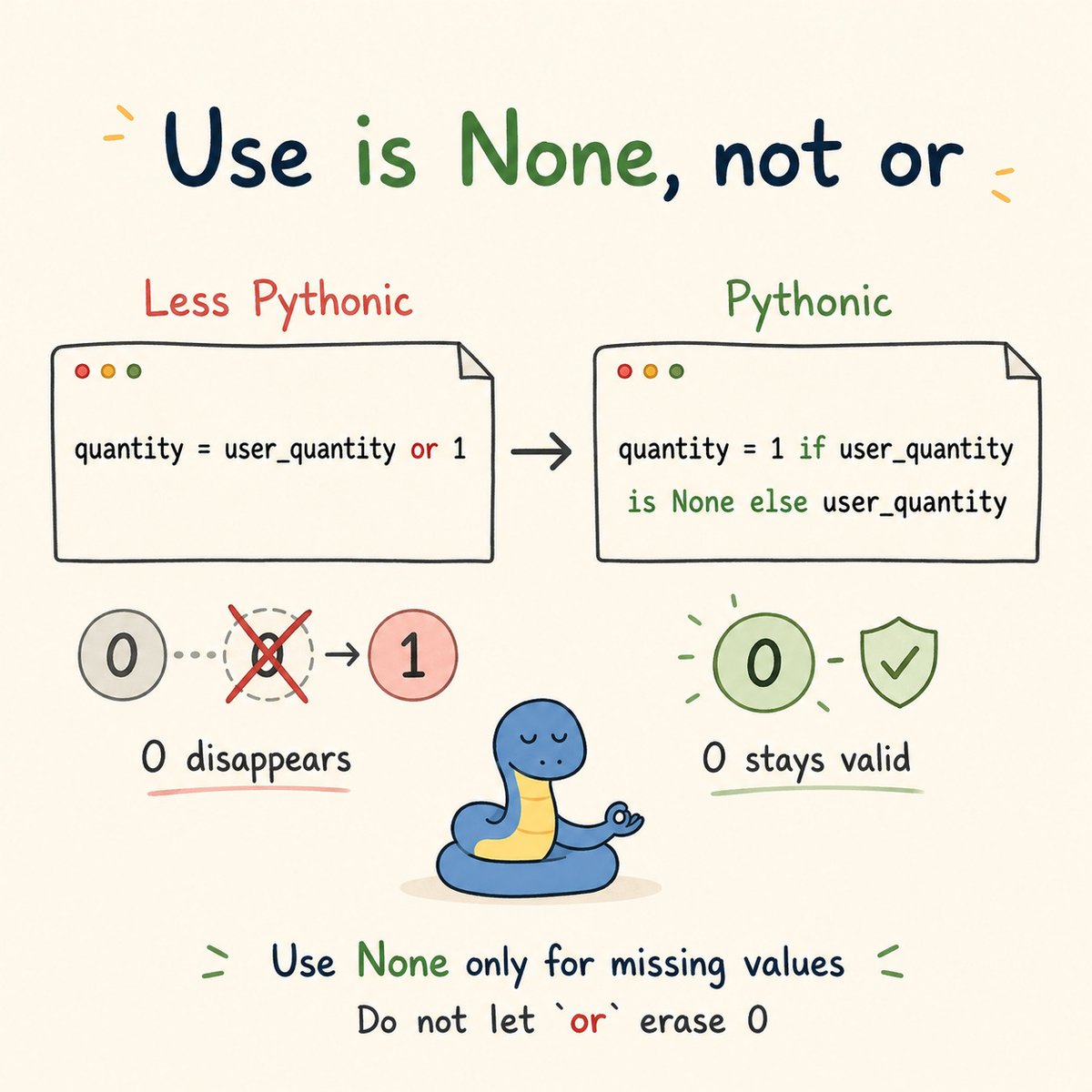
The or trick looks nice… until a real value disappears.
Instead of writing:
quantity = user_quantity or 1
✨ Write it the Pythonic way:
quantity = 1 if user_quantity is None else user_quantity
If user_quantity is 0, the first version replaces it with 1.
But sometimes 0 is a valid value.
Use is None when you only want a default for missing values.
When 0 is a real answer, do not let or erase it. 🐍
#Python #PythonCode #Coding #Programming #CodeNewbie #100DaysOfCode #Developer #AI #PythonTips
1
27

Here's a Python snippet that surprises most developers:
x = 10
def show():
print(x)
def modify():
print(x) # UnboundLocalError
x = 20
show() # prints 10
modify() # crashes
Same variable. Same function structure. Two completely different outcomes.
This isn't a bug. This is Python working exactly as designed.
Once you understand scope, this makes perfect sense. Until you do, it looks like the interpreter is making arbitrary decisions.
The LEGB rule explains everything, how Python decides which variable it's reading, why closures remember values, and when global and nonlocal are the right tool versus a design smell.
I put it all in a free guide:
- The complete LEGB lookup chain with annotated examples
- Closures and late binding demystified
- global and nonlocal, mechanics and when to avoid them
- The scope patterns that produce silent, hard-to-trace bugs
python-variable-scope.develo…
#Python #PythonTips #SoftwareEngineering #CodeQuality
13

☠️ Exception Handling:
No matter:
> How good your logic is
> How clean your code is
> How detailed your documentation is
If you don't handle exceptions, you're shipping bugs, not features.
Production doesn't care about your perfect happy path.
Any day:
❌ Network can fail
❌ Database can timeout
❌ API can return unexpected data
❌ User can provide invalid input
> A design pattern isn't complete without exception handling.
> An architecture is incomplete if it assumes everything will always work.
Great engineers don't just write code that works.
They write code that fails gracefully, recovers intelligently, and logs meaningfully.
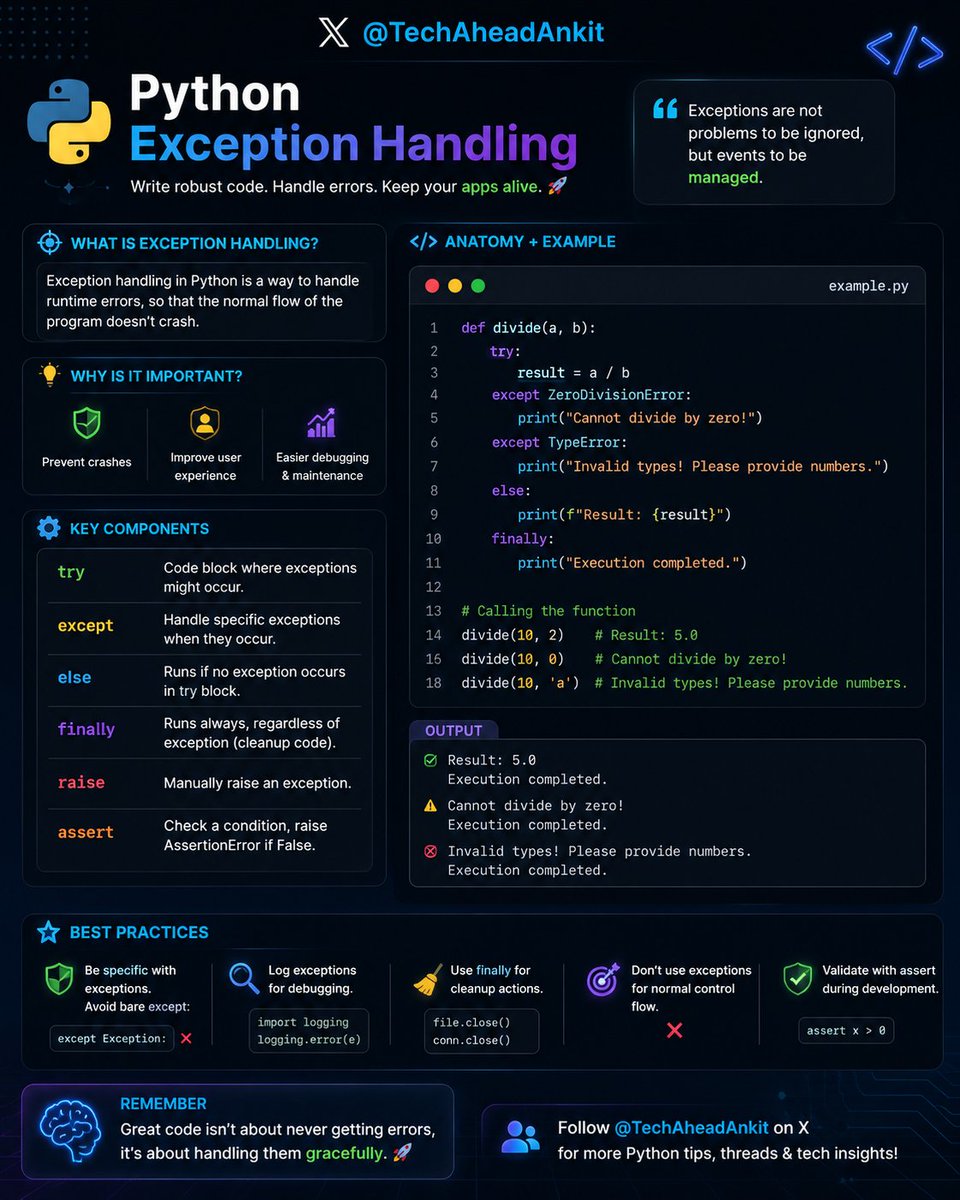
try → Detect
except → Handle
else → Continue
finally → Clean up
Exception handling isn't an afterthought.
It's part of the design.
#Python #Programming #Coding #SoftwareEngineering #Backend #Developer #Tech #PythonTips
1
3
145

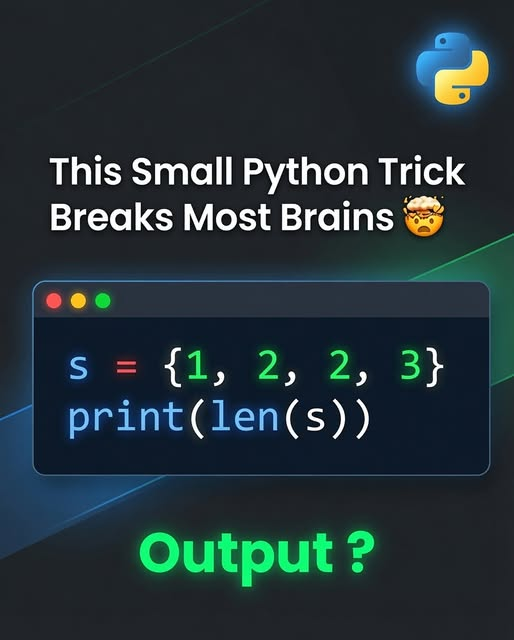
🚀 This Small Python Trick Will Level Up Your Data Science & Software Engineering Skills!
```python
s = {1, 2, 2, 3}
print(len(s))
#Python #DataScience #SoftwareEngineering #CodingTips #PythonTips #DataEngineering #MachineLearning #Programming
1
1
267
🐍 Make It Pythonic
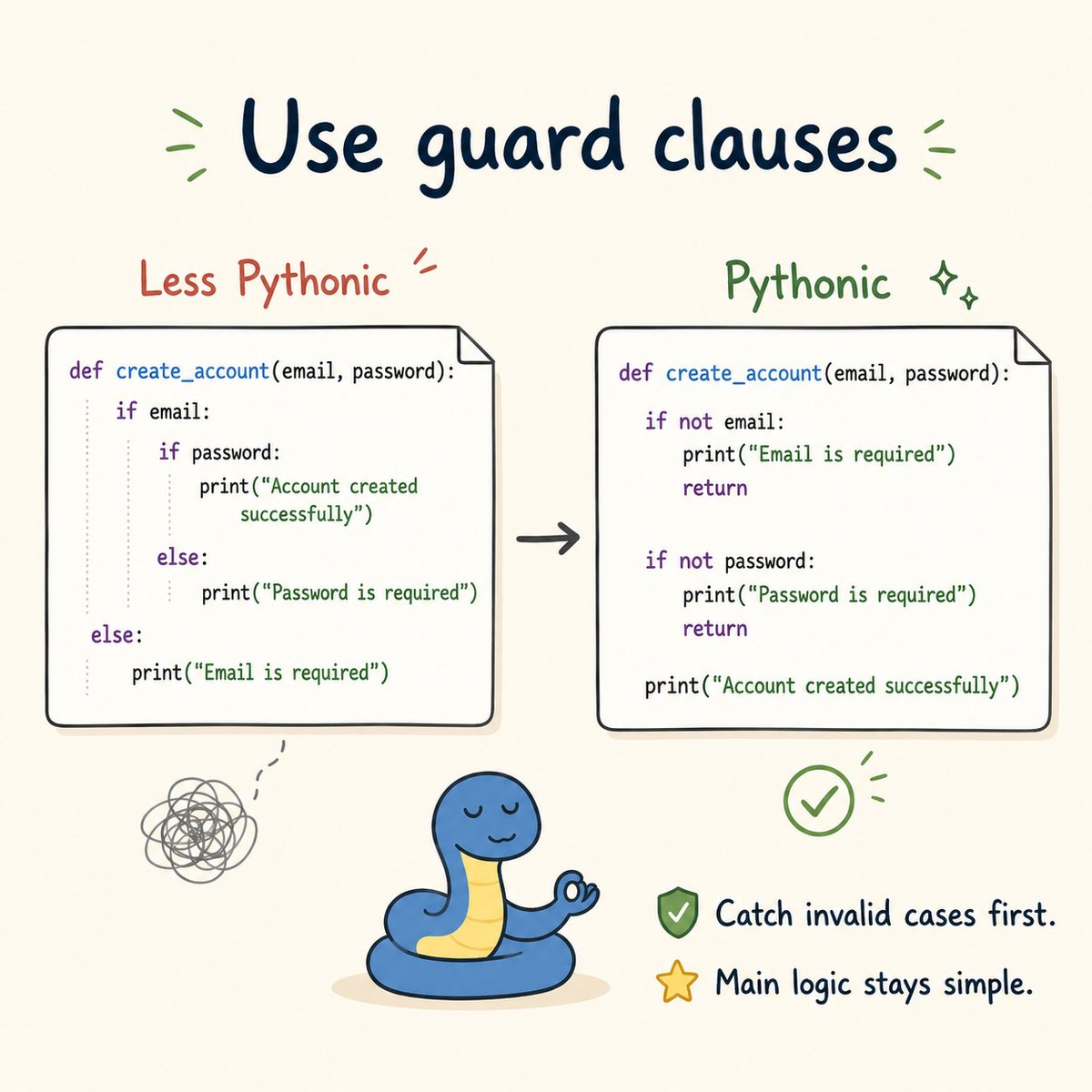
A function is easier to read when the invalid cases are handled first.
Instead of writing:
def create_account(email, password):
if email:
if password:
print("Account created successfully")
else:
print("Password is required")
else:
print("Email is required")
✨ Write it the Pythonic way:
def create_account(email, password):
if not email:
print("Email is required")
return
if not password:
print("Password is required")
return
print("Account created successfully")
These are called guard clauses.
They deal with invalid input before the main action begins.
Catch the invalid case first, so the main logic stays simple. 🐍
#Python #PythonCode #Coding #Programming #CodeNewbie #100DaysOfCode #Developer #AI #PythonTips
1
1
23

💡Python tip: Match makes your code readable 👇
#PythonTips #LearnPython #PythonBasics
youtu.be/DcpRnGC7w7g
1
1
33

Who believes that majority of Kenya is rigid when it comes to tech...🤔
#FastAPI
#Python
#PythonDeveloper
#PythonProgramming
#PythonCode
#PythonTips
#Coding
#Programming
#Code
#Coder
#Developer
#SoftwareDeveloper
#SoftwareEngineering
#SoftwareEngineer
6
from idea to design in a few minutes , google stitch antigravity , dm if you want the full playbook.🔥
#FastAPI
#Python
#PythonDeveloper
#AI
#claude
#PythonCode
#PythonTips
#stitch
#Coding
#Programming
#Code
#Coder
#Developer
#SoftwareDeveloper
#AgenticAI
#IndieHacker
33

Jun 5
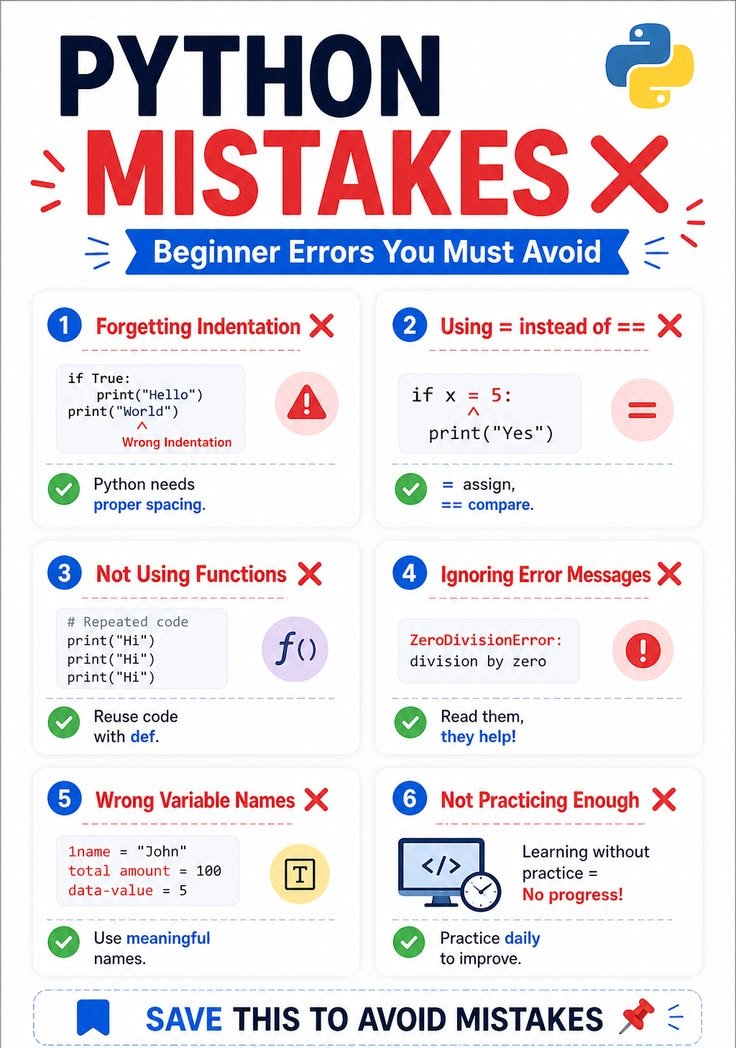
Stop making these common Python mistakes ❌
Fix your basics fast and code like a pro 🚀
This Python cheat sheet covers beginner errors you must avoid, from indentation to variable naming.
Perfect for anyone learning python basics, coding notes, and preparing for interviews.
Save this to quickly revise and improve your programming basics anytime.
Save this for later 📌 and level up your coding faster!
#python #learnpython #programming #pythontips
2
22
129
3,814

May 27
Python print new line. More options than you think. More edge cases than you want.
Kimberly Fessel's complete guide:
roadmap.sh/python/print-new-…
#Python #Developer #Programming #LearnPython #PythonTips
5
187
5 Python built-in functions every beginner must know:
len() — length of anything
range() — generate number sequences
enumerate() — loop with index
zip() — combine two lists
sorted() — sort any list
Save this. You'll use all 5 today.
#Python #PythonTips #LearnPython

2
23
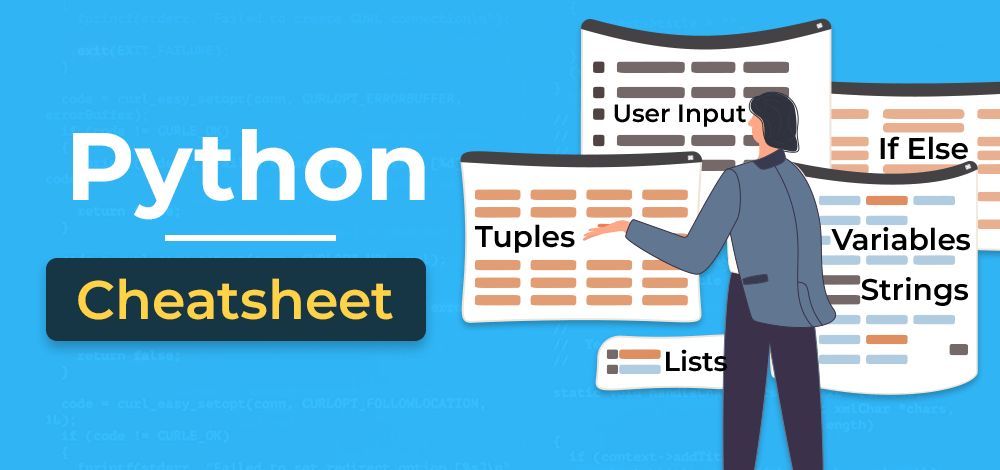
Python tip for beginners
Stop writing long if/else chains.
Use a dictionary instead 👇
pythongrades = {90: "A", 80: "B", 70: "C"}
score = 85
grade = grades.get(score // 10 * 10, "F")
Your code will thank you.
enemzy.blogspot.com/
#Python #PythonTips #CodeNewbie
1
2
46

May 23
2
14

May 5
Handling millions of files can crash your program if resources aren’t properly closed.
For this week’s #PythonTips, learn how context managers help by ensuring files, database connections, and more are cleaned up automatically, even when something breaks.
1
5
748
Apr 29
If you write research software, a CITATION.cff file helps others cite your code correctly.
This week’s #PythonTips explores how to generate a CITATION.cff file, add it to your GitHub repo, and create a “Cite” button.
citation-file-format.github.…
4
8
2,635

Ready to master Python loops? 🚀 Learn how the range() function works to control your iterations like a pro! 🐍 Perfect for absolute beginners.
Watch here: youtube.com/watch?v=aBUsQ56L…
#Python #100DaysOfCode #Coding #PythonTips #LearnToCode

3
57
Apr 21
This week’s #PythonTips explores conda channels, our curated repositories of packages. 📦
One example is conda-forge, a community-maintained channel with thousands of contributed packages.
Explore different channels and what they offer on anaconda.org.
1
1
4
714