
6 Sep 2024
@0xhexhex Hi, please find the unroll here: threadreaderapp.com/thread/1… Share this if you think it's interesting. 🤖
1
14

5 Sep 2024
#Robotic sanding is an area where PushCorp's equipment excels with precise force & constant speed end effectors that accommodate part variability & abrasive wear, making #automation of manual processes easier than before
📹 @ReadyRobotics
 Wevolver
2
4
75
25 Jun 2024
#Robotic sanding is an area where PushCorp's equipment excels with precise force & constant speed end effectors that accommodate part variability & abrasive wear, making #automation of manual processes easier than before
📹 @ReadyRobotics
Wevolver
1
2
37

14 May 2024
This Thursday, #MachineDesign is hosting a roundtable discussion on leveraging #robotics for gaining control & flexibility in meeting business goals. Experts from @MachinaLabs_, @ReadyRobotics & Vention will provide crucial #robot insights. bit.ly/4a6KHN9
3
4
519

12 May 2024
I appreciate that you guys have a competitive mindset. It's like having a responsible brother nearby you, cause here in Europe, Chinese automation and robotics (tech in general) is off the radar. It's disconcerting how unaware or ignorant folk here are about these developments.
1
78

True but they are outpacing us by multiples in new installs.
They are building way more mass manufactured end products that actually drive demand for industrial robots.
Eg. highly automated factor of the world's largest e-bike maker which made 16M 2 wheelers in 2023.
1
4
239

11 May 2024
Excellent thread!
Safety could be a reason #7, and the challenge of getting safety with productivity could be reason #8.
2
55
11 May 2024
That's an incredibly clean cabinet. I've never see one that clean after it's integrated.
2
38

11 May 2024
Wrong, even in robot density China is higher than US
6 Apr 2024

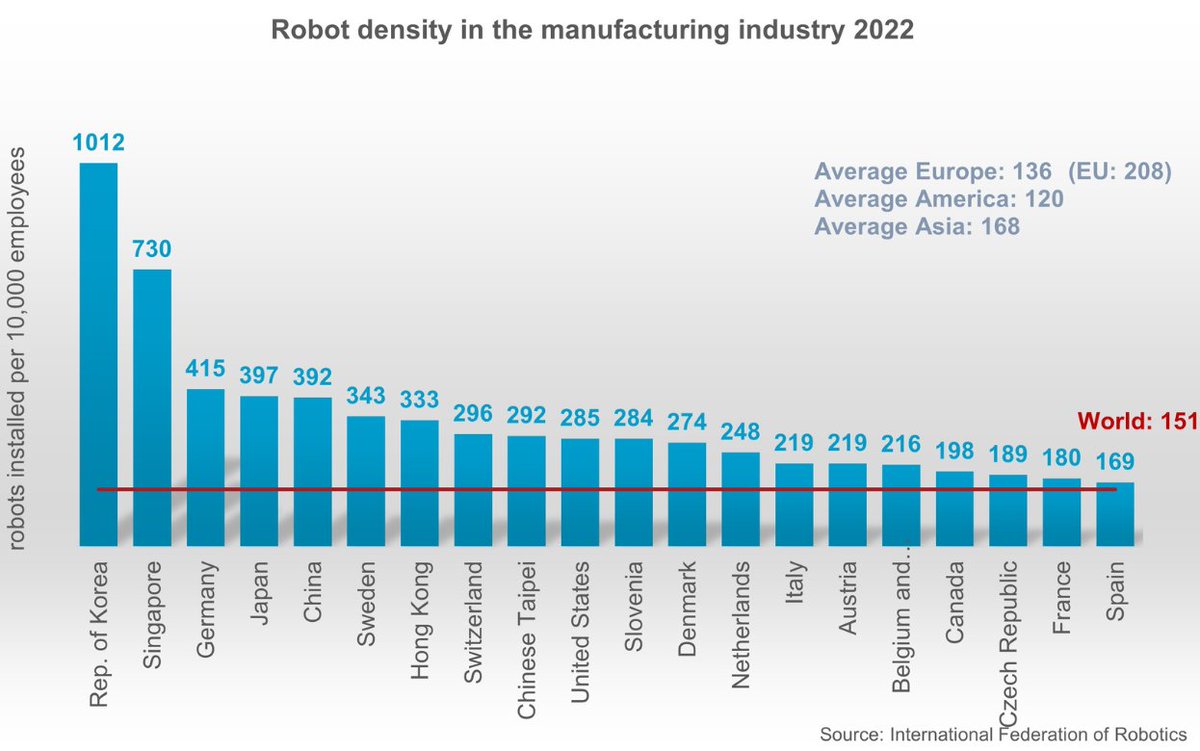
Robot density is the term. From the same source FT is using, world top 5 are 🇰🇷🇸🇬🇩🇪🇯🇵🇨🇳
3
85

10 May 2024
There’s a lot of competition in China from other Chinese companies. People forget this. The main driver of cost reductions are not American manufacturing firms but American buyers choosing between Chinese suppliers.
2
45

10 May 2024
I think it goes deeper than debt though: China can produce a lot more steel a lot cheaper than anyone else, which let's them build a lot more cheap steel robot arms.
2
42
10 May 2024
I just realized I was looking at an older stat... And China installed 290k robots last year, not 140k.

1
12
593

10 May 2024
Most laymen can get head around "robot does these steps in this order" (move steps, loops, etc). Figuring out which modbus register to read from on some random sensor and how to cast value from uint16 not so much.
2
36
10 May 2024
I agree. There is this misconception that "if only robots were easier to use", etc -- integration can only be as easy as the hardest-to-use thing in the cell. Robot sw getting better quickly for quite some time -- sw for other things, not so much.
1
3
58

10 May 2024
This is the most important reason and you should rename it to integration.
1
3
298
10 May 2024
Please make this mini thread its own tweet if it doesn’t exist already, this needs to be referenced more.
4
586

10 May 2024
Great thread by @BGGthoughts of @ReadyRobotics on why we don't see more robots deployed in the USA: skepticism, cost, software complexity, tool design...
10 May 2024

Why We Don't See More Robots Deployed, Reason #1:
Skepticism. Everyone who works in a factory either has direct experience with a failed robot deployment, or they have a friend, or a cousin, or a friend's cousin's uncle who tried using a robot and it didn't work out.
3
16
3,296
10 May 2024
All the complexity adds a whole lot of friction to the process of deploying robots. We're working on solving the software complexity layer here at @ReadyRobotics, but that is only one piece of the puzzle!
I deeply believe that solving for the software complexity will significantly reduce the friction of managing robot cells once they're deployed, but we don't have magic technology that solves the friction of the design and implementation.
You need a whole team of specialists to deploy a single robot cell.
This is why ultimately large enterprises will establish an internal team to build and install robot cells, as well as relying on systems integrators.
2
1
5
1,202
10 May 2024
Thanks for tagging me in @adamgluck (and great meeting in person at Automate)!
Oh yeah, I definitely have thoughts here. Standard disclaimers on bias, etc, etc...
Why don't we see more robots deployed? A thread with all the reasons I've seen:
1
4
16
3,880
10 May 2024
Ok maybe the better question is why can they do this in China? Is it the usual answer, which is better collocation of skilled talent, resources, and supply chains make it make more sense? Or just thst things are less established easier to innovate?
2
5
1,256