
After reading "How Crypto Businesses Turn Products into Platforms"
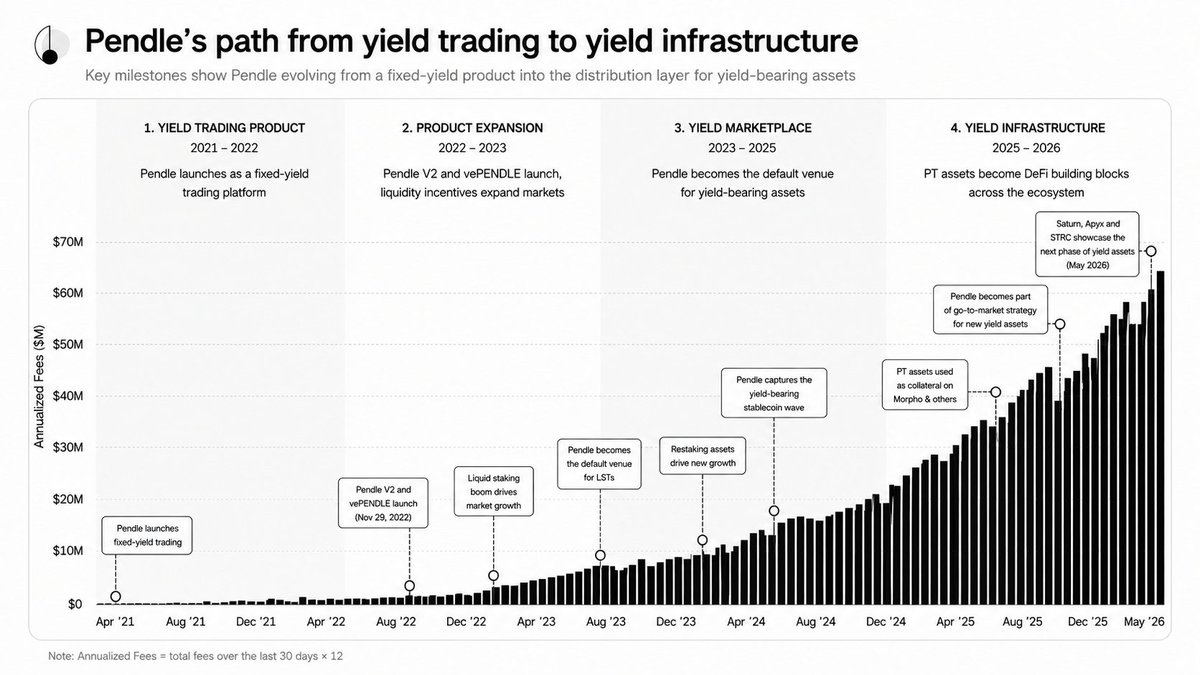
I realized that @pendle_fi may be one of the clearest examples of this evolution in DeFi
⤷ Product → Platform model
In the beginning, Pendle was simply a product.
A place to trade yield.
Users came to Pendle to:
• Lock fixed yield
• Go long yield
• Go short yield
That was the product, but over the last two years, Pendle's role has changed dramatically.
• Restaking emerged.
• Yield-bearing stablecoins emerged.
• Tokenized assets started gaining traction.
And almost every major DeFi yield narrative ended up passing through Pendle.
From restaking assets like eETH and rsETH, to yield-bearing stablecoins such as sUSDe, sUSDS, USD3, USDat, and apxUSD, and more recently the STRC, Saturn, and Apyx ecosystem, nearly every major yield narrative has found its way to Pendle.
The interesting part is that Pendle did not create these narratives.
But it became the place where these narratives were amplified.
In the past, projects launched an asset and then tried to attract liquidity.
Today, many projects launch an asset and a Pendle market almost at the same time.
Because Pendle immediately provides:
• Fixed yield
• Yield speculation
• Leverage strategies
• Liquidity
• Distribution
In other words, Pendle is increasingly becoming part of the go-to-market strategy for new yield assets.
That is the moment when a product starts becoming a platform.
And the story does not stop there.
Today, PTs are starting to appear outside of Pendle itself.
• PTs are being used in lending markets.
• PTs are being integrated into vaults.
• PTs are being accepted as collateral.
This shows that the value of Pendle is no longer limited to its yield trading interface.
The value is increasingly embedded in PTs themselves.
One of the strongest signals of this shift is seeing protocols like Sky use PTs as backend infrastructure for yield strategies built on top of them.
When one protocol begins using another protocol's product as a building block for new products, that is often the clearest sign that the Product → Platform transition is underway.
1
18

Economic security shouldn’t only belong to projects with massive funding.
@CNPYNetwork explores community-driven security through restaking mechanics.
#CNPY #Web3
1
2

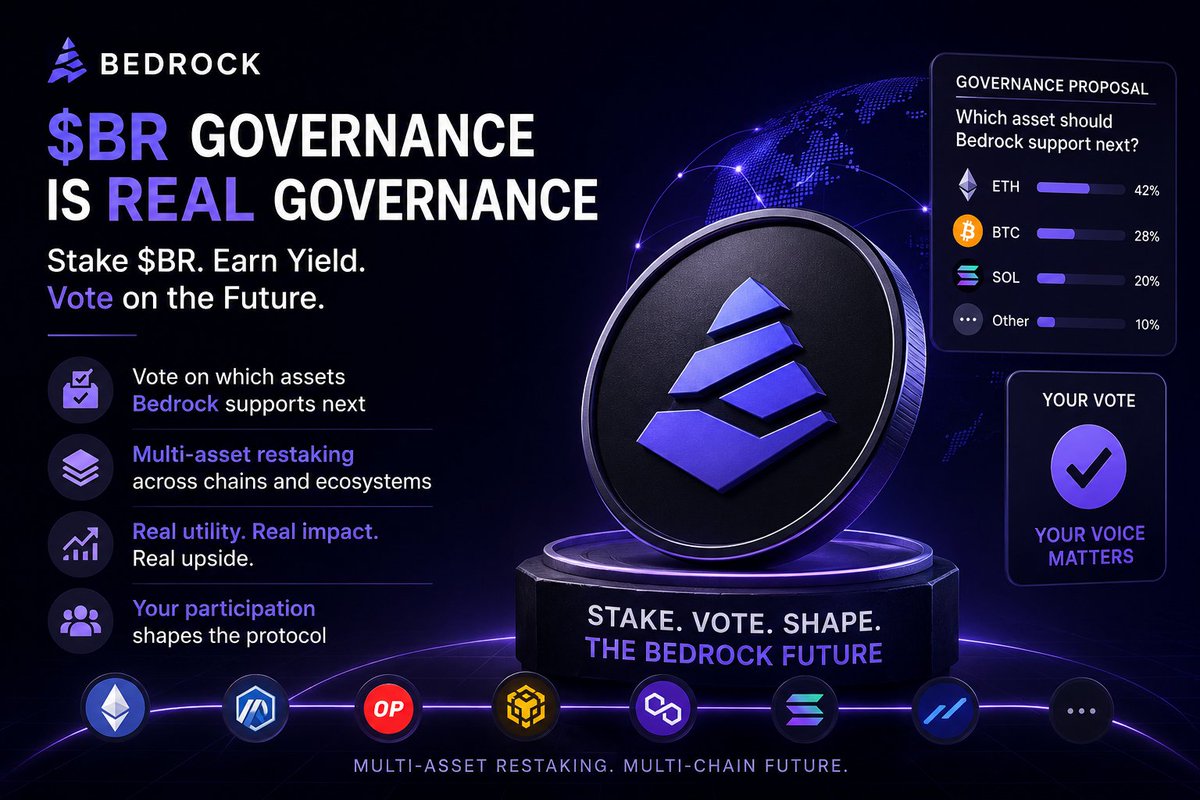
By staking $BR, you're not just earning yield—you help decide which assets Bedrock supports next. That's real participation in protocol growth.
The multi-asset restaking model is what makes it even more interesting. Governance isn't just a feature.
#BR #Bedrock #DeFi #Restaking
9


Restaking brilliantly turns economic security into a reusable and shareable resource. This paradigm shift ultimately benefits every participant in the blockchain technology stack. #EigenLayer
5

Deeply understanding the different restaking risks including smart contract, operator, and systemic is fundamental for responsible and successful participation. #Restaking
3

Builders widely praise restaking for removing security as a major bottleneck. Overall innovation speed increases noticeably across the entire Web3 ecosystem. #Blockchain
1

Restaking yields remain competitive even as the market matures, thanks to genuine utility and growing demand for security services. #Restaking
1


Practical guides to safe restaking practices are becoming essential reading in 2026 as more capital flows into shared security. #EigenLayer
2

Restaking creates meaningful opportunities for greater geographic decentralization of validators through broader and more attractive participation incentives. #Blockchain
3

Ethereum’s clear leadership in restaking further cements its position as the premier settlement and security layer for the entire decentralized internet. #Crypto
1
3

Shared security encourages long-term thinking among stakers and projects alike. Sustainable incentives replace short-term farming. #Restaking
1

Watching new AVS launches secured by restaking never gets old. Each one beautifully demonstrates the flexibility and real power of shared security models. #EigenLayer
2

Restaking in 2026 extends well beyond Ethereum. Innovative cross-chain shared security concepts are emerging and rapidly gaining community attention. #EigenLayer
7

Restaking reduces overall industry security costs while increasing total protected value. Tremendous positive impact on crypto economics. #Blockchain
1

Comprehensive education around shared security helps newcomers navigate restaking opportunities both safely and profitably. Community knowledge sharing remains key. #Restaking
2

New restaking protocols emphasize different trade-offs between yield, security, and decentralization. Healthy diversity benefits the ecosystem. #DeFi
1
4

Shared security is the invisible infrastructure making flashy Web3 applications possible. Restaking deserves more recognition for this role. #Restaking
2