
24 Oct 2025
🧩 Result Pattern vs Excepciones en .NET
En tus proyectos .NET, no todo error debe lanzarse con throw. ⚠️
A veces, el Result Pattern es una opción más limpia y predecible.
💥 Excepciones 💥
⚙️ Perfectas para errores inesperados o críticos (bugs, fallos de infraestructura).
🧾 Incluyen stack trace y buena integración con logs.
🐢 Pero... son costosas si se usan para flujo normal.
✅ Result Pattern ✅
🧩 Ideal para errores esperados de negocio (validaciones, reglas, no encontrado).
🔍 Hace el código explícito y composable (IsSuccess, Error, etc.).
⚡ Más performante cuando los fallos son frecuentes.
⚖️ En resumen:
👉 Usa excepciones para lo excepcional.
👉 Usa Result<T> para lo esperado.
👉 Combina ambos según la capa (Domain, Application, Infra).
🚀 Escribe APIs más claras, predecibles y con mejor manejo de errores.
#dotnet #CleanArchitecture #DDD #ResultPattern #CSharp #SoftwareEngineering #MediatR #ErrorHandling
2
6
137

7 Oct 2025
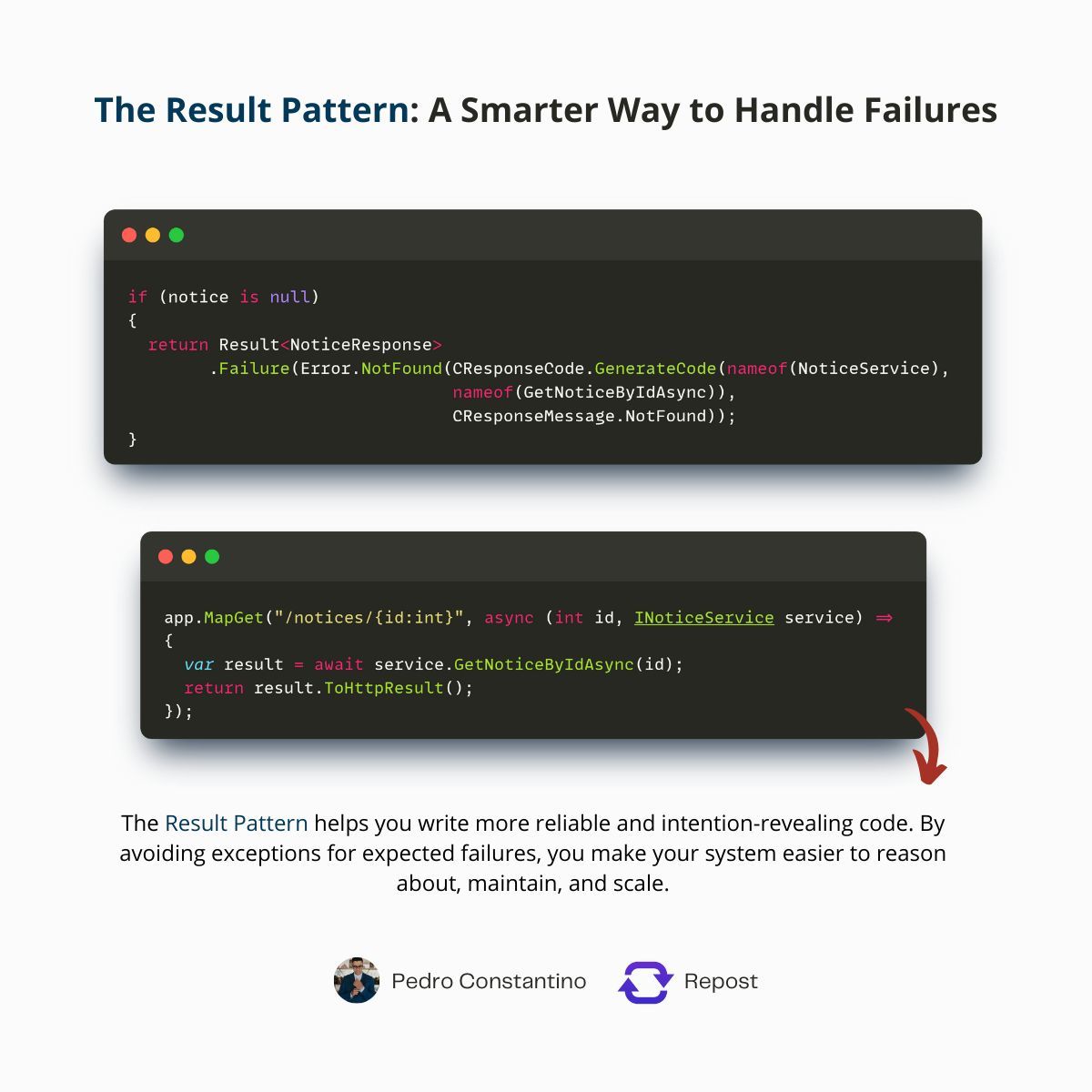
🔵 𝐓𝐡𝐞 𝐑𝐞𝐬𝐮𝐥𝐭 𝐏𝐚𝐭𝐭𝐞𝐫𝐧: 𝐀 𝐒𝐦𝐚𝐫𝐭𝐞𝐫 𝐖𝐚𝐲 𝐭𝐨 𝐇𝐚𝐧𝐝𝐥𝐞 𝐅𝐚𝐢𝐥𝐮𝐫𝐞𝐬
Nested try-catch blocks, unreadable logs, no status code return and unclear return paths make debugging a painful experience. But what if there was a simpler, cleaner, and more predictable way to deal with failures?
The Result Pattern offers just that. Instead of relying on exceptions for flow control, it embraces explicit success and failure outcomes, making your code easier to read, test, and maintain.
💬 𝐌𝐲 𝐭𝐚𝐤𝐞? Since I adopted the Result Pattern in APIs and services, I’ve seen better maintainability, clearer contracts, and more confidence in error handling.
It’s not just functional programming hype: it works.
What about you? Have you implemented the Result Pattern in your codebase?
❤️ Like if this was helpful
💬 Drop your thoughts below
🔄 Share with someone tired of chaos
#dotnet #csharp #webapi #cleancode #resultpattern #errorhandling #programming #developerlife #softwarearchitecture #backend #restapi #minimalapi #aspnetcore #cleanarchitecture
1
3
48
17 Jul 2025
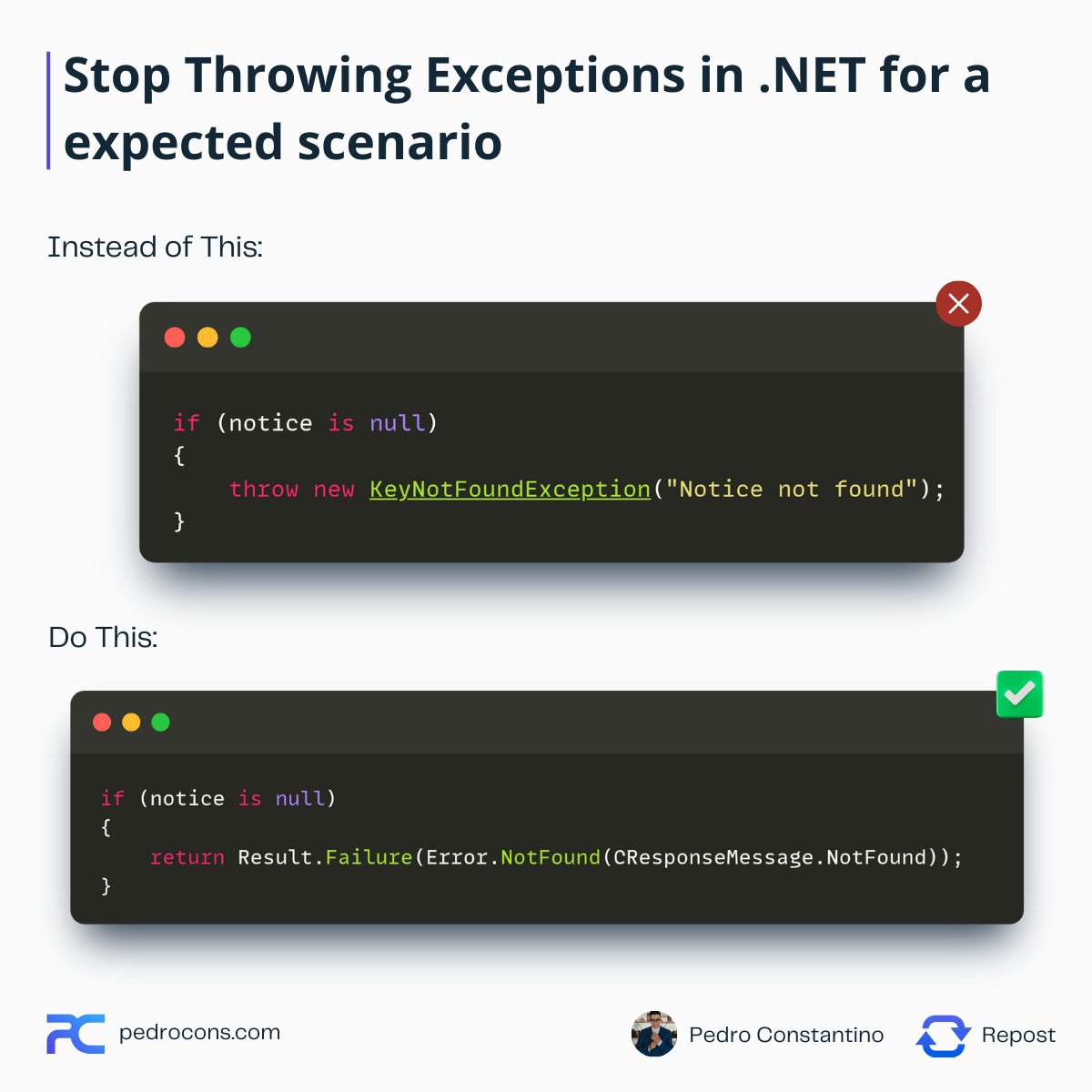
🔵 𝐒𝐭𝐨𝐩 𝐓𝐡𝐫𝐨𝐰𝐢𝐧𝐠 𝐄𝐱𝐜𝐞𝐩𝐭𝐢𝐨𝐧𝐬 𝐢𝐧 .𝐍𝐄𝐓 𝐟𝐨𝐫 𝐚 𝐞𝐱𝐩𝐞𝐜𝐭𝐞𝐝 𝐬𝐜𝐞𝐧𝐚𝐫𝐢𝐨
Throwing exceptions everywhere? That might be killing your performance... and your maintainability.
Exceptions in .NET are expensive, hard to test, and often misused for flow control.
The Result Pattern turns error handling into a first-class citizen.
In my blog, I show how I implement it in real projects using a reusable Result<T> structure with success/failure states.
Link is in the comments!
💬 Are you still relying on exceptions to control your flow?
❤️ Like if you learned something new
🔁 Repost and help others write cleaner APIs
#DotNet #CSharp #CleanCode #ResultPattern #ErrorHandling #BackendDevelopment #BestPractices #CodeQuality #AspNetCore
1
1
4
102

22 Jul 2024
Depende del contexto creo... Si un input va a cambiar de valor lo más prolijo creo que es un out parameter, como los tryParse.
Si no va a ser algo reiterativo y tú versión de c# lo permite, una tupla con nombres. Otro caso, una clase, sea temporal o no, como en un ResultPattern.
2
118

17 Apr 2024
2
2
177