
Dawno dawno temu pisałem "aplikacje" w vba do excela. Też mi się wydawała kompletna dopóki do jej obsługi nie dali mi takiego imbecyla, że potrafił zrobić najgłupsze i najmniej przewidywalne rzeczy. Kurwiłem na niego ale finalnie uzyskałem pełne security i errorhandling 🤣
2
15


May 26
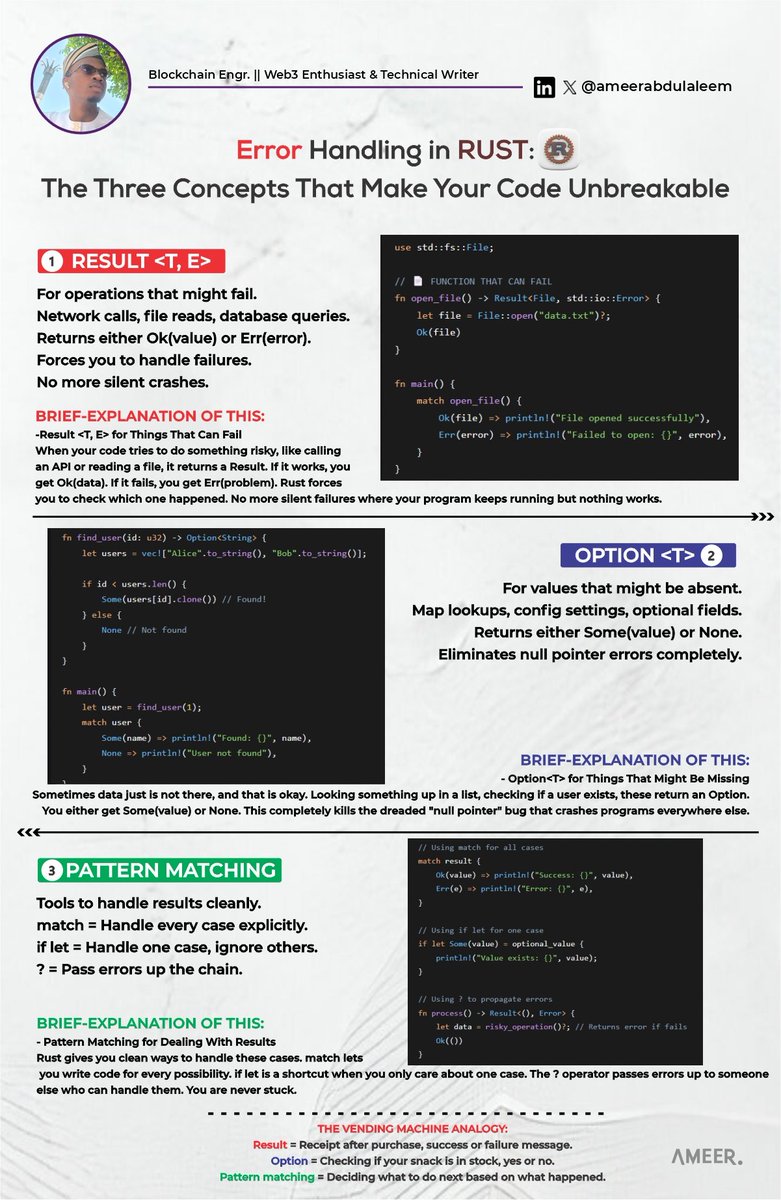
🔰Error Handling in Rust: The Three Concepts That Make Your Code Unbreakable
One of the biggest adjustments for developers coming to Rust from other languages is how explicitly errors must be handled. This is not a design quirk, it is a deliberate choice to eliminate entire classes of bugs that plague production systems. Understanding Rust's error handling tools is essential for building reliable blockchain infrastructure.
Three Core Concepts in Rust Error Handling:
1️⃣ Result<T, E> :
for Recoverable Errors When an operation might fail in a way you can recover from,Rust uses the Result type. File operations, network requests, and database queries all return a Result. It has two possible variants, Ok(value) when everything worked, and Err(error) when something went wrong. By forcing you to handle both cases, Rust ensures that network timeouts, missing files, and failed API calls never go unnoticed.
2️⃣ Option<T> :
for Optional Values Sometimes a value might simply not exist,and that is not necessarily an error. Looking up a key in a map, finding a user in a database, or checking if a configuration value is set all return an Option. The variants are Some(value) when the value exists and None when it does not. This completely eliminates the null pointer errors that crash programs in other languages.
3️⃣ Pattern Matching:
for Clean Handling Rust gives you powerful tools to work with Result and Option. The match expression lets you handle every possible case explicitly. The if let syntax provides a shorter way when you only care about one specific case. And the ? operator lets you pass errors up to the caller when you cannot handle them locally. Together, these tools make error handling expressive and safe.
The Restaurant Order Analogy: Imagine ordering food at a busy restaurant.Result is like your order receipt. It either says "Order confirmed, food coming" or "Sorry, we are out of that dish." You have to check which one you got before you leave the counter. Option is like asking if they have today's special. They either tell you what it is, Some("grilled fish"), or they say "Sorry, not today," None. Pattern matching is you deciding what to do next. If the food is coming, you wait. If they are out, you order something else. You never just walk away confused and hungry.
How has Rust's explicit error handling changed the way you think about writing reliable code?
#RustLang #ErrorHandling #SystemsProgramming #BlockchainDevelopment #Web3
3
25
May 26
🔰𝗥𝗨𝗦𝗧'𝗦 𝗘𝗥𝗥𝗢𝗥 𝗛𝗔𝗡𝗗𝗟𝗜𝗡𝗚 𝗙𝗘𝗘𝗟𝗦 𝗦𝗧𝗥𝗜𝗖𝗧, 𝗕𝗨𝗧 𝗜𝗧 𝗜𝗦 𝗔𝗖𝗧𝗨𝗔𝗟𝗟𝗬 𝗣𝗥𝗢𝗧𝗘𝗖𝗧𝗜𝗡𝗚 𝗬𝗢𝗨🛡️.
If you are coming to Rust from languages like JavaScript, Python, or Solidity, the way Rust deals with errors can feel uncomfortable at first. In those languages, you can often ignore errors or forget to handle them, and the code will still run until something crashes. Rust refuses to let you do that. It forces you to confront every possibility of failure at compile time.
This design is not meant to annoy you. It is meant to save you from the kind of bugs that lose money, damage reputations, and crash systems at 3 AM.
Rust provides two main tools for handling situations where things might go wrong: Result and Option.
Option is for when a value might be present or might be absent. Think of looking for a file in a folder. It is either there, Some(file), or it is not, None. The compiler makes you check which case it is before you can use the value. This prevents the dreaded "null pointer" errors that plague other languages.
Result is for when an operation could succeed or fail. Database queries, network requests, file operations, they all return a Result. If it succeeds, you get Ok(value). If it fails, you get Err(error). And again, Rust forces you to handle both possibilities before your code will compile.
This is where the unwrap() trap catches beginners. When you are learning, calling unwrap() on a Result or Option is tempting. It just gives you the value if it exists or crashes if it does not. It feels like a shortcut. But in production code, unwrap() is usually the wrong choice because it throws away all of Rust's careful safety guarantees. Instead, you should learn to match on these types, propagate errors with the ? operator, or provide meaningful fallback values.
👉THE VENDING MACHINE ANALOGY:
Imagine buying a snack from a vending machine.In many languages, the machine might just give you nothing and keep your money if something goes wrong, no explanation, no recourse. Rust's approach is like a vending machine that always gives you a receipt. The receipt clearly says either "Here is your snack, enjoy" or "Error: insufficient funds" or "Error: machine is empty." You are forced to read the receipt before you walk away. It feels like extra work, but you never walk away hungry and confused, and you never lose your money without knowing why. The machine holds you accountable, and that accountability builds trust.
What was your first experience with Rust's error handling, and did you fall into the unwrap() trap like the rest of us?
#RustLang #ErrorHandling #SystemsProgramming #Web3Development #CodingBestPractices

3
21

May 24
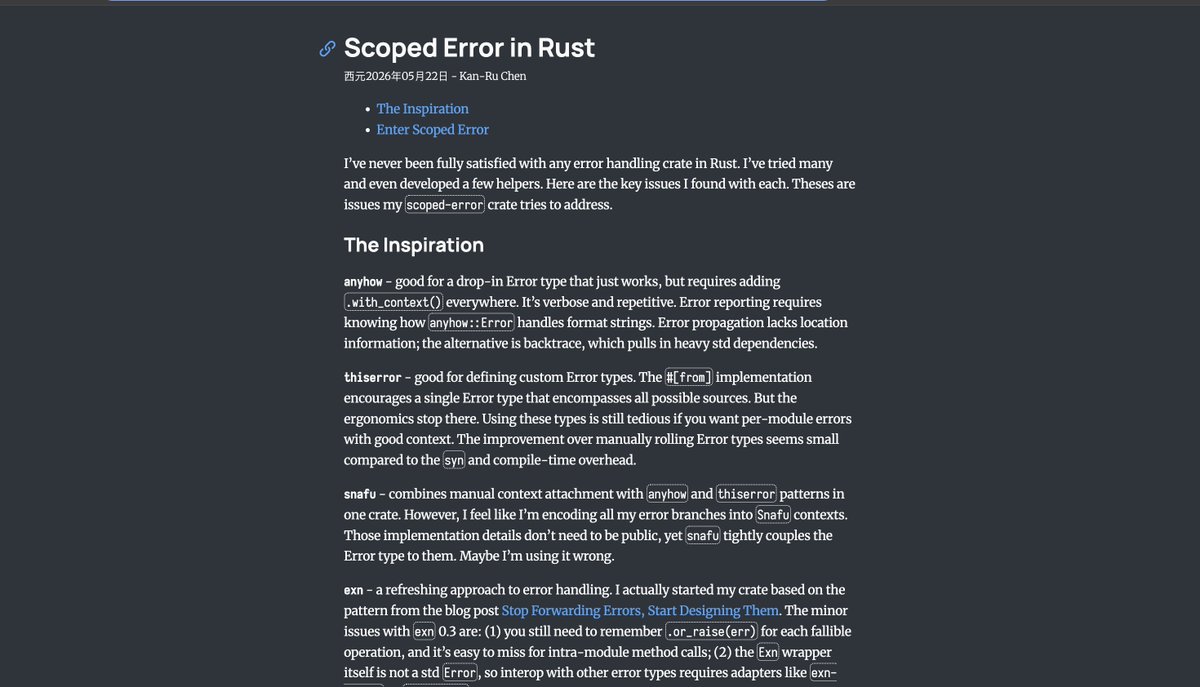
Rust scoped errors = finally feels right. 🦀
scoped-error is a new crate that attaches context once per function, not at every call site. Clean error trees with file locations, tiny core, std-compatible.
A fresh take if anyhow/thiserror/snafu haven't fully clicked for you.
🔗 kanru.info/scoped-error/
#Rust #RustLang #ErrorHandling #OpenSource
8
16
158
10,239

May 8
Code fatega, tension mat lo.
Try = risky code try karo
Catch = error aaye to sambhal lo
Finally = error aaye ya na aaye, chalta hai
Error handling sikho, app crash se bacho 👇
imohit1o1.hashnode.dev/error…
@ChaiCodeHQ @Hiteshdotcom @piyushgarg_dev
#errorhandling #javascript
1
4
92

Apr 26
هل تجد صعوبة في قراءة وفهم رسائل الخطأ في بايثون؟ 🐍 لا تقلق، تعلم فن قراءة أخطاء بايثون.
اقرأ المزيد وارتقِ بمهاراتك البرمجية الآن!
arabpython.com/2026/04/readi…
بايثون #برمجة #تعلمالبرمجة #Python #Coding #ErrorHandling #تطويرالبرمجيات #تعلم_بايثون
1
3
32

Apr 24
Day 81 of backend
one thing I really struggled with was error handling. Those production errors and operation errors still confuse me till today
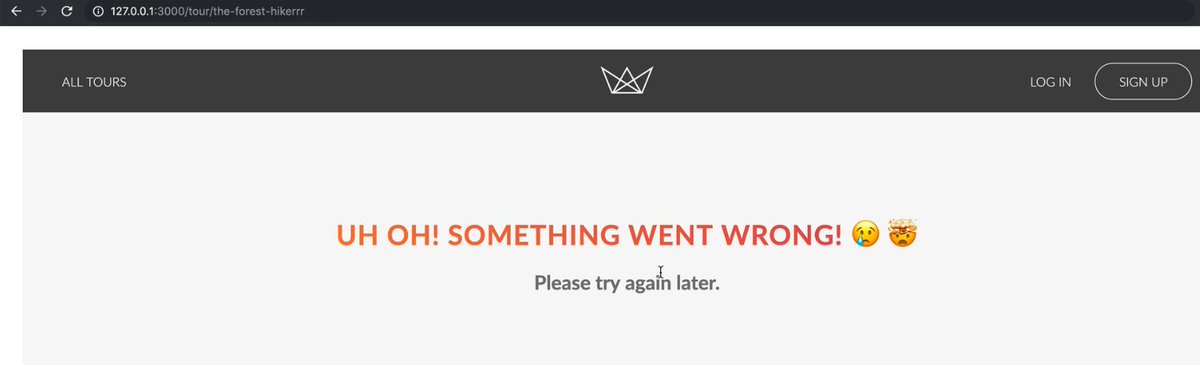
Today was about Building Custom Error Pages.
No more raw JSON leaks
We Created a dedicated error page that extends the main base.pug layout.
Environment Handling: Shows detailed error stack trace for easy debugging
Production: Displays only a friendly “Something went wrong!” message for security
#NodeJS #ExpressJS #ErrorHandling #BackendDevelopment #100DaysOfCode

Apr 23

Day 80 of backend
🙂🙂80 friggin days
Today I learnt how to properly implement a Logout feature using JWT cookies.
Backend (authController.js)
Create a dedicated logout route that will simple send back a new cookie with the exact same name but without the token then that will overwrite the current cookie we have in the browser. since we can't Identifier the user without the token, the user will be logged out
Frontend Used Axios to call the logout endpoint on button click.
On success, use location.reload(true) to refresh the UI and show the logged-out state.
Super clean and secure way to handle authentication state without messing with localStorage. Drop your approach #NodeJS #ExpressJS #WebDev #JWT #100DaysOfCode

2
1
13
502

Agent Scriptにはレシピサイトがあるの知ってました?
🧩 アクション関連(外部連携や処理の核)
エージェントが「何をするか」に関わる部分
ActionDefinitions
→ APIや外部システムを呼び出す「アクションの定義方法」
ActionCallbacks
→ アクション実行後に処理をつなぐ(チェーン処理)
AdvancedInputBindings
→ アクションに渡す入力データの高度な設定
ActionDescriptionOverrides
→ LLMが適切なアクションを選ぶための説明調整
InstructionActionReferences
→ 推論(プロンプト)内でアクションを直接参照する方法
CustomLightningTypes
→ UI表示などに関わるカスタムタイプ(※一部バグ注意)
🧠 推論・ロジック系(Agentの“頭脳”)
より高度な思考・判断をさせるためのパターン
AdvancedReasoningPatterns
→ 複数データソースや複雑なロジックを組み合わせる高度パターン
AfterReasoning
→ 推論後の処理フック(ライフサイクル制御)
🏗 アーキテクチャ設計(構造・設計パターン)
エージェント全体の構成や安全性
ErrorHandling
→ エラー処理やバリデーションの設計
ExternalAPIIntegration
→ FlowやApexを使った外部API連携
BidirectionalNavigation
→ 専門エージェント間を行き来するナビゲーション設計
🌍 言語・設定系
エージェントの基本設定
LanguageSettings
→ 多言語対応やロケール設定
HelloWorld
→ 最小構成のサンプル(最初の一歩)

1
2
28
1,480

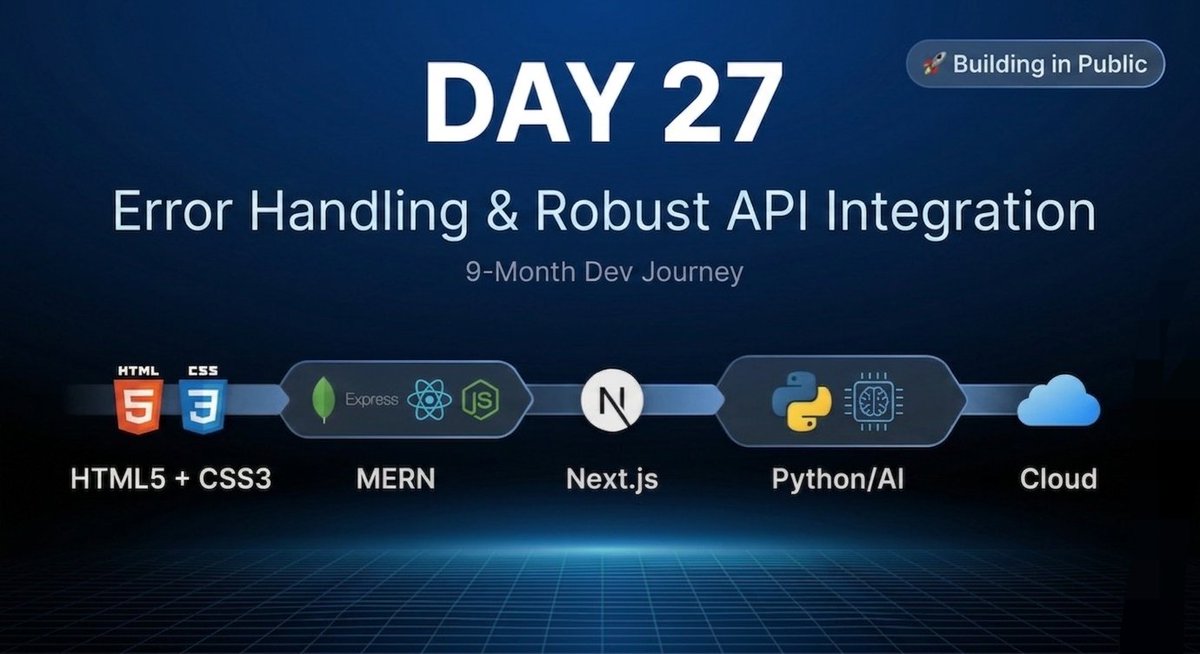
Day 27 ✅
Today I learned:
• Network errors vs HTTP errors (404, 500)
• try/catch for async/await
• response.ok validation
• Retry logic
• Loading spinners & empty states
• API response caching
• Offline fallbacks
#100DaysOfCode #BuildInPublic #ErrorHandling
1
2
26

⚡ 𝗘𝗿𝗿𝗼𝗿𝘀 𝗦𝗵𝗼𝘂𝗹𝗱𝗻’𝘁 𝗖𝗿𝗮𝘀𝗵 𝗬𝗼𝘂𝗿 𝗔𝗽𝗽 ⤵️
Error Handling in JavaScript: Try, Catch, Finally 🛠️
🔗 𝗥𝗲𝗮𝗱 𝗵𝗲𝗿𝗲: blog.thitainfo.com/error-han…
𝗧𝗼𝗽𝗶𝗰𝘀 𝗰𝗼𝘃𝗲𝗿𝗲𝗱 ✍🏻:
⎺⎺⎺⎺⎺⎺⎺⎺⎺⎺⎺⎺⎺⎺⎺
⇢ Why unhandled errors break your app
⇢ try/catch — handling failures safely
⇢ finally — guaranteed cleanup logic
⇢ Throwing custom errors for better control
⇢ Real-world example with async API calls
⇢ Common mistakes & performance tradeoffs
Thanks @Hiteshdotcom Sir & @piyushgarg_dev Sir, and the amazing @ChaiCodeHQ community 🙌
#ChaiAurCode #JavaScript #ErrorHandling #WebDevelopment #Programming #Hashnode
2
9

With 2FA enabled, the /v3/api/password/change API stopped returning success.
Instead it returned:
{
"success": false,
"message": "lang.2fa_code_required"
}
Our catch block treated this as a generic error. User saw a weird flash message
"lang.2fa_code_required" and nothing happened.
No navigation. No 2FA screen. Just confusion.
#ReactNative #API #ErrorHandling #MobileDevelopment #CodingLife
2
14

Crash‑proof your Xojo apps with structured exception handling. Catch errors gracefully using Try/Catch, prevent NilObjectException, and keep users happy.
👉 documentation.xojo.com/getti…
#Xojo #ErrorHandling #Stability

4
80

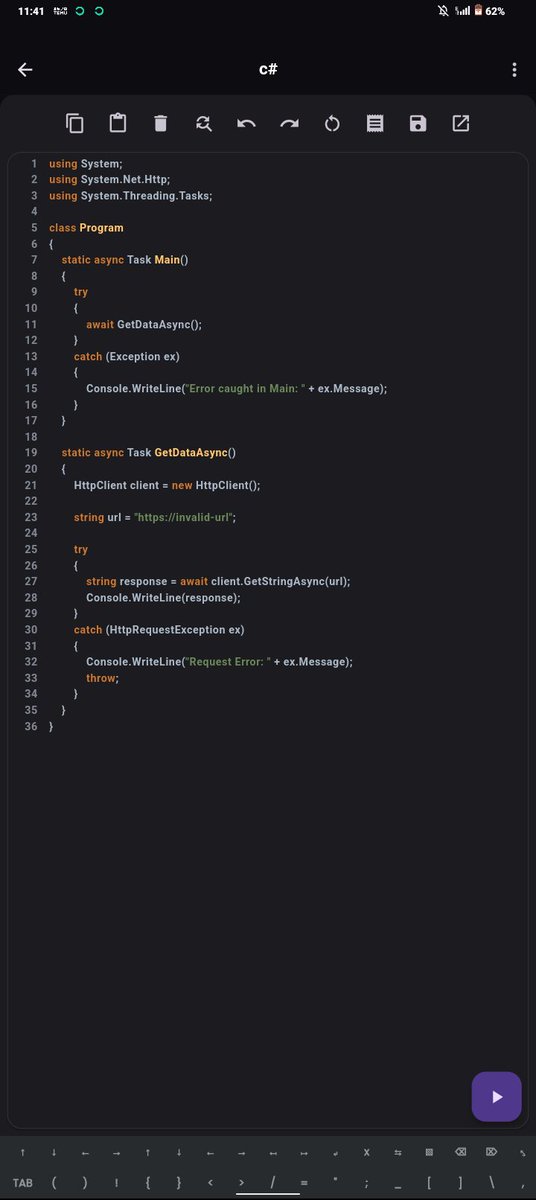
DAY 73 OF CODING C# WITH A PHONE💻❤️
Understanding error handling in asynchronous programming by combining try-catch with async/await, ensuring robust and reliable execution of network operations within the .NET ecosystem.
#CSharp #DotNet #AsyncAwait #ErrorHandling #100DaysOfCode
2
8
86

Mar 24
Error handling isn't just code.
It's user experience.
'Something went wrong' = Frustration
'Email already exists - try logging in?' = Helpful
Write errors for humans, not developers.
#ErrorHandling #BuildInPublic
1
3
120

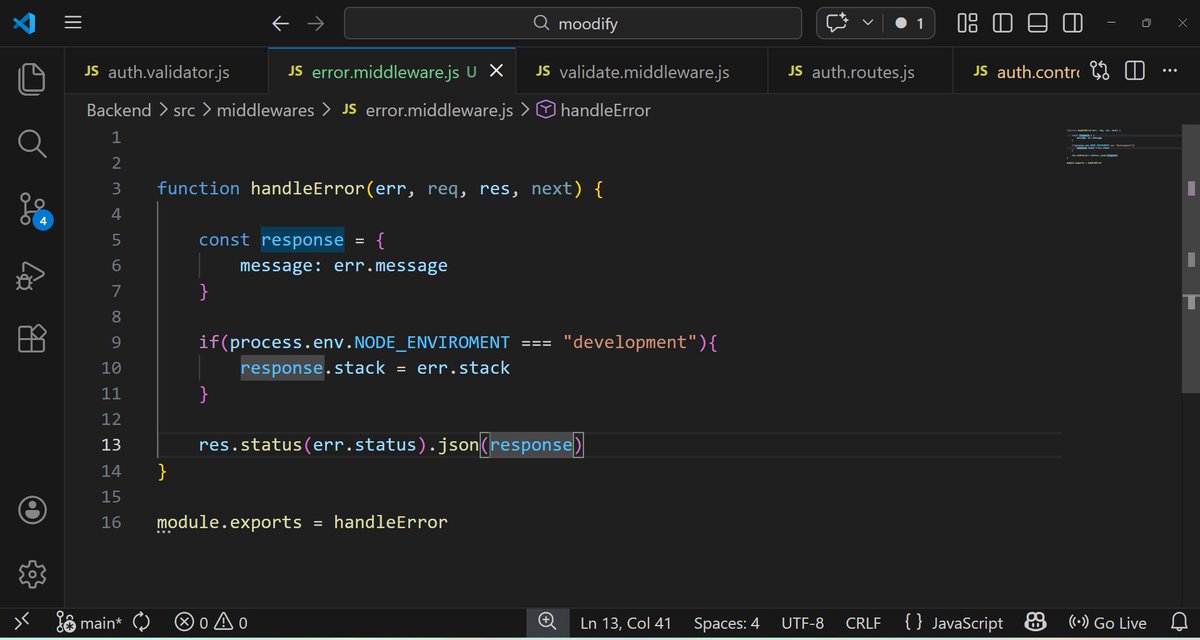
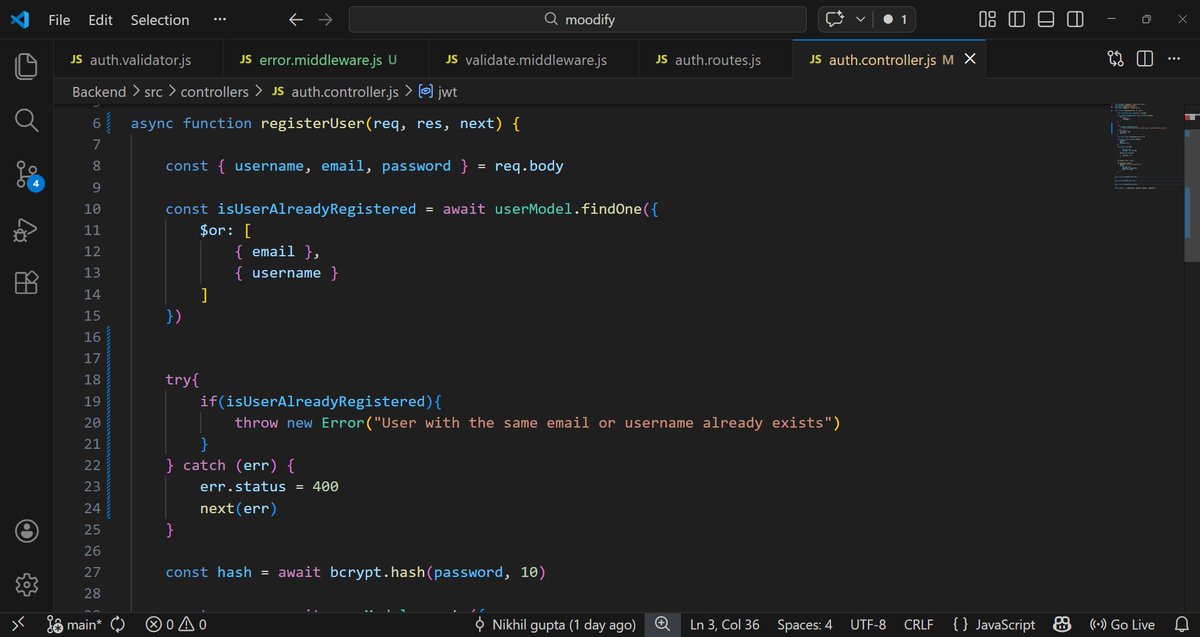
Day 147 🚀
Learned Error Handling and explored Express Validator in more depth to improve backend API reliability.
Learning at Sheriyansh Coding School.
#Day147 #ErrorHandling #ExpressValidator #BackendDevelopment #NodeJS #sheryiansh

ALT @sarthacksharma
6
48

Feb 28
Day 13/30: of my AI & Automation Journey at TS Academy
Topic: Advanced Make Features & Troubleshooting
Leveled up today by mastering the art of troubleshooting and
optimization. This is what separates hobbyists from pros.
Key skills gained:
➔ Debugging complex scenarios
➔ Advanced error handling (6 types!)
➔ Creating reusable templates
➔ Performance optimization
➔ Monitoring and analytics
Real results:
- Reduced one scenario from 150 to 30 operations (-80%)
- Improved execution speed from 45s to 2s (95% faster)
- Error rate from 15% to 0.1% (99% better)
Built error handling with:
✓ Retry logic for temporary failures
✓ Rollback for transactions
✓ Resume for non-critical operations
✓ Complete error logging
Now my automations are production-ready, bulletproof, and
optimized. This is enterprise-grade automation.
#30DaysOfTech #LearningWithTSAcademy #Debugging
#ErrorHandling #Optimization #TSAcademy

Feb 27

Day 12/30: of my AI & Automation Journey at TS Academy
Topic: Multi-App Workflows & Case Studies
Today I designed and built complete business automation systems.
This is where it all comes together.
Built a full e-commerce order system:
➔ Order received → Validated → Inventory checked
➔ Smart routing (in stock/low stock/backorder)
➔ Customer notifications
➔ Inventory updates
➔ Shipping labels
➔ Accounting integration
➔ Complete logging
8 apps integrated. 25 modules. 3 routing paths. 40 operations
per order. Processes 100 orders/day automatically.
ROI: $45,000/year savings. 95% error reduction. 10x capacity
increase.
This isn't just automation - it's business transformation.
From concept to production-ready system in one day. The skills
from Days 1-11 all came together perfectly.
#30DaysOfTech #LearningWithTSAcademy #EnterpriseAutomation
#BusinessTransformation #TSAcademy

2
128

Feb 23
Today's topic : A Promise to a Chai☕
Today I learned about JS classes , ErrorHandling , Symbols , Promises by @Hiteshdotcom sir.
This is one the most interesting session due to examples.
Thanks to @ChaiCodeHQ team and @yntpdotme ,@nirudhuuu for helping throughout the session.

1
3
81

Someone implemented errorhandling wrong. Programs dont just crash for no reason, they crash to prevent further issues from the program continuing to run. I can't really read that error, but if its fatal, there could be massive instability from MH continuing to run past the crash.
13
2,329
Feb 19
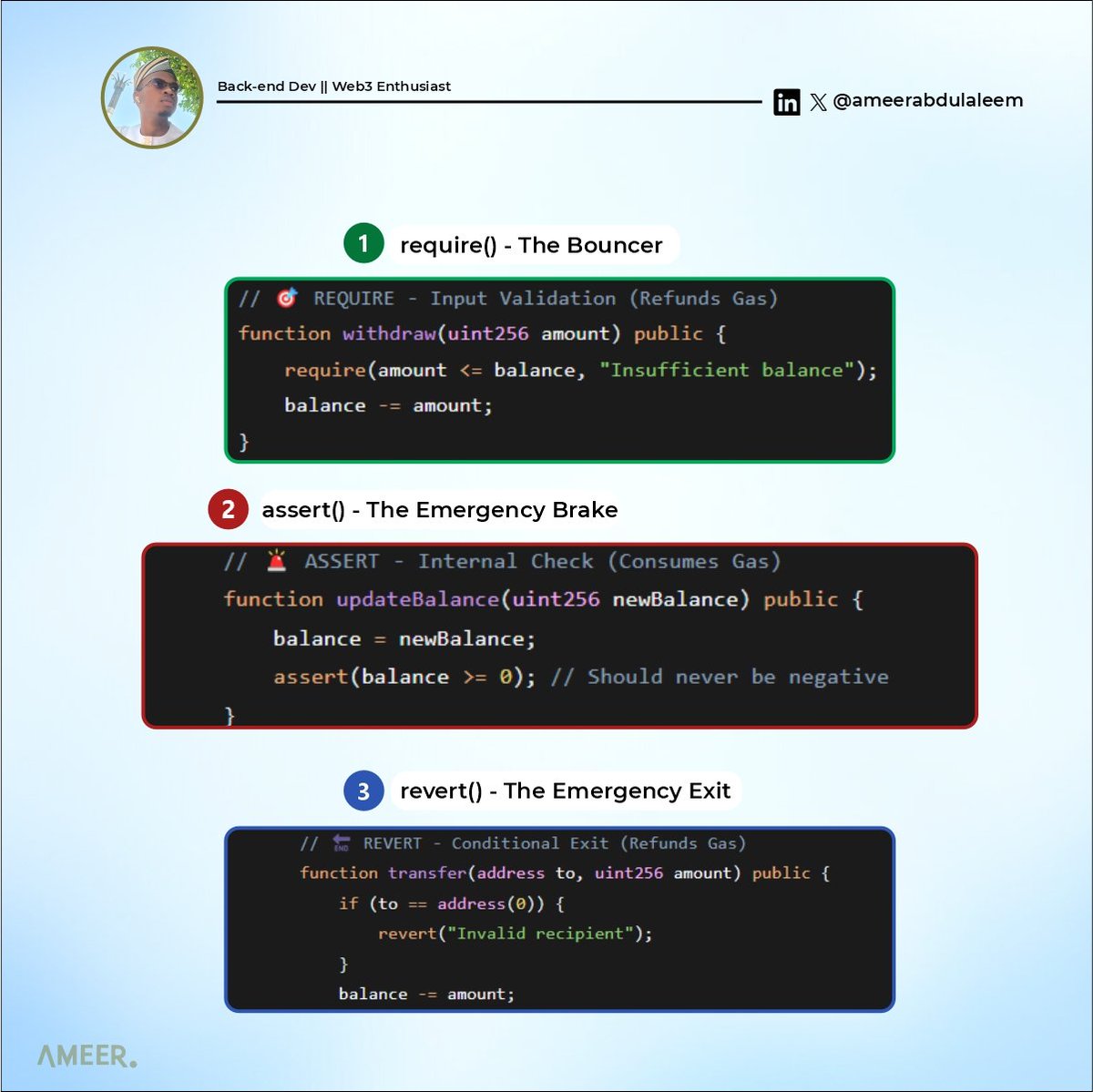
🔰Why Do Smart Contract Transactions Fail? Understanding Reverts & Error Handling.
Seeing "transaction reverted" can be frustrating, but it's actually your contract's security system in action. Understanding the three guardians of your contract logic is essential for both development and debugging.
The 3 Guardians of Smart Contract Logic:
1️⃣ require() - The Bouncer
· Purpose: Validates inputs and conditions before execution
· Gas: Refunds unused gas
· Use Case: User input validation, pre-condition checks
· Example: require(msg.value >= 0.1 ether, "Insufficient ETH");
2️⃣ assert() - The Emergency Brake
· Purpose: Checks for internal bugs and impossible states
· Gas: Consumes all gas (indicates a critical failure)
· Use Case: Invariant checks, overflow/underflow protection
· Example: assert(balance >= 0); // Should never be negative
3️⃣ revert() - The Emergency Exit
· Purpose: Unconditionally aborts execution with custom logic
· Gas: Refunds unused gas
· Use Case: Complex conditional logic in if/else statements
· Example: if (user.balance < amount) { revert("Insufficient balance"); }
The Simple Analogy: Think of Fun-Fair event security system:
· require() = ID check at the door (validates entry, refunds if rejected)
· assert() = Fire alarm system (emergency only, everyone evacuates)
· revert() = Manager's emergency stop button (stops everything immediately)
Choosing the right error handler ensures better user experience and contract security.
Which error handling function do you use most frequently in your projects? Share your experiences below! 👇
#Solidity #SmartContracts #BlockchainDevelopment #Web3 #ErrorHandling
2
43