
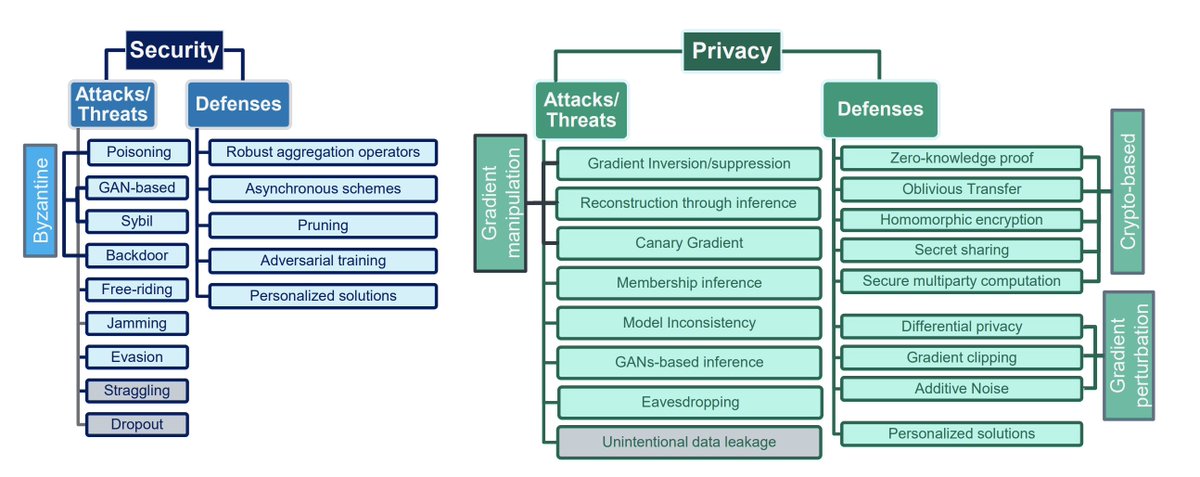
Security and privacy taxonomy for attacks and defenses in Federated Learning (FL) - arxiv.org/pdf/2508.13730
Federated Learning (FL) [6] has emerged as a powerful paradigm enabling multiple clients (local nodes, parties, participants) to train ML models collaboratively without sharing raw data.
While FL enhances data privacy, it also introduces unique security and privacy challenges that do not exist in traditional centralized learning settings, including vulnerabilities exacerbated by non-IID (non-Independent and Identically Distributed) data, where client datasets exhibit statistical heterogeneity in label, feature, or quantity distributions.
Non-IID data amplifies security risks such as poisoning attacks, as adversaries can exploit skewed local updates to manipulate the global model, and privacy risks like membership inference, where attackers inferparticipation of specific data points by exploiting distributional disparities.
Authors: Daniel M. Jimenez-Gutierrez, Yelizaveta Falkouskaya, José L. Hernández-Ramos, @arisana, @ichatzi, @avitaletti
#FederatedLearning #PrivacyPreservingML #AISecurity #RobustAggregation #DifferentialPrivacy #SecureAggregation #ByzantineResilience #BackdoorAttacks #NonIID #AdversarialML #HomomorphicEncryption #SecureMPC #EdgeAI #DistributedAI #FLFrameworks
1
11
350