
Jun 10
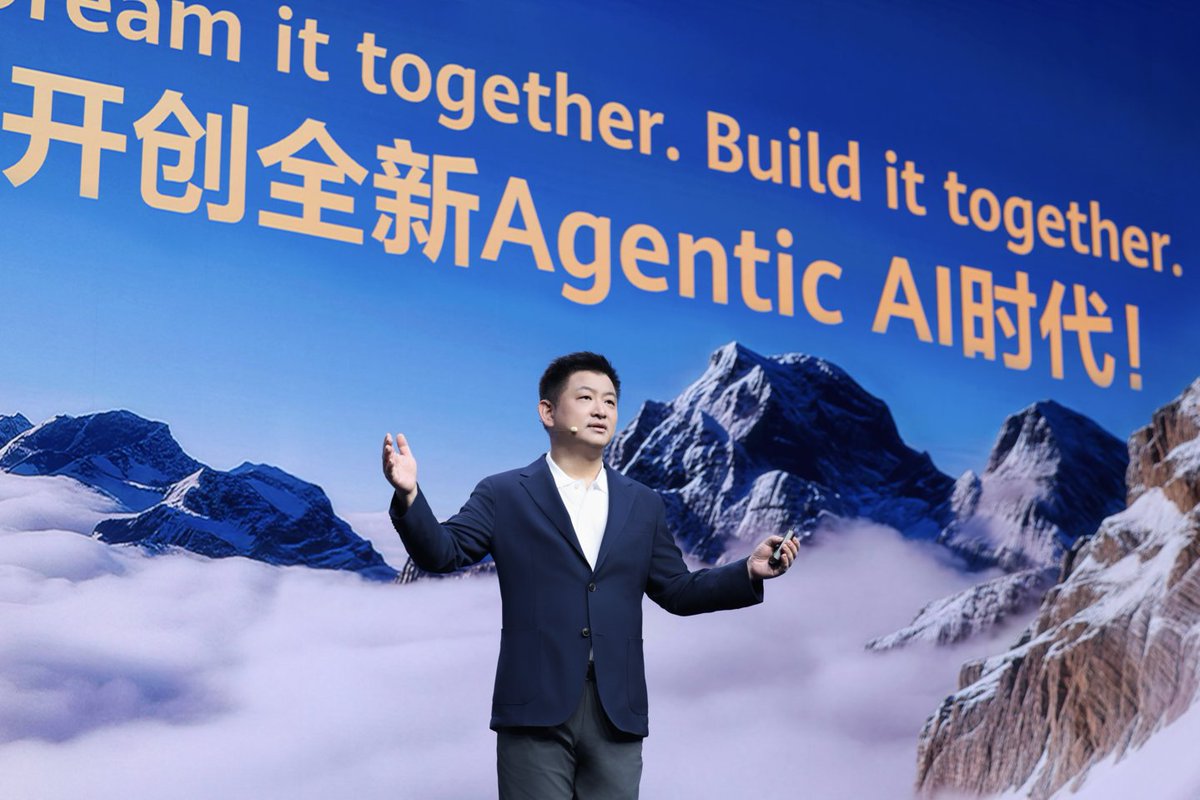
"I don't really care what the total Token volume is, nor what the total revenue is." Huawei Cloud CEO Zhou Yuefeng's opening remark at the June 5 INSPIRE conference in 2026 was a deliberate break from the AI cloud narrative that has dominated the past six months.
Alibaba Cloud and ByteDance's Volcano Engine have anchored their AI cloud stories on daily Token call volume and MaaS revenue scale. Model labs including Moonshot AI, DeepSeek, and Zhipu have kept cutting inference prices. The industry conversation has orbited around one question: how many Tokens are moving through whose pipes.
Zhou offered a different answer and a different KPI. What matters, he said, is "whether each Token genuinely improves productivity."
Three structural choices make this more than rhetorical positioning.
The first is the compute substrate. Huawei Cloud runs on a fully domestic stack: Ascend, Kunpeng, CANN, EulerOS, all self-built. Zhou was direct about the constraint: Huawei cannot use anyone else's compute, so it must turn domestic chips into an industry-grade answer rather than compete on raw scale with the NVIDIA-plus-public-cloud plane. "I'm not willing to compare revenue or ranking with other cloud companies," he said. "It doesn't mean anything."
The second is the customer base. Where internet-platform clouds lean on consumer traffic and developer ecosystems, Huawei Cloud concentrates on government, finance, and state-owned enterprises. Its hybrid cloud has held the top market share in those verticals for years, serving over 5,500 global clients. Zhou's advice to such clients reflects Huawei's own architecture: do not build your own 100,000-card cluster. Keep data local, pull AI compute and models from the public cloud, and use confidential inference and training techniques to bridge the sovereignty-scale gap. The pitch is essentially a pipeline for delivering public-cloud iteration speed to organizations that cannot fully migrate.
The third is the ecosystem bet. Huawei open-sourced CANN, EulerOS, the CCE Volcano scheduler, and the ModelArts toolchain. The new agent platform AgentArts ships an open-source edition, openJiuwen, sharing over 90% of its core with the commercial version. At the conference, Huawei also announced a partnership program with more than 20 model providers, including Zhipu, DeepSeek, MiniMax, Kimi, StepFun, Baidu, Meituan's LongCat, and iFlytek Spark.
The logic is straightforward: when domestic compute remains capacity-constrained and capability-limited, the second compute plane can only establish itself by offering the widest possible model selection and the most open ecosystem.
That hardware and customer reality sets the boundaries. The positive bet is what Huawei calls "Agentic Infra," a four-part product stack that reframes AI cloud competition around whether agents can actually run inside enterprises rather than how many Tokens they consume.
The components target the engineering problems that block enterprise agent deployment. The AICS cluster compresses Token latency on a 100,000-card system to under 10 milliseconds. The AMS memory storage uses NPU-direct access to content management systems for petabyte-scale memory, addressing long-horizon task retention for agents. The CCE Volcano Next scheduler runs training and inference on shared pools, lifting resource utilization by over 30%. The AgentSphere security runtime uses lightweight sandboxes to achieve 100-millisecond startup and batch creation at 100,000 instances per minute.
ModelArts Next adds model routing across 15-plus SOTA models with cost-priority, performance-priority, and balanced modes, claiming over 95% routing accuracy and average cost reductions of 20%.
The clearest sign of where Huawei Cloud wants to differentiate showed up in the four industry-specific "AI Dream Factories" it launched: smart healthcare, embodied intelligence, smart manufacturing, and scientific computing.
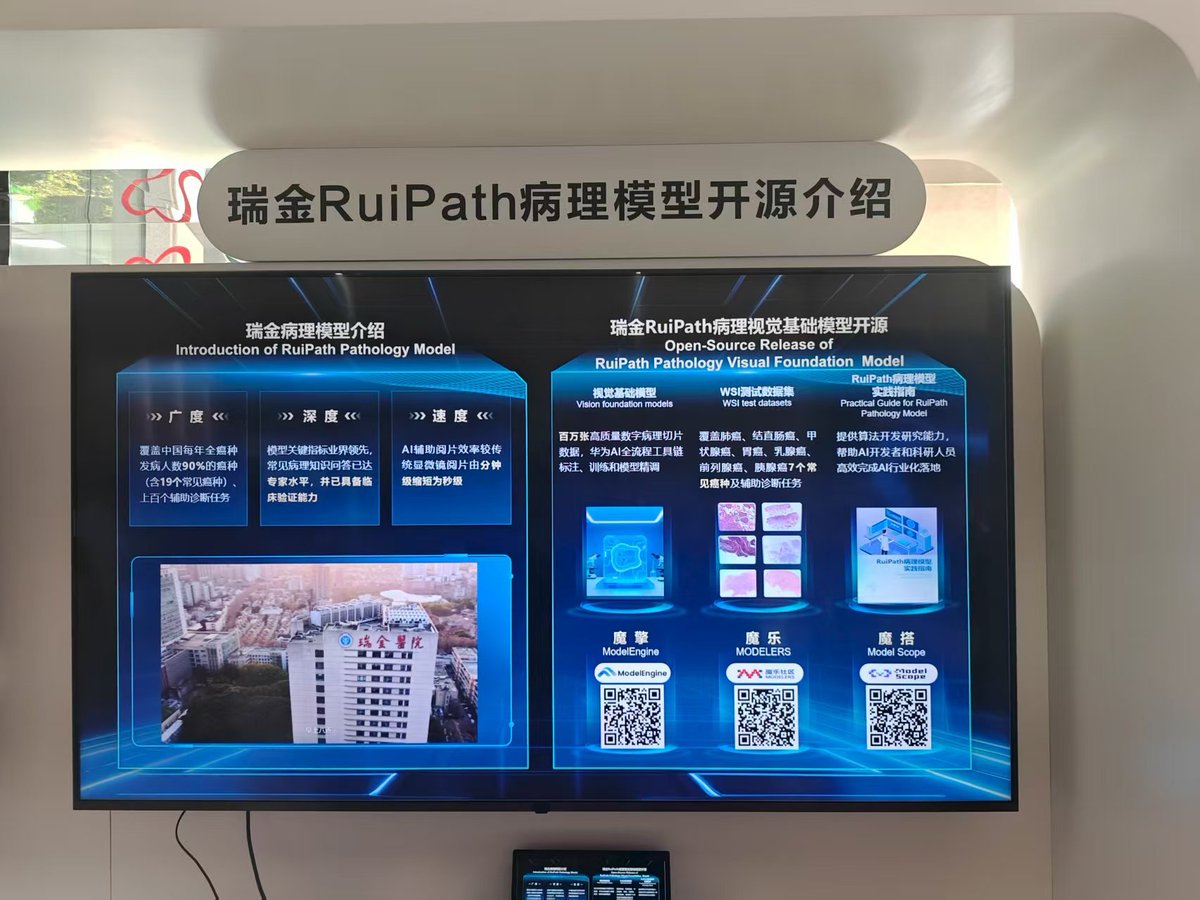
On healthcare: a pathology model built with Shanghai's Ruijin Hospital, RuiPath, is already deployed across more than 20 hospitals at the Grade A, municipal, and county levels, from Handan to Qianxinan. Diagnostics expertise that has always been locked inside senior pathologists is now being distributed as a cloud service to county hospitals for the first time.
On embodied intelligence: CloudRobo, billed as the first full-stack embodied intelligence development platform, aims to serve the toolchain needs of over 300 Chinese embodied AI startups.
Zhou's industry thesis was explicit. Healthcare and finance are China's most digitized, most data-rich industries. If AI cannot work there, he argued, it is unlikely to work anywhere else. And in those industries, the right metric is not daily active users or Token volume. It is the financial risk prevention rate, the improvement in credit efficiency, the probability that a patient in a remote area gets an accurate diagnosis.
What has been written here before about China's AI competition being less an OpenAI race than a set of embedded business systems holds particularly clearly for what Huawei Cloud is attempting. The company is using domestic compute plus open-source infrastructure to cover government and enterprise, hybrid cloud plus confidential computing to serve regulated clients, and Agentic Infra plus industry verticals to shift the fight from selling Tokens to selling productivity.
That path is slower than chasing MaaS revenue growth and harder to dress up as a quarter-over-quarter number. But it sidesteps the most intense price competition in AI cloud today and places a different wager: that when agents genuinely enter industry, the infrastructure layer that underpins them will matter more than who sold the cheapest Token.
Zhou put it plainly: "I have no way to build a silicon black soil out of parts from every country." The question Huawei Cloud is now posing is whether a domestic compute system, built under constraint, can meet what Chinese industry will actually need from AI.
Robotics #ChinaAI
---
3
2
14
1,579


6 Jul 2025
Ruijin Hospital and Huawei open-sourced RuiPath, an AI tool helping pathologists read slides faster and more accurately
Chin doctors face huge workloads300 slides daily vs. ~50 in the West. RuiPath acts like a copilot, boosting speed and precision. Big win for AI in healthcare
6
13
3,352

2 Jul 2025
#China is among the countries most severely affected by cancer, placing immense pressure on hospitals to deliver accurate and timely pathology diagnoses. #Shanghai's #RuijinHospital partnered with @Huawei to develop RuiPath—a visual foundational model for cancer pathology.
2
184

1 Jul 2025
Shanghai Jiao Tong University-affiliated Ruijin Hospital teamed up with Huawei to open-source RuiPath, the city's first pathology AI model from a medical institution. Trained and based on over one million of the hospital's datasets covering seven common cancers and Huawei's full-stack AI toolchain ModelEngine, the visual foundation model is expected to lower deployment barriers for AI-assisted pathological diagnosis in hospitals. @Huawei #pathologicalmodel #ModelEngine #RuiPath #AIModels
2
505

9 Mar 2025
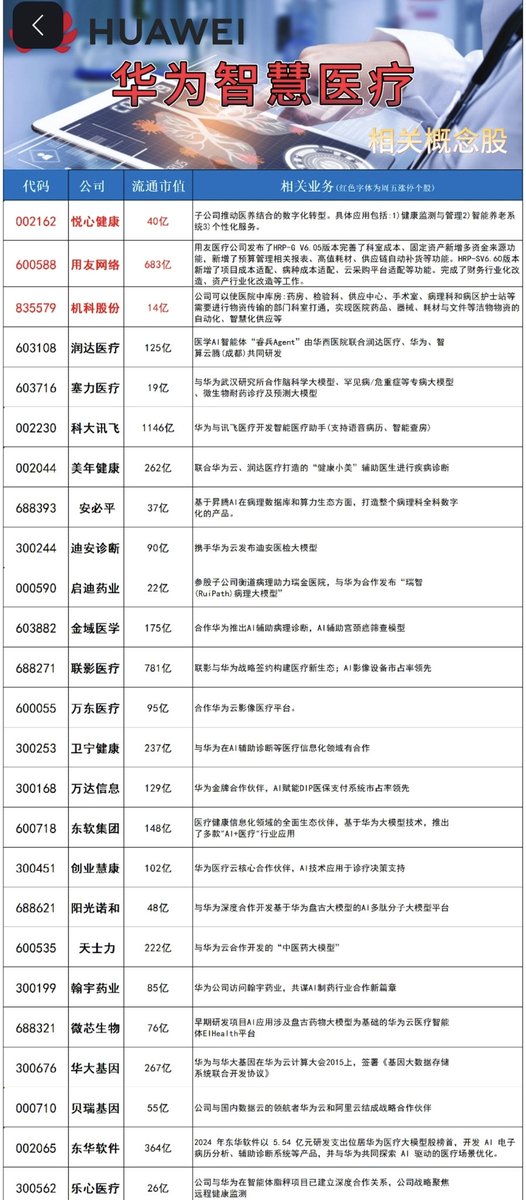
华为医疗卫生军团正式组建,最相关的12家公司梳理(附股)
3月7日,据财联社报道,华为正式组建医疗卫生军团,标志着其将智慧健康产业提升至战略级别,通过整合5G、云计算、昇腾AI等技术构建新一代智能医疗系统,聚焦AI辅助诊断解决方案,推动医疗大模型在临床场景的应用,推动医疗行业的数字化转型。
华为医疗卫生军团依托昇腾计算架构、盘古大模型及5G通信等技术,构建了覆盖数据采集、处理到应用的完整链条。针对医疗行业数据预处理耗时长、资源利用率低等问题,华为DCS AI解决方案通过高效数据工程工具、系统级加速能力和低代码平台,将模型训练周期缩短30%,应用开发效率提升80%。例如,与上海瑞金医院联合开发的病理大模型RuiPath,可覆盖90%常见癌症,单切片AI诊断时间仅需数秒,显著提升效率。该模型基于华为DCS AI解决方案打造,通过国产存储与算力协同,仅需16张算力卡即可运行。
AI医疗大模型与智慧医疗服务
润达医疗:与华为云签署全面战略合作协议,是华为盘古大模型在医疗领域内选择的唯一合作伙伴。双方合作推出了“良医小慧”健康助理、生成式病历、数字人智慧服务等产品,并在杭州拱墅区共建医疗大模型应用创新中心。
卫宁健康:与华为在AI辅助诊断等医疗信息化领域有合作,其在图像检测、医疗数据处理以及医疗文本生成等关键技术领域取得了相关发明专利。
迪安诊断:2024年9月,携手华为云发布迪安医检大模型,该模型能够自动化完成报告总结、精准疾病风险分析、个性化就医推荐及干预建议等。10月,双方又正式签署AI健康管理合作协议,进一步拓展合作领域。
AI辅助病理诊断
塞力医疗:2月21日与华为在华为武汉研究所签署合作协议。双方宣布将基于各自领域的技术优势,以AI技术为纽带,在智能诊断产品研发、数字疗法及脑科学大模型、罕见病/危重症等专病大模型、微生物耐药诊疗及预测大模型、智慧“无废城市”、“无废院区”等多个领域展开深度合作。
金域医学:2018年与华为签署合作协议,双方在AI辅助病理诊断应用开发方面取得突破性进展,共同训练出精准、高效的AI辅助宫颈癌筛查模型。
安必平:与华为合作,基于昇腾AI的病理数据库和算力生态,打造整个病理科全科数字化的产品,推出了“爱病理App”和“实视”实时镜下视野共享的病理平台。
医疗信息化与AI诊断
万达信息:华为金牌合作伙伴,DIP医保支付系统市占率领先(中标14个地市),AI赋能后毛利率提升。
东软集团:基于华为大模型技术,推出了多款“AI 医疗”行业应用。
AI医学影像与设备
联影医疗:AI影像设备市占率领先(肺癌检出率98%),海外高端市场突破(北美AI-CT订单增长50%)。
万东医疗:昆仑AI平台降低基层医院成本,政策推动影像共享直接利好设备销售。
迈瑞医疗:启元重症模型减少ICU重复工作30%,契合急危重症AI布局。
其他合作
美年健康:2024年1月,联合华为云、润达医疗打造的“健康小美”开启内部试运行,该产品可辅助医生进行疾病诊断,提高诊断效率。
2
1,453
9 Mar 2025
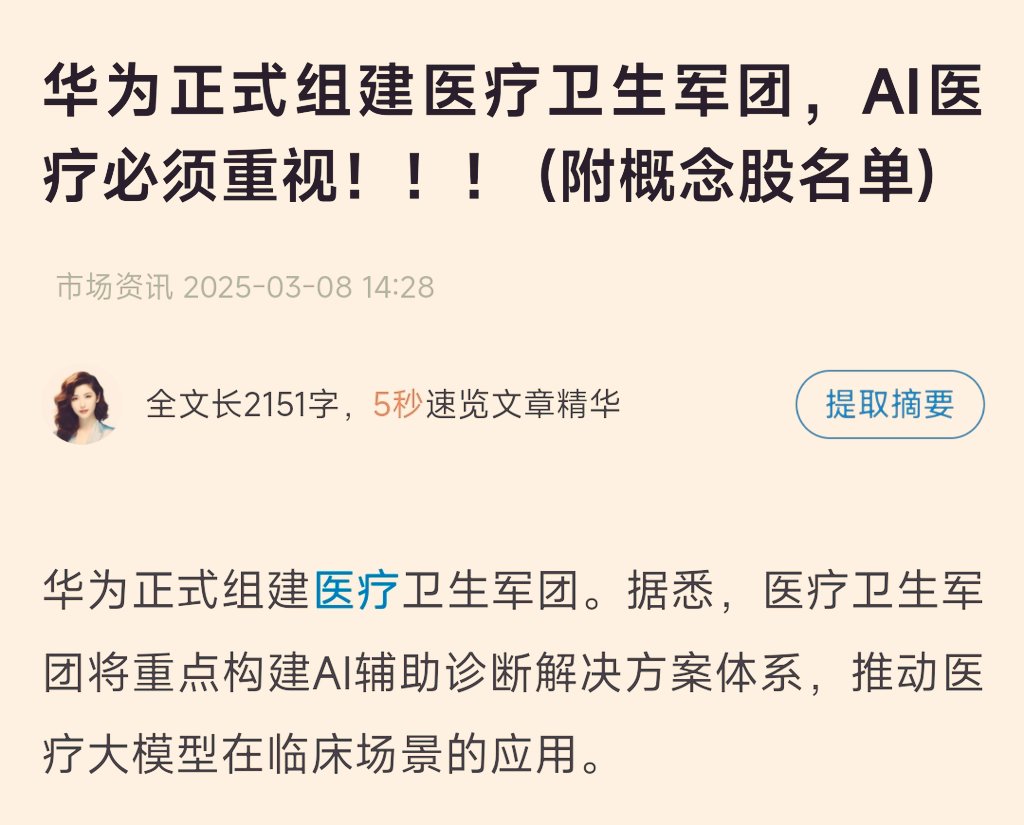
华为组建医疗卫生军团,AI医疗有望加速落地(附股)
1️⃣华为正式组建医疗卫生军团,将重点构建AI辅助诊断解决方案体系,推动医疗大模型在临床场景的应用。华为军团聚焦重点业务突破,快速集结资源,打造“从0到1”的方案,负责把空间做得越来越大。
2️⃣华为大模型在医疗早有布局,赋能生命科学 药械企业 医疗健康。在L1层行业大模型,华为已有医疗大模型和药物大模型,并且与润达医疗合作医检大模型“良医小慧”,与天士力合作 “数智本草”中医大模型,与瑞金医院合作“RuiPath”病理大模型,从医药研发到临床诊断,从专科疾病到综合病理分析,华为积极推动大模型在医疗各领域的应用。
3️⃣医疗行业要实现从信息化到数字化再到智能化的跨越,需要多方力量。22年6月时任华为轮值董事长胡厚崑曾表示,华为军团聚焦特定行业,与行业的头部企业建立合作关系,把能力赋能给伙伴。我们认为,华为军团将整合自身的资源力量,以“盘古大模型 昇腾AI框架 云计算”为核心技术,赋能行业伙伴,加快AI医疗智能化。
4️⃣建议关注:润达医疗、卫宁健康、创业慧康、嘉和美康、东软集团、久远银海、国新健康、万达信息、东华软件、讯飞医疗科技、医渡科技、晶泰控股
1
5
1,548

9 Mar 2025
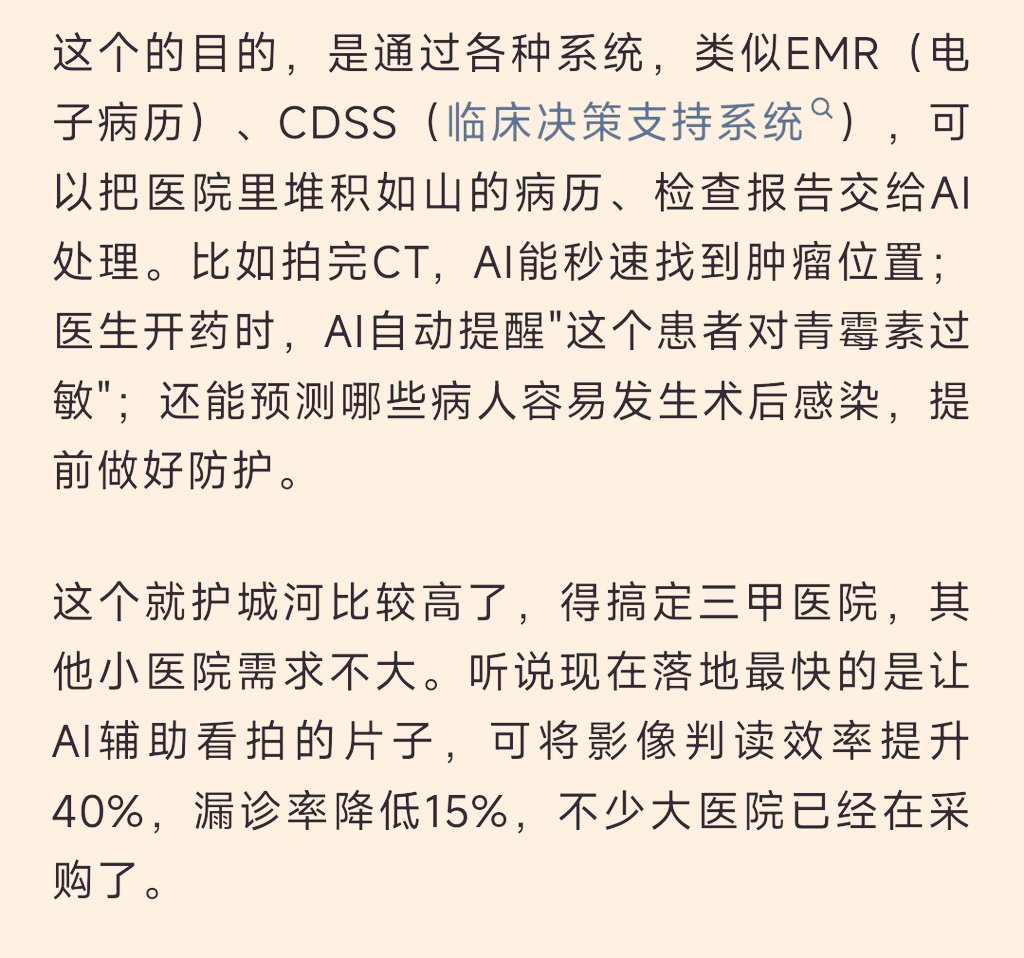
周末吹爆的华为AI医疗逻辑:
2月18日,华为联合瑞金医院发布了临床级多模态互动式病理大模型RuiPath。该大模型基于华为DCS AI解决方案打造,通过利用国产存储和算力的协同,仅需算力卡16张。
华为想做的是这个:AI医疗信息化/辅助诊断(类似"医院智慧大脑")。华为想推的收费模式是“SaaS AI服务分成”,也就是不仅卖医疗软件给医院,而且可以对AI服务按次付费,比如AI辅助诊断一次就收一次的钱,这样现金流比较好。
4
8
30,628


19 Feb 2025
上海交通大学医学院付属の瑞金医院が、華為(ファーウェイ)と共同開発した病理診断に特化したAIモデル「RuiPath」を発表。
これまで病理医が手作業で行っていたプロセスでは、顕微鏡で1つの組織切片を観察するのに従来は5~10分を要していたが、AIでは数秒に短縮。 #中国
4
748

19 Feb 2025
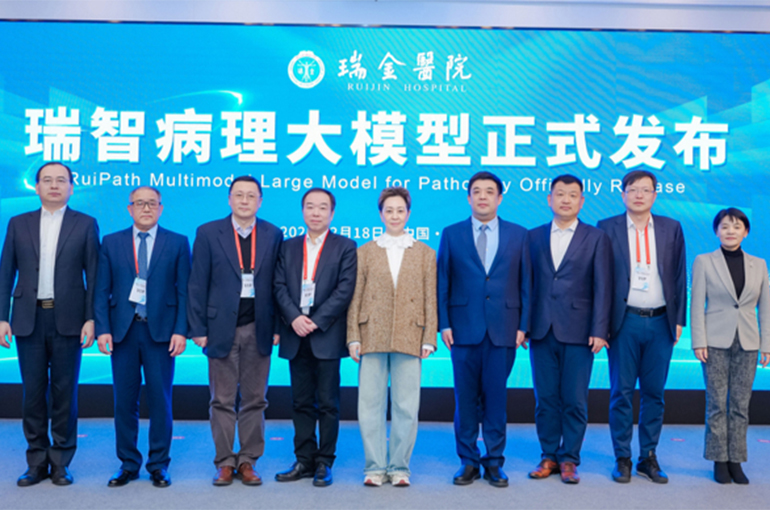
Ruijin Hospital & Huawei unveil RuiPath, an AI pathology model. This tool will boost diagnostic efficiency and accuracy. A breakthrough in medical AI!
This is exactly what I discussed in my latest article on AI and its impact on the job market in the future. See link in the description or on the Orange app.
1
9
1,271

18 Jul 2018
"Ota riski, tunne Pada!"
*myyntihymy, nostaa toista kulmakarvaa*
1


7 Mar 2018
🎶🎸some folks ale boln with silvel spoon in hand lold they dont help themselves 🥁🎶
1

25 Feb 2018
Näissä yhteyksissä toivoisin yhtä gif:iä käyttöni. "10 käskyä" -elokuvassa Yul Brunner, faaraon poika ja Charlton Heston, ottopoika Mooses asetetaan jonkun pienen veljellisen kisan eteen. Yul kääntyy voitonvarmasti hymyillen Charltonin puoleen ja sanoo: "A noble task" - Se gif.
16 Feb 2018
Heti en osaa päättää millaista musiikkia tyttöbändini "Likaiset pulmuset" soittaisi, mutta meillä olisi yksi biisi omistettuna @ruipath :lle. x.com/ruipath/status/9644185…
2
2


17 Sep 2017
Niin. Unelmista, jotka laksatoituvat kaiken nielevään cloakiin, puhdistetaan ja niellään uudestaan. Turhaan.
