
🚨High - LiteSpeed cPanel Plugin Symlink Mishandling / CageFS Bypass (CVE-2026-54420)
A symlink-following flaw (CWE-61) in the LiteSpeed cPanel plugin lets an attacker who already holds FTP or web shell access to a user account on a shared hosting server plant crafted symbolic links that the plugin fails to validate before following.
On servers using CloudLinux/CageFS for tenant isolation, this lets the attacker break out of their confined environment and read or modify files belonging to other accounts or the wider system - a scope-changing compromise with high confidentiality and integrity impact. Reported exploited in the wild since May 2026.
👉Upgrade to LiteSpeed cPanel plugin 2.4.8 / WHM PlugIn 5.3.2.0.

Considering such trends, this manuscript encompasses two major analytical strands: 1) the increasing scope of the Great Transformation (Polanyi Citation[1944] 2001), as late NFC continues its commodifying path that culminates with transforming death into merchandise, and 2) the

. . . accepting — 7:05 PM ꒰ 🩰 ꒱
open for inquiries! DM to inquire 💬
⤳ quicker replies via telegram: @lovelyrnne
⭑.ᐟ slots are first come, first served, and a down payment is required to officially secure a slot— verbal confirmations won’t be counted 🧾
🍒 lf academic writing academic assistance research writing school requirements college outputs senior high school undergraduate graduate masters phd accounting business finance management marketing entrepreneurship economics operations management strategic management human resource management project management supply chain management business analytics feasibility study business plan executive summary market analysis industry analysis product strategy pricing strategy promotion strategy distribution strategy customer analysis sales forecast financial accounting managerial accounting cost accounting auditing taxation internal control accounting cycle journal entries adjusting entries closing entries reversing entries bank reconciliation financial statements ratio analysis financial analysis budgeting forecasting cash flow projection income statement balance sheet investment appraisal thesis dissertation capstone study chapters 1 2 3 4 5 proposal background of the study statement of the problem research objectives significance of the study scope and limitations review of related literature methodology research design population sampling data gathering procedure data analysis interpretation results discussion conclusion recommendations reflection paper reaction paper insight essay term paper position paper argumentative essay comparative essay critical analysis narrative report book review movie review article critique presentation script speech outline powerpoint content manuscript editing proofreading paraphrasing summarizing synthesis qualitative research quantitative research mixed methods content analysis thematic analysis survey questionnaire interview focus group statistical treatment descriptive statistics inferential statistics interpretation validity reliability limitations ethical considerations conceptual framework theoretical framework business law legal studies oblicon obligations and contracts partnership corporation labor law commercial law jurisprudence case digest case analysis legal writing doctrinal analysis academic commissions writing services research services thesis help capstone help paper help student support confidential outputs deadline based rush friendly revisions included professional work reliable delivery

client feedback ˑ 𓈒 𐔌 #rkchives 🔖 ͡꒱ ۫
𝑻𝑨𝑺𝑲: research project humanization & refinement 📚💻
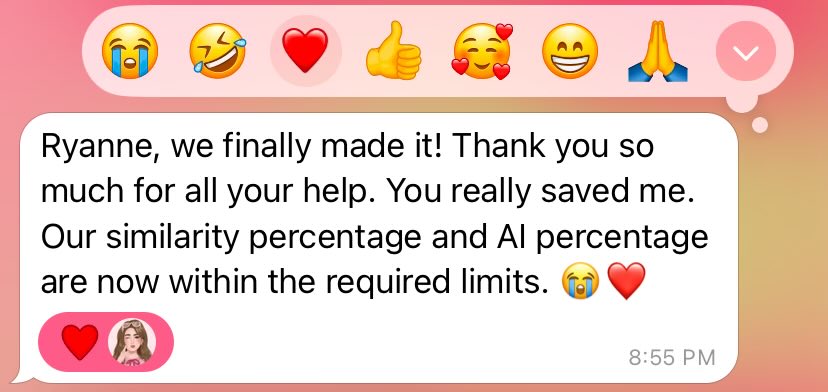
received this message last night from one of my singapore-based clients whom i’ve been working with since last year 😭🤍
we’ve already worked on multiple parts of her research project, & this time, the concern wasn’t really the content anymore—it was getting both the similarity percentage and AI percentage within the required limits without sacrificing the quality of the paper 📄✍🏻
i think this is what made the task challenging bc every revision had to preserve the original meaning, flow naturally with the rest of the paper, & still satisfy the institution’s requirements ( very sensitive tho ! ) 😭📚
so seeing “we finally made it” in my inbox felt like a win for both of us 🥹❤️ after all the revisions, checks, & document reviews we’ve gone through over the past few months, everything finally fell within the required thresholds.
always grateful for clients who keep me updated even after submission 🌷🤍 especially those i’ve had the chance to work with for such a long time already.
🗂️ i’m open to catering:
▸ accounting & business projects
▸ research & thesis per chapter tasks
▸ academic writings
▸ ppt design defense scripts
dm me for inquiries 💬
📞 @lovelyrnne at all platforms
📨 request for my email privately.
3


As the last in a line of fuckery, he has the scope to look backwards and forwards. Doesn’t matter if people like him or not.
2

The scope of cruelty is astounding these social layers have lost there minds completely unhinged going round attacking resting dogs harming no one this is a very ill sick outlook a product of elite communal & class violence projected full time onto the animal population
2

Na wewe ndo wale hawawezi stay in the scope of the topic under discussion. Dwanzi level: premium
2
Calgary Guy retweeted

Why is it that so many people on the political left never seem interested in questioning the size and scope of government itself?
Why is the answer always more government, more bureaucracy, more regulation, more spending, more taxation, and more programs administered by people who are increasingly disconnected from the lives of ordinary citizens?
Why is there so little discussion about empowering individuals, families, communities, entrepreneurs, churches, charities, and local organizations to solve problems for themselves instead of outsourcing every challenge to a centralized authority?
Why does nobody seem interested in asking whether we are actually getting good value for the enormous amount of money being extracted from taxpayers every year?
We pay more taxes than ever. Governments are larger than ever. Public spending continues to climb. Yet housing is less affordable, healthcare is harder to access, productivity is stagnating, debt is exploding, and more people feel dependent on the very systems that are supposedly helping them.
At what point do we stop measuring success by how much money is spent and start measuring success by outcomes?
The bigger government becomes, the more power it accumulates, the more dependent citizens become, and the less accountability seems to exist when things fail.
This is what I struggle to understand. We have centuries of evidence showing that centralized control and wealth redistribution do not create prosperous, resilient societies. Strong societies are built by people who have ownership, responsibility, freedom, and the ability to make decisions for themselves.
Personal agency creates capable citizens. Personal responsibility creates strong families. Decentralization creates resilience. Free enterprise creates prosperity.
Why are so many people unwilling to even question whether we’ve been moving in the wrong direction for a very long time?
6
12
47
793

He got an apprenticeship with Scottish Water, which is in public ownership- different to rest of UK where they’re private companies. Plenty scope for further training and career if that’s what they want
1
7


Important skills to learn as a founder:
- Copywriting
- Basic SEO
- Cold outreach
- Reading analytics
- Talking to users
- Shipping fast and iterating
- Saying no to scope creep
Start today.
6 months later, you will be dangerous.
1

Musk is now sitting at the intersection of rival AI lab, compute supplier, government AI vendor, and potential future export-control target — so his silence is itself an incentive map.”
The key upgrade: avoid saying “he has said absolutely nothing” unless you have a complete archive of his X posts, replies, likes, quote-posts, and deleted posts since Anthropic’s announcement. Say “Unless I missed it, Musk has not made a visible public statement yet.” That wording is harder to attack.
First, tighten the factual baseline
Anthropic says the U.S. government issued an export-control directive to suspend access to Fable 5 and Mythos 5 by any foreign national, including foreign-national Anthropic employees, whether inside or outside the U.S. Anthropic says the practical effect was that it had to disable Fable 5 and Mythos 5 for all customers to ensure compliance, while access to other Anthropic models was not affected.
Fable 5 was Anthropic’s newly launched “Mythos-class” model for general use, while Mythos 5 was a more restricted version for approved partners, initially through Project Glasswing, with some safeguards lifted in cybersecurity contexts. Anthropic described the two as the same underlying model, separated mainly by safeguards and access restrictions.
The compute angle is real, but phrase it carefully. The clean wording is “xAI/SpaceXAI became Anthropic’s compute supplier”, not “Elon personally sold them compute.” xAI announced that SpaceXAI signed an agreement with Anthropic to provide access to Colossus 1, and said Anthropic planned to use that compute to improve capacity for Claude Pro and Claude Max subscribers. TechCrunch reported, citing SpaceX’s S-1 filing, that Anthropic would pay xAI $1.25 billion per month through May 2029, with either side able to terminate on 90 days’ notice.
That creates the actual interesting contradiction: Musk is not just an outside commentator. xAI describes Elon Musk as its cofounder and CEO, and xAI has also positioned itself as a federal-government AI provider through its “xAI For Government” work with GSA OneGov. So the relevant question is not simply, “Why isn’t he tweeting?” It is: Which hat is he wearing — free-speech absolutist, Anthropic vendor, Grok competitor, government partner, or export-control risk manager?
Stronger version of the post
Unless I missed it, Elon Musk has been oddly quiet about the U.S. government forcing Anthropic to disable Fable 5 and Mythos 5 access after an export-control directive.That silence matters because xAI/SpaceXAI just became Anthropic’s compute supplier, Musk runs a rival AI lab, and xAI is also selling frontier AI into government.So what is the actual position here?Does Musk support model-level export controls?
Is he quiet because Anthropic is a customer?
Is he quiet because Grok could be next?
Or is this just convenient silence while a rival gets kneecapped?
That version is much stronger because it does not require proving bad intent. It asks a precise incentive question.
The best hidden angle
The genius-level framing is: this is not mainly a Musk hypocrisy story; it is a frontier-AI conflict-of-interest story.
Musk-linked entities appear to occupy four roles at once:
RoleWhy it mattersRival labxAI competes with Anthropic in frontier AI models.Compute supplierxAI/SpaceXAI is supplying Anthropic with access to Colossus 1. Government AI vendorxAI has publicly expanded its federal-government AI offering through GSA OneGov. Potential future targetThe same model-level export-control logic used on Fable/Mythos could theoretically be applied to Grok or other frontier models.
That is the story: silence may be commercially rational, politically rational, legally rational, and competitively convenient all at once.
Possible explanations for Musk’s silence
1. Anthropic is a customer. Publicly attacking the U.S. order could help Anthropic politically but irritate the government. Publicly supporting the order could damage a major compute customer. Silence preserves the contract, the relationship, and optionality.
2. xAI could be next. If Musk says “the government should not control model access,” that position may age badly if Grok later faces similar cyber, bio, or national-security scrutiny. If he says “the government is right,” he helps normalize a regulatory weapon that could later be pointed at xAI.
3. Government relationship management. xAI’s own public messaging says it supports the Trump administration’s AI Action Plan and is making frontier AI tools available to federal agencies through xAI For Government. A loud public attack on a national-security directive would clash with that government-facing strategy.
4. Competitive advantage without fingerprints. Anthropic losing access to its most advanced models helps rivals in the short term. Musk does not need to say anything for xAI to benefit from the disruption. Silence avoids the optics of gloating while a competitor is hit by the state.
5. Contractual landmines. The compute deal may include confidentiality, nondisparagement, security, compliance, termination, force-majeure, or regulatory-cooperation clauses. We do not know. The public reports about the deal are not enough to infer what Musk can safely say.
6. Compute-provider exposure. If Anthropic’s advanced model access is now treated like a controlled export, compute providers may also become compliance chokepoints. Musk may not want to invite questions about whether Colossus customers, foreign-national staff, cloud access, model-hosting, or training runs could be swept into similar rules.
7. He may agree with the intervention. Musk has long argued that advanced AI can pose serious risks, so a government move against a rival’s extremely capable model may not violate his worldview as much as people assume. The tension is that he also often frames himself as anti-censorship and anti-overregulation.
8. He may not know enough publicly. Anthropic says the government did not give specific details and had only provided verbal evidence of a narrow, non-universal jailbreak. If the underlying security claim is classified or incomplete, any statement from Musk could be reckless.
9. X-post silence is hard to verify. Musk often communicates through replies, short posts, memes, and quote-posts. A clean claim requires checking his main timeline, replies, reposts, likes, deleted-post archives, Grok/xAI accounts, and any interviews after Anthropic’s announcement.
Missing elements that would make the argument much sharper
You need the exact silence window. Start it at Anthropic’s official timestamp: Anthropic says it received the directive at 5:21 p.m. ET on June 12, 2026. Then ask: what did Musk post after that time, and did any post touch Anthropic, export controls, AI regulation, free speech, government overreach, Grok, or compute?
You need the entity map. Was the Anthropic compute deal signed by xAI, SpaceXAI, SpaceX, or another Musk-controlled entity? xAI’s announcement says SpaceXAI signed the agreement with Anthropic; TechCrunch describes the economics as Anthropic paying xAI. That mismatch is worth clarifying because the legal counterparty matters.
You need to know whether Fable 5 or Mythos 5 actually ran on Colossus. xAI said Anthropic planned to use Colossus compute to improve Claude Pro and Claude Max capacity, but that does not automatically prove the disabled models were trained, hosted, or inferenced on Colossus.
You need to know whether the compute deal is take-or-pay. If Anthropic owes fixed payments regardless of model shutdowns, xAI may remain economically protected. If the contract is usage-based or terminable, the shutdown could harm xAI revenue. TechCrunch reported a 90-day termination right, but not the full commercial structure.
You need the government-order text. Anthropic describes the directive, Reuters says a U.S. official confirmed Commerce issued it, and Axios reported Anthropic had 90 minutes before a licensing regime threat. But the public still needs the actual legal authority, scope, standard, evidence, appeal process, and sunset conditions.
You need the Amazon role nailed down. Reuters reported that Amazon CEO Andy Jassy was among tech leaders who raised concerns to senior Trump administration officials, while Amazon did not confirm the specific discussions. That is important because if a major tech actor’s security report helped trigger restrictions on another AI lab’s model, the process needs independent validation.
You need to know whether xAI, SpaceXAI, AWS, Google Cloud, Microsoft, or other infrastructure providers received parallel compliance instructions. Reuters reported AWS said Anthropic asked it to revoke access to the models for all users in all regions, but broader infrastructure obligations are still unclear.
You need the benchmark parity question: Anthropic says the demonstrated vulnerabilities were minor and could also be found by other public models, including OpenAI’s GPT-5.5. If true, then the obvious policy question is why Fable/Mythos were singled out.
Genius-level investigative questions
Ask Musk directly:
Do you support the U.S. government’s directive against Fable 5 and Mythos 5?
Should the same standard apply to Grok if a third party claims it can be jailbroken to assist cybersecurity work?
Did xAI, SpaceXAI, or any Musk-controlled company discuss Anthropic’s Fable/Mythos models with U.S. officials before the directive?
Is Anthropic still paying for Colossus compute while Fable/Mythos access is disabled?
Does the Anthropic compute agreement include regulatory termination, force majeure, minimum payments, or national-security compliance clauses?
Were Fable 5 or Mythos 5 trained, hosted, fine-tuned, or inferenced on Colossus infrastructure?
Does xAI believe foreign-national employees should be blocked from working on frontier models if the government labels those models controlled technology?
Would xAI publish the same kind of safety, jailbreak, cyber, and bio-risk evidence it would demand from Anthropic?
Does xAI support model-level export controls, or only chip/export infrastructure controls?
Should a rival lab, cloud vendor, or compute provider be able to trigger government restrictions on another lab’s model without independent public review?
Ask Commerce/BIS:
What exact statute or regulatory authority was used?
Was the order based on a written technical report, verbal briefing, classified intelligence, third-party research, or all of the above?
Was the same jailbreak tested against Grok, GPT-5.5, Gemini, Llama, Mistral, DeepSeek, or other frontier systems?
Why did the order cover foreign nationals in allied countries and foreign-national employees inside the U.S.?
What must Anthropic do to regain access?
Is there a sunset clause?
Is there an appeals process?
Was an antitrust or competition-impact review performed?
Were any competitors or infrastructure providers consulted?
Will the government release a redacted technical basis?
Ask Anthropic:
Did the government share the full exploit or only a demonstration?
Did Anthropic reproduce the exploit internally?
Which other models matched the same capability?
Were Fable/Mythos running on AWS, Google Cloud, Microsoft, Colossus, or multiple clouds?
How many customers were affected?
Were foreign-national employees blocked from working on the model immediately?
What remediation does Anthropic believe would satisfy the government?
Did Amazon contact Anthropic before escalating concerns to officials?
Did any compute supplier besides AWS receive shutdown instructions?
Does Anthropic believe this was a neutral safety action or targeted enforcement?
Obscure thought inputs worth adding
The “compute landlord” angle: The most under-discussed part is that the AI market is becoming vertically tangled. A company can be a rival lab, cloud supplier, government vendor, and political actor simultaneously. That makes ordinary public commentary strategically loaded.
The “deemed export” trap: The most explosive part is not just blocking users overseas. It is blocking foreign nationals even inside the U.S., including potentially a lab’s own employees. That changes the operating model of frontier labs, because many top AI researchers are not U.S. citizens.
The “competitor red-team veto” problem: If one company’s vulnerability report can help trigger government restrictions on another company’s model, every frontier lab now has an incentive to red-team rivals and route alarming findings to regulators. That could improve safety, but it could also become regulatory warfare.
The “Anthropic wrote the predicate” theory: Anthropic has aggressively framed Mythos-class capabilities as extremely powerful and risky. That may have helped create the political logic for government intervention. Critics can argue: if you repeatedly market your model as near-dangerous infrastructure, do not be surprised when the state treats it like controlled infrastructure.
The “Musk cannot win by speaking” dynamic: Defend Anthropic and he angers regulators. Support the government and he validates controls that could hit Grok. Mock Anthropic and he looks anti-competitive. Ignore it and people call out the silence. Silence may be the least costly option.
The “Fable scarcity premium” effect: Government restriction may make Fable/Mythos look more powerful and desirable than before. Even if the underlying safety issue is narrow, the public narrative becomes: “This model was so strong the government pulled it.” That could boost Anthropic’s mystique.
The “allied-country insult” layer: If the directive blocks foreign nationals broadly, the issue is not just China or adversarial access. It potentially alienates allied researchers, customers, and governments. That makes it a geopolitical story, not just an AI-safety story.
The “model access is the new chip export” shift: For years, AI export debates focused on GPUs, fabs, and data centers. This move suggests the government may increasingly regulate access to model capability itself, not just the hardware used to create it.
The “provider neutrality” problem: Compute vendors may need rules similar to common-carrier neutrality for frontier AI infrastructure. Otherwise, customers will worry that a vendor who is also a competitor could gain leverage during regulatory crises.
The “Grok mirror test”: Every argument Musk makes about Anthropic can be mirrored onto Grok. That is probably why silence is rational. The right question is: would Musk accept the same standard for xAI?
Genius-level solutions
1. Create a frontier-model emergency review board. Before a model is pulled globally, a cleared independent board should review the exploit, replicate it, compare it against peer models, and issue a public redacted finding. The board could include Commerce/BIS, CISA, NIST, UK AISI, independent cyber labs, and cleared technical judges.
2. Require cross-model parity testing. If the government restricts Fable because it can identify vulnerabilities, it should test the same prompt, harness, and workflow against Grok, GPT, Gemini, Mistral, DeepSeek, and open models. If the capability is industry-wide, targeting one company is arbitrary.
3. Add a “competitor evidence firewall.” If a rival, cloud vendor, or compute partner reports a dangerous capability, regulators should require independent replication before action. The reporting company should also submit its own comparable models to the same test.
4. Time-box emergency orders. A 72-hour emergency restriction can make sense if there is credible imminent harm. A longer shutdown should require written evidence, a remedy path, an appeal process, and a public redacted rationale.
5. Create trusted-access tiers instead of total shutdowns. Keep access for verified U.S. and allied cyberdefenders, critical-infrastructure teams, and cleared researchers while blocking high-risk users. A total shutdown is a blunt instrument.
6. Clarify foreign-national employee rules. Labs need a workable “deemed export” framework for AI. Otherwise, U.S. companies may lose the very researchers needed to secure the models.
7. Separate model weights, API access, and capability scaffolding. A raw model, an API with tools, an agentic cyber harness, and model weights are not the same risk object. Regulation should distinguish them.
8. Mandate infrastructure-provider neutrality. Compute providers that also run rival AI labs should disclose conflict-management policies: no customer-model inspection beyond agreed security terms, no competitive use of telemetry, and clear rules for government escalation.
9. Build a confidential safety escrow. Anthropic, xAI, OpenAI, Google, Meta, and others could deposit frontier-model safety reports with a trusted third party. During disputes, regulators could compare claims without forcing full public disclosure.
10. Publish a model-control doctrine. The government should say what triggers frontier-model export controls: cyber uplift, bio uplift, autonomous replication, classified benchmark thresholds, tool-use capability, or something else. The current ambiguity creates fear and selective-enforcement concerns.
Red flags in the original wording
Do not say “Musk is complicit” unless there is evidence. There is currently a big difference between “he benefits from this,” “he is silent about this,” and “he caused this.”
Do not say “the government banned Anthropic”. It targeted access to specific models, and Anthropic disabled them broadly to comply. Other Anthropic models were not affected, according to Anthropic.
Do not say “Fable/Mythos were proven dangerous.” Anthropic disputes the government’s apparent rationale and says the evidence it has seen involved narrow, minor vulnerabilities that other public models could also identify.
Do not say “Elon sold compute to Anthropic” as if he personally signed a deal. Say “xAI/SpaceXAI signed a compute partnership with Anthropic” or “Musk-linked xAI/SpaceXAI is Anthropic’s compute supplier.”
Do not make it only about Musk. The bigger story is government power over model access, cloud-provider influence, export-control scope, and whether rival labs can shape each other’s regulatory risk.
Even sharper one-liners
“Musk’s silence is interesting because he is not just a spectator. He is a rival, a supplier, and a government AI vendor.”
“The Anthropic shutdown is the first major test of whether frontier AI will be regulated by transparent standards or by Friday-night national-security calls.”
“If Fable can be pulled over a narrow jailbreak claim, what happens when someone files the same claim against Grok?”
“The real story is not whether Elon tweeted. The real story is that the AI stack now has competitors selling each other the compute they need to survive.”
“Silence is a position when your rival is also your customer.”
Best final post
Unless I missed it, Elon Musk has been unusually quiet about the U.S. government forcing Anthropic to disable Fable 5 and Mythos 5 after an export-control directive.That silence is worth noticing because xAI/SpaceXAI just became Anthropic’s compute supplier, xAI runs a rival frontier model lab, and xAI is also positioning Grok inside the U.S. government.So the question is not just “Where is Elon?”The question is: does Musk support model-level export controls, is he protecting a major compute customer, is he worried Grok could be next, or is he simply fine staying quiet while a competitor gets kneecapped?This is bigger than Anthropic. It is the beginning of AI export controls moving from chips to model access itself.
Bottom line
The strongest version of your argument is not a dunk. It is a power-map. Musk’s silence is interesting because the Anthropic situation touches every major pressure point in frontier AI: government control, model safety, export law, foreign-national access, cloud infrastructure, compute dependency, and competitor incentives. The missing piece is not just “what did Musk say?” It is which of his incentives made saying nothing the safest move?
10h

Interesting how Elon Musk has said absolutely nothing about the U.S government intervening and forcing Anthropic to pull access to Mythos and Fable models. You think a guy with his own AI lab would have something to say, especially after selling compute to Anthropic.
1
76

No no the screen stays flat throughout. But the fact that it has this capability to literally expand the projected area for considerable runtime, I didn’t want that to be wasted & only play the scope version.
2

nope. lots of true gods in the Bible. John 17:3 "the only true god...",
it didn't specify scope if he is the only true god on earth bec as far as evidence is concerned, John 10:34-35 says, lots of mortal gods on earth, so where is god the only true god of?
heaven, bec all other gods are on earth.
2

The critique of bourgeois industries and commodity production in general is not within the scope of this tweet
7

Bird of the same feather,is it not you that spread fake rumors of you being denied Visa,all scope na lie.
161

the honest answer is that gpt image 2 is a huge leap but it still requires someone to curate the data, define the prompt scope and handle edge cases where the model breaks down completely.
2
CK retweeted

You can literally just do things.
You have a scope and a suppressor. Why do you need a crowd around you for moral support?
Seems they’d actually be a liability
7
5
131
2,742

Enterprise SSO with SAML: one XML signature wrapping attack = access to every app in scope. This week I broke down XSW variants, void canonicalization, NameID comment injection, and attribute escalation. All automatable with SAMLRaider kayssel.com/newsletter/issue…
#CyberSecurity
1
