
How Iran engineered its multipolar breakthrough
Pepe EscobarJune 15, 2026
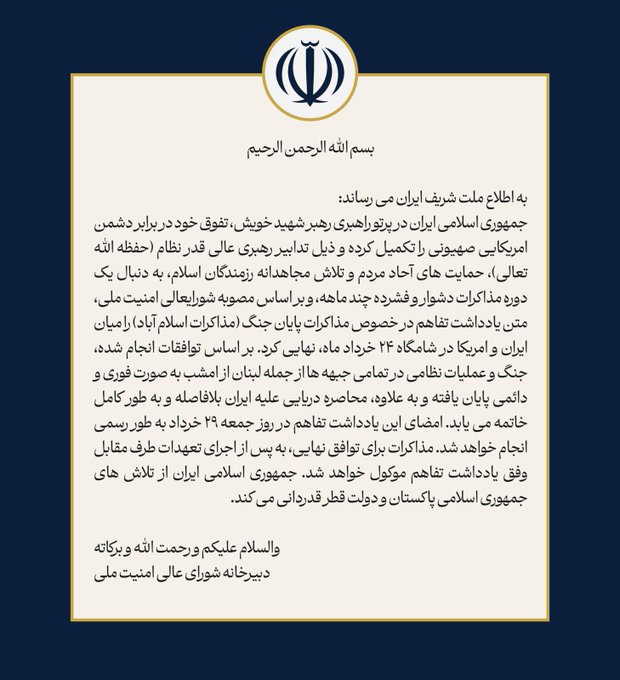
Let’s start with a historic statement, by Iran’s Supreme National Security Council (SNSC).The key takeaways:“The Islamic Republic of Iran, in light of the guidance of its martyred Leader, has completed its superiority over the American-Zionist enemy.”“The text of the memorandum of understanding regarding negotiations to end the war, ‘the Islamabad negotiations,’ was finalized between Iran and the United States on the evening of June 14th.”“The war and military operations on all fronts, including Lebanon, will end immediately and permanently from tonight.”“In addition, the naval blockade against Iran will be ended immediately and completely.”“The signing of this memorandum of understanding will officially take place on Friday” [that would be June 19, in Geneva].“Negotiations for a final agreement will be postponed until after the other side’s commitments are implemented in accordance with the memorandum of understanding.”
Amidst so much to unpack, a few crucial facts: the MoU will only be agreed by the SNSC under direct order of Leader Mojtaba Khamenei, the Ultimate Decider; there is no (italics mine) guarantee the death cult in West Asia will refrain from attacking Lebanon; and it’s only after June 19 that the long and winding road – or Deal Dance – really begins.
The news of an “Islamabad Accord” was broken last Friday by Transition Protocol, a new project Larry Johnson and I are sharing, after we detailed it the week before in our previous channel, Power Shift, deleted by a direct order to Google by the US government.
We announced the exact blueprint of this structural transformation. We also shared our sources’ assessment that Iran, if pushed to the brink, would be prepared to follow a North Korean-style deterrence model - including the possibility of demonstrating a nuclear capability on its own soil in order to end decades of coercion by the US/Israel.
So it’s no wonder that Iran, via the SNSC, also expressed its full “appreciation” for the non-stop work of Pakistani mediators as well as Qatar.
The Iran-Pakistan connection
Now to the intel breakdown on how this multipolar triumph was engineered, according to our Iran-Pakistan sources.
The architect of the MoU breakthrough was essentially Iranian Foreign Minister Abbas Araghchi. On Sunday he returned to Tehran after a highly confidential mission to Islamabad over the weekend, where he successfully formulated the final details of the framework Trump himself – otherwise very busy with an array of cage matches by the White House lawn - announced. Yet this is not a deal: it’s a MoU.
Predictably, the death cult in West Asia desperately attempted to derail the MoU by attacking Lebanon. Iran then delivered a stark ultimatum to Trump via the Pakistani mediators: if that continued, Iran was locked and loaded to hit Israel very hard. Trump finally decided he didn’t want his (italics mine) deal to be derailed.
Our sources had previously confirmed that Tehran had drawn a hard line and had given Washington until the end of June to meet two core conditions: the unfreezing and return of approximately $12 billion in Iranian funds; and the complete lifting of US sanctions.
In return, Iran would formally agree to forgo the development of a nuclear weapon and offer specific, structured concessions.
The key point is that Tehran made sure the deadline was real, and Washington should understand that it was real.
Now back to key issues revolving around the MoU.
On the nuclear assets: Tehran definitively confirmed the Highly Enriched Uranium (HEU) stockpile is completely secured and permanently out of the reach of US-Israel.
Multipolar Integration: Pakistan emerges as the anchor of a new West Asia-South Asia regional architecture. Islamabad, quietly, is also facilitating a very complex rapprochement between Iran and the UAE. The head of the UAE security apparatus visited Iran on Friday – that was facilitated by Pakistan – so Abu Dhabi could deliver $2 billion in frozen funds to Iran.
The Security Matrix: Pakistan is the primary facilitator bridging Iran with Qatar, Bahrain, Saudi Arabia, and Egypt. With full support from China, Pakistan will possibly be providing J-10C fighter jets to several of these players.
Finally, there’s the stunning symbolic framework of Iran inflicting a serious strategic defeat on US/Israel. To seal this monumental shift, the funeral of assassinated Supreme Leader Ayatollah Khamenei will take place on and around the 10th of Muharram (Ashura), in the first week of July. This will be framed as a massive "Victory Day" all across Iran. The whole Global South will be watching.
Will the US be agreement-capable?
The Sisyphean tasks for the MoU, as revealed by Iranian media, start right away, along the 30-day period after the signing.
Washington will have to confirm “its commitment to non-interference in Iran’s domestic affairs and respect for the sovereignty of the Islamic Republic of Iran.” Talk about a tall order.
Upon signing, the US will have to affirm that “it will not increase the amount of troops or military assets present in the region, nor impose any new sanctions during the negotiations.”
Iran will reaffirm “its commitment to the Non-Proliferation Treaty (NPT) and confirms that it will never produce, develop, or acquire a nuclear weapon.” That has always been official Iranian policy.
Upon signing the MoU, the US must declare that “it will provide Iran with half of its frozen funds, amounting to a value of $12 billion, to be made available in a non-reversible manner within 30 days, with a commitment to make the remaining half available during the subsequent 60 days.”
The US must also “issue sanctions waivers for Iranian oil, gas, and petrochemical exports, effective immediately, with a commitment to extend these waivers permanently once a final agreement is reached.”
The US “will begin immediate consultations with Israel to present a short-term timeframe for a full Israeli withdrawal from Lebanon, including points occupied following the 2024 Israel-Hezbollah agreement.” Realistically, that will be impossible.
Iran will confirm “it will reopen the Strait of Hormuz to commercial maritime traffic, according to certain specified arrangements determined by Iran, within 30 days.” There’s no way there won’t be a toll booth.
Assuming all of the above proceeds with No Hell from Above – or Below – we then reach Phase III on Negotiations on a Final Deal: a 60-day period, plus a nearly inevitable extension. The 60-day negotiating period will begin once all (italics mine) terms of the MoU have been met in the previous 30 days.
It's during these 60 days that the US will have to pay the remaining $12 billion of Iran’s frozen assets, as well as “present plans for a reconstruction fund for Iran, amounting to a value of at least $300 billion, funded partially by Gulf states.” This is as unrealistic as it gets.
And then, finally, the US and Iran “will begin detailed discussions on a permanent solution to nuclear-related matters, including enrichment, the existing uranium stockpile, and the fate of the nuclear sites.”
As if all of the above was not hardcore enough, then there’s the negotiations on “lifting of all economic sanctions on Iran, including primary, secondary, US and UN sanctions, as well as the withdrawal of all UN Security Council and IAEA Board of Governors resolutions against Iran.”
The final “deal”, of course, if it ever happens, will be approved by a UN Security Council Resolution. The JCPOA also was. And Trump still destroyed it.
Why Trump changed his rhetoric
Trump’s abrupt shift from the vociferations about “destroying” Iranian civilization to exhorting an “agreement on the table” may be just fog of war: a deception to captivate markets, then the Department of Forever Wars launches a new wave of attacks.
Yet the severe punishment inflicted on the US Al-Azraq base in Jordan – expanding the battlefield - did alter Washington’s calculations.
Add to it that the Iranian conditions previously agreed upon in principle never allowed Trump to present the outcome as a victory. As we approached the possibility of an “Islamabad Accord”, Trump backed away - and sent new demands/ amendments to Tehran via the Pakistani mediators.
Tehran played it cool, and kept him waiting, exasperated, over several days. At the same time, all echelons of the Iranian government were sending a clear message, over and over again: you cannot alter the reality of your strategic defeat through your maneuvering antics.
Trump predictably attempted to turn up the military volume while Pakistani mediators were still in Tehran. Iran responded during two nights of escalation by striking twice as many targets as those hit by the US. That’s when Trump may finally have read the writing on the wall.
If this MoU is indeed signed next Friday – and that’s a major “if” - then this is the beginning of a whole new geopolitical ball game, as astonishing as it gets, and absolutely impossible to foresee only a few months ago.
The new game includes the sunset of US Gulf military infrastructure, bypassed in real-time, and Iran in full control of the Strait of Hormuz and with unstoppable firepower ranging from Anatolia to Mogadishu.
This is already one of the defining geopolitical stories of the Eurasia Century: a fundamental paradigm shift engineeed by war, and sovereign resilience on the ground. And from now on, Washington will have to learn, the hard, realistic way, that any retreat from commitments made in front of the whole planet will be bilateral.
83
save the Republic from billionaires retweeted

Receipts:
Iran's SNSC Statement on the Latest Negotiations to End the War
wanaen.com/irans-snsc-statem…
Iran says deal with US finalised, signing set for June 19
thestar.com.my/news/world/20…
Iran War Live Updates: Trump Calls for Restraint
nytimes.com/live/2026/06/14/…
Iran war live: US, Tehran confirm 'peace deal' reached
aljazeera.com/news/liveblog/…
5
3
7
2,528
jemilat omolola retweeted

Iran’s SNSC Secretariat official statement regarding the MoU:
The Islamic Republic of Iran, in light of the guidance of its martyred Leader, has completed its superiority over the American-Zionist enemy.
Under the measures of the esteemed Leader, the support of all segments of the people, and the selfless efforts of the fighters of Islam, following several months of difficult and intensive negotiations, and based on the approval of the SNSC, the text of the memorandum of understanding regarding negotiations to end the war, “the Islamabad negotiations,” was finalized between Iran and the United States on the evening of June 14th.
According to the agreements reached, the war and military operations on all fronts, including Lebanon, will end immediately and permanently from tonight.
In addition, the naval blockade against Iran will be ended immediately and completely.
The signing of this memorandum of understanding will officially take place on Friday.
Negotiations for a final agreement will be postponed until after the other side’s commitments are implemented in accordance with the memorandum of understanding.
The Islamic Republic of Iran expresses its appreciation for the efforts of the Islamic Republic of Pakistan and the government of Qatar.
24
116
525
20,016

▪️ईरान ने अमेरिका के साथ युद्धविराम समझौते का किया ऐलान
SNSC ने दी आधिकारिक जानकारी
▪️पाकिस्तान करेगा US-Iran समझौते की मेजबानी, शहबाज शरीफ का बड़ा बयान
#Iran #USA #USIranDeal #Ceasefire #PeaceAgreement #MiddleEast #Pakistan #ShehbazSharif | @SumitDefence
1
19
175
27,412
Guillermo R. Beiza retweeted

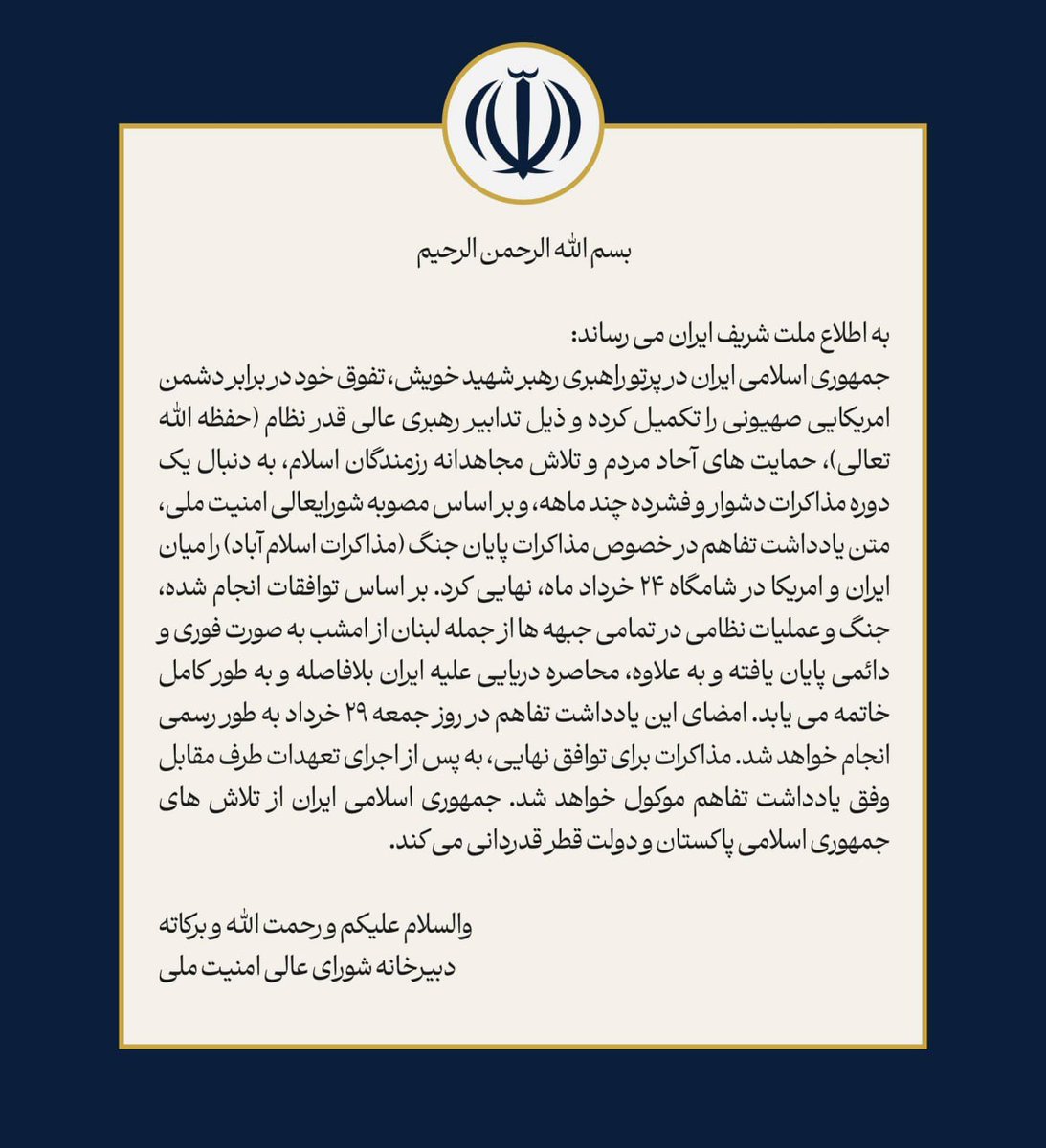
Statement by Supreme National Security Council (SNSC) of I.R. Iran:
The Islamic Republic of Iran, through the guidance of its martyred Leader, has completed its superiority over the American-Zionist enemy.
Under the measures of the esteemed Leader, support of the people, and selfless efforts of the fighters of Islam, following several months of difficult and intensive negotiations, and based on the resolution of the SNSC, the text of the memorandum of understanding regarding negotiations to end the war, (Islamabad Talks) was finalized between Iran and the United States on the evening of June 14th.
According to the agreements reached, the war and military operations on all fronts, including Lebanon, will end immediately and permanently starting tonight.
In addition, the naval blockade against Iran will be ended immediately and completely.
The signing of the MoU will officially take place on Friday (19 June).
Negotiations for a final agreement will be postponed until after the other side’s commitments are implemented in accordance with the MoU.
The Islamic Republic of Iran expresses appreciation for the efforts of the Islamic Republic of Pakistan and the government of Qatar.
9
22
61
2,009

It cost an 87 year old cancer patient who was replaced the next day and some outdated equipment from the 80's 🥱
Meanwhile, they've gained Billions in oil sales and toll fees while perfecting their AD and missile architecture.
Aragachi runs nothing, the SNSC Khamenei decide.
1
33

presstv.ir/Detail/2026/06/15…
Israelin raivo yhteisymmärryspöytäkirjasta on "selkeä merkki" Iranin voitosta - Iranin presidentti / Press TV
Maanantai, 15. kesäkuuta 2026 klo 17.11
Iranin presidentti Masoud Pezeshkian osallistuu maanlaajuiseen konferenssiin Teheranissa 15. kesäkuuta 2026, jossa on läsnä hallituksen jäseniä, kuvernöörejä ja piirikunnan virkamiehiä eri puolilta maata. (Kuva: president.ir)
Presidentti Masoud Pezeshkian sanoo, että Israelin viha Iranin ja Yhdysvaltojen välisestä yhteisymmärryspöytäkirjasta on selkeä merkki Iranin kansakunnan menestyksestä ja voitosta.
Pezeshkian esitti huomautuksen puheessaan maanantaina maanlaajuisessa konferenssissa, päivää sen jälkeen, kun Iranin korkein kansallinen turvallisuusneuvosto (SNSC) ilmoitti Teheranin ja Washingtonin välisen sodan lopettamiseen tähtäävän yhteisymmärryspöytäkirjan tekstin viimeistelystä.
Yhteisymmärryspöytäkirjan odotetaan pysäyttävän sodan välittömästi ja pysyvästi kaikilla rintamilla, myös Libanonissa, ja lopettavan Yhdysvaltojen merisaarron Irania vastaan. Se on määrä allekirjoittaa virallisesti Genevessä, Sveitsissä, 19. kesäkuuta.
"Sionistisen hallinnon (Israelin) huoli ja viha tästä prosessista on selvä merkki Iranin kansakunnan menestyksestä ja voitosta. Jumalallisen armon avulla tämä tie jatkuu voimalla", hän sanoi.
Presidentti kiitti Iranin neuvotteluryhmän jäsenten, mukaan lukien pääneuvottelijan Mohammad Baqer Qalibafin ja ulkoministeri Abbas Araghchin, suuria ponnisteluja ja sanoi, että diplomaattinen läpimurto on merkittävä saavutus Iranin islamilaiselle tasavallalle.
Hän sanoi, että diplomaattinen menestys oli seurausta esimerkillisestä yhteenkuuluvuudesta, empatiasta ja koordinoinnista hallituksen kolmen haaran ja asevoimien välillä.
Pezeshkian lisäsi, että sopimuksen täysimääräinen täytäntöönpano ja vastapuolen sitoutuminen sitoumuksiinsa voisivat tasoittaa tietä "monien alueellisten ongelmien ratkaisemiselle ja uuden tilanteen luomiselle kansainvälisellä areenalla".
Hän toisti neuvottelutiimin olevan täysin kuuliainen islamilaisen vallankumouksen johtajalle ajatollah Seyyed Mojtaba Khameneille ja sanoi, että neuvottelijat eivät missään olosuhteissa poikkea johtajan asettamista puitteista ja politiikoista.
"Kaikki toimet toteutetaan kansallisten etujen ja islamilaisen vallan piirtämien punaisten viivojen mukaisesti."
Presidentti sanoi, että johtajan ohjeilla ja tuella oli ratkaiseva rooli diplomaattisen menestyksen saavuttamisessa.
"Ilman johtajan ohjeita ja tukea tällaisen saavutuksen saavuttaminen ei olisi mahdollista."
Hän sanoi, että Iranin kansa, hallitus ja kaikki asiaankuuluvat elimet ovat velvollisia vahvistamaan maata eri aloilla solidaarisuuden ja yhteistyön avulla sekä nopeuttamaan kasvun ja edistyksen tietä.
"Niin kauan kuin seisomme yhdessä, mikään voima ei voi vahingoittaa tai rampauttaa maata", Pezeshkian sanoi.
Hän lisäsi, että vihollinen oli olettanut, että kaikki sotilaalliset toimet Irania vastaan etäännyttäisivät kansan maasta, mutta Iranin kansa puolusti islamilaista vallankumousta, islamilaista vallanpitäjää ja maataan eeppisellä ja harvinaisella tuenosoituksellaan.
”Nämä ihmiset ansaitsevat korkeimman mahdollisen kiitollisuuden, ja virkamiesten on palveltava heitä rehellisesti ja vilpittömästi”, hän sanoi.
Lähetä palautetta
4
William Battersby🇮🇪🇵🇸🇨🇺🇾🇪🥀💙#Think32 retweeted
According to Fars, in a few minutes the official statement of the Secretariat of Iran’s SNSC regarding the MoU agreement will be published.
Fars says after the attack on Beirut, Iran cancelled its negotiations and prepared to attack the Zionist regime.
However, in the end, with last-minute concessions offered by Trump, including preserving Lebanon’s territorial integrity, Israel’s withdrawal from Lebanon’s borders, and the immediate lifting of the blockade … Iran was persuaded to refrain from carrying out its attack.
It was also agreed that the legal framework for passage through the waters of the Persian Gulf would be regulated in cooperation between Iran and Oman.

BREAKING: The Pakistani mediator says Iran & US reached an agreement (so called “MoU”).
The official signing ceremony will be on Friday, 19 June in Switzerland.
44
180
743
45,180

بیانیه شورای عالی امنیت ملی برگردانده شده به زبان آدمیزاد
freudianassociation.org/?p=9…
#ایران #آمریکا
#شعام #بیانیه
#تفاهمنامه #لبنان
#مذاکرات #توافق
#محاصره_دریایی
#انجمن_فرویدی
#میتراکدیور #میترا_کدیور
#فر_ایران_را_می_ستائیم
#اینترنت_برای_میترا
#Iran #USA
#SNSC
1
1
21

Iran’s Supreme National Security Council (SNSC) said the Memorandum of Understanding (MoU) announced by Tehran and Washington on Monday morning will end the war on all fronts, including Lebanon.
7
Isaias ኢሳይያስ إسياس 🇪🇷 retweeted
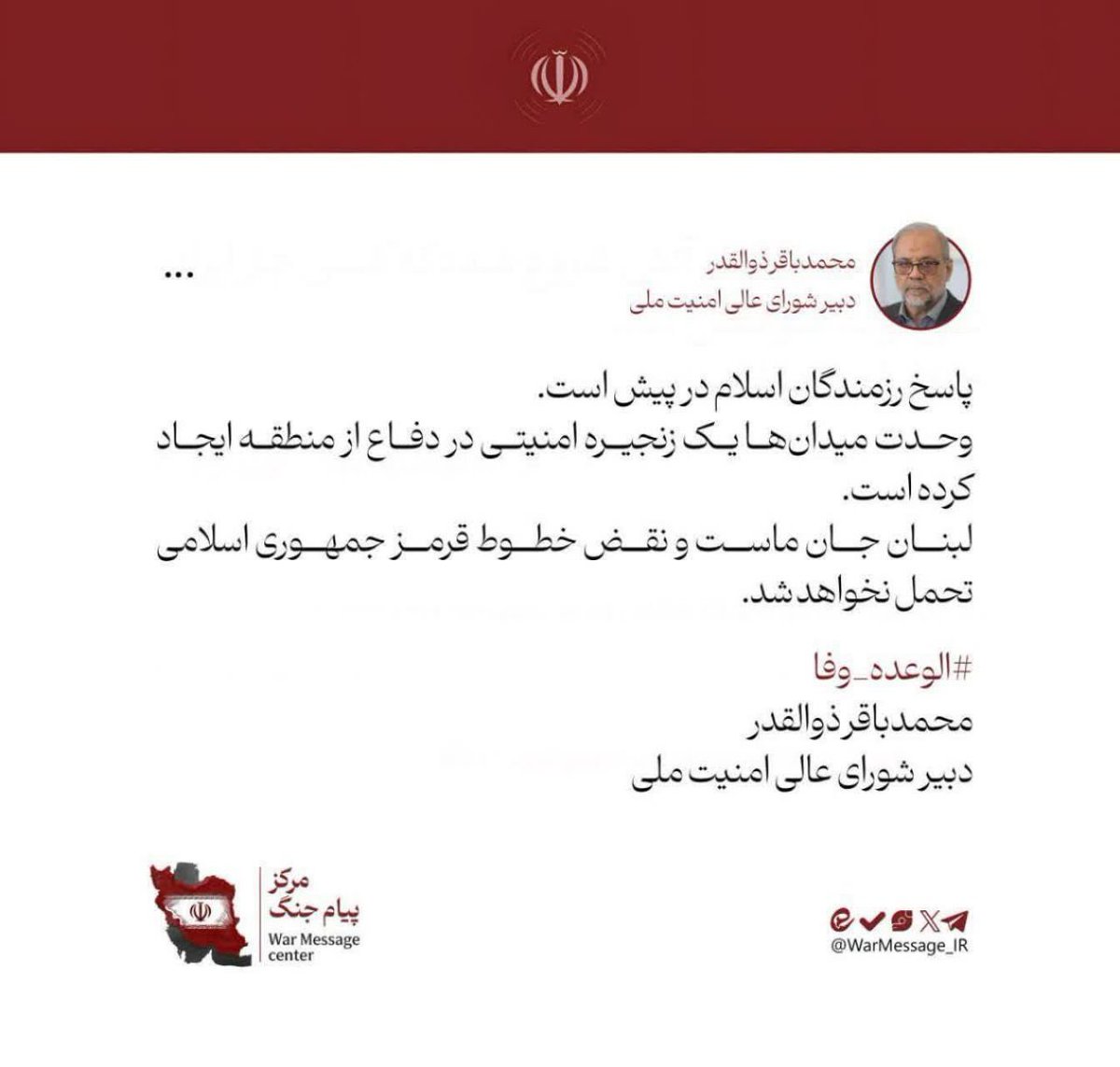
BREAKING: Iran’s Secretary of the SNSC:
Lebanon is our life and violating the red lines of the Islamic Republic will not be tolerated.
13
251
1,172
22,490
en.mehrnews.com/news/245359/
Sodan lopettaminen Libanonissa olennainen osa Iranin ja Yhdysvaltojen välistä yhteisymmärryspöytäkirjaa - Mehr News Agency
TEHERAN, 15. kesäkuuta (MNA) – Iranin ulkoministeriön tiedottaja Esmaeil Baghaei on sanonut, että sodan lopettaminen Libanonissa on erottamaton osa Iranin ja Yhdysvaltojen välistä sopimusta.
Maanantaina Muharramin surukuukauden kynnyksellä pitämässään viikoittaisessa lehdistötilaisuudessa hän korosti, että sodan lopettamista koskevan yhteisymmärryspöytäkirjan tekstin viimeistely pysäytti välittömästi ja pysyvästi sotilasoperaatiot kaikilla rintamilla, myös Libanonissa, ja lopetti Yhdysvaltojen merisaarron Irania vastaan.
Yhdysvaltojen ja Israelin hallinnon Irania vastaan käymästä hyökkäyssodasta Baghaei totesi, että Yhdysvallat ja Israel hyökkäsivät Iranin ydinlaitoksiin viime vuoden aikana, eikä kansainvälinen yhteisö selvinnyt tästä kokeesta voittajina.
Tiedottaja sanoi, että jokainen päätös tehdään Iranin kansallisten etujen tarkan ja kattavan arvioinnin perusteella, ja lisäsi, että ajan myötä käy selvemmäksi, miten Israelin hallinnon terroriteko lopulta maksimoi sekä Iranin että Libanonin kansalliset edut.
Hän jatkoi sanomalla, että tulevat sukupolvet näkisivät, että Iran ja sen liittolaiset eivät antaneet Israelin hallinnon toimien häiritä Iranin ja Libanonin etujen turvaamiseen tähtääviä pyrkimyksiä ja että rikos lopulta vahvisti Vastarintaliikkeen yhtenäisyyttä sionistista hallintoa vastaan.
Tiedottaja toisti, että Libanon ja sodan lopettaminen kyseisessä maassa ovat erottamaton osa Iranin ja Yhdysvaltojen välistä sodan lopettamiseen tähtäävää yhteisymmärrystä, ja sanoi, että Iran on osoittanut sekä päättäväisyyttä että vakavuutta asiassa ja jatkaa tapahtumien tarkkaa seuraamista.
Vastatessaan muistiossa oleviin viittauksiin Libanoniin Baghaei sanoi, että sana "Libanon" esiintyy tekstissä kolme kertaa.
Muualla huomautuksissaan Baghaei lisäsi, että muistiossa viitataan nimenomaisesti sodan lopettamiseen tavalla, joka sisältää Libanonin ja korostaa Libanonin suvereniteetin ja alueellisen koskemattomuuden kunnioittamista.
Hänen kommenttinsa tulivat sen jälkeen, kun Pakistanin pääministeri Shehbaz Sharif ilmoitti, että Iranin ja Yhdysvaltojen välillä on saavutettu rauhansopimus viikkoja kestäneiden Pakistanin välittämien ja Qatarin, Saudi-Arabian ja Turkin tukemien neuvottelujen jälkeen.
Sharifin mukaan sopimus määrää sotilasoperaatioiden välittömän ja pysyvän lopettamisen kaikilla rintamilla, myös Libanonissa, ja sen on määrä allekirjoittaa virallisesti Sveitsissä 19. kesäkuuta.
Aiemmin maanantaina Iranin oikeudellisista ja kansainvälisistä asioista vastaava varaulkoministeri Kazem Gharibabadi vahvisti yhteisymmärryspöytäkirjan (MoU) viimeistelyn ja sanoi, että Teheran on sisällyttänyt keskeiset kantansa tekstiin ja varmistaa Yhdysvaltojen sitoumusten täytäntöönpanon ennen jatkoneuvottelujen aloittamista.
Hän sanoi, että sopimus sisältää Yhdysvaltojen merisaarron purkamisen ja vaiheittaisen prosessin kohti laajempia neuvotteluja pakotteiden lieventämisestä, jälleenrakennuksesta ja muista kysymyksistä.
Iranin korkein kansallinen turvallisuusneuvosto (SNSC) ilmoitti myöhemmin, että viimeistelty yhteisymmärryspöytäkirja lopettaa sodan ja sotilasoperaatiot kaikilla rintamilla ja että tulevat neuvottelut jatkuvat vasta, kun toinen osapuoli on pannut sitoumuksensa täytäntöön.
Asiasta perillä olevan lähteen mukaan Iranin ehdottamiin lopullisiin muutoksiin sisältyivät Hormuzinsalmen hallintaan liittyvät määräykset sekä Libanonin itsemääräämisoikeuden ja alueellisen koskemattomuuden takeet, ulkoministeriön tiedottaja lisäsi.
MNA
Lähetä palautetta
6

#jeddahMassage in #riyadh
🍃🍃🍃🍃🍃🌾🌾🌾
Massage in #jeddah #khobar
#dammam #hofuf
🌰🍅Russia wa.me/ 966577084034
مساج في لخبر
مساج في الرياض
مساج في جدة
مساج في بريدة
مساج في الهفوف
🫗SNSC🌯
TDF

13