RIGHTS. retweeted

Jun 15
#SupremeCourt
#HighCourt
#informationtechnology #ActIT2000
#Section79
#InformationTechnologyAct
#ITAct2000
#SafeHarbour
#IntermediaryLiability
#DigitalLaw
#CyberLawIndia
#ShreyaSinghalCase
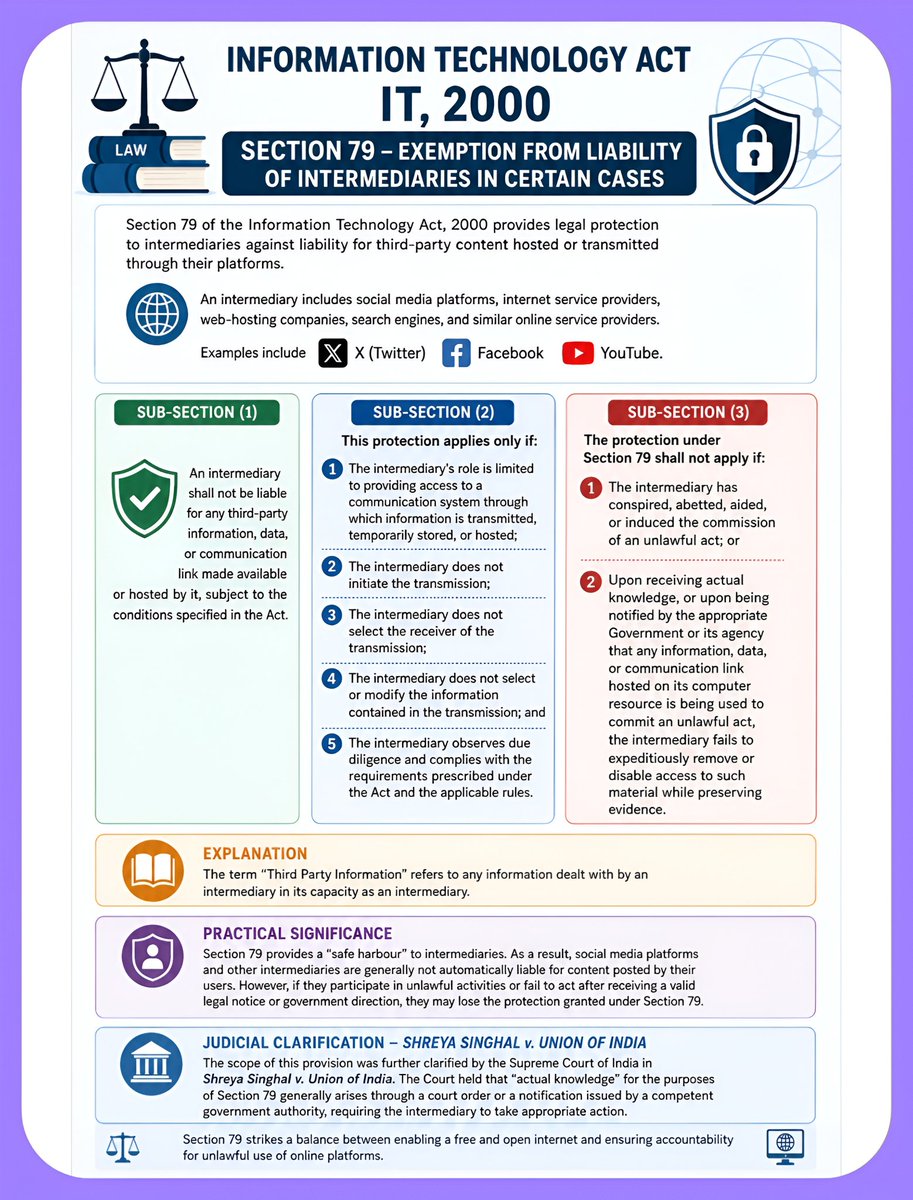
Exemption from Liability of Intermediaries in Certain Cases
Section 79 of the Information Technology Act, 2000 provides legal protection to intermediaries against liability for third-party content hosted or transmitted through their platforms.
An intermediary includes social media platforms, internet service providers, web-hosting companies, search engines, and similar online service providers. Examples include X (Twitter), Facebook, and YouTube.
Sub-section (1)
An intermediary shall not be liable for any third-party information, data, or communication link made available or hosted by it, subject to the conditions specified in the Act.
Sub-section (2)
This protection applies only if:
The intermediary's role is limited to providing access to a communication system through which information is transmitted, temporarily stored, or hosted;
The intermediary does not initiate the transmission;
The intermediary does not select the receiver of the transmission;
The intermediary does not select or modify the information contained in the transmission; and
The intermediary observes due diligence and complies with the requirements prescribed under the Act and the applicable rules.
Sub-section (3)
The protection under Section 79 shall not apply if:
1. The intermediary has conspired, abetted, aided, or induced the commission of an unlawful act; or
2. Upon receiving actual knowledge, or upon being notified by the appropriate Government or its agency that any information, data, or communication link hosted on its computer resource is being used to commit an unlawful act, the intermediary fails to expeditiously remove or disable access to such material while preserving evidence.
Explanation
The term “Third Party Information” refers to any information dealt with by an intermediary in its capacity as an intermediary.
Practical Significance
Section 79 provides a “safe Harbour” to intermediaries. As a result, social media platforms and other intermediaries are generally not automatically liable for content posted by their users. However, if they participate in unlawful activities or fail to act after receiving a valid legal notice or government direction, they may lose the protection granted under Section 79.
The scope of this provision was further clarified by the Supreme Court of India in Shreya Singhal v. Union of India. The Court held that “Actual knowledge” for the purposes of Section 79 generally arises through a court order or a notification issued by a competent government authority, requiring the intermediary to take appropriate action.
1
1
46

Jun 11
#GST #CaseLaw
Pre-Adjudication Garnishee Recovery From Customers Invalid; Section 79 Recovery Requires Crystallized Liability: HC
Read the (Madras) High Court Order: centax.one/FrEXH
Citation: (2026) 43 Centax 175 (Mad.)
𝐅𝐨𝐫 𝐃𝐚𝐢𝐥𝐲 𝐔𝐩𝐝𝐚𝐭𝐞𝐬 𝐨𝐧 𝐈𝐧𝐝𝐢𝐫𝐞𝐜𝐭 𝐓𝐚𝐱 𝐋𝐚𝐰𝐬, 𝐅𝐨𝐥𝐥𝐨𝐰 ‘𝐂𝐞𝐧𝐭𝐚𝐱’ 𝐨𝐧 𝐖𝐡𝐚𝐭𝐬𝐀𝐩𝐩: centax.one/3CQ4
#CentaxUpdates #Section79
25

Talking like this to a lady is a punishable crime under BNS section79. He can be out in jail for max upto three years. Delhi police @DelhiPolice Arrest him ‼️⬇️⬇️

🚨This verbal attack on the lady's modesty by the old man is actually 𝙥𝙪𝙣𝙞𝙨𝙝𝙖𝙗𝙡𝙚 (Section 79 of B.N.S.)
It's a Cognizable offence — Police can register an FIR without a court order in many cases.
If she decides to press charges, he'd be in jail for upto three years‼️
1
3
16

May 12
@internetfreedom This is exactly what happened
to my account @_kalavastra — geo-restricted
under 79(3)(b) with ZERO violations confirmed
by Meta. 4 small clothing businesses hit
simultaneously. I have emailed your team.
Please help. #KalaVastra #Section79
1
2
33
May 12
My small clothing business @_kalavastra was geo-restricted in India under Section 79(3)(b) IT Act. META CONFIRMED: ZERO violations. 4 unrelated "kalavastra" accounts hit same day — bulk keyword takedown of small businesses.@internetfreedom @Meta
#DigitalRights #Section79
2
1
2
42

Bottom line
Father’s GST dues cannot be recovered from son merely because both used the same trade name; liability must first be adjudicated under law. #Section79 #Section93 #DRC13 #BankAttachment
1
313

Mar 20
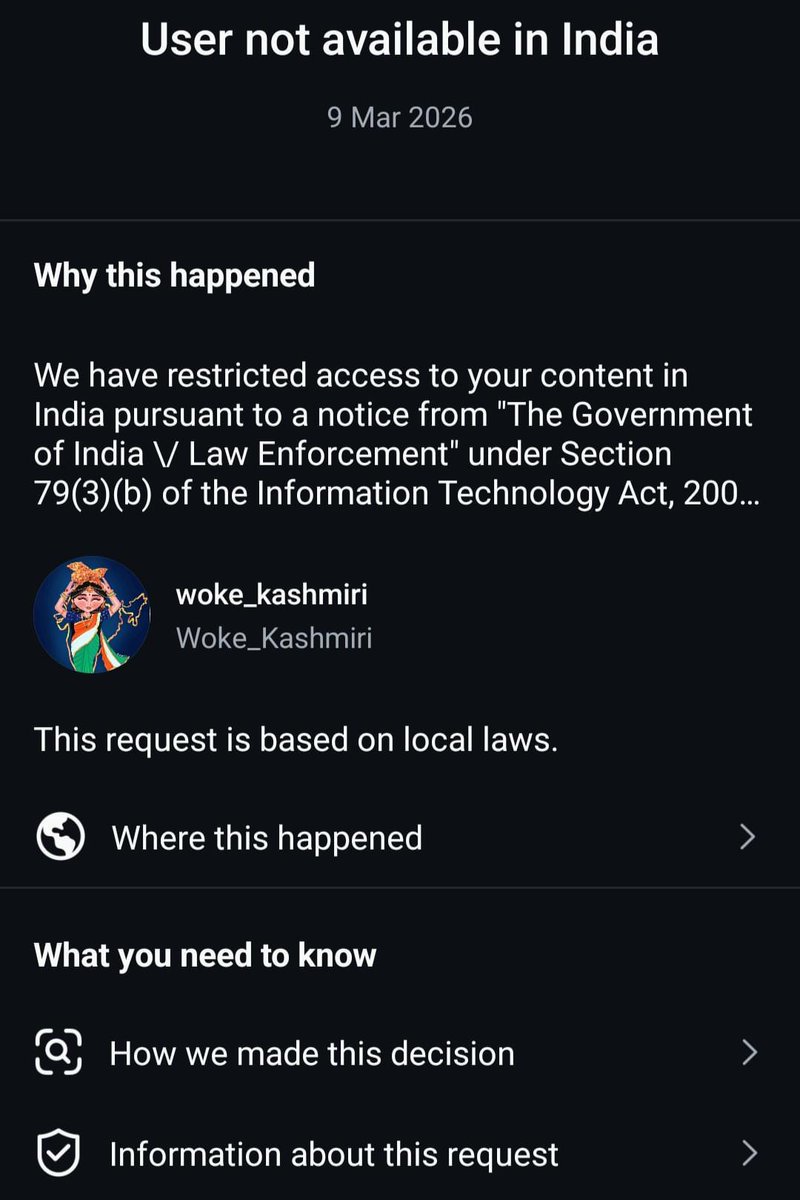
We have restricted access to your content in India pursuant to a notice from The Government of India / Law Enforcement under Section 79(3)(b) of the Information Technology
#amitkilhor #kilhor #section79(3)(b) #censor
30
282
1,117
21,960

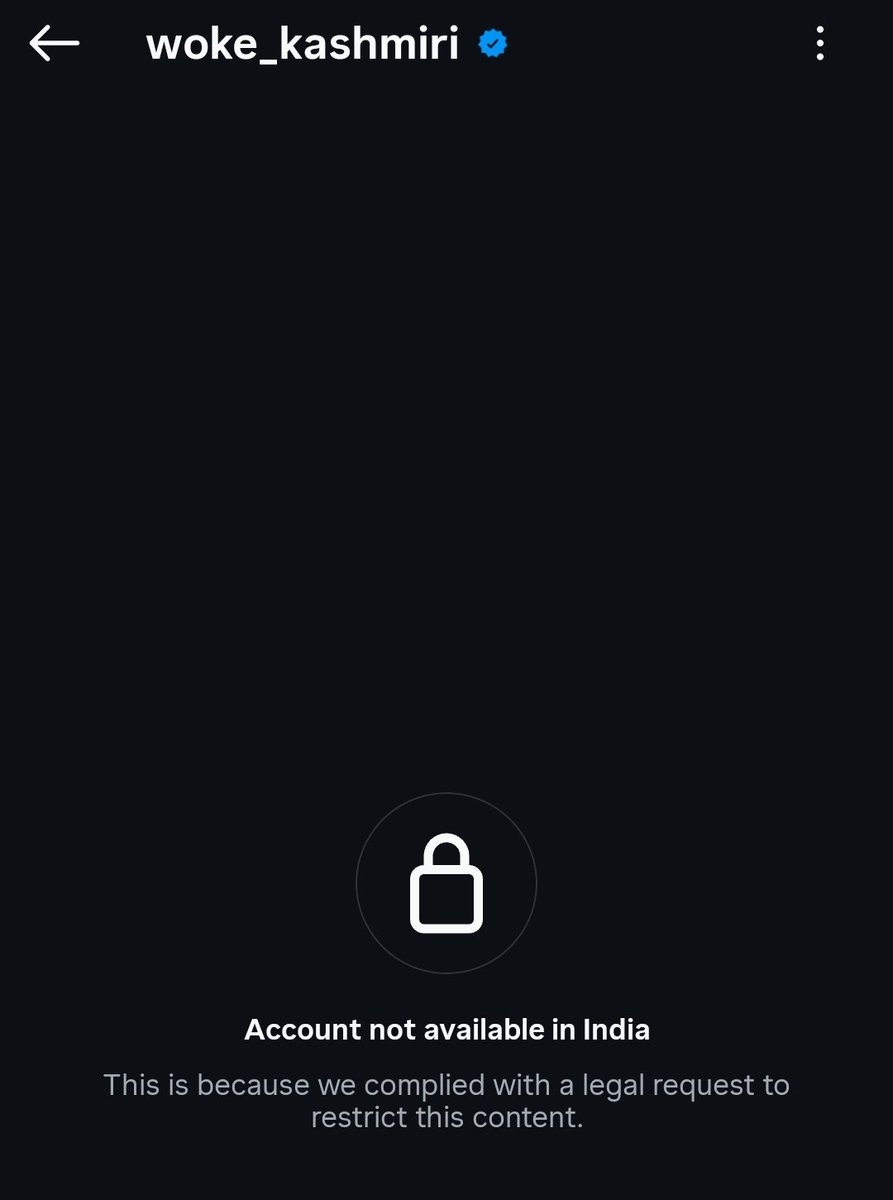
URGENT: Arbitrary digital block of @woke_kashmiri on Instagram (203K followers) in India.
As of 9 Mar 2026, access is restricted citing a notice from "Govt of India V Law Enforcement" under Section 79(3)(b) of the IT Act. This is a bypass of the procedural safeguards mandated by the Supreme Court for content blocking.
For 6 years, this account has been a pillar of nationalist research.. providing fact-based analysis on India's security, history, and geopolitical truths. To silence a pro-Bharat voice that counters anti-India narratives is counter-intuitive to our national interest.
If there is no violation of community guidelines or constitutional law, this geoblock is an overreach that denies millions of Indians access to vital research-driven discourse.
I Demand for Transparency & Reinstatement:
@InstagramComms @Mosseri @Meta @MetaNewsroom — Please Review this compliance. Automated/legal geoblocking must not be used to suppress factual nationalist content.
@Cyberdost @MahaCyber1 @GoI_MeitY
& respected @AshwiniVaishnaw @PMOIndia @narendramodi — Kindly examine this order.
Why is a voice strengthening Bharat’s narrative being restricted?
#FreeWokeKashmiri #RightToExpression #Section79
9
40
91
2,859

Feb 11
The Government has amended the IT Rules, 2021, mandating social media platforms to remove flagged AI-generated and deepfake content within 3 hours of a lawful order. The new rules, effective February 20, 2026, also require mandatory labelling, metadata tagging, and proactive detection tools. Non-compliance may lead to loss of safe harbour protection under Section 79 of the IT Act.
#ITRules2026 #DeepfakeLaw #AIRegulation #Section79 #SocialMediaLaw
4
11
841

Jan 6
BUSINESS
Grok content: Govt gives X time till Jan 7 to submit report
Click- dailypioneer.com/news/grok-c…
#XPlatform #ElonMusk #GrokAI
#AIRegulation #ITMinistry #DigitalSafety
#OnlineHarassment #CyberLaw #Section79
#ContentModeration #WomenSafety #AICompliance
#ObsceneContent #TechNews #IndiaTech
1
2
76

केंद्र सरकार का बड़ा कदम: सोशल मीडिया प्लेटफॉर्म X को अश्लील और महिलाओं से जुड़े आपत्तिजनक कंटेंट हटाने का निर्देश!
केंद्र सरकार ने सोशल मीडिया प्लेटफॉर्म X (पूर्व में ट्विटर) को तत्काल प्रभाव से अश्लील और आपत्तिजनक सामग्री हटाने के आदेश दिए हैं। इस कार्रवाई को डिजिटल स्पेस में कानून-व्यवस्था और महिलाओं की गरिमा की रक्षा से जोड़कर देखा जा रहा है।
इस मामले पर साइबर विशेषज्ञों ने भी कहा कि ऐसे अपराध भारतीय न्याय संहिता (BNS) और आईटी एक्ट के तहत पूरी तरह प्रतिबंधित हैं। उन्होंने स्पष्ट किया कि X जैसी कंपनियाँ आईटी एक्ट की धारा 79 के तहत इंटरमीडियरी की श्रेणी में आती हैं और उन पर भारत के कानूनों का पालन करना अनिवार्य है।
यदि कोई प्लेटफॉर्म नियमों का पालन नहीं करता, तो उसे सेफ हार्बर कानूनी संरक्षण से वंचित किया जा सकता है।
हाल के दिनों में सोशल मीडिया पर महिलाओं की तस्वीरों के दुरुपयोग, एआई टूल्स के माध्यम से आपत्तिजनक कंटेंट तैयार करने और फेक अकाउंट्स के बढ़ते मामलों को लेकर सरकार पहले ही सख्त रुख अपना चुकी है।
इलेक्ट्रॉनिक्स एवं सूचना प्रौद्योगिकी मंत्रालय (MeitY) लगातार प्लेटफॉर्म्स को चेतावनी दे रहा है कि डिजिटल प्लेटफॉर्म्स की जवाबदेही तय की जाएगी।
सरकार का कहना है कि अभिव्यक्ति की स्वतंत्रता के नाम पर कानून का उल्लंघन बर्दाश्त नहीं किया जाएगा और जरूरत पड़ी तो और कड़े कदम उठाए जाएंगे।
#Hashtags
#SocialMediaRegulation #XPlatform #ITAct #Section79 #BhartiyaNyayaSanhita
#CyberLaw #DigitalSafety #WomenSafety #ObsceneContent
#SafeHarbour #MeitY #AIAbuse #SocialMediaAccountability
@grok
2
3
157

26 Nov 2025
Funny how you used the word eliminate not scrap,what you mean is mitigate. As they have already been doing with Scottish child payment introduced in 2018 under section79 of social security, Scotland act.
6
190

13 Nov 2025
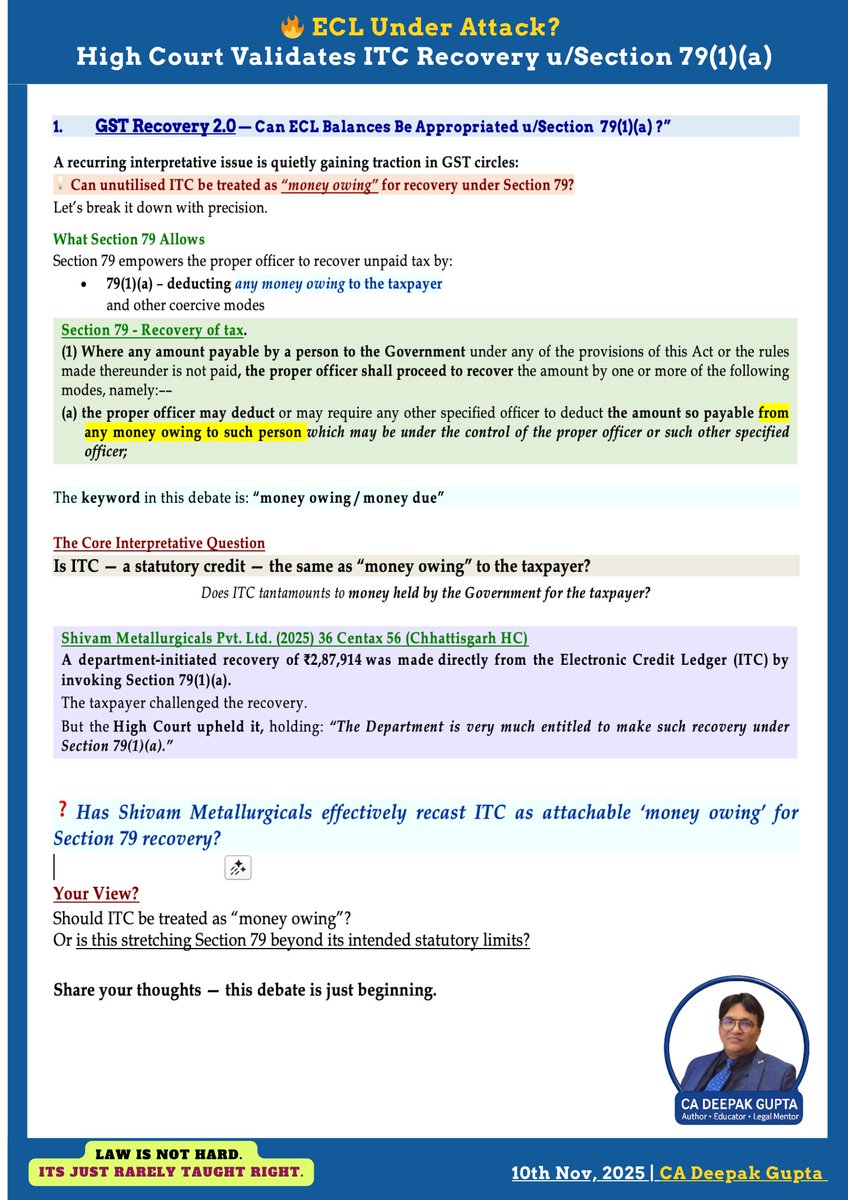
🔥 ECL Under Attack? High Court Validates ITC Recovery Under Section 79
Has the Electronic Credit Ledger quietly become a “recoverable asset” u/Sec 79(1)(a)?
A single High Court ruling has opened a door no one expected.
Recovery under Section 79(1)(a) — traditionally limited to “money owing” — has now been applied directly to ITC in the ECL.
#GSTLaw #GSTUpdates #GSTLitigation #Section79 #ITC #ElectronicCreditLedger #GSTRecovery #IndirectTax #TaxProfessionals #GSTCaseLaws #GSTIndia #TaxCompliance #ChhattisgarhHighCourt #GSTInterpretation #RevenueRecovery #GSTPractitioner #LegalUpdate #TaxLaw #GSTExpert #GSTInsights #GSTDiscussion #IndirectTaxation #FinanceAct2025 #GSTDebate #GSTNotification #GSTJurisdiction #InputTaxCredit #GSTIndustry #TaxReforms #GSTCommunity
2
236

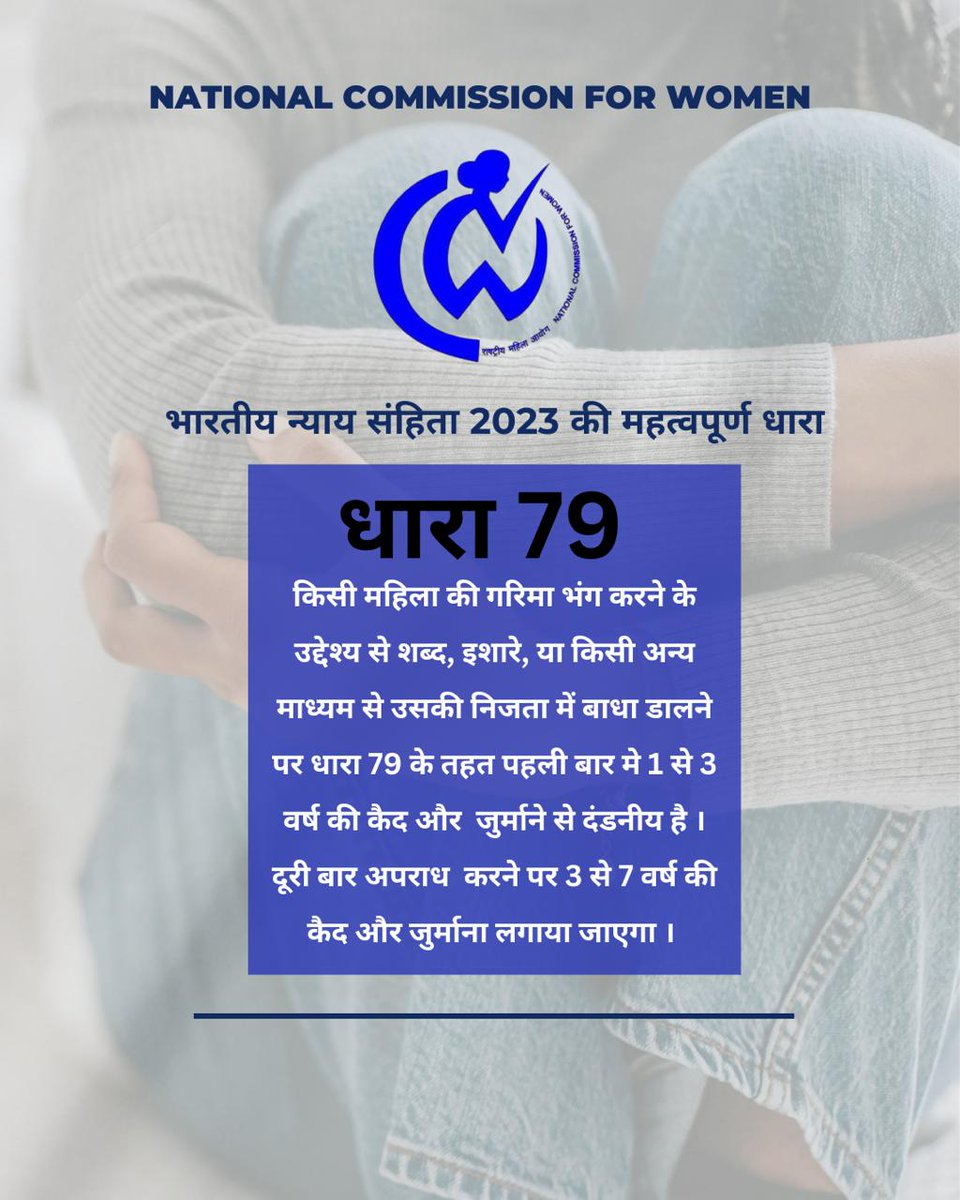
Bharatiya Nyaya Sanhita, 2023 – Section 79
Any act of insulting a woman’s dignity through words, gestures, or any other means that intrudes upon her privacy is a punishable offence.
🔹 First offence: Imprisonment from 1 to 3 years Fine
🔹 Repeat offence: Imprisonment from 3 to 7 years Fine
The law strictly safeguards the dignity and privacy of every woman.
#NCW #WomenSafety #BNS2023 #Section79 #EndHarassment
4
349

25 Aug 2025
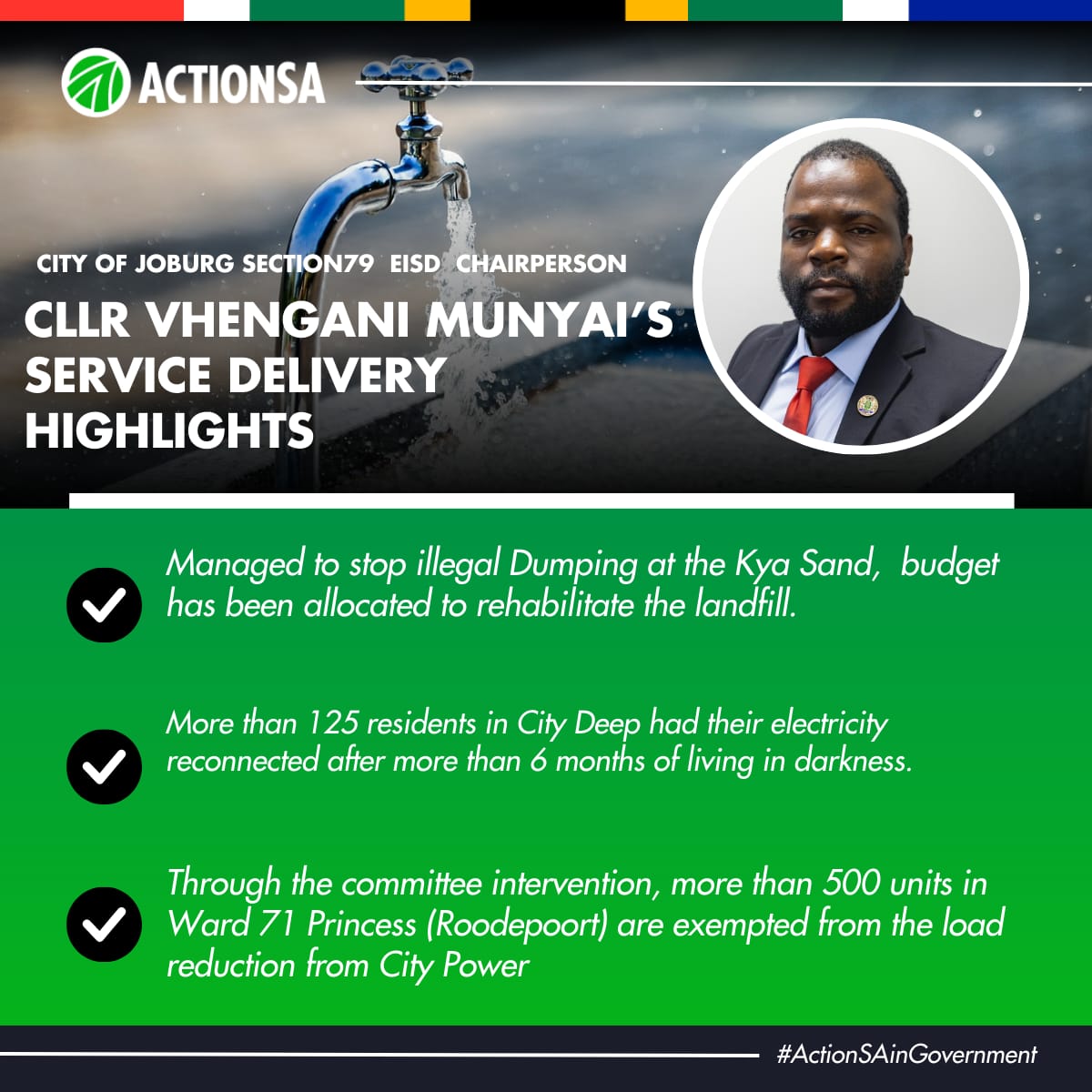
@CityofJoburgZA , Section79 EISD Chairperson, Cllr Vhengani Munyayi has been critical in turning the City around. Cllr Munyayi has restored hope to the City residents but most importantly bring the much needed services in more than 6 million residents.
11
12
351

6 Aug 2025
these notices were issued under Section79(3)(b) of the IT Act to remove #illegalcontent like #hatespeech, #misinformation,#childsexualabuse material,&threats to #publicorder.
3) The Sahyog portal, launched by I4C under the Ministry of Home Affairs, centralises takedown...
(n/3)
1
2
35

6 Aug 2025
Elon Musk’s X Drags Indian Government to Court Over ‘Arbitrary’ Content Takedown Regime
Read more 👉 thelawreporters.com/elon-mus…
#XCorp #Elon #ContentModeration #FreeSpeech #DigitalRights #KarnatakaHighCourt #ITAct #Section79 #ShreyaSinghal #InternetFreedom #PlatformLiability #IndiaNews #Misinformation #SocialMediaRegulation #TechLaw #ConstitutionalLaw #TheLawReporters
1
22

4 Aug 2025
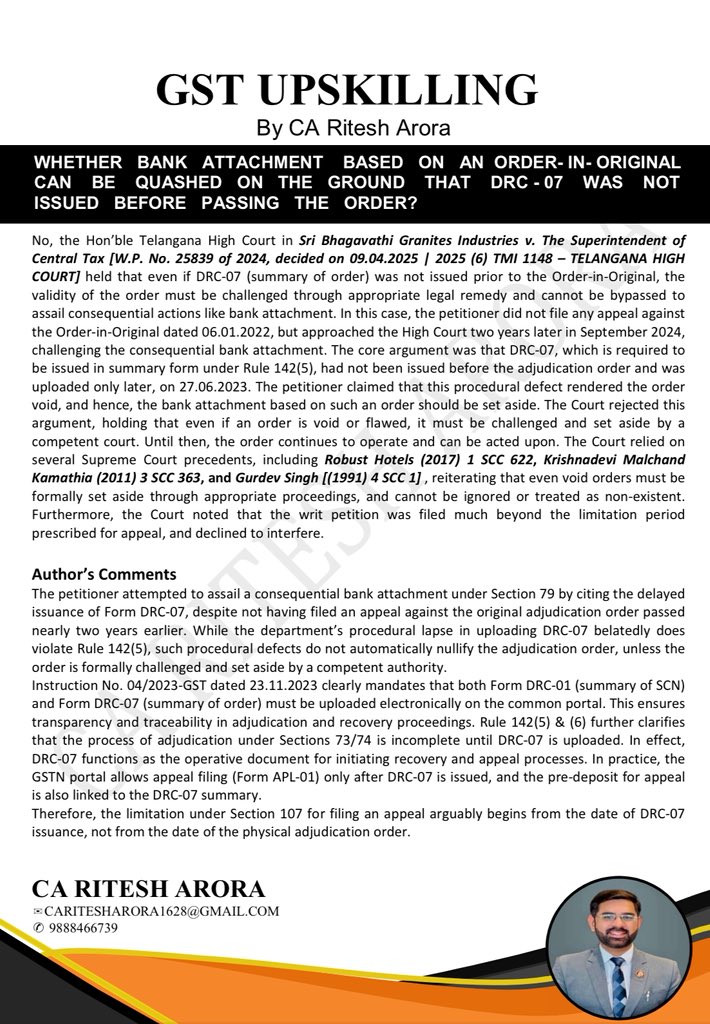
Can bank attachment under GST be quashed if DRC-07 (summary of order) was not issued before the Order-in-Original?
No, held the Hon’ble Telangana High Court in Sri Bhagavathi Granites Industries v. Superintendent of Central Tax
[W.P. No. 25839 of 2024, decided on 09.04.2025 | 2025 (6) TMI 1148 – TELANGANA HC]
📝 Brief Facts:
The petitioner challenged a bank attachment under Section 79, citing that Form DRC-07 was issued over a year after the Order-in-Original dated 06.01.2022. No appeal was filed against the order. The writ was filed only in Sept 2024, seeking to invalidate the recovery on procedural grounds.
⚖️ Court’s Observations:
➡️Procedural defects like delayed DRC-07 issuance do not render the adjudication order void.
➡️Even a flawed order continues to operate unless formally challenged and set aside.
➡️Relied on SC precedents (Robust Hotels, Krishnadevi Kamathia, Gurdev Singh) to hold that even void orders must be assailed legally.
➡️Dismissed the writ as being filed beyond limitation without challenging the original order.
🧾 Author’s Comments:
✅While Rule 142(5) & Instruction 04/2023-GST mandate timely issuance of DRC-07, non-compliance doesn’t nullify the order.
✅DRC-07 is crucial for recovery and appeal—but unless the adjudication order is appealed, bank attachment cannot be assailed independently.
✅Practically, appeal timelines may be argued to begin from DRC-07 issuance, not from the date of the Order-in-Original.
📌 Takeaway:
Always challenge flawed adjudication orders within limitation, rather than attacking consequential actions later.
#GSTLitigation #DRC07 #GSTRecovery #TelanganaHighCourt #OrderInOriginal #Section79 #Rule142 #IndirectTax #GSTJudgment #CACommunity #TaxLaw #LitigationInsights #RiteshAroraWrites
2
4
136

29 Jul 2025
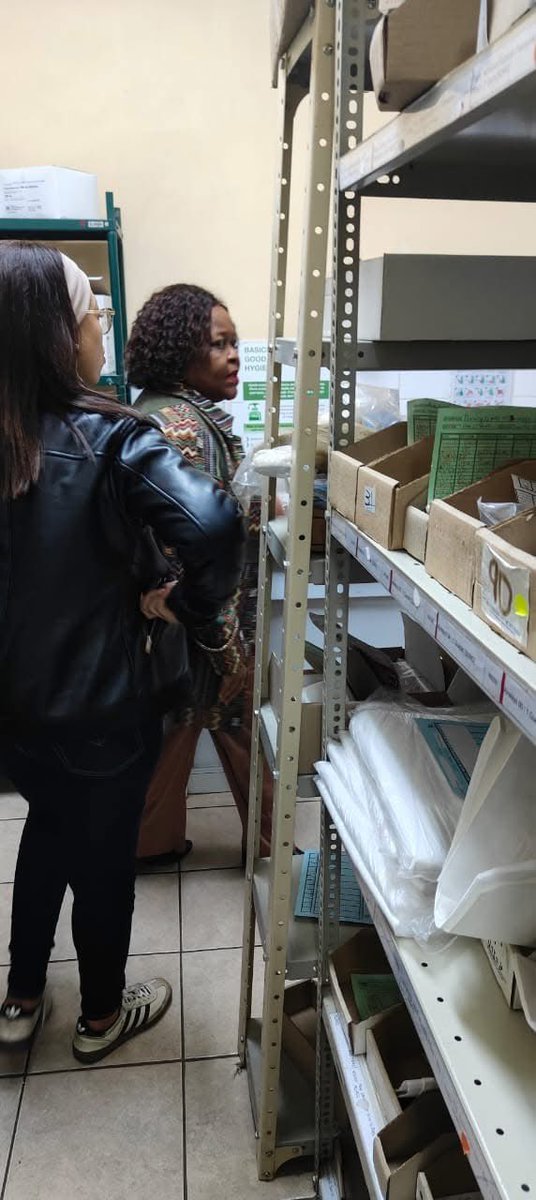
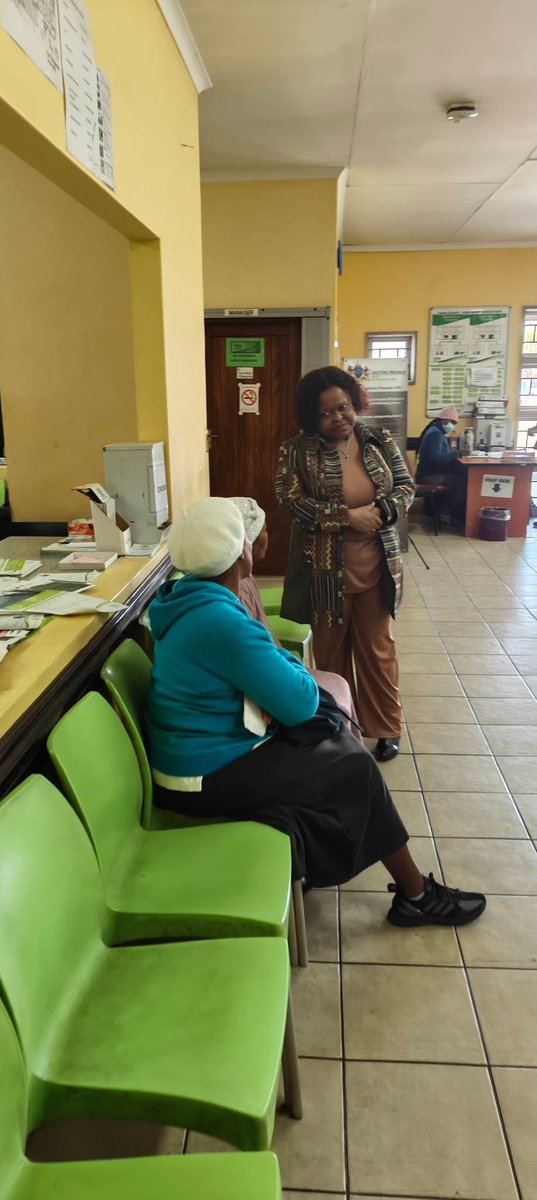
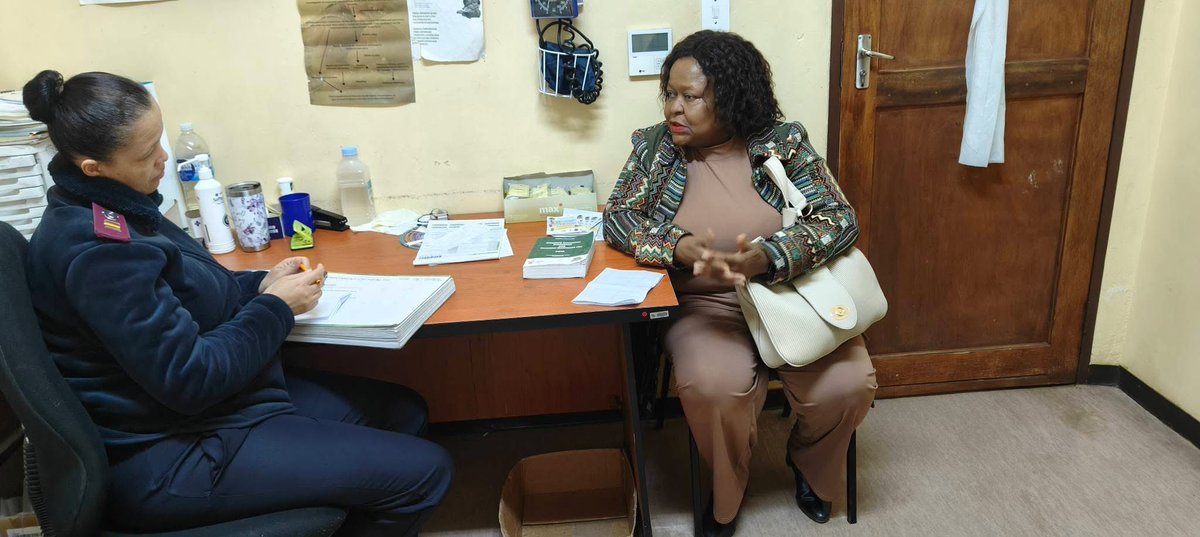
ActionSA Section79 Health Chairperson Cllr Peggy de Bruin conducted an unannounced pre-inspection at Nellmapius Clinic today. The purpose of these visits to health care facilities in the @CityTshwane is to identify challenges for possible intervention. #ServiceDelivery

4
7
339