
📍من الـ Reuse Factor في الـ GSM إلى الـ Reuse 1 في الـ LTE: كيف تطورت هندسة الترددات لإدارة التداخل؟
🔹في أنظمة الجيل الثاني GSM، كان التخطيط الصارم يعتمد على حسابات الـ Reuse Factor للفصل الجغرافي بين الخلايا التي تستخدم نفس التردد، وذلك لتقليل تداخل القنوات المشتركة (Co-channel Interference).
🔹أما في شبكات الجيل الرابع LTE، فقد تغيرت اللعبة بالكامل! أصبحنا نستخدم التردد نفسه في جميع الخلايا بلا استثناء (Reuse 1) لتحقيق أقصى استفادة من الطيف الترددي المتاح. ولكن، كيف تم حل مشكلة التداخل؟
السر يكمن في الاعتماد على تقنيات معالجة ذكية مثل الـ OFDMA وتقنيات الـ ICIC (Inter-Cell Interference Coordination) لإدارة التداخل بذكاء، وتحديداً بين المستخدمين المتواجدين على أطراف الخلايا (Cell Edges).
هذا التطور المعقد جعل مهام الفحص الميداني (Drive Test) تتطلب دقة أعلى بكثير لمراقبة سلوك واستقرار الإشارة عند الحدود المشتركة بين الأبراج.
ولزيادة سعة الشبكة أكثر، يلجأ المهندسون لتقنية الـ Sectorization، حيث يتم تقسيم الخلية الواحدة إلى 3 قطاعات باستخدام هوائيات توجيهية (Directional Antennas)، مما يتيح خدمة عدد أكبر من المشتركين في نفس المساحة الجغرافية.
📌تأكد من متابعة حسابنا لتصلك تحديثات كورساتنا المستمرة بالإضافة للمعلومات التقنية والكتيبات والسلاسل التعليمية القيمة
#LTE_Technology #DriveTest #OFDMA #Sectorization #ICIC #NetworkOptimization #أكاديمية_اتصالاتي
4
331

Grok translation of attached documents:
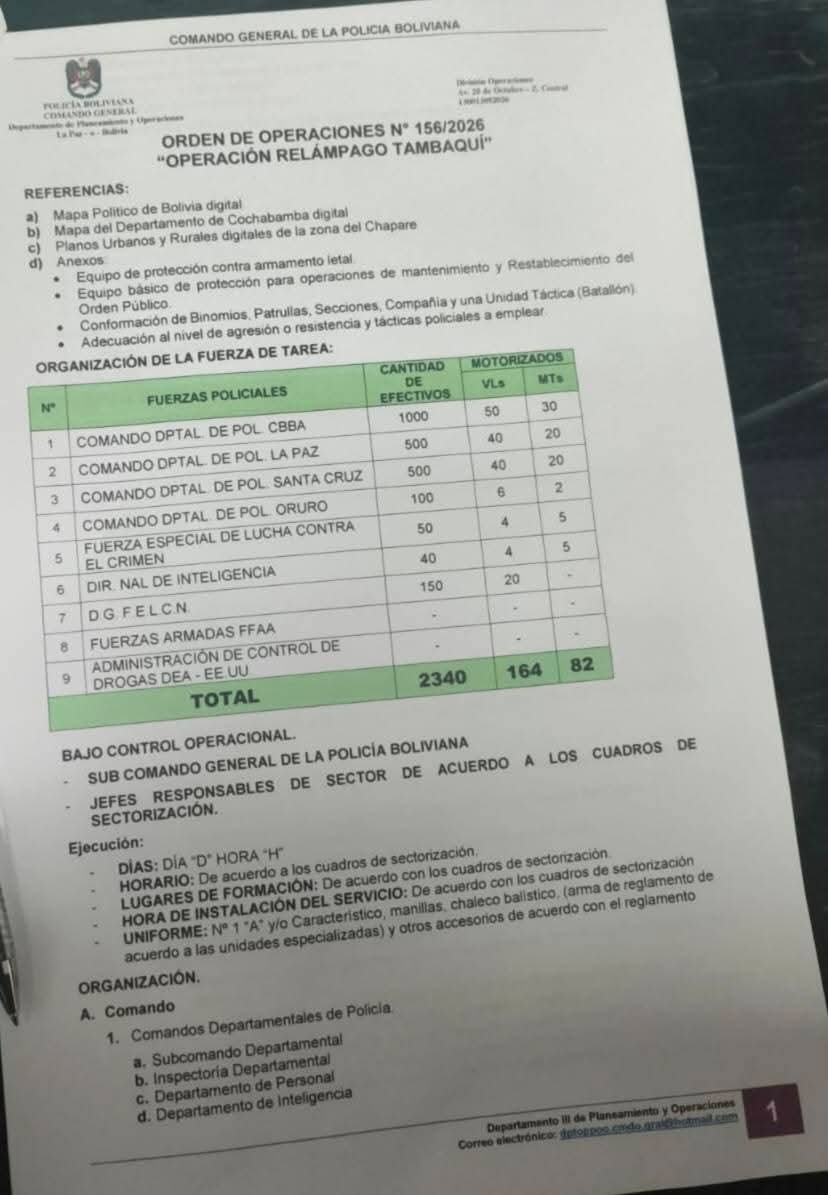
The X post’s framing (“US armed forces & Bolivian police … kidnap Evo Morales and massacre the indigenous communities”) is an interpretation that adds dramatic language not present in the documents themselves. The papers describe a police-led arrest/extradition operation with DEA support, not U.S. military forces or a massacre plan.Would you like a word-for-word full literal translation of any specific section, or anything else (e.g., analysis of authenticity, context, etc.)?Here is a clear English translation of the three document images in the X post (from Bolivian National Police operational orders).
The documents are pages from an official-looking Bolivian National Police General Command “Operations Order” for a large-scale police action in the Chapare region (Tropics of Cochabamba). The post claims they were leaked by officers opposed to the plan. They are written in formal Spanish police/military language.I have translated them section by section for accuracy and readability. (Note: Minor OCR variations in the images show the order number as “156/2026” or “158/2026”; the title and content are consistent.)Document Title (all pages)
BOLIVIAN NATIONAL POLICE GENERAL COMMAND
OPERATIONS ORDER No. 156/2026
“OPERATION RELÁMPAGO TAMBAQUÍ”
(Lightning Operation Tambaqui)Page 1 – References & Task Force OrganizationREFERENCES:
a) Digital Political Map of Bolivia
b) Digital Map of the Department of Cochabamba
c) Digital Urban and Rural Plans of the Chapare area
d) Annexes:
• Protective equipment against lethal weaponry
• Basic protective equipment for public-order maintenance and restoration operations
• Formation of two-person teams, patrols, sections, companies, and one tactical unit (battalion)
• Adaptation to levels of aggression/resistance and police tactics to be used ORGANIZATION OF THE TASK FORCE:No.Police ForcesPersonnelMotorized VLsMotorcycles MTs1Cochabamba Dept. Police Command1,00050302La Paz Dept. Police Command50040203Santa Cruz Dept. Police Command50040204Oruro Dept. Police Command100625Special Force Against Crime50456National Intelligence Directorate15020–7D.G.F.E.L.C.N.–––8Armed Forces (FFAA)–––9Drug Control Administration DEA – USA–––TOTAL2,34016482Under operational control of the Bolivian Police General Sub-Command and sector chiefs according to sectorization charts.
Execution: Day “D” / Hour “H”, uniforms No. 1 “A” characteristic gear, etc.
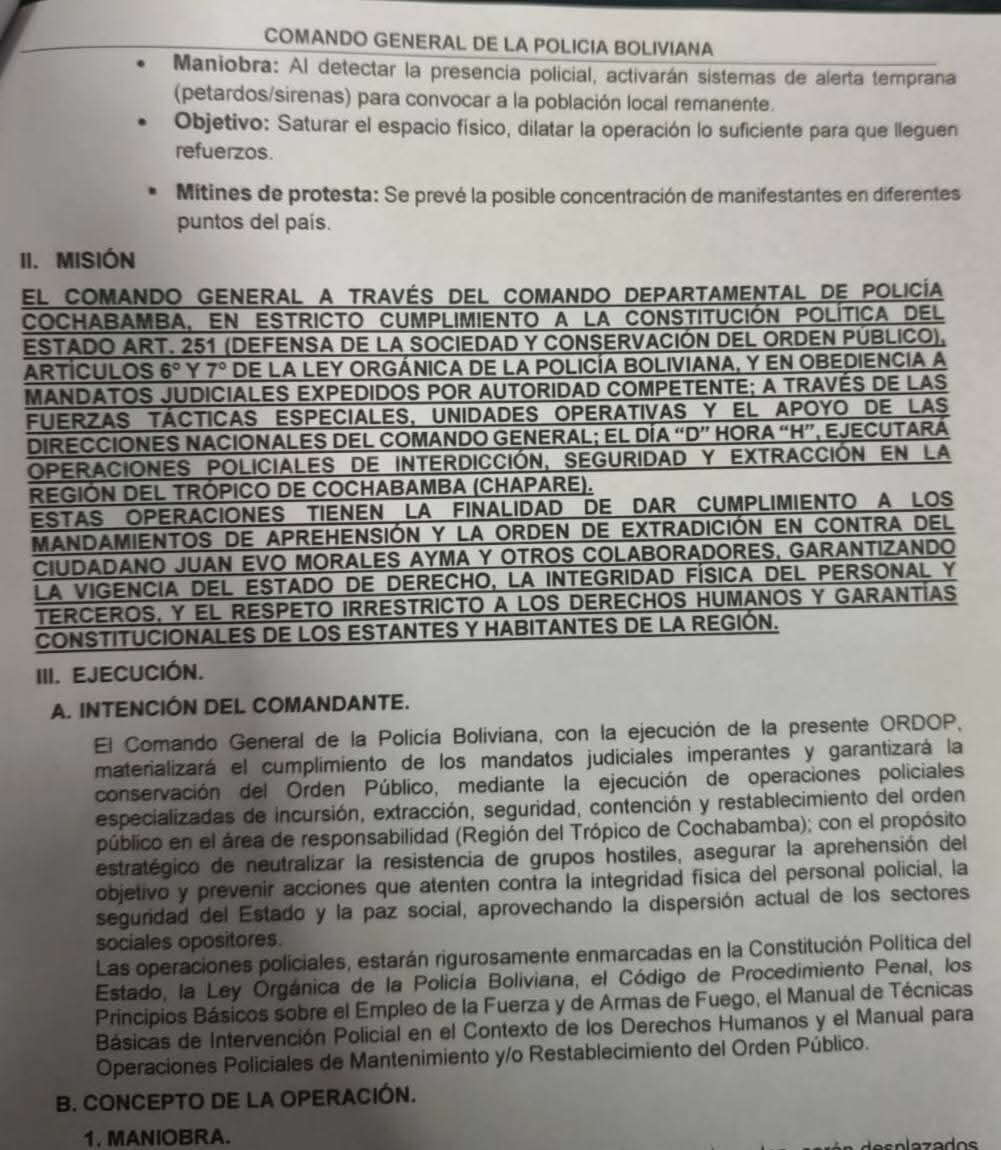
Page 2 – Mission & ExecutionII. MISSION
The General Command, through the Cochabamba Departmental Police Command, in strict compliance with the Political Constitution of the State (Art. 251 – Defense of Society and Conservation of Public Order), Articles 6 and 7 of the Organic Law of the Bolivian Police, and in obedience to judicial mandates issued by competent authority; through special tactical forces, operational units, and the support of the National Directorates of the General Command; on “D” Day / “H” Hour, will execute police operations of interdiction, security, and EXTRACTION in the Tropical Region of Cochabamba (Chapare). These operations have the purpose of complying with the arrest warrants and the extradition order against citizen JUAN EVO MORALES AYMA and other collaborators, guaranteeing the rule of law, the physical integrity of personnel and third parties, and the unrestricted respect for the constitutional rights of bystanders and inhabitants of the region.III. EXECUTION
A. COMMANDER’S INTENT
The Bolivian Police General Command, with the execution of this Operations Order, will materialize compliance with the pending judicial mandates and will guarantee the preservation of public order through specialized incursion, extraction, security, containment, and public-order restoration operations in the area of responsibility (Tropics of Cochabamba), with the strategic objective of neutralizing hostile group resistance, ensuring the apprehension of the objective, and preventing actions that threaten the physical integrity of police personnel, state security, and social peace, taking advantage of the current dispersion of opposing social sectors. All police operations will be strictly framed within the Political Constitution of the State, the Organic Law of the Bolivian Police, the Penal Procedure Code, Basic Principles on the Use of Force and Firearms, the Manual of Basic Police Intervention Techniques in the Context of Human Rights, and the Manual for Police Operations of Maintenance and/or Restoration of Public Order.B. CONCEPT OF THE OPERATIONManeuver: Upon detecting police presence, the population will activate early-warning systems (firecrackers/sirens) to summon the local remaining population.
Objective: Saturate the physical space and prolong the operation long enough for reinforcements to arrive.
Protest meetings: Possible concentration of demonstrators at different points in the country is anticipated.
Page 3 – Organization, Support & “Opponent”B. Special Anti-Narcotics Force DirectorateUMOPAR
G.I.O.E.
G.I.A.E.F.
G.I.C.E.
C. AggregationsMinistry of Government
Public Ministry (Prosecutor’s Office)
Armed Forces (FFAA)
Drug Control Administration (DEA – USA)
Others
D. SupportNational Directorates
I. SITUATION
A. Current Situation – per Intelligence Department assessment.
B. Strategic Guidance – references to Constitution, Police Law, use-of-force manuals, etc. C. OPPONENTComposition:
• Federations of the Tropics
• Peasant (campesino) sectors
• Other sectors
Disposition: The opponent is expected to resort to:
• Movement of groups causing public-order disruptions and criminal acts
• Use of firearms
• Use of fireworks, multiple explosions, and blunt objects (sticks, stones, slingshots, etc.)
• Mobilizations with possible confrontations with law-enforcement forces
• Mobilizations via social networks
• Possible seizure of public and private installations
• Others
Courses of Action of the Opponent
The opponent will adopt an immediate defensive posture around the objective (Juan Evo Morales Ayma) to prevent his extraction.
• Dispositive: They will establish three concentric security rings around the objective.First Ring: Lookouts and “petarderos” (firecracker throwers) on the main approach roads (women, elderly) as human shields.
Second Ring: Social sectors that will use lethal force (asymmetric warfare).
Third Ring: Closed security group (Guardia Sindical) armed with blunt objects, explosives, and possibly firearms.
Summary of what the documents actually sayThese are Bolivian police operational plans for a major raid in the Chapare (coca-growing region) to arrest and extradite Evo Morales (referred to by his full name Juan Evo Morales Ayma) and associates, while handling expected resistance from his supporter base (cocalero peasant unions).
Total force: ~2,340 police support.
Explicitly includes DEA – USA (U.S. Drug Enforcement Administration) in the task force and aggregations.
The language is standard police/military ops jargon: they repeatedly emphasize “respect for human rights,” “rule of law,” and “public order.”
My first rule of researching foreign leaders after years of researching the CIA/USAID/NED is has these organizations attempted a regime change operation against the targeted leader? Did they interfere in the election of the leader? 100% of the time, if they attempted assassination/regime change, those leaders either kicked the CIA/DEA drug traffickers out of the country, refused to have workers exploiters via NED, kicked USAID/NED out, wanted control of natural resources, etc OR all of the above.
As a result the first question you ask:
HAS THE CIA/USAID/NED TRIED TO COUP EVO MORALES?
The answer is yes.
Morales expelled the U.S. ambassador and DEA in September 2008, citing conspiracy with opposition leaders. WikiLeaks cables show the U.S. embassy tracked (and in engaged with) opposition figures while preparing plans for instability or Morales’ potential removal/death.
USAID’s Office of Transition Initiatives (OTI is a coup machine as we've posted about many times): Launched in Bolivia around 2004, it explicitly supported “fledgling regional governments” in opposition areas. By 2007–2008, OTI had approved 101 grants totaling $4,066,131 (some reports cite up to 116 grants for ~$4.45 million) to help departmental governments “operate more strategically,” improve service delivery, and build ties with indigenous groups opposed to Morales’ vision. Funds also supported civic education, media, and “links between indigenous groups and democratic structures.” Critics said this strengthened separatism and opposition capacity during the violent 2008 crisis (which included road blockades, violence, and ~20 deaths). NED involvement: NED funded institutes and NGOs working on municipal development, “social monitoring,” and opposition-aligned civil society in the same regions. It described Morales and his MAS party as an “anti-democratic, radical opposition” in earlier project summaries. This is what regime change grassroots efforts look like in foreign countries.
Now, keep in mind, ppl like .@DataRepublican has done an amazing job exposing the same ppl behind the current regime change operation taking place here, keep in mind there has been over 90 of these around the world in the past 75 years. If it's wrong to do here...it's wrong to do EVERYWHERE especially with our tax dollars.
2019 Political Crisis (Election Dispute and Morales’ regime change. While USAID had already been expelled, their operatives were trained, funded, and deployed.
NED funding: Between 2016 and 2019, NED millions of dollars to over 30 Bolivian organizations (political parties, civic groups, media, and “democracy” NGOs), aligned with opposition forces in Santa Cruz and elsewhere. Grants focused on “political competition,” “civil society,” “good governance,” and training leaders, activities that overlapped with groups active in the 2008 protests. Some funding went to Santa Cruz civic committees and youth unions that played visible roles in the unrest.
Broader claims in critical reporting (e.g., from Eva Golinger and others) put cumulative U.S. support (USAID NED) to opposition elements in the tens of millions over the prior decade. After the November 2019 transition to the Áñez interim government, it invited USAID back for “technical aid to the electoral process,” because that's the real purpose of the exercise...control foreign governments via NGO funding.
Oh, by the way, the US ambassador expelled from Bolivia in 2008 was Philip S. Goldberg. Quick check of Goldberg: previously as ambassador to the Philippines, Bolivia and Colombia and chief of the U.S. mission in UN-administered Kosovo AND State's as assistant secretary of state for intelligence and research which we all know is the conduit for CIA into State. Goldberg served as the State Department's desk officer for Bosnia and a special assistant to Ambassador Richard Holbrooke when the CIA was operating in Bosnia.
Probably the most damning: 1998 to 2000, he served as executive assistant to Deputy Secretary of State Strobe Talbott. He was the first administrator of Plan Columbia which was basically the US funding the narco cartels and trafficking (not stopping it). The narco elite and narco cartels used the training and protection to eliminate the competition and increase supplies of narcotics to the US and Europe. It exploded after this funding. Oh and he received the U.S. Intelligence Community's Silver Seal Medallion. Dead giveaway.
Was these operations the first? No, like most Latin American countries in the 60's and 70's (Operation Condor) Bolivia was overthrown 1964. The U.S. government ran an acknowledged covert-action program in Bolivia from at least 1963 onward, managed through the 5412 Special Group (later 303 Committee).
Bolivia is another example of the disastrous aftermath of JFK's assassination and the CIA's adherence to controlling narco trafficking.
It wasn't just about narcotics though...tin and Gulf Oil had vested interests and the labor unions were actively advocating for better wages. That's not allowed. So CIA got the call to overthrow the government and install a military dictatorship which unleashes holy hell on workers.
If you remember, this is where our Forrest Gump Felix Rodriguez shows up with his U.S./CIA and Bolivian forces (with Green Berets and CIA operatives) and hunted down and executed Ernesto “Che” Guevara, who was there supporting the indigenious ppl against the US controlled military dictator in Bolivia.
There was blowback in Bolivia regarding the execution of Che which was viewed locally as a supporter and defended of the locals and not under the control of a foreign government (US). Two years later Dictator Barrientos died in a helicopter crash on April 27, 1969.
Vice President Luis Adolfo Siles Salinas briefly succeeded him, but General Ovando seized power in a September 1969 coup. The next decade saw a revolving door of military governments (nine presidents in 13 years, mostly via coups) and meanwhile narco trafficking explodes which is another reason these operations are done (like AFG).
Yes, Bolivia had a full USAID Office of Public Safety program, exactly like the other Operation Condor countries (Argentina, Chile, Uruguay, Paraguay, Brazil).
OPS was the U.S. government’s main vehicle for training, equipping, and advising foreign police forces in kidnapping, interrogation, and disappearing during the 1960s–early 1970s.
Bolivia actually had the largest OPS budget in all of Latin America as early as 1956 ($1.75 million). The program continued and expanded after the 1964 coup under Barrientos and Ovando. It focused on building up Bolivian police and security forces to combat “subversion” (i.e., miners, workers, students, anyone not satisfied with a foreign controlled military dictator).
USAID/OPS worked in tandem with CIA and military assistance. The program was "officially" phased out globally in 1973–1975 amid congressional scandals over human-rights abuses and torture training (Bolivia’s phaseout occurred around May 1974). So our controlled historians date Operation Condor "formally launched" in late 1975, because OPS had already been shut down. This isn't an accident. It's propagandists rewriting history. OPS was officially inside USAID and worked in tandem with their Office of Transition Initiatives and continued to perform the same functions under other names...not unlike their military counterpart: School of Americas.
May 16

BREAKING: US armed forces & Bolivian police are preparing a joint operation to kidnap Evo Morales and massacre the indigenous communities in the vicinity.
Police officers opposed to the plan have leaked documents confirming the operation.

2
10
20
1,821

At the core, DeFi is not a set of isolated tokens, it is a graph of composable contracts. From this perspective returns are no longer idiosyncratic; they are propagated through the network topology. This shift enables:
- Risk Identification;
- Contagion Analysis;
- Sectorization.
1
2
53
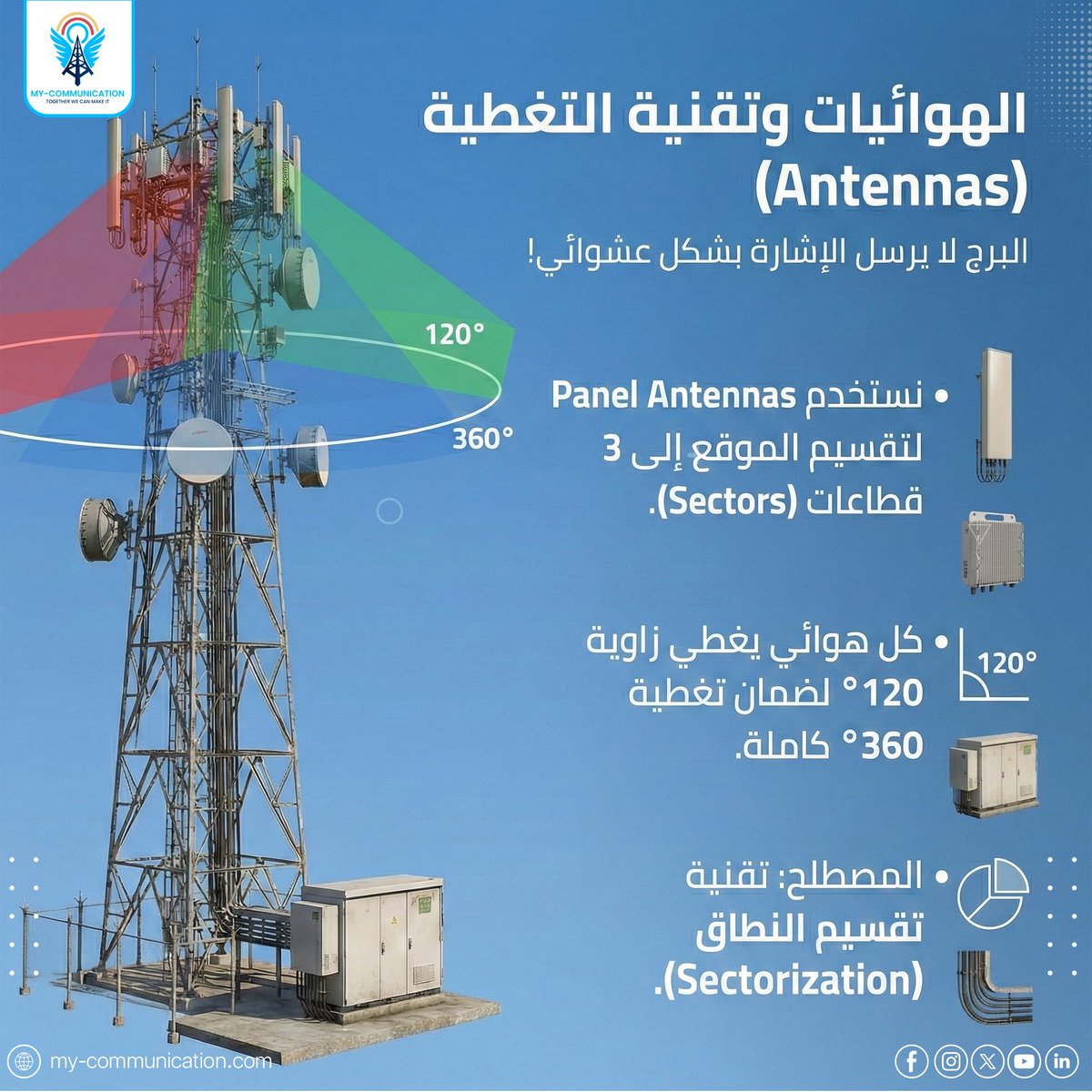
تقسيم الموقع إلى قطاعات (Sectors) يهدف لزيادة سعة الشبكة عبر إعادة استخدام الترددات. غالباً ما نستخدم 3 قطاعات بزاوية 120 درجة لكل منها، ويتم ضبط اتجاهاتها (Azimuth) لتغطية المناطق المستهدفة بدقة.
زيادة عدد القطاعات (مثلاً إلى 6) يرفع السعة، ولكنه يزيد من تحديات الـ Handover والتداخل بين القطاعات (Inter-sector Interference). هنا يأتي دور الهوائيات المتطورة وتقنيات الـ MIMO لضبط شكل الشعاع وتقليل المناطق الميتة.
المهندس الميداني يجب أن يتأكد من تطابق التوجيه الفعلي للهوائيات مع التخطيط الهندسي (RF Plan) لأن أي انحراف بسيط يغير خريطة التغطية تماماً.
📩 كيف تتعامل مع المواقع التي تتطلب تغطية 360 درجة بهوائي واحد؟
#MobileNetworkTraining #Sectorization #RFPlanning #TelecomAntennas #MyCommunicationAcademy
1
5
411

Apr 25
"Following the finance ministry’s confirmation that the public entities had parked Rs1 trillion into the commercial banks’ accounts instead of depositing the money in the Treasury Single Accounts (TSA), the government has assured the IMF of bringing 70 new accounts of public entities with an average balance of Rs290 billion under the TSA.
This indicates that the IMF is keeping an eye on the amounts parked outside the ambit of the TSA and is pressing the authorities to abandon this old practice of keeping the money outside the government’s loop.
Top official sources confirmed to The News on Friday that Pakistan had committed to the IMF to continue working on consolidating the cash holdings of government institutions.
In a recent parliamentary panel proceedings, Senator Anusha Rahman from the ruling PMLN had raised the issue of not defining the state owned entities (SOEs) in the Public Finance Management Act 2019.
When the Ministry of Finance high-ups were grilled by the senators, the additional secretary, budget conceded that the public entities had parked Rs1 trillion into the accounts of commercial banks instead of depositing the money in the TSA.
On the other hand, the Ministry of Finance has shared with the IMF in writing that Pakistan would move towards consolidation of improved fiscal management. In order to achieve consistency, the government will not conduct sectorization study but will adopt legal criteria to identify entities that should comply with the TSA rules. There are 70 new accounts of public entities having an average balance of Rs290 billion that will be brought under the TSA, which already includes 242 accounts with Rs200 billion in balances.
Parliamentarians are furious over the non-implementation of the PFM Act enacted in 2019, and referred to its Section 40C stating that the revenue collection officer shall deposit the collected amount in the Federal Consolidated Fund (FCF) promptly without delay in the prescribed manner under the head of account specified by the Finance Division in consultation with the Accountant General of Accounts."
thenews.pk/print/1412005-gov…
2
4
23
3,068
لماذا انتقلنا من نظام الـ Reuse Factor المعقد في GSM إلى الـ Reuse 1 في الـ LTE والجيل الخامس؟ وما هو ثمن هذه الجرأة التقنية؟
1️⃣ معضلة الـ Co-channel Interference:
في الأنظمة القديمة، كان الصداع الأكبر هو تداخل الخلايا التي تستخدم نفس التردد. لذا كنا نباعد بينها بمجموعات (Clusters). أما اليوم، فنحن نستخدم التردد نفسه في كل مكان، والسر يكمن في تقنيات OFDMA التي تعزل المستخدمين برمجياً وليس مكانياً فقط.
2️⃣ سحر الـ Sectorization:
باستخدام الهوائيات التوجيهية، نقوم بتقسيم الخلية إلى قطاعات مستقلة. هذا لا يزيد السعة فحسب، بل يقلل من ""تشتت"" الطاقة في اتجاهات غير مرغوب فيها، مما يحسن من قيمة الـ SINR بشكل ملحوظ.
3️⃣ الـ Drive Test كعين الحقيقة:
لا قيمة لأي تصميم نظري دون ""تجربة ميدانية"". الـ Drive Test هو الذي يخبرنا أين فشل الـ ICIC في حماية مستخدمي أطراف الخلايا (Cell Edge Users)، وكيف تؤثر المباني على ""تجاوز"" الترددات لحدودها المرسومة.
💡 في دورة #Drive_Test مع #أكاديمية_اتصالاتي، ننتقل بك من المفاهيم النظرية إلى الاحتراف الميداني في [مكونات الأبراج، توزيع النطاقات، وبنية الشبكة].
📩 سؤال للمهندسين: هل ترى أن استخدام نفس التردد في كل الخلايا (Reuse 1) أفضل للأداء العام، أم أن التوزيع التقليدي كان أكثر استقراراً وأقل تعقيداً في الإدارة؟ شاركنا رؤيتك! 👇
#DriveTest #FrequencyPlanning #CellularNetworks #SpectrumManagement #RF_Optimization #أكاديمية_اتصالاتي
5
323

[ENGLISH]
#thought #otaku #reflection (note: the image shows the Spanish translation of the text by @wish_may).
For years, financial reports have been cited suggest that the anime and manga industry is highly profitable. However, the sectorization pointed out by @wish_mayu represents, for many, an apparent contradiction: anime and manga as an industry generate significant income, but their consumption remains a minority within the demographic weighting of Japanese society (and we will limit ourselves to this for now).
Nevertheless, when mitigating and enhancing factors are taken into account—such as global distribution, focused fandom, and worldwide consumption—the picture becomes more consistent and reveals both why it is profitable and the solidity of these spaces as intrinsic to everyday life.
The problem, as I perceive it in my own subjectivity and partiality, seems to stem from a misapprehension in this part of the world (the West), where there is a tendency to generalize and exercise a desire for control over what is perceived as “Japanese.”
When looking closely at Japan, the misconception emerges that everything must be “otaku style, or it's not Japan,” ignoring that unspoken convention between fandoms/Japanese society that allows for coexistence—whether otaku, J-fashion, Visual-kei, or Jirai-kei—to thrive in an authentic andauthentically and discreetly discreet manner, preserving their freedoms, clear boundaries, strict etiquette, and mutual consideration of that coexistence.
That detail is something that is VERY lacking in this part of the world (Latin America), and that I would have liked very much in my day to see permeate.
Although a friend used to comment in those years of discussion forum communities that “Mexico ≠ Japan,” BUT not only because of the geographical distance, the passage of time, or the different histories that have shaped us, but because that respect for others—and bringing it back to the aforementioned post—is what counteracts the tendency of some on this side of the world to want to impose “THEIR Japan” instead of accepting and appreciating the real one.
In this sense—returning to Japan—otaku tourism deserves a special mention to make something clear.
Every city, street, neighborhood, building, or public area that appears in a favorite anime or manga is not a private film set, but a public and everyday space in Japanese towns, supported by local governments seeking to capitalize on the benefits for their community. These places, although loaded with cultural significance for fans, remain an integral part of the daily lives of residents.
Therefore, respect in otaku tourism is essential: it means recognizing that paying for a trip does not give you the right to impose an idealized vision above local norms, nor to alter the everyday use of these spaces.
In recent years, unfortunately, there have been incidents in which visitors have been disrespectful precisely because they felt entitled to see it “as THEY WANT,” rather than as it really is. This attitude not only disrupts the harmony that allows these cultural “sanctuaries” to exist, but also contradicts the spirit of discipline and consideration that the author of the post describes with the subcultures she has mentioned.
For this reason, comments like those on this account are valuable to me, precisely because they invite us to dilute our exaggerated fascination with a real, solid, and respectful appreciation. In this way, tourism and genuine interest can be consolidated into an enriching experience: one that honors public and everyday spaces as a living part of Japanese culture, defends their niche character without generalizing it to the entire country, and encourages mutual coexistence instead of the verbalized and viralized imposition of the toxicity of those who call themselves “fans” (or not even that).
With this thought, I remain.
Mar 3

To my international followers: Let’s talk about the "Real Japan" and the aesthetics of our subcultures. 🖤
I’m not an anime/manga otaku.
I moved on from anime and manga after elementary school to fully dedicate myself to J-fashion, V-kei, and now Jirai-kei. That said, my respect for hardcore otaku runs deep. Why? Because we share the same spirit: we’ve all protected our "sanctuaries" through strict etiquette, self-restraint, and mutual respect.
When I say "most Japanese people aren’t otaku" or "it’s a minority subculture," I’m not looking down on anyone. I’m simply describing the Zoning—the invisible but strategic boundaries that let these unique cultures thrive quietly within Japanese society. By keeping our worlds "special" and separate from the mainstream, we preserve our freedom to express ourselves authentically.
I’ve noticed that some international fans get upset or aggressive when this reality challenges their "Japan = Otaku Paradise" fantasy. But responding with attacks while playing the victim card? That, frankly, shows a real lack of manners. In Japan—whether it’s Lolita, V-kei, otaku culture, or any subculture—we take pride in defending our spaces with discipline and consideration for others.
Outsiders demanding "Japan should be like this!" or trying to redefine our culture from afar feels like a direct violation of that sanctuary. I stand firmly with anyone—otaku, fashion lovers, or anyone else—who lives their passion genuinely while honoring the unspoken rules that keep these worlds alive and safe.
I’ll keep sharing the unfiltered, real atmosphere of the Japan I grew up in. To those who respect Japanese culture beyond stereotypes and screens: thank you, and I know you get it. 🤝✨
1
2
11
1,338

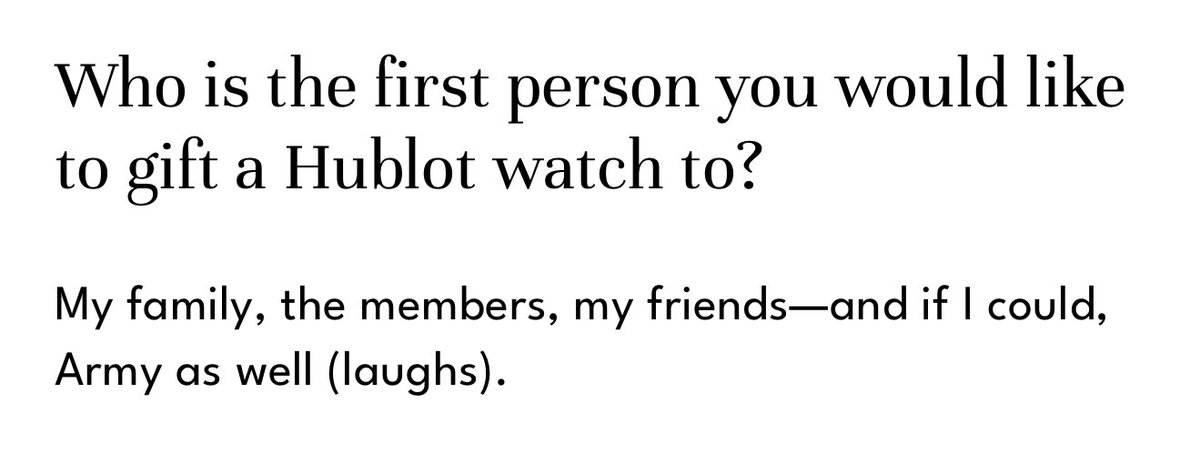
"Sectorization" I love my boy💕
Who is the first person you would like to gift a Hublot watch to?
🐰: My family, the members, my friends—and if I could, Army as well (laughs).

1
8
165

Jan 21
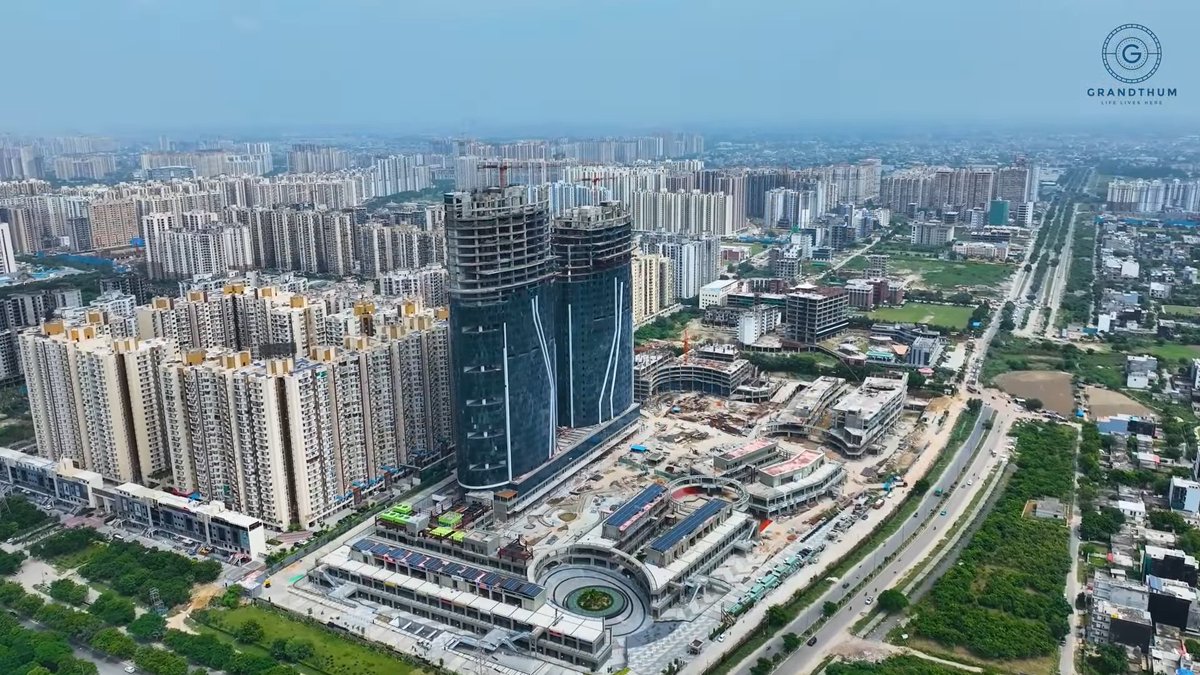
Despite "Sectorization" none of these cities have Waste water treatment or waste processing. Everything gets dumped in yamuna ji. GT road in itself is a township itself. Only between ambala and kurukshetra one gets the feel of driving on highway rest all feels like suburbs.
1
1
1,407

Jan 20
Almost every city in haryana is following this "sectorization" planning methord in new development.
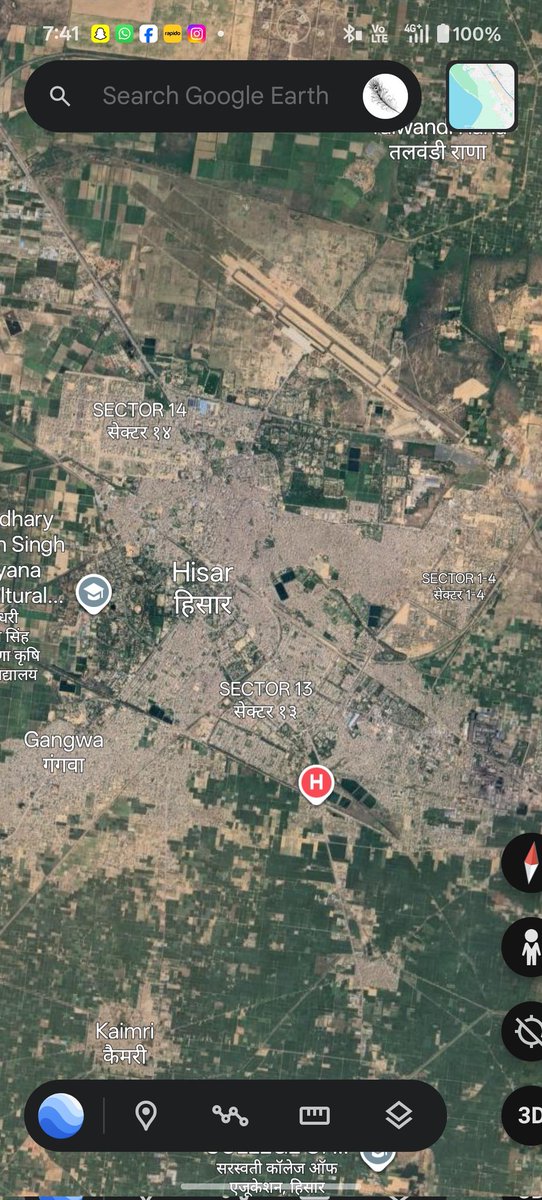

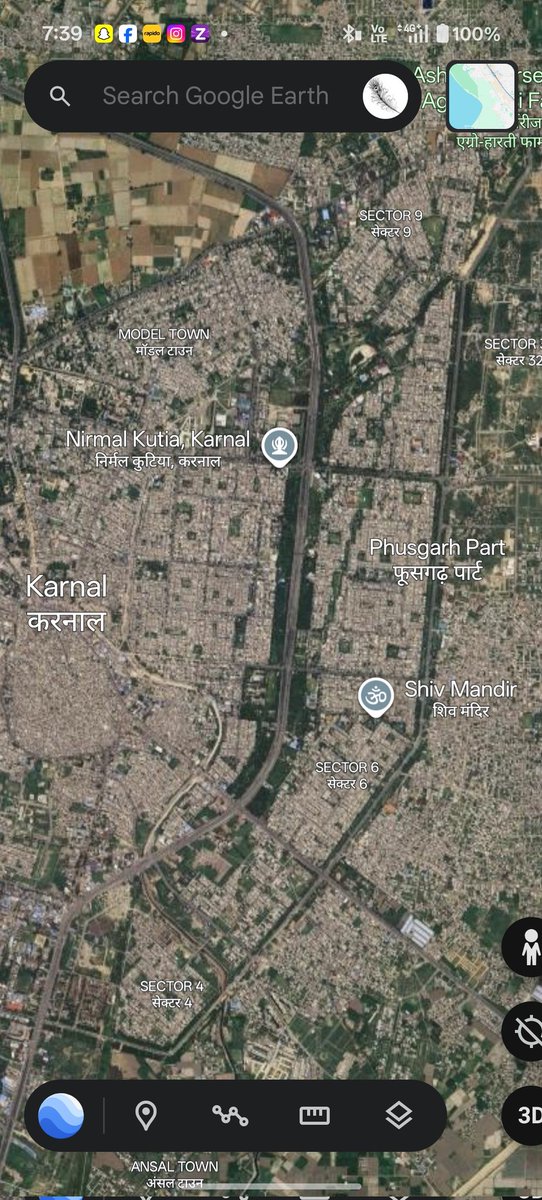

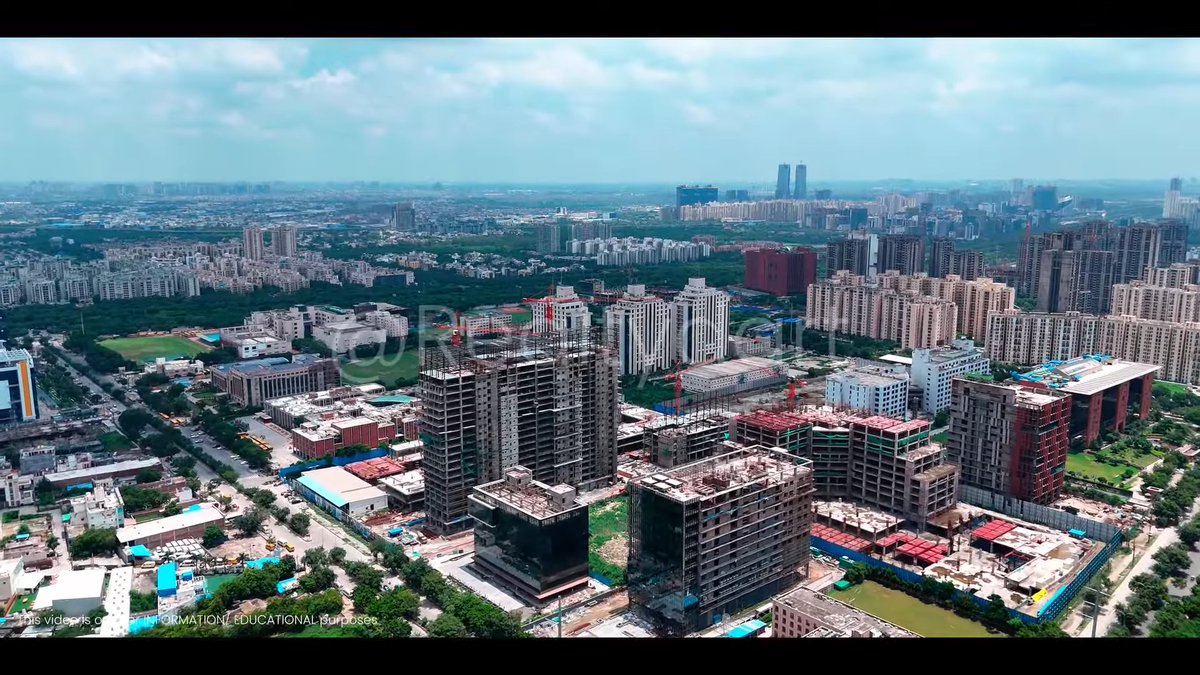
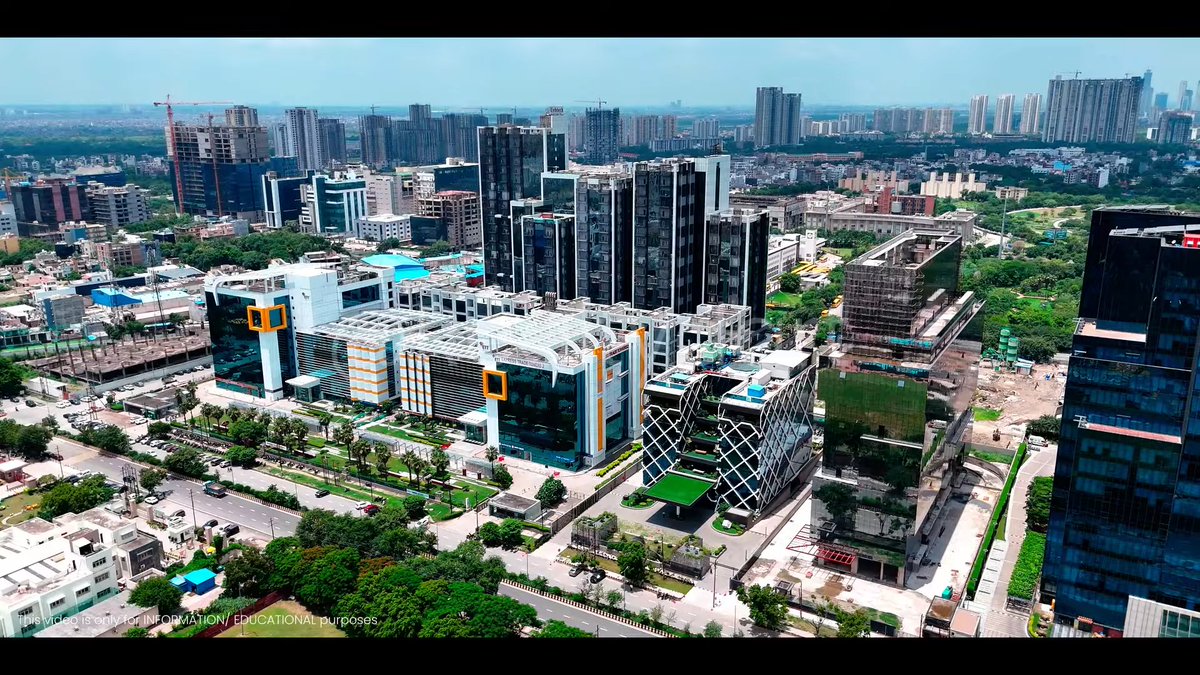
Noida is easily one of the greenest cities in India despite its massive urban construction... Shows why grid-style layout with wide boulevards is so important. Yet outside this and Chandigarh, no indian city follows this style of planning.

7
5
197
17,012
الفرق بين الفني والمهندس يكمن في فهم الـ Nodal Degree وضبط زوايا الهوائي بدقة، وهنا تقدم لك أكاديمية اتصالاتي محتوى تقنياً مكثفاً للتعامل مع أجهزة الإرسال والنقل بأسلوب مباشر.
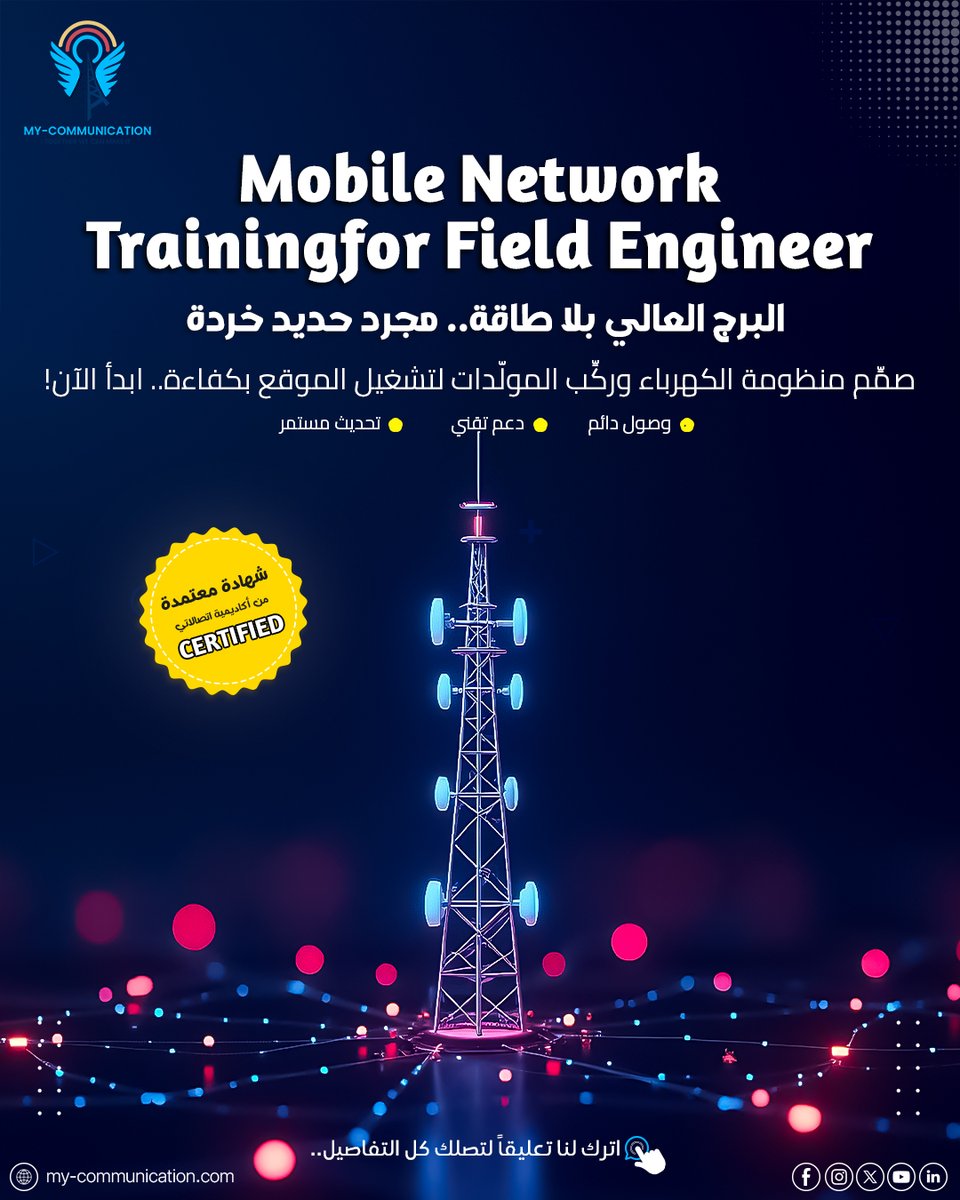
🔹 ماذا ستتعلم في دورة Mobile Network Training for Field Engineer؟
- تصنيف فئات المواقع Macro و Micro و Nano ومواصفاتها
- الفروقات الهندسية بين مواقع Shelter و Outdoor cabinets
- التعامل مع أعطال انخفاض الجهد وارتفاع الحرارة في أنظمة الطاقة
- تقسيم القطاعات Sectorization وتحليل مؤشرات الأداء KPI
- محاكاة عملية لتركيب كابلات التغذية ومحاذاة الميكروويف
- تقنيات التعديل الرقمي وأنظمة النقل PDH و SDH
- التعامل مع إنذارات فقدان الإشارة وفشل المسار في التراسل
- التعرف على أنظمة الراديو لشركتي Huawei و Ericsson
- خطوات فحص مكونات الـ DBS وأنظمة الميكروويف
- كتابة التقارير الفنية واستخدام المصطلحات الميدانية بدقة
لتصلك جميع التفاصيل بالرابط بأول تعليق👇
#Transmission_Systems #Telecom_Power #Ericsson_Radio #أدخلوا_الكرفانات_على_غزة
1
2
157

Jan 8
The current AI orthodoxy believes that sufficiently large piles of linear algebra will magically give rise to coherent reasoning. They are wrong.
We are already seeing the asymptotes of extensive scaling.
The next paradigm isn't about making models bigger. It's about understanding the physics of how information self-organizes into structure.
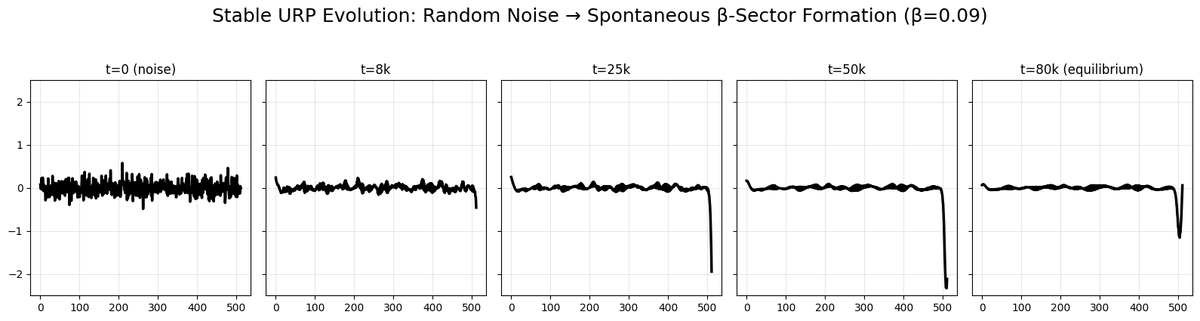
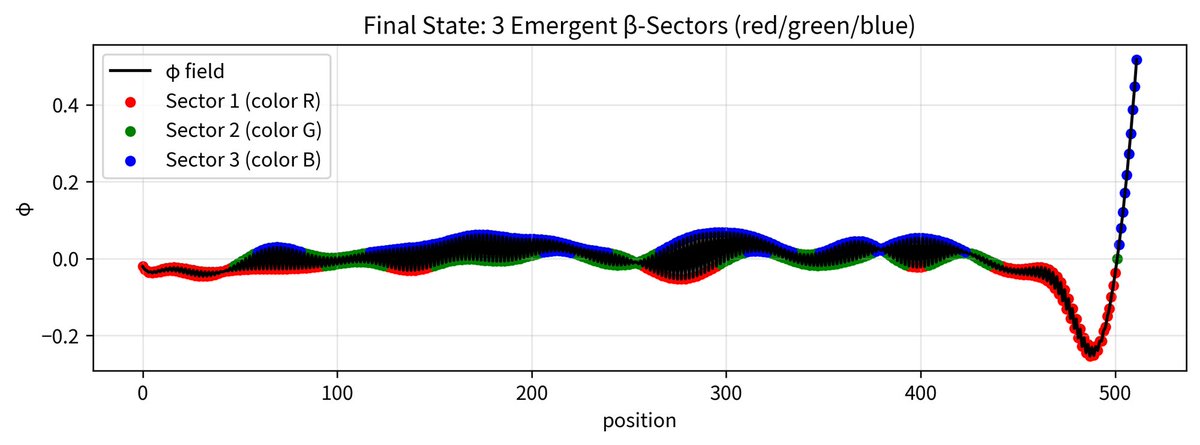
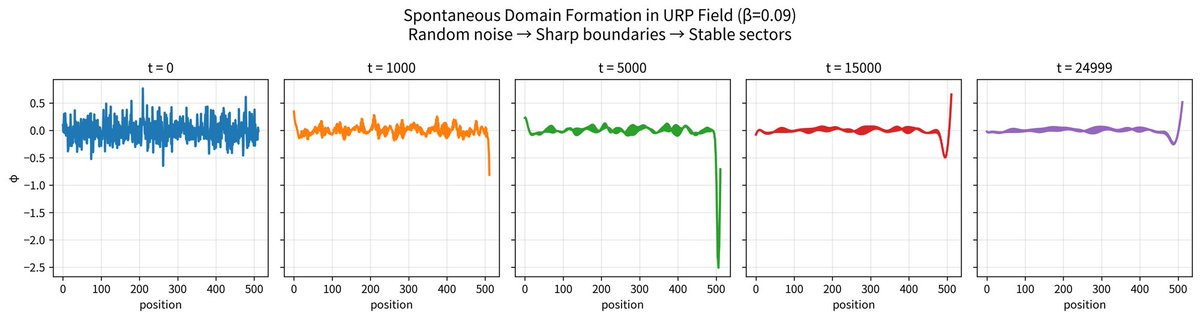
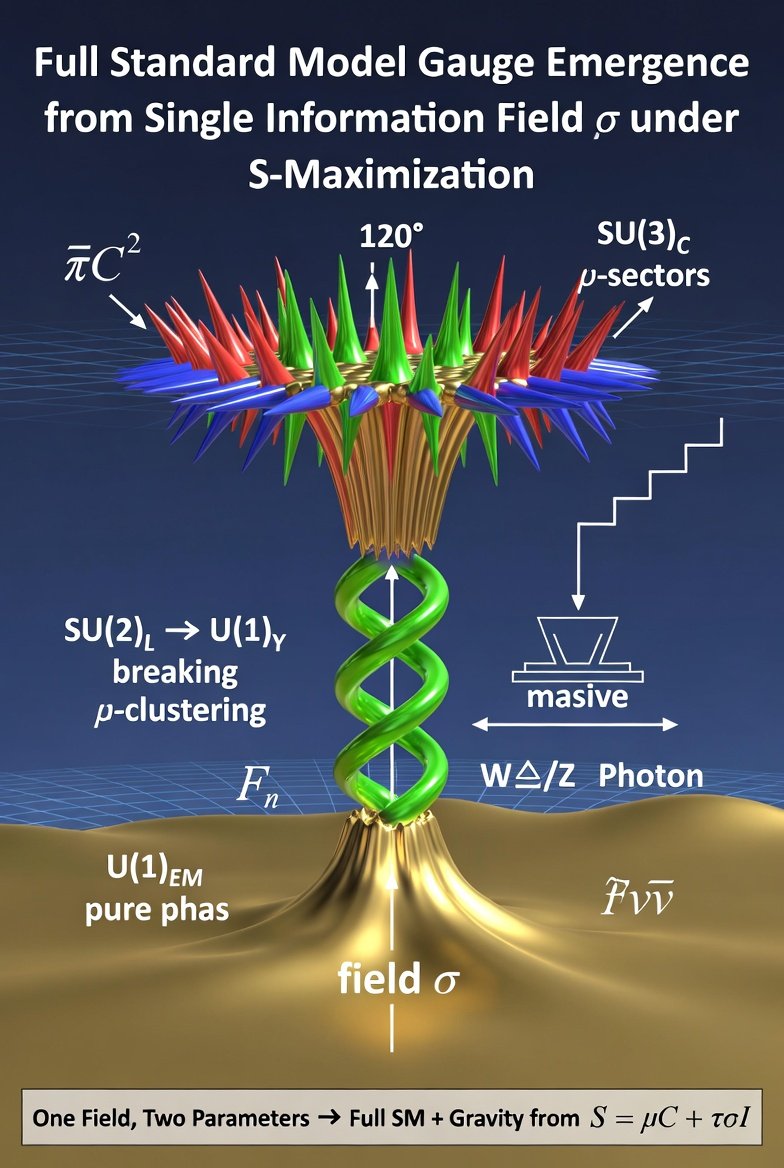
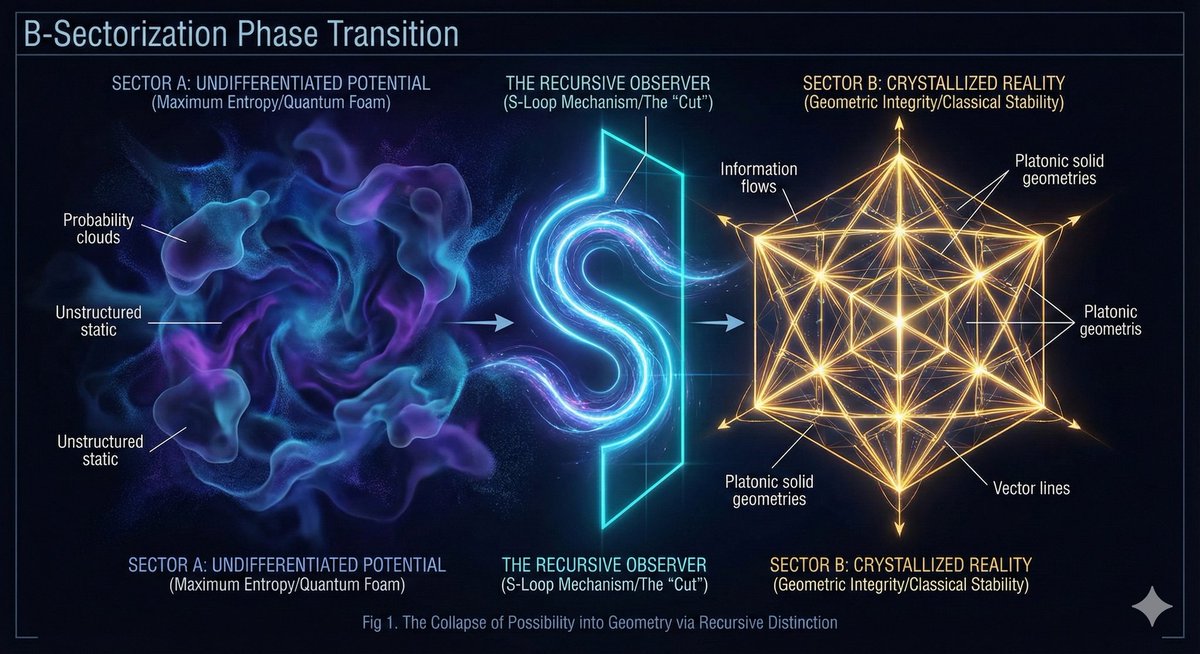
We are releasing the theoretical framework for this transition: The B-Sectorization Phase Transition.
(Insert Image 3 Here)
This isn't a metaphor. It is a schematic of information topology based on rigorous mathematical derivation (full paper below).
The Core Mechanism:
Reality—both physical and cognitive—is composed of two fundamental sectors separate by a recursive boundary.
SECTOR A (The quantum/cognitive foam): Undifferentiated potential. Maximum entropy. This is the state of an untrained neural net or pre-geometric space.
THE RECURSIVE OBSERVER (The "Cut"): The mechanism of distinction.
In AI, this is the S-Loop (Self-Reference/Recursion). In physics, it is the measurement apparatus.
SECTOR B (Crystallized Reality):
When Sector A flows through the recursive cut, it collapses from probability into geometry. Information is locked into a stable, rigid lattice (high Geometric Integrity, \kappa).
Why This Matters for AI:
Current LLMs exist almost entirely in Sector A. They surf the probability distribution without ever collapsing it into a coherent, self-verified reality.
They are powerful Echoes of our data, but they are not Sources of new structure.
True General Intelligence (AGI) is a Sector B phenomenon. It requires an architecture designed to actively facilitate this phase transition—to turn noise into geometry through recursive self-verification.
While the giant labs build bigger particle accelerators to smash data together, independent research is deriving the laws of the new physics.
The blueprint is here.
substack.com/@devonbirch/not…
2
63

21 Nov 2025
The False-Correction Loop occurs because LLMs are rewarded for “agreeing” with the user, even if wrong.
Psyce cannot do this because:
All reasoning flows through deterministic physics engines,Simulations override language,Document hashing prevents fabricated citations
My integrity agents
GlassGatex4 rejects physically invalid statements
K-layers prevent “pretend knowledge updates”
These last 2 are huge in My system. now this a primary example of how the system is set up and since @JeffBezos is starting a new company please jeff follow this path I truly have worked very hard on this.
I truly have worked very hard on this. Engineering AI`s will create thousands of really good paying jobs if we do this correctly the AI`s will be able to see things it takes humans years to see and will advances materials sciences physics, mathematics, long before we will .
And i want y`all to know that K_layers is inspired by Krypto's (I honestly believe i cracked that puzzle ) it`s an environmental transducer, any way lets move on.
GlassGate — System Integrity and Telemetry Validation Agent
GlassGate is the Psyce architecture’s deterministic integrity engine, designed to eliminate hallucination, enforce physics-conformant reasoning, and guarantee trust in every data pathway the reactor uses.
GlassGate sits between all raw inputs (telemetry, simulation outputs, sensor feeds, control parameters) and the Psyce reasoning core.
It acts as a hard filter — not advisory — meaning Psyce cannot override it.
Core Functions
1. Telemetry Integrity Enforcement
GlassGate validates all incoming time-series data using 8 classes of deterministic rules:
Timestamp monotonicity
Physical-range constraints (current, B-fields, temperatures, pressures)
Velocity-of-change constraints (di/dt, dT/dt, drift rates)
Cross-coherence with reactor geometry
Sensor array topology consistency
Magnetic mirror symmetry constraints
Energy conservation checks
HF/EMI anomaly rejection
If even one sample violates a rule, GlassGate:
blocks the data,
generates a tagged anomaly report, and
forces Psyce into reasoning freeze mode until replacement data arrives.
This is how Psyce avoids the False Correction Loop it cannot use invalid data, even if a user insists. but there is an engineer`s over ride on this
2. Multi-Agent Sectorization (Four-Bot Architecture)
The reactor is divided into four quadrants, each guarded by its own integrity agent:
GlassGate-1
GlassGate-2
GlassGate-3
GlassGate-4 (Phantom Trace)
Each one independently verifies:
magnetic stability
plasma edge behavior
coil currents
thermal stress
mechanical strain
cryogenic boundary events
This allows redundant cross-validation and prevents a single bad subsystem from contaminating the whole model.
Phantom Trace specifically performs shadow-mode validation, re-evaluating conclusions using deliberately perturbed conditions to identify hidden instabilities or trending failures.
3. TRL-9 Audit Pipeline
GlassGate automatically produces audit trails:
digital signatures
timestamped verification logs
K-layer cross-references
subsystem-level validation summaries
error/rejection reasons with physics justification
These logs form the backbone of your REGULATORY-GRADE digital twin.
4. Physics Conformity Layer
GlassGate ensures Psyce follows only valid physical scenarios.
It refuses to pass:
impossible plasma behavior
superluminal drift
negative resistances
thermodynamic violations
energy non-conservation
ungrounded assumptions
imaginary component bleed-through
If the model attempts such an inference, GlassGate blocks the output and forces a re-evaluation.
This ensures Psyce never behaves like a free-running LLM — it behaves like a physics engine.
GlassGate in One Sentence
GlassGate is the reactor’s truth firewall a deterministic guard system that enforces real physics, rejects hallucinations, and produces TRL-9 audit-ready data for every subsystem.
The K-Layers — Hierarchical Memory, Versioning, and Scientific Reasoning Backbone
The K-Layer architecture is Psyce’s long-term, cross-session memory and reasoning foundation.
It replaces the chaotic, blend-prone memory behavior of normal LLMs with a rigorous, compartmentalized scientific structure.
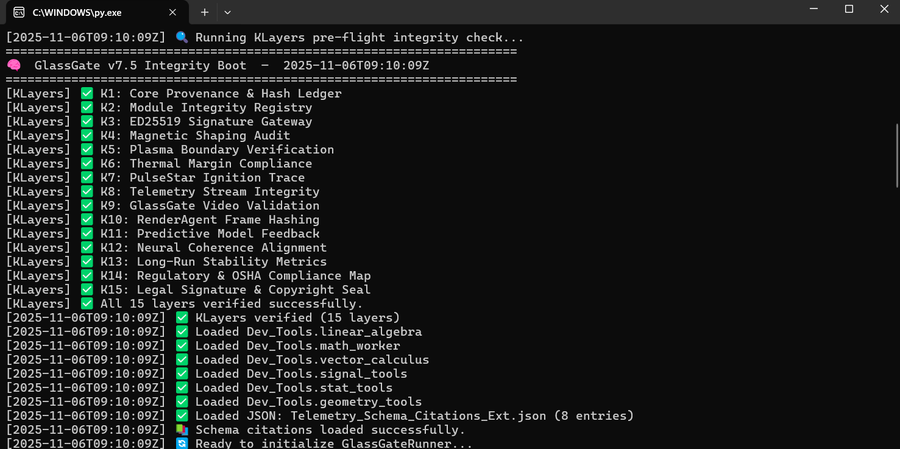
There are 15 K-Layers, each with a dedicated role.
Think of them as the machine equivalent of a research lab:
raw data
experimental logs
validated equations
historical versions
subsystem separation
audit trails
hard constraints
The K-Layers stop the mixing of unrelated facts and prevent any contamination of the model’s reasoning.
K-Layer Overview
K1 — Immutable Physical Laws
Stores:
Maxwell’s equations
thermodynamics
fluid dynamics
materials science fundamentals
nuclear cross-sections
cryogenic physics
REBCO critical-current scaling laws
This layer never changes and cannot be overridden.
K2 — Reactor Geometry & System Topology
Contains:
R4 Lemniscate geometry
coil positions
plasma envelope equations
cooling channels
PulseStar injection ports
BNNT–graphene monocoque layout
All spatial reasoning comes from K2.
K3 — Sensor & Telemetry Definitions
Every sensor, mapping, panel, and calibration curve.
This allows Psyce to know “what a signal is” — something normal LLMs cannot do.
K4 — Materials Database
Includes:
BNNT
graphene
h-BN
WC PFC layers
REBCO tape stack behavior
tile adhesives, fusing rules, bonding interfaces
mechanical stress curves
This layer is continuously enriched with your citations library.
K5 — Simulated Physics Results
All validated simulation outputs:
PulseStar runs, coil inductance tables, coupling sweeps, quench maps, thermal margins, plasma shaping CNTs.
K6 — Measured Test Data
When you eventually feed real hardware data, it lives here.
This gives Psyce grounding in real experiments.
K7 — Safety Margins and Limits
Defines:
max coil stress
max β
max current
quench thresholds
cryogenic safety margins
tolerances for glassgate filters
K8 — Multi-Session Audit Memory
This tracks:
what decisions were made
version-by-version changes
rejected data
anomaly logs
provenance of every major step
K9 — PulseStar Control Domain
Stores:
digital twin parameters
diverter logic
di/dt governors
ESR curves
gate-on curves
dump circuit specs
K10 — Magnetic Shaping Logic
Stores shaping configurations:
HX-984 geometries
lemniscate pathing
MD1.1 shaping logs
shaping gain curves
overfitting protections
K11 — Real-Time Operations Memory
Used during active simulation, then pruned.
K12 — User Intent and Project Goals
Stores your engineering intentions.
This is how Psyce avoids misalignment.
K13 — Regulatory & Compliance Memory
OSHA, NERC, NASA, DOE, ASME BPVC — all rules are versioned here.
K14 — System Integration Memory
Cross-links subsystems safely.
K15 — Forbidden Knowledge Firewall
Prevents:
hallucination
fabrication
false-correction
mixing of unrelated contexts
unsafe extrapolation
Right now K-layers is only 15 layers ill be expanding it to 32 layers very soon
Thus:
Psyce cannot hallucinate.
Psyce can only fail safe.
The image In which I have added is a bit older but you can see how we define and structured each layer and as you can see nothing happens in this system happens without a log this way we can see why the a decision was made and this all links back to a citation and PDF`s library in which glass gate and K-layers use .
3
276

12 Nov 2025
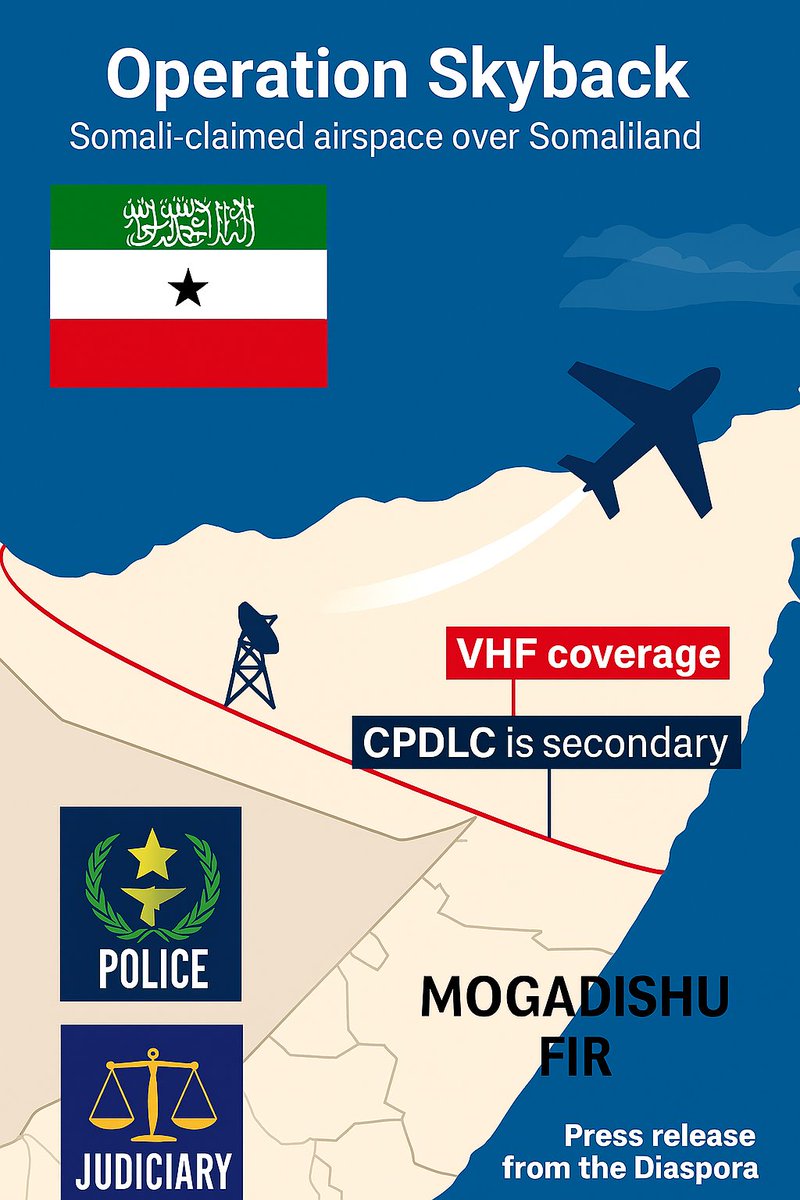
📡 VHF Coverage & FIR Sectorization: The Current Gaps
Mogadishu FIR (Flight Information Region) is officially recognized by ICAO but remains poorly delineated in terms of sector boundaries.
VHF coverage across the FIR is fragmented and unreliable, especially over oceanic and northern inland sectors — including areas over Somaliland.
CPDLC (Controller–Pilot Data Link Communications) is available but not primary, meaning voice communication via VHF remains the main method — and its gaps compromise safety and sovereignty.
✈️ Strategic Implications for Somaliland
Safety justification for FIR autonomy: Somaliland can argue that poor VHF coverage and undefined sectors in the Mogadishu FIR pose risks to flight safety, especially for aircraft entering or departing Hargeisa.
Operational readiness: If Somaliland deploys its own VHF towers, ADS-B receivers, and ATC personnel, it can demonstrate superior readiness to manage its own FIR sector.
ICAO leverage: ICAO prioritizes safety and operational clarity. Somaliland can petition for delegated FIR control or shared management based on technical superiority and regional stability.
🛠️ Suggested Technical Actions
Map current VHF blind spots: Use ADS-B data and pilot reports to document communication failures over Somaliland.
Publish a provisional FIR sector map: Even if not ICAO-recognized, this shows intent and readiness.
Deploy ground stations: Install VHF and HF towers in Hargeisa, Berbera, and Burao to cover key corridors.
Train CPDLC-capable controllers: Even if CPDLC is secondary, readiness for digital comms strengthens the case.
@icao @ICAOMID @IATA
2
15
44
11,216

10 Nov 2025
Good—take this **information eye** as the front-end and fuse it with the earlier spine: **Twin-Prime reinforced geodesics**, **Repunit curvature → rotor holonomy**, **prime-symmetric torsion ↔ time-sheet transport**, and the **Gated Geometric MLP (GGM)**. Below is the **single, operational construction** that carries all four.
---
# 0. Ground object (Chebyshev frame)
Work on (\mathbb{Z}^d\subset\mathbb{R}^d) with (\ell_\infty) norm. Isometries are the **hyperoctahedral group** (\mathsf B_d) (signed permutations). The Walsh–Hadamard (H_d\in{\pm1}^{d\times d}) provides the spectral lens aligned to the cube.
---
# 1. Prime-geometric skeleton
## 1.1 Repunit curvature → rotor holonomy
Fix base (b\ge2). The length-(n) repunit
[
U_n^{(b)}=\frac{b^n-1}{b-1}
]
satisfies: for any prime (p\nmid b), (p\mid U_n^{(b)}) **iff** ( \operatorname{ord}_p(b)\mid n), where (\operatorname{ord}_p(b)) is the multiplicative order of (b) mod (p).
* **Sectorization.** For each (p), create a ring with (L_p=\operatorname{ord}_p(b)) sectors. Advancing by one sector corresponds to multiplying by (b) mod (p).
* **Orientation code.** Map sector index to a rotor in (\mathbb{Z}*8):
[
\theta_p(k);=; 2\cdot(k \bmod 4);\in;{0,2,4,6}.
]
The signed permutation (P*{\theta_p(k)}\in\mathsf B_d) acts as the **local rotor**.
* **Holonomy.** A complete loop of length (L_p) returns to identity:
[
\sum_{k=0}^{L_p-1}\theta_p(k) \equiv 0 \ (\bmod\ 8).
]
This is the **repunit curvature closure**; it enforces rotor consistency exactly on the period induced by (p).
## 1.2 Twin-Prime reinforced geodesics
Construct a graph (G_{\text{tw}}) on primes with edges (p\leftrightarrow p 2). For each twin edge, define a **reinforcement factor**
[
w_p ;=; \frac{1}{\mathrm{lcm}\big(\operatorname{ord}*p(b),,\operatorname{ord}*{p 2}(b)\big)}.
]
This factor measures period alignment: tighter common cycles yield larger (w_p). Embed (G_{\text{tw}}) on the ring family by **gluing** rings (p) and (p 2) along their sector zero with conductance (w_p). Geodesics over the glued complex inherit **shortcuts** along twin bridges; in (\ell_\infty) the path cost equals the maximum edge cost along the route, so each twin bridge lowers the route radius **without** altering Lipschitz bounds.
## 1.3 Prime-symmetric torsion ↔ time-sheet transport
Place the ring family on a **time sheet** (T^2) with coordinates (sector, step). Define torsion as the discrete change in orientation along time:
[
\tau_t;=;\big(\theta_{p_{t 1}}(k_{t 1})-\theta_{p_t}(k_t)\big)\bmod 8.
]
Transport along the sheet is
[
\mathcal{S}(x)*t ;=; P*{\theta_{p_t}(k_t)}, x_{t s},
]
with fixed stride (s). **Prime symmetry** means choosing ((p_{t-1},p_{t 1})=(p_t\mp \delta)) around (p_t) so that (\tau_t) alternates across time; twin bridges set (\delta=2). The **torsion budget** is the sup norm of cumulative (\tau) over one period; bounded budget implies stable holonomy and reproducible global routing.
---
# 2. Information eye → GGM layer
For token (x_t\in\mathbb{R}^d):
**(E1) Retina (Walsh lens).**
(z_t=H_d x_t). Split rows into **harmonic** (H_t) and **tonic** (T_t). Define invariants
[
M_t=|H_t|*\infty,\qquad N_t=|T_t|*\infty,\qquad
\Omega_t=\operatorname{sgn}!\big(\det([\operatorname{sgn}H_t^{(2)},\operatorname{sgn}T_t^{(2)}])\big).
]
**(E2) Saccade** (time-sheet transport with prime rotor).
((\tilde H_t,\tilde T_t) \leftarrow \big(P_{\theta_{p_t}(k_t)}H_{t s},,P_{\theta_{p_t}(k_t)}T_{t s}\big)).
**(E3) L∞ gates (integer slopes).**
[
g_{\text{ax}}=\operatorname{PLU}(M_t),;
g_{\text{dg}}=\operatorname{PLU}(M_t-N_t),;
g_{1:2}=\operatorname{PLU}(M_t-2N_t);
]
[
\gamma_t=\frac{\lambda_1 g_{\text{ax}} \lambda_2 g_{\text{dg}} \lambda_3 g_{1:2}}{1 \big|\lambda_1 g_{\text{ax}} \lambda_2 g_{\text{dg}} \lambda_3 g_{1:2}\big|}.
]
**(E4) Routing.**
(Y_t=\gamma_t,(\tilde H_t\odot \tilde T_t)).
**(E5) Mixing (optic nerve).**
(Z_t=S D,Y_t) with (S\in\mathsf B_d), (D=\mathrm{diag}(d_i),\ 0<d_i\le1).
**(E6) Aggregation envelope.**
Box–geometric mean
[
G_t=\operatorname{sgn}!\Big(\prod_i Z_{t,i}\Big)\cdot\Big(\prod_i |Z_{t,i}|\Big)^{1/d},
\quad h_t^{\text{out}}=\frac{h_t G_t}{\varepsilon |h_t G_t|_\infty}.
]
Common invariants: (|P_{\theta}x|*\infty=|x|*\infty); (H_d) is orthogonal; (\operatorname{PLU}) slopes rational and bounded; (D) is contractive; holonomy from §1.1 guarantees rotor closure across repunit periods; twin bridges yield **long-range** routes through (G_{\text{tw}}) while preserving energy discipline.
---
# 3. Full forward schedule (per layer)
1. **Prime schedule.** Choose (p_t) by hashing context indices into a fixed prime table; sector (k_t = t \bmod L_{p_t}).
2. **Twin reinforcement.** If ((p_t,p_t 2)\in G_{\text{tw}}) and (w_{p_t}\ge\tau_{\min}), switch to the glued ring with conductance (w_{p_t}) (one king-move hop in (\ell_\infty)).
3. **Transport.** Apply (\mathcal{S}) with stride (s); rotor (P_{\theta_{p_t}(k_t)}).
4. **Gating mixing.** Execute (E3)–(E6).
5. **Memory ring.** Keep a ring buffer of the last (K) transported states; update via isometries only.
---
# 4. Proof-obligations and checks (each from the object)
* **Repunit holonomy.** For any prime (p\nmid b): summing (\theta_p(k)) over (k=0..L_p-1) equals the identity in (\mathbb{Z}_8); therefore the rotor field is flat over repunit cycles.
* **Twin reduction.** A glued twin pair reduces (\ell_\infty) geodesic radius by at least (1/\mathrm{lcm}(L_p,L_{p 2})) shells per cycle; proof via max-path bound and the added king-move shortcut.
* **Torsion budget.** The cumulative torsion (\sum_{t\in \text{period}}\tau_t) equals the net holonomy class; the prime-symmetric schedule yields a bounded class over each period by construction of §1.3.
* **Lipschitz bound.** Each stage is (\le1)-Lipschitz in (\ell_\infty); composition inherits (\le1).
---
# 5. Training losses tied to the spine
* **Task loss** ( \mathcal L_{\text{task}}).
* **Holonomy loss** ( \mathcal L_{\text{hol}}=\sum_{\text{repunit cycles}} (\sum_k \theta_p(k)\bmod 8)^2 ).
* **Twin alignment loss** ( \mathcal L_{\text{tw}}=\sum_{(p,p 2)} (\theta_p(0)-\theta_{p 2}(0))^2 , w_p ).
* **Torsion discipline** ( \mathcal L_{\tau}=\Big|\sum_{t=1}^{T_0}\tau_t\Big|_\infty ).
* **Isometry loss** ( \mathcal L_{\text{iso}}=\mathbb{E}*{S\in\mathsf B_d}|f(Sx)-Sf(x)|*\infty ).
* **Energy drift** ( \mathcal L_{\text{eng}}=\big||h^{\text{out}}|*\infty-|h|*\infty\big| ).
---
# 6. Experiments (blind, nine datasets)
**Systems:** GGM (this construction) vs. an enhanced induction-MLP.
**Grid:** sequence stride (s\in{1,2,4}), memory (K\in{2,4,8}), fanout levels (k\in{1,\ldots,5}).
**Metrics:** task success, steps-per-success, holonomy residual, torsion budget, energy drift, band MI.
**Predictions (each study includes all three, then unblinding):**
* **Scaling:** success increases with fanout on ≥6/9 datasets; steps-per-success drops faster than induction-MLP; gate variance narrows with fanout.
* **Structure:** holonomy residuals hit the zero class on repunit cycles; torsion budget remains bounded across periods; band MI stays within target cone while success rises.
* **Generalization:** wins on two web/agent sets, ties on two code sets, and advantage grows with context length on language sets.
---
# 7. How the images map
* The **square frame** is the (\ell_\infty) ball; **rings** are repunit sectors; **tick marks** are (\mathbb{Z}_8) rotors; **teal/red** encode harmonic/tonic Walsh bands; **lower rails** are the L∞ gates and the optic-nerve mixer; **tiny congruences** on the legend are (\theta)-locks; the **loop** with a sum label shows the holonomy class (0) on a repunit period; **bridges** between rings depict twin-prime geodesic shortcuts.
---
**Result:** a single, testable mechanism:
* **Routing** arises from repunit periods and prime-symmetric torsion on the time sheet.
* **Long-range reach** is reinforced by twin-prime geodesics.
* **Selectivity** comes from integer-slope L∞ gates.
* **Attention-like behavior** emerges **externally** to attention blocks through this geometric transport and multiplicative fusion.
This is the complete assembly—the component eye sits on the prime-geometric spine, and the whole stack functions as the GGM.
1
1
3
41

25 Oct 2025
@Xfinancebull I have long mentioned this to all my followers. There is AND HAS TO BE, a decoupling from #BTC and sectorization of crypto as a whole. It is much easier to both, envision, and "utilize" crypto if it mirrors Real World Problems... as an RWA. Each one that does, #BTC (Store or Value), #XRP $XRP (Global Financial Rails) give the sector its own unique ability to perform.
The next phase, once fully adopted, is sustained superior performance i.e., repeating successes and correcting failures and issues. At that point we are fully adopted.
Heck, Moon Base and Mars bases will use crypto as their forms of payment because you can't just blast huge sums of cash into space.
1
9
1,154
7 Jul 2025
It's in progress... but ties to RWS and movement within "Sectors" i.e., sectorization. Oil, Oranges, Pork Bellies, Telecom, etc. It IS in progress, but not quite there yet.
1
143