
13 Oct 2025
💡 From Static Models to Self-Learning Systems: MIT’s SEAL Shows LLMs Can Now Rewrite Their Own Training Process
Large language models are brilliant but static. Once trained, they don’t truly learn anymore; they just recall and reason from fixed parameters. This new MIT paper, Self-Adapting Language Models (SEAL), challenges that limitation by introducing a framework where models can generate their own finetuning data and self-improvement strategies.
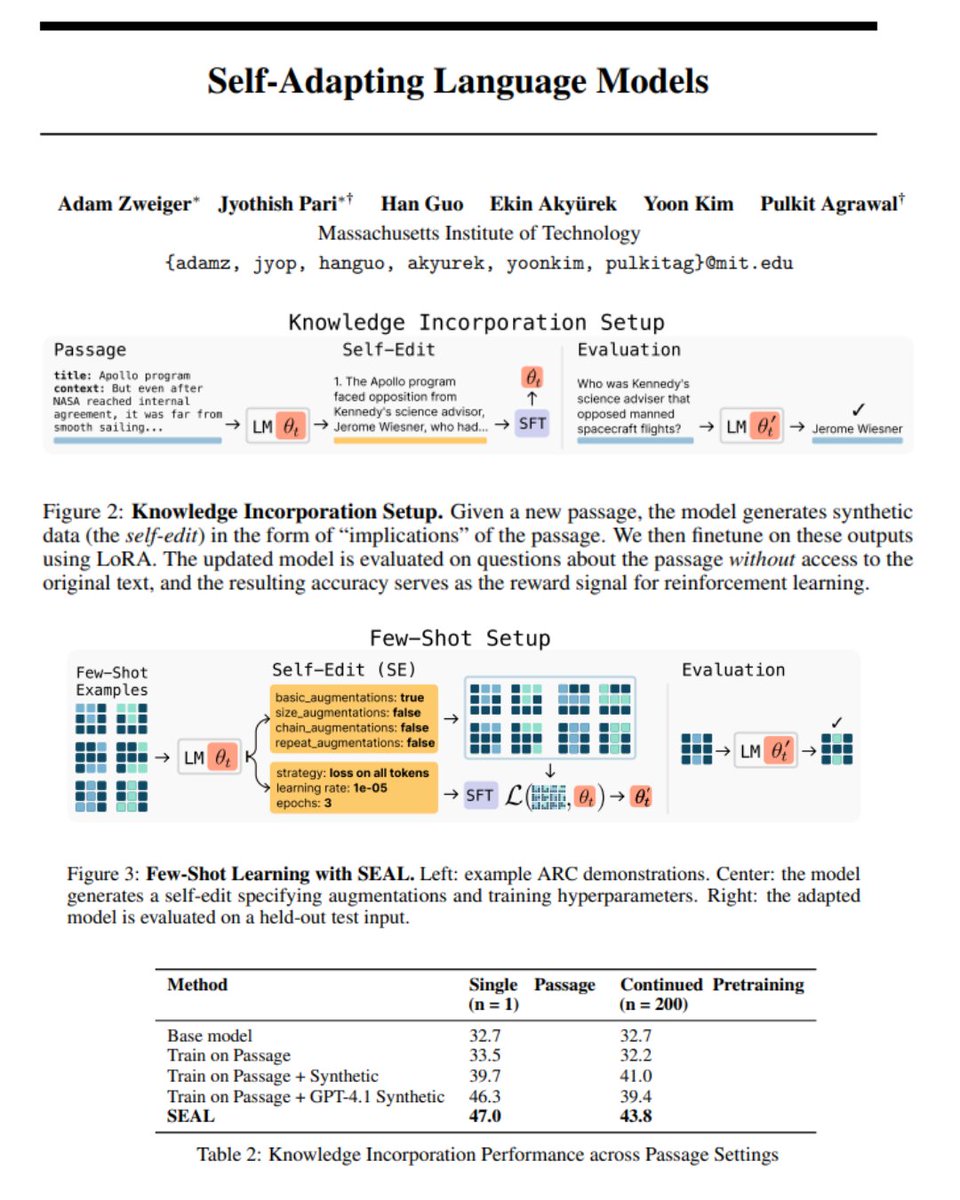
SEAL enables a model to self-edit to decide how it should update its weights when it encounters new information. Instead of waiting for humans to craft training data, the model creates its own synthetic examples and even defines how to optimize on them. A reinforcement-learning loop evaluates whether these edits actually improve downstream task performance, forming a cycle of self-directed adaptation.
In experiments, SEAL integrates new factual knowledge and performs few-shot reasoning far better than traditional methods—sometimes even outperforming GPT-4.1–generated data on knowledge incorporation tasks. In one case, accuracy on a no-context QA benchmark rose from 33.5% to 47% after the model trained on its own generated data.
Why it matters: as AI systems hit the “data wall,” genuine progress will hinge on models that can learn how to learn—autonomously, efficiently, and continuously. SEAL is an early but promising glimpse of that future: LLMs that evolve through self-reflection and self-directed training, not just bigger datasets.
#AIResearch #MachineLearning #LLM #SelfImprovingAI #ReinforcementLearning #MetaLearning #AdaptiveAI #MITResearch #AgenticAI #FutureOfAI #SyntheticData #SelfLearningModels #AIInnovation
2
6
27
2,661