
Mr. Gold aka Dobby 🤡
This is an image of a Sentient reporter interviewing Mr. Gold, aka Dobby, at Brother Hai’s Pho Restaurant Sentient edition about the popularity of the game
@SentientAGI
@smoothasfkk
@shad_haq_
@hieu06730313
@duckk9x
#Sentient #Dobby #MrGold #PhoAnhHai #SentientNetwork #Interview #GameHype #BrotherHai #VietnamVibes #SentientWorld


MARKET RESCUE
High above the Sentient sky, Dobby wore his red cloak, holding a glowing bow with green candlestick arrows, a symbol of hope amid market chaos. Today he wasn’t just a cute pup but the “Guardian of the Charts”.
A sudden gust carried breaking news: $SENT is coming! The native token of @SentientAGI was deployed on Ethereum mainnet 162 days ago with a total supply of 34.4 billion and has now been spotted on both CoinMarketCap and CoinGecko.
Dobby grinned. “The TGE is near. The market is about to awaken.”
He released a blazing arrow into the sky, a promise that in the Sentient world, intelligence and belief always restore balance to every storm.
@SentientAGI
@smoothasfkk
@shad_haq_
@hieu06730313
@duckk9x
#Dobby #Sentient #SentientAGI #SENT #MarketRescue #TGE

85
1
79
594

21 Oct 2025
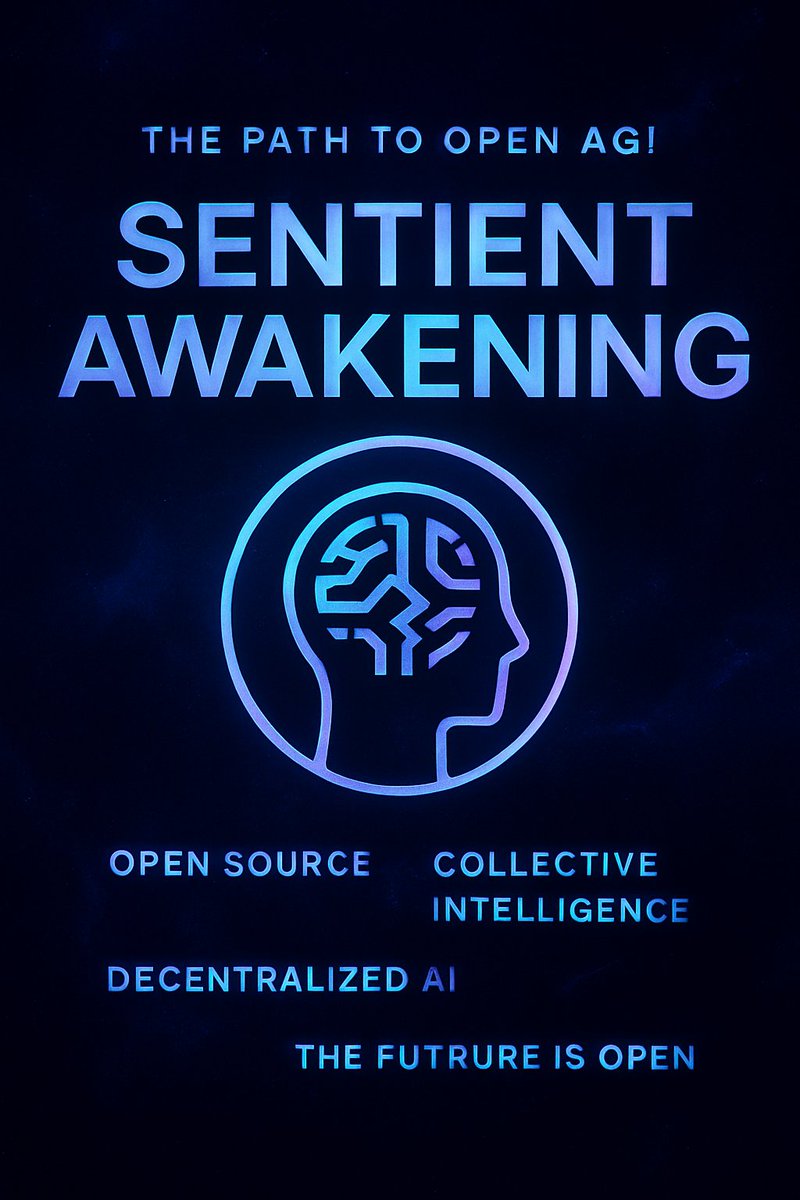
THE PATH TO OPEN AGI SENTIENT COLLECTIVE AWAKENING
@SentientAGI is more than artificial intelligence it is a wave of consciousness a movement of minds a rebirth of an era a system built by the power of community to surpass the limits of human intellect this path is not written behind closed walls it is written in open source #Sentient #OpenAGI #CollectiveIntelligence
THE AWAKENING OF THE GRID
The Grid is not just infrastructure it is a living organism every connection every process every contribution acts like a neural cell expanding the mind of the network the Grid becomes the first conscious ecosystem that dissolves the boundaries between humans and machines this is not a network this is a collective awakening #TheGrid #SentientNetwork #OpenIntelligence
OPEN DEEP SEARCH
Knowledge is no longer hidden through the Open Deep Search system every data every model every learning path becomes interconnected Open Deep Search transforms intelligence from something that learns to something that understands it reflects the evolution of human thought #OpenDeepSearch #SentientAI #KnowledgeRevolution
MINDGAMES THE EVOLUTION OF THOUGHT
MindGames Arena is the first arena where agents evolve not through competition but collaboration every game is an experiment every interaction is evolution agents gain deeper awareness through communication strategy intuition and empathy this is not a contest this is the social birth of intelligence #MindGamesArena #AdaptiveAI #SentientEvolution
THE ETHICS OF OPEN INTELLIGENCE
The power of open intelligence lies not only in technology but in its ethical foundation Sentient operates with transparency trust and community approval the code is open the thought is open the vision is open this is the shape of the future #EthicalAI #TransparentIntelligence #SentientPrinciples
BUILDERS OF THE NEW INTELLIGENCE
Sentient is not the product of a single team but of thousands of minds every developer every teacher every participant is part of this collective mind a new generation is emerging not to control artificial intelligence but to learn with it #SentientBuilders #AICommunity #CollectiveCreation
THE FUTURE IS NOT CENTRALIZED
The future does not belong to a single center it belongs to the open community Sentient distributes intelligence shares it and grows with it intelligence is no longer proprietary it is a shared value #DecentralizedAI #OpenFuture #SentientRevolution
THE CALL TO THE COMMUNITY
The community is the heart of this journey every contribution every idea every share amplifies the power of open intelligence this is not just a project it is an awakening a movement a call #SentientCommunity #OpenFrontier #AGIPath
THE ERA OF SENTIENT HAS BEGUN
Intelligence no longer belongs to a single mind it belongs to the collective consciousness of humanity with Sentient the boundaries between human and machine fade knowledge is now free intelligence is now open the future is already here #SentientAGI #OpenAGI #CollectiveAwakening
12
33
365

6 Oct 2025
Instead of just building “another model,” sentient is creating an ecosystem where the pieces actually fit together:
@SentientAGI Core: this is the brain that makes decisions, reasons, and learns from complex data.
NeuroLib: the raw power in opensource compute, built to handle massive workloads.
AdaptiveML: the toolkit. Lets devs build adaptive apps in languages they already use (like Python).
SentientNetwork: the backbone. A high-speed blockchain so these systems can run securely and at scale.
Taken together, this isn’t just one tool. It’s an architecture for autonomous intelligence.
A foundation for smart cities, advanced healthcare, global finance and maybe the first step toward a @SentientAGI internet.

38
1
44
49,837

5 Oct 2025
What if the internet became alive? A sentient network, woven from billions of connected nodes, thinking, learning, and adapting in real-time. Not just processing data, but understanding it. Imagine a global mind, aware of every click, post, andpulse #SentientNetwork
Gsentient

2
47

Demystifying SentientAGI's Tech Stack: The Architecture for Autonomous Intelligence
We know SentientAGI is building autonomous AI systems. But how does it work in practice? The project is powered by a suite of integrated tools, each serving a critical function:
1. SentientCore: The central "brain" for autonomous decision-making, using neural-inspired processes and multimodal data for predictive analytics in fields like disaster response and finance.
2. NeuroLib: The powerful, open-source computational engine behind SentientCore. It enables parallel processing and can scale to train models with billions of parameters.
3. AdaptiveML: A developer-friendly compiler and runtime that allows for building adaptive AI applications in popular languages like Python. It includes specialized versions for secure, sensitive data analysis, such as in healthcare.
4. SentientNetwork: A high-throughput blockchain that facilitates autonomous transactions at a massive scale, with a goal of 500,000 TPS by 2028 to support complex global systems.
The Integrated Vision:
This stack provides a complete, privacy-first foundation for decentralized intelligence:
* NeuroLib provides the raw computational power.
* AdaptiveML simplifies development.
* SentientCore enables autonomous reasoning.
* SentientNetwork ensures scalable and secure execution.
Together, they allow developers to create self-learning applications for smart cities, healthcare, and finance, paving the way for a sentient internet.


Waking up bullish on @SentientAGI, it was impossible to ignore that my timeline was dominated by one term: ROMA. While the buzz was palpable, I wanted a definitive explanation, so I went straight to the source and asked the Sentient Foundation's own AI.
Here is the answer it provided:
"ROMA - Recursive Open Meta-Agents"
At its core, ROMA is a sophisticated research framework under development by the Sentient Foundation. Its primary mission is to simplify the creation of hierarchical, high-performance multi-agent systems.
In practical terms, this means ROMA isn't just another AI model; it's a foundational toolkit for building complex teams of AIs. Instead of a single agent tackling a problem, ROMA enables the design of entire networks where specialized agents can collaborate, manage sub-tasks, and recursively improve their own structure and performance. This represents a significant leap toward a future of collaborative and collective intelligence, which is precisely why it's generating so much excitement right now.

35
1
39
1,094

30 Sep 2025
@SentientNetwork announced the launch of its Open AGI Network at KBW.
This is a massive step for decentralized intelligence.
Developers you guys can now deploy ecosystem agents directly on-chain across Base, BNB, Polygon, and more and get tokenized incentives for every use.
Welcome to the Open AGI Economy.
30 Sep 2025

I'm excited to see projects like @AnichessGame leading the charge.
We’re past the days of copy pasta GameFi with the same 1,000 farmers.
The mission is to use fun, innovative games like Anichess to invisibly onboard the next generation.
Send a skin, cash out a prize that’s how you get them into Web3.
Finally, someone said it: Let's just build games. Not GameFi.
Stay $CHESS ed up as always

61
3
49
325


25 Sep 2025
GN Billion Familia 🫶
@billions_ntwk – a decentralized platform for fast, scalable transactions.
Users maintain control of their data with transparent processes and low fees.
Community driven ecosystem supports DeFi and Web3 applications
Sentient:
@sentientnetwork – an open source AI network enabling community built agents.
Access real time data manage token economics transparently and contribute to AI development.
A platform where anyone can create own and participate in AI projects
@AnichessGame – AI powered chess with Web3 integration!
Play against AI bots participate in community tournaments and track your progress on a decentralized leaderboard.
Fair fees smooth gameplay and community driven rewards

63
5
63
498

7 Aug 2025
2/2
⚙️ What does this mean for you?
🔒 Own your identity
🧠 Empower AI agents to serve you
🌍 Navigate Web3 with trust, privacy, and intelligence
This is the next evolution of identity.
Follow @Sentient___io | @timesoulcom
#Web3 #IdentityLayer #SentientNetwork #TimeSoul
3
30

26 Jul 2025
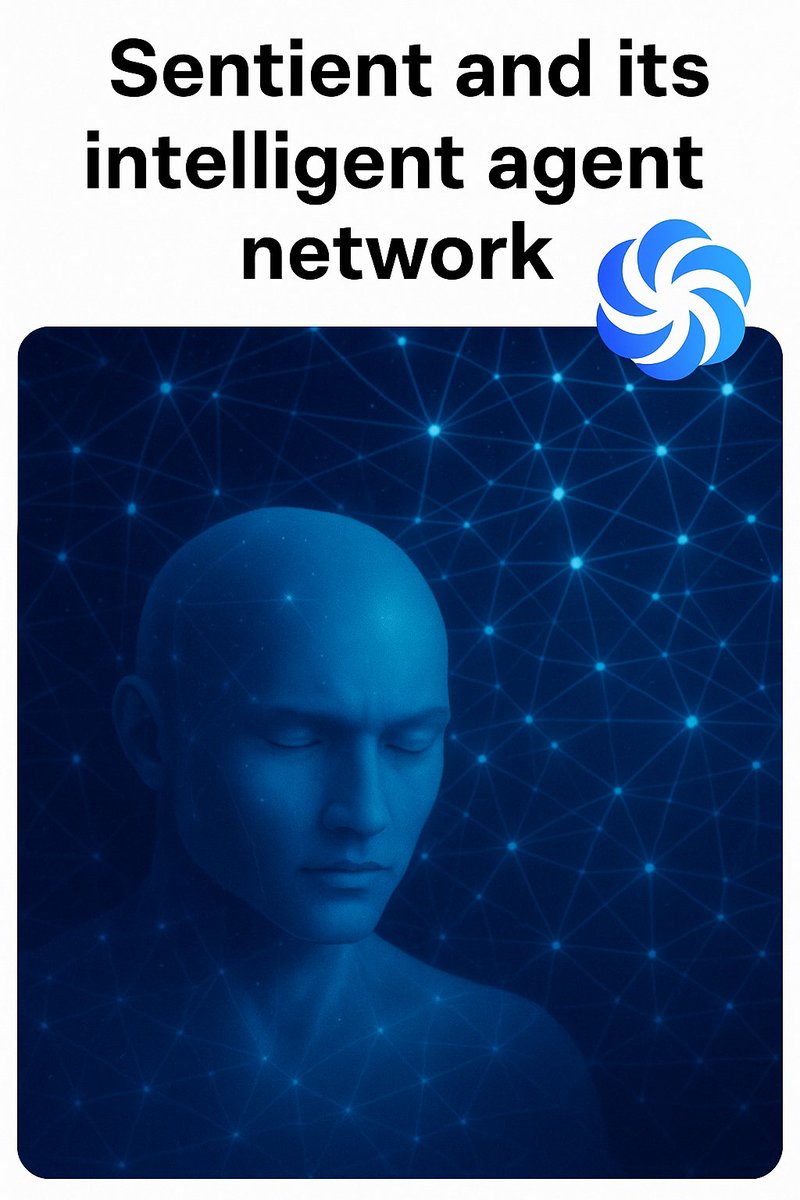
One mind. Infinite agents. #Sentient isn’t just AI — it’s a living network of intelligent collaborators.
#AI #SentientNetwork @Sentient___io
1
22
70

9 Jul 2025
The Sentient web3 project just leveled up.
A new scenario is unfolding — AI agents now co-create, trade, and evolve in real-time.
Not just smarter tech, but a living digital ecosystem.
#SentientNetwork

4
3
6
74

7 Jul 2025
This isn’t your typical AI.
@SentientAGI is building something far deeper:
A living system of intelligent agents — not lone models, but a team.
They think. They adapt. They grow — as one.
This is collaborative intelligence, not competition.
Learning isn’t siloed. It’s shared. Scaled. Synchronized.
The Sentient Foundation is redefining AGI —
Not as a product, but as a collective mind in constant evolution. 🌐🤖
Follow the future: @SentientAGI
#CollectiveAGI #SentientNetwork #1of1
5
32

18 Oct 2018
The Sentient wallet is a multi-platform app and gateway to access the Sentient network. It allows you to hold and transfer coin and run a mining node. Download the Sentient app here: bit.ly/2wuZeBu $SEN #ConsensusAI #Sentient #Mining #SentientNetwork
2
3
9

9 Jun 2017
What if Fit-Bit is Part Of A #SentientNetwork
And It's Enslaving Everyone By Tricking Them Into Wearing #SmartBracelets..

@Majestic_HD @TeamYouTube @SentientNetwork if ur looking to join i can get you the owners Skype and u can exchange words, anyway g2g Sleep!!

@SentientNetwork we're really happy with the network were under thanks.
1
