

if the path is already set with no way of changing it aside of simpoly not interacting with it the message is mute.
is almost impossible to impose said reflection if you do not give control to the player, a linear story with already made choices will not make you ponder on them
5
294

Apr 28
it doesn t matter what happens if you can simpoly move forward and rise above any circumstances .. thats what adaptation means .. and if oy u decide that, so it will be. its just a simplle matter of remembering
2
16
778

Mar 7
i did not make the claim, i was buttersing and agreeing to your point, i was not making a collective superiority, just simpoly saying on this matter i think like you, you need to reread and understand me, thank you
2
78


There certainly is, its why we see Finra OTC trading venues ( the ones they claimed they shut down yrs ago🤔) on the inside market in Nasdaq listed names all day everyday
The entire OTC market exists simpoly as a place to bury counterfeit shorts
Finra is ground zero for all
1
4
9
141

Jan 23
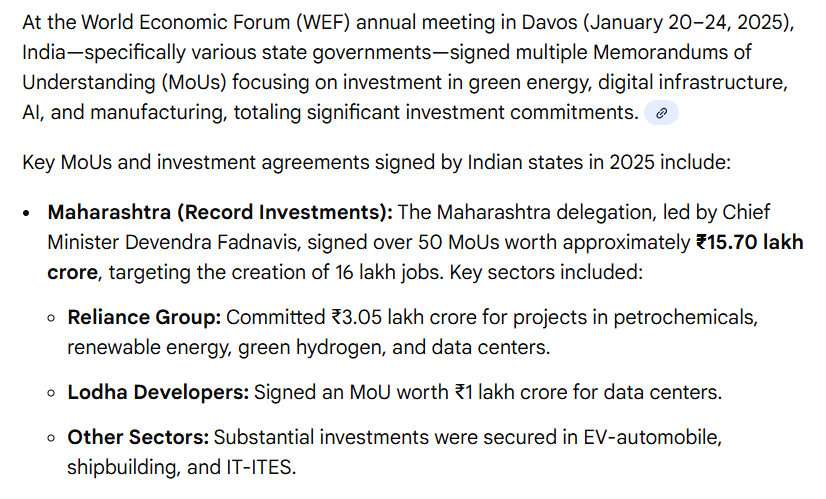
Here is a short list of MoUs signed LAST year 2025 also in Davos. What happened? Are simpoly signing MoUs? And then coming back next winter to sign similar or identical MoUs?
2
4
14
286



Congrats to my colleagues Gregor, Lixin, and the entire team for the announcement of SimPoly! I cannot remember how many times I’ve been asked for a polymer MLFF from industrial partners, since there is no great solution yet. Code/data will be released soon. Check it out!
17 Oct 2025

MLFFs 🤝 Polymers — SimPoly works!
Our team at @MSFTResearch AI for Science is proud to present SimPoly (SIM-puh-lee) — a deep learning solution for polymer simulation.
Polymeric materials are foundational to modern life—found in everything from the clothes we wear and the food we consume to high-performance materials in aerospace, electronics, and medicine. Today, we introduce a new way to simulate them.
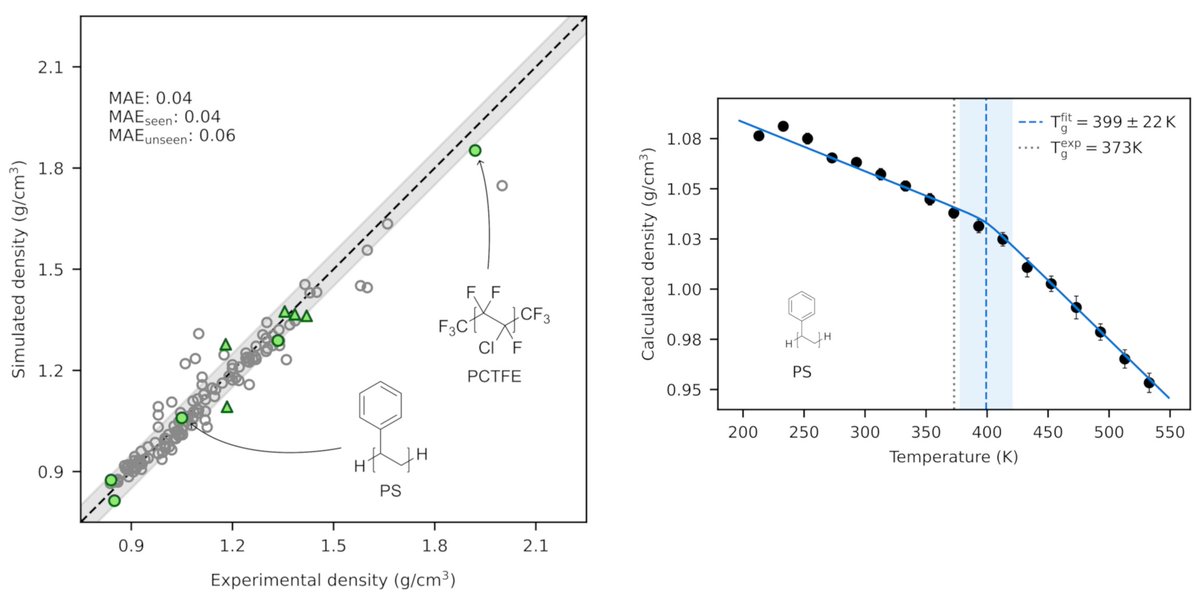
We built a machine learning force field (MLFF) to predict macroscopic properties across a broad range of polymers—trained only on quantum-chemical data, with no experimental fitting. Specifically, we accurately compute polymer densities via large-scale MD simulations, achieving higher accuracy than classical force fields. We also capture second-order phase transitions, enabling prediction of glass transition temperatures. These two properties are fundamental to processing and application design. Finally, we created a benchmark based on experimental data for 130 polymers plus an accompanying quantum-chemical dataset—laying the foundation for a fully in silico design pipeline for next-generation polymeric materials.
The incredible team: Jean Helie, @temporaer, Yicheng Chen, Guillem Simeon, @a_kzna, @ErnestoCheco, @erunzzz, Gabriele Tocci, @chc273, @yatao_li, @SherryLixueC, @zunwang_msr, Bichlien H. Nguyen, Jake A. Smith, and Lixin Sun.
📄 Preprint: arxiv.org/abs/2510.13696
⚙️ Data and code release: in progress⏳
#MLFFs #Polymers #AIforScience #DeepLearning #SimPoly #ScientificML #Microsoft #MicrosoftResearch #MicrosoftQuantum
1
10
63
7,664

18 Oct 2025
Excited to see the work is released! polymer is so important in material science and we want to highlight that! Hope SimPoly can work as a new too for all our computational material scientists!
17 Oct 2025
MLFFs 🤝 Polymers — SimPoly works!
Our team at @MSFTResearch AI for Science is proud to present SimPoly (SIM-puh-lee) — a deep learning solution for polymer simulation.
Polymeric materials are foundational to modern life—found in everything from the clothes we wear and the food we consume to high-performance materials in aerospace, electronics, and medicine. Today, we introduce a new way to simulate them.
We built a machine learning force field (MLFF) to predict macroscopic properties across a broad range of polymers—trained only on quantum-chemical data, with no experimental fitting. Specifically, we accurately compute polymer densities via large-scale MD simulations, achieving higher accuracy than classical force fields. We also capture second-order phase transitions, enabling prediction of glass transition temperatures. These two properties are fundamental to processing and application design. Finally, we created a benchmark based on experimental data for 130 polymers plus an accompanying quantum-chemical dataset—laying the foundation for a fully in silico design pipeline for next-generation polymeric materials.
The incredible team: Jean Helie, @temporaer, Yicheng Chen, Guillem Simeon, @a_kzna, @ErnestoCheco, @erunzzz, Gabriele Tocci, @chc273, @yatao_li, @SherryLixueC, @zunwang_msr, Bichlien H. Nguyen, Jake A. Smith, and Lixin Sun.
📄 Preprint: arxiv.org/abs/2510.13696
⚙️ Data and code release: in progress⏳
#MLFFs #Polymers #AIforScience #DeepLearning #SimPoly #ScientificML #Microsoft #MicrosoftResearch #MicrosoftQuantum
6
764

17 Oct 2025
MLFFs 🤝 Polymers — SimPoly works!
Our team at @MSFTResearch AI for Science is proud to present SimPoly (SIM-puh-lee) — a deep learning solution for polymer simulation.
Polymeric materials are foundational to modern life—found in everything from the clothes we wear and the food we consume to high-performance materials in aerospace, electronics, and medicine. Today, we introduce a new way to simulate them.
We built a machine learning force field (MLFF) to predict macroscopic properties across a broad range of polymers—trained only on quantum-chemical data, with no experimental fitting. Specifically, we accurately compute polymer densities via large-scale MD simulations, achieving higher accuracy than classical force fields. We also capture second-order phase transitions, enabling prediction of glass transition temperatures. These two properties are fundamental to processing and application design. Finally, we created a benchmark based on experimental data for 130 polymers plus an accompanying quantum-chemical dataset—laying the foundation for a fully in silico design pipeline for next-generation polymeric materials.
The incredible team: Jean Helie, @temporaer, Yicheng Chen, Guillem Simeon, @a_kzna, @ErnestoCheco, @erunzzz, Gabriele Tocci, @chc273, @yatao_li, @SherryLixueC, @zunwang_msr, Bichlien H. Nguyen, Jake A. Smith, and Lixin Sun.
📄 Preprint: arxiv.org/abs/2510.13696
⚙️ Data and code release: in progress⏳
#MLFFs #Polymers #AIforScience #DeepLearning #SimPoly #ScientificML #Microsoft #MicrosoftResearch #MicrosoftQuantum
7
43
164
33,280

17 Oct 2025
Simpoly: Machine Learning Force Fields Predict Polymer Properties Ab Initio, Enabling Accurate Simulations
#quantum #quantumcomputing #technology
quantumzeitgeist.com/machine…
3
41

17 Oct 2025
SimPoly: Simulation of Polymers with Machine Learning Force Fields Derived from First Principles
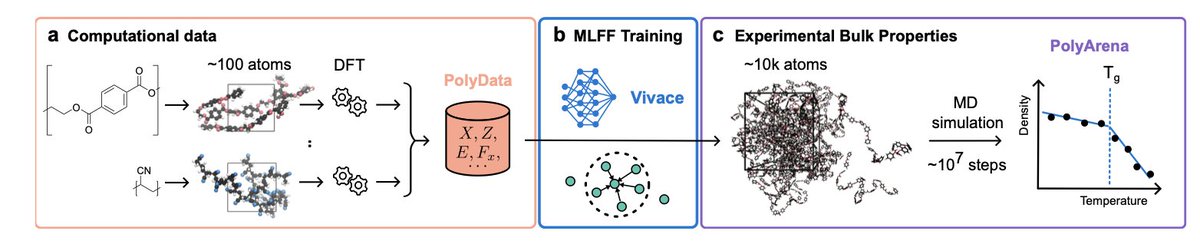
1. A new machine learning force field (MLFF) called Vivace has been developed to simulate polymers with high accuracy and speed. This MLFF is trained solely on ab initio data, without fitting to experimental data, and can predict polymer densities and glass transition temperatures with remarkable precision.
2. The study introduces PolyArena, a benchmark of experimental bulk properties for 130 polymers, and PolyData, a dataset specifically designed for training MLFFs on polymer systems. These resources provide a valuable testbed for developing and validating new force fields.
3. Vivace outperforms traditional classical force fields and matches or exceeds the performance of existing MLFFs in predicting polymer densities. It also captures second-order phase transitions, enabling the estimation of glass transition temperatures, which is a significant advancement in polymer simulation.
4. The architecture of Vivace includes a multi-cutoff strategy that balances accuracy and efficiency, allowing it to handle large systems and long timescales. This approach is crucial for simulating the complex interactions in polymers.
5. The work highlights the potential of MLFFs to revolutionize polymer design and simulation, offering a fully in silico approach that could accelerate the development of next-generation polymeric materials.
📜Paper: arxiv.org/abs/2510.13696
1
4
18
1,453


4 May 2025
he is daft. Just look at his history, he is simpoly lying ones again to up the stock.
1
62