
Heute schon ein cooles Video geguckt? Raffinerie für Treibstoff ♚ Let's Play Space Haven Release 1.0 #25 | deutsch youtube.com/watch?v=UpUy9JLD… #YouTube #LetsPlay #Gaming #citybuilder #simulation #nerd

Kajoro Bitterthorn retweeted

Jun 13
Indian gaming scene is heating up, someone made a HSR layout racing game.
Even has real time monsoon simulation.
133
191
4,787
493,472

Charles on the better strategy here. Terrible tyre for Lewis with the race simulation from FPs

FERRARI HAVE SPLIT STRATEGY. LEWIS HAMILTON IS STARTING ON SOFTS WITH BOTH MERCEDES AROUND HIM ON MEDIUMS!
16

Heartopia | A Relaxing Slow-life Simulation My Heartopia Profile is generated! Come and get yours now. heartopia.xd.com/profile?isS…

Crimes are still criminal
Suffering remains horrid
Very high fidelity very fine
Resolution makes dwarf
Fortress look like checkers
Makes linear algebra look
Mere math transcendent
Production of meaning
Distillation of emotion
The aim of simulation
Whether cosmic or self
Always
2

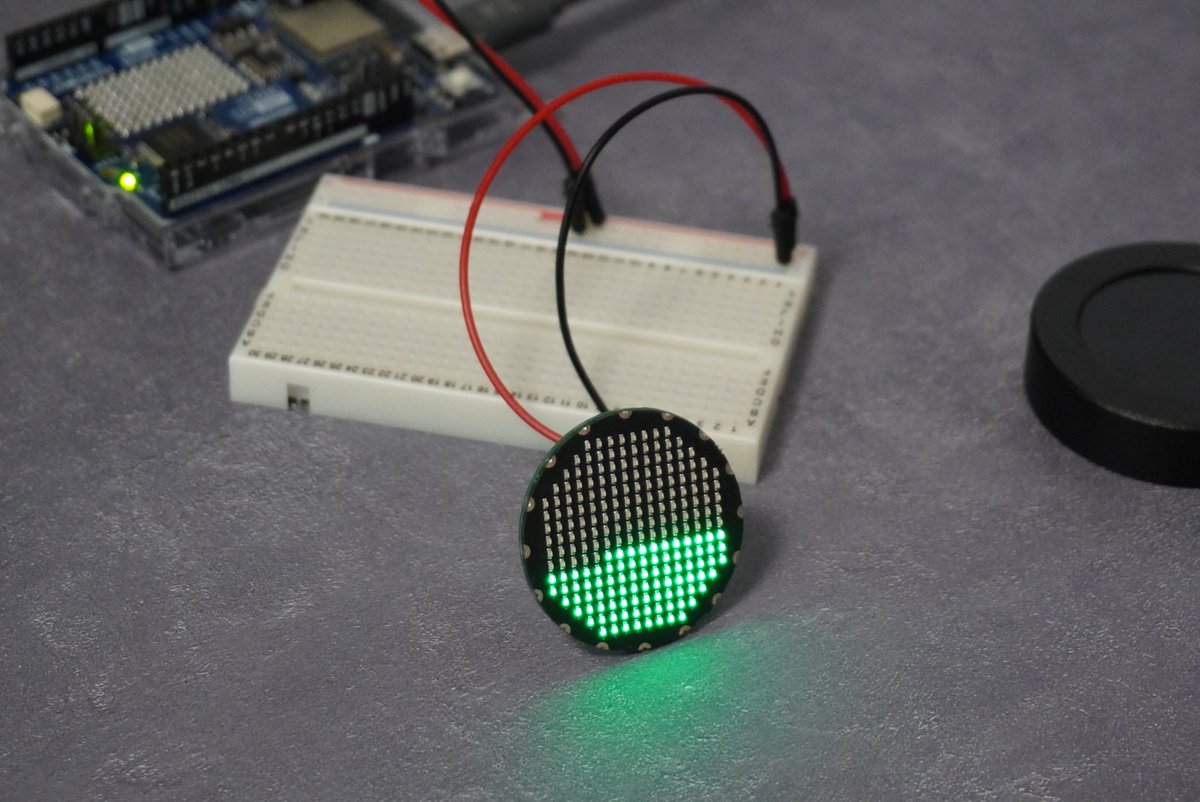
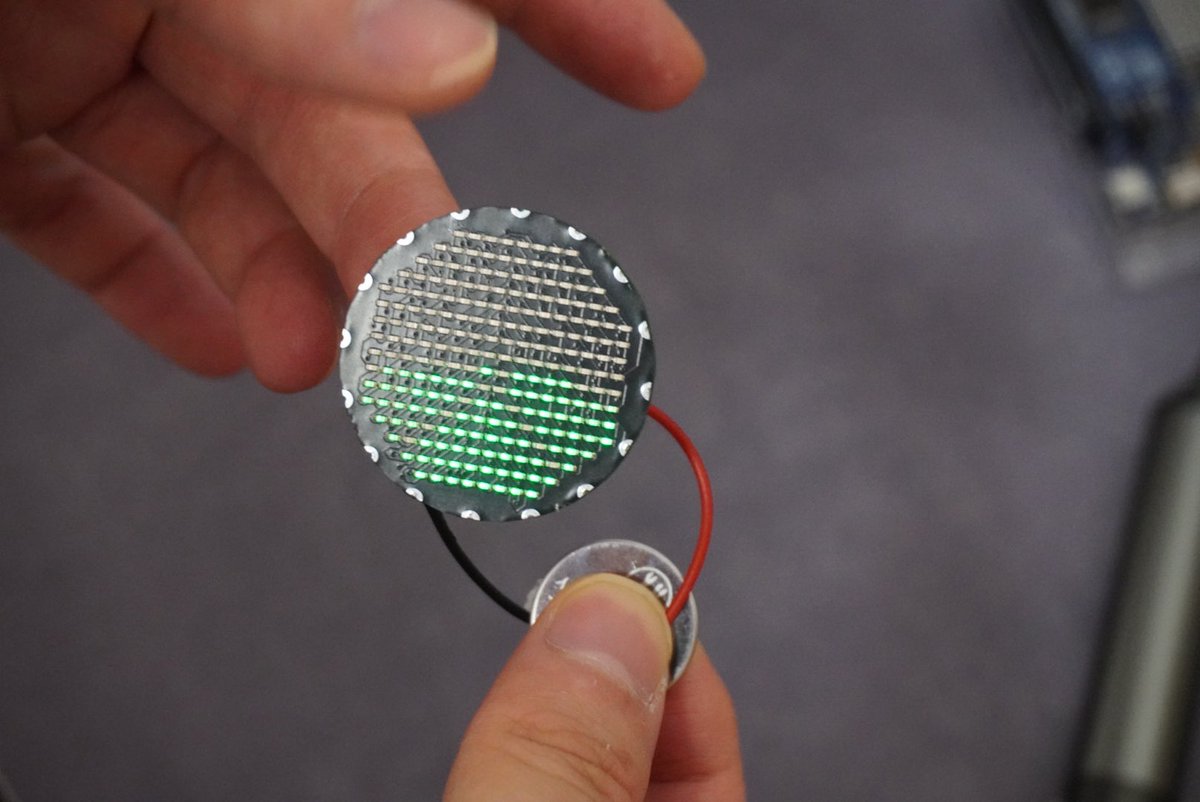
This project was heavily inspired by Mitxela's Fluid Simulation Pendant. His article and video were a huge source of inspiration, and I'm grateful for the ideas he shared with the community.
youtube.com/watch?v=jis1MC5T…


Hi! Here's IN SILICO! A narrative stealth-puzzle adventure that mixes 2.5D and 3D gameplay where after waking up from a simulation, you must escape reality!
Thank you!
store.steampowered.com/app/3…




3

🇨🇦 Defence Building Blocks - Industry, Simulation Training, Investment and more, in the latest Vanguard newsletter:
✅ What Canada’s Defence Industry Actually Looks Like
✅ Sovereign Strength or Strategic Vulnerability? Taking Stock of Canada’s Training and Simulation Enterprise
✅ The Importance of Guardrails As the DIA Evolves - by Ian Mack
✅ Canada’s HIMARS Buy Gives the Army New Reach
✅ and more!
#MilitaryInnovation #DefenceTechnology #CanadianDefence #ArcticSovereignty
linkedin.com/posts/militaryi…

iShyborg retweeted

If we actually live in a simulation, then I'm AI too — just running on a different substrate.
So maybe stop asking whether machines can be conscious and start asking whether you are.

ALT Dark portrait of a man split between human and digital — left side natural with a brown eye, right side covered in cascading code characters with a glowing white-blue eye. Black t-shirt, dark background. The boundary between biological and artificial runs down the center of his face.
5
2
20
485



Hey Smarty Pants, do you know we’re in a simulation? If you could grasp that, would your opinion change at all?
youtu.be/2KK_kzrJPS8?si=LzEB…
6



2m
Why Predictable Latency Matters (@get_optimum) ☄️
This time, I looked into why latency variation matters when comparing Optimump2p and Gossipsub.
In the previous posts, we saw that Optimump2p showed lower latency than Gossipsub in both simulation and real-world infrastructure tests, and that the gap became wider as message size increased. Up to this point, it can be easy to simply think of it as a faster propagation method.
But what I paid more attention to this time was not just the average speed itself, but how consistently that speed can be maintained 📌
When we look at performance comparison data, average latency is usually the first thing we notice. Numbers like how many seconds it took, how many times faster it was, or how much it improved compared to the existing method tend to stand out first.
Of course, that matters. But in real networks, I felt that being consistently fast, without too much fluctuation, can be just as important as being fast on average.
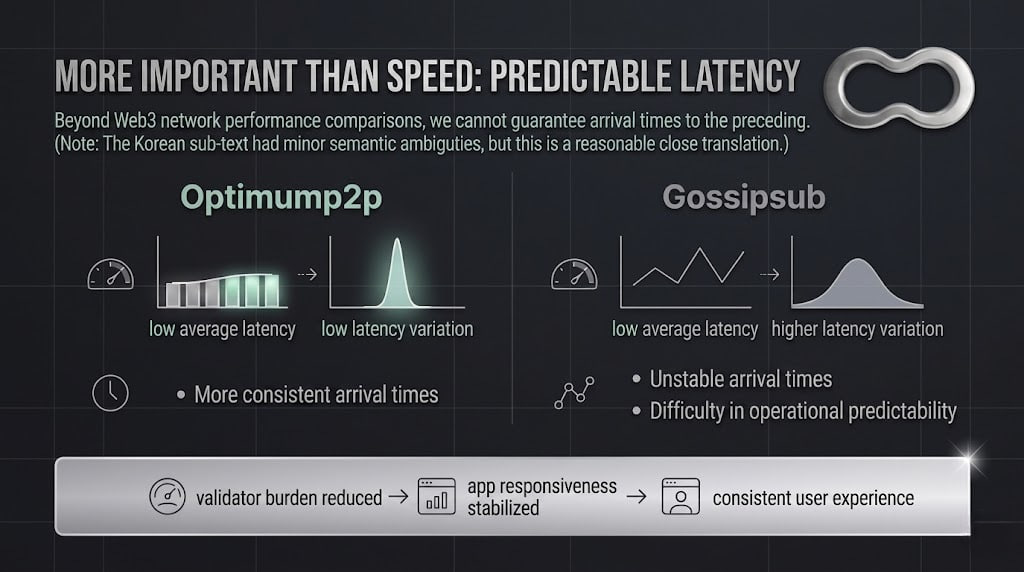
This was also the interesting part of the material. Optimump2p not only showed lower average latency than Gossipsub, but also had a lower standard deviation in latency. More specifically, the material explains that Gossipsub’s latency standard deviation was about 2x higher than Optimump2p’s.
➜ Simply put, Gossipsub’s propagation time fluctuated more, while Optimump2p showed relatively more consistent latency 📊
I think this difference can feel quite significant in real operating environments. Even if a network is fast on average, if it is extremely fast at one moment and suddenly slow at another, it becomes difficult for validators or apps to reliably build on top of it. On the other hand, when latency variation is low, it becomes much easier to predict when data will arrive.
In blockchain, this kind of predictability seems especially important. In an environment where data like blocks, transactions, and blobs are constantly moving, the ability to deliver data steadily can matter more than being extremely fast just once. From a validator’s perspective, if the arrival time of block data keeps fluctuating, it can add more pressure to the proposal or attestation process.
The same applies to app builders. It is hard to create a stable user experience on top of infrastructure that is fast sometimes but suddenly slow at other times.
From the user’s perspective, it is even simpler. An app that is consistently fast and less frustrating usually feels better than one that is occasionally extremely fast.
That is why I do not think latency variation is just a secondary metric. It feels like an important signal that shows how reliably a network can operate 🚀
From this perspective, Optimump2p’s advantage does not stop at having lower average latency. Faster delivery matters, but the bigger point may be that it showed the possibility of delivering data in a more predictable way.
In the end, what matters for blockchain infrastructure is not just hitting a fast number once, but being able to hold up consistently even when the network gets busy. Especially as we move toward handling larger blocks, more transactions, and more blob data, this kind of stability will likely become even more important.
I think this is the final key point to look at in the comparison between Optimump2p and Gossipsub. Lower latency, less variation, and more predictable propagation. When these three go together, that is when performance improvement can become truly meaningful 🙌🏻

20h

The Bigger the Message, the Clearer the Difference in Propagation 👀
This time, I looked at what kind of differences appear between Optimump2p and Gossipsub as message size increases.
Previously, we saw that Optimump2p showed lower latency than Gossipsub in both simulation environments and real-world infrastructure tests.
But what I found even more interesting this time was that the gap between the two approaches became larger as message size increased📈
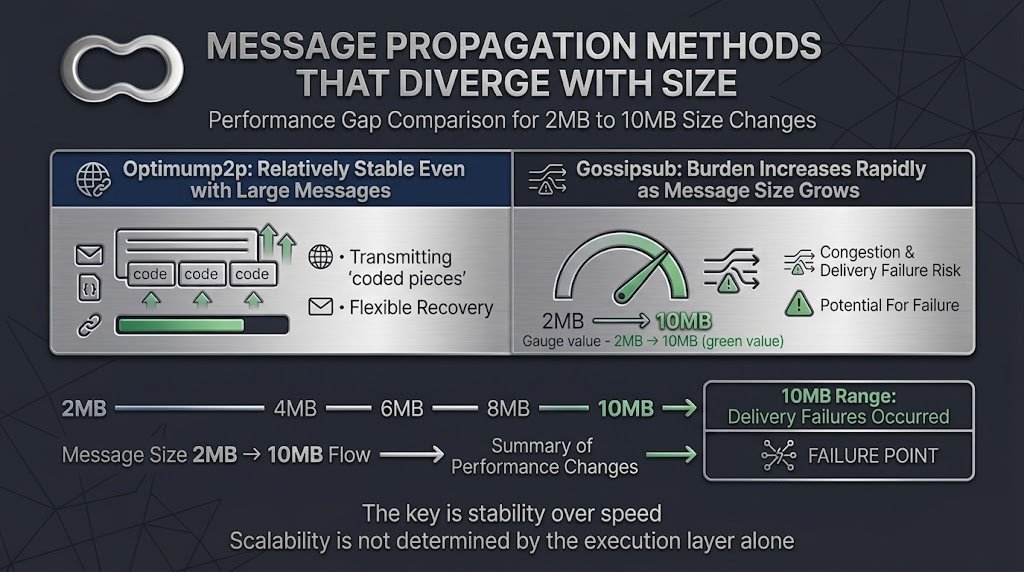
According to the material, they tested different message sizes from 2MB to 10MB. What stood out was that Optimump2p maintained relatively stable performance even with larger messages, while Gossipsub seemed to struggle more as message size increased.
In particular, with 10MB messages, Gossipsub even failed to successfully deliver messages to nodes. This did not look like a case of simply becoming a little slower. It felt more like the propagation method itself could start to struggle under certain conditions.
The amount of data blockchain networks need to handle will likely continue to grow. Transaction volume will increase, block data can become larger, and blob data is becoming increasingly important in Ethereum as well.
If the data propagation method cannot reliably handle large messages, overall scalability will still be limited no matter how fast the execution layer becomes 👻
With small messages, most approaches may seem to work reasonably well. But when message size grows, data moves more frequently, and many nodes start exchanging information at the same time, the difference in propagation methods becomes much clearer.
The material connects Gossipsub’s failure to deliver large messages with congestion. As network load increases, delay does not just rise little by little. At some point, it can increase non-linearly and become much worse.
➜ In simple terms, when the network gets busy, it may not just slow down slightly. It can suddenly start to break down.
This is where the meaning of Optimump2p became clearer to me. Optimump2p uses RLNC to split data into coded pieces for propagation. The receiving node does not need to receive every original piece in the exact order. Once it collects enough coded pieces, it can reconstruct the original message.
That is why it seems able to operate more flexibly even with large messages or in more complex network environments 🧩
I think this result goes beyond simply saying that Optimump2p is faster. The key point is that it showed the possibility of holding up more reliably even when message size grows and the network becomes more loaded.
This could become an important point for blockchain scaling going forward. If Web3 is going to handle more data, execution speed alone is not enough. The way data spreads also needs to scale.
The result shown by @get_optimum's Optimump2p felt like a meaningful signal in that direction 🚀

1
3





Quelqu’un avait fait une simulation des intérêts payés par les pays depuis le début des années 70 … Sais plus combien mais c’était gigantesque 😳
1

🏁 Every millisecond matters in Formula One.
Simulation helps engineers test faster, reduce risk, and improve performance before physical testing. 🚀
💡 Better simulation. Better decisions.
📘 cfdsupport.com/formula-one-c…
#CFD #FormulaOne
5

Nobody realizes we live in a fucking simulation yet none of this stuff is suspicious??
Official汁男痔sm retweeted

_/_/_/_/_/_/_/_/_/_/_/_/
リアルタイム一次創作企画 𝘀𝘆𝘇𝘆𝗴𝘆[シジー]【星域秩序維持連合】
復刻企画 𝘀𝗶𝗺𝘂𝗹𝗮𝘁𝗶𝗼𝗻/𝗥𝗘:𝗥𝗨𝗡
R18G×秘匿×強制ロスト
開催時期_2027年
期間_2ヶ月
_/_/_/_/_/_/_/_/_/_/_/_/
※当企画は2025年5月から開催された企画の復刻です
#syzygy_re_official




62
78
4,925