
Jun 8
フィラデルフィア巨大クルー「Army of the Pharaohs」オリジナルメンバー(J.M.TやBahamadiaも在籍)Kamachiの傑作◎カット🔥DJ Mighty Mi プロデュース作品!
Chief Kamachi & The Juju Mob - No Chorus feat. State Store (2005)
#ChiefKamachi #JuJuMob #StateStore #DJMightyMi #今夜のアングラ
5
36
1,604

May 21
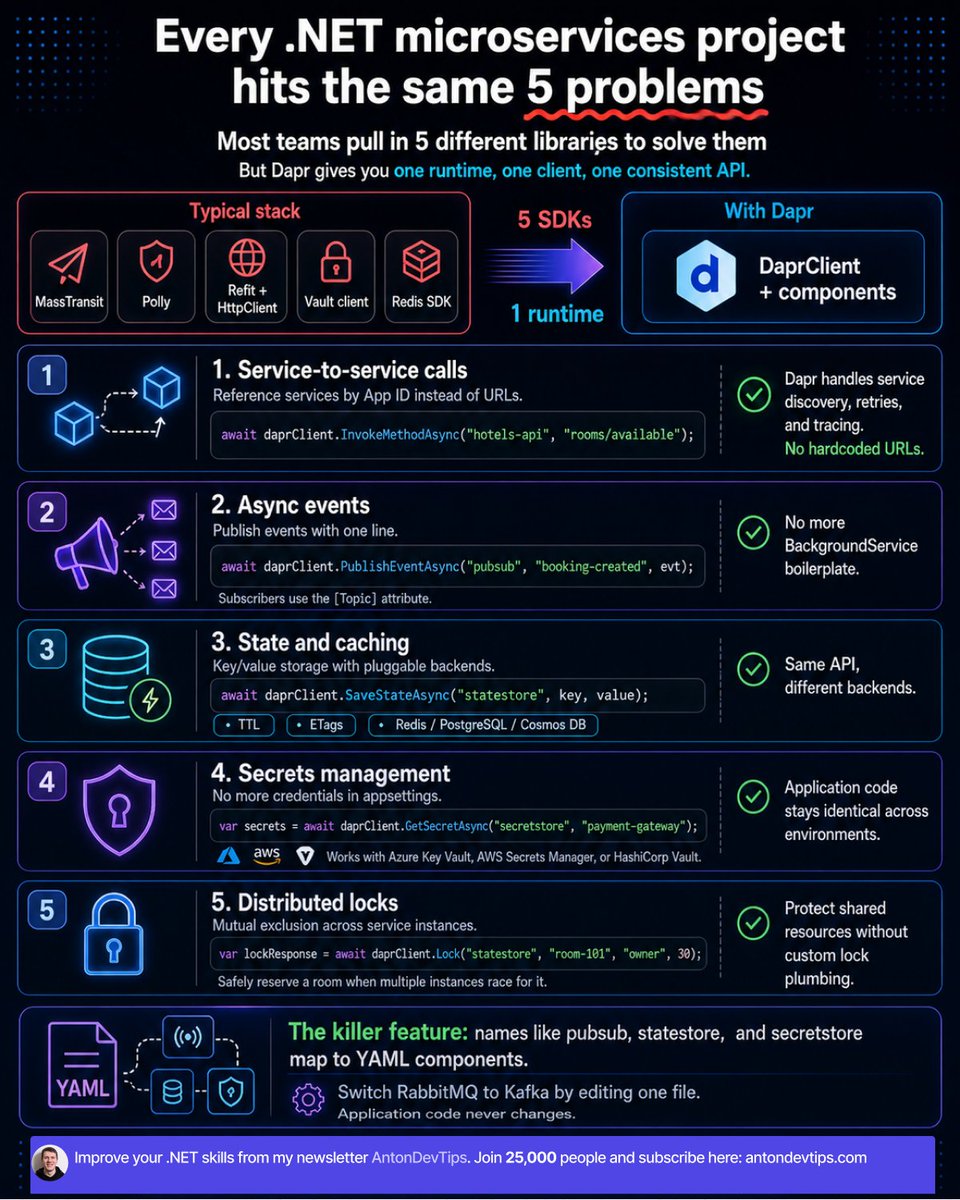
Every .NET microservices project hits the same 5 problems
Most teams pull in 5 different libraries to solve them
There is a better way.
I rebuilt a hotel booking system with 4 microservices last week.
In a typical setup I would need:
→ MassTransit for messaging
→ Polly for retries
→ Refit HttpClient for service calls
→ A Vault client for secrets
→ A Redis SDK for caching and locks
Five SDKs.
Five config styles.
Five mental models.
Instead, I used Dapr - one runtime, one client, one consistent API.
Here are the 5 problems and how Dapr solves each:
𝟭. 𝗦𝗲𝗿𝘃𝗶𝗰𝗲-𝘁𝗼-𝘀𝗲𝗿𝘃𝗶𝗰𝗲 𝗰𝗮𝗹𝗹𝘀
You reference services by App ID instead of URLs.
𝚊𝚠𝚊𝚒𝚝 𝚍𝚊𝚙𝚛𝙲𝚕𝚒𝚎𝚗𝚝.𝙸𝚗𝚟𝚘𝚔𝚎𝙼𝚎𝚝𝚑𝚘𝚍𝙰𝚜𝚢𝚗𝚌("𝚑𝚘𝚝𝚎𝚕𝚜-𝚊𝚙𝚒", "𝚛𝚘𝚘𝚖𝚜/𝚊𝚟𝚊𝚒𝚕𝚊𝚋𝚕𝚎");
Dapr handles service discovery, retries, and tracing.
No hardcoded URLs anywhere.
𝟮. 𝗔𝘀𝘆𝗻𝗰 𝗲𝘃𝗲𝗻𝘁𝘀
Publish events with one line:
𝚊𝚠𝚊𝚒𝚝 𝚍𝚊𝚙𝚛𝙲𝚕𝚒𝚎𝚗𝚝.𝙿𝚞𝚋𝚕𝚒𝚜𝚑𝙴𝚟𝚎𝚗𝚝𝙰𝚜𝚢𝚗𝚌("𝚙𝚞𝚋𝚜𝚞𝚋", "𝚋𝚘𝚘𝚔𝚒𝚗𝚐-𝚌𝚛𝚎𝚊𝚝𝚎𝚍", 𝚎𝚟𝚝);
Subscribers handle them via the [Topic] attribute.
No more BackgroundService boilerplate code.
𝟯. 𝗦𝘁𝗮𝘁𝗲 𝗮𝗻𝗱 𝗰𝗮𝗰𝗵𝗶𝗻𝗴
Key/value storage with pluggable backends:
𝚊𝚠𝚊𝚒𝚝 𝚍𝚊𝚙𝚛𝙲𝚕𝚒𝚎𝚗𝚝.𝚂𝚊𝚟𝚎𝚂𝚝𝚊𝚝𝚎𝙰𝚜𝚢𝚗𝚌("𝚜𝚝𝚊𝚝𝚎𝚜𝚝𝚘𝚛𝚎", 𝚔𝚎𝚢, 𝚟𝚊𝚕𝚞𝚎);
↳ Want TTL? Pass metadata.
↳ Want optimistic locking? Use ETags.
↳ Backend can be Redis, PostgreSQL, or Cosmos DB.
𝟰. 𝗦𝗲𝗰𝗿𝗲𝘁𝘀 𝗺𝗮𝗻𝗮𝗴𝗲𝗺𝗲𝗻𝘁
No more credentials in appsettings:
𝚟𝚊𝚛 𝚜𝚎𝚌𝚛𝚎𝚝𝚜 = 𝚊𝚠𝚊𝚒𝚝 𝚍𝚊𝚙𝚛𝙲𝚕𝚒𝚎𝚗𝚝.𝙶𝚎𝚝𝚂𝚎𝚌𝚛𝚎𝚝𝙰𝚜𝚢𝚗𝚌("𝚜𝚎𝚌𝚛𝚎𝚝𝚜𝚝𝚘𝚛𝚎", "𝚙𝚊𝚢𝚖𝚎𝚗𝚝-𝚐𝚊𝚝𝚎𝚠𝚊𝚢");
Backend can be Azure Key Vault, AWS Secrets Manager, or HashiCorp Vault.
Application code stays identical across environments.
𝟱. 𝗗𝗶𝘀𝘁𝗿𝗶𝗯𝘂𝘁𝗲𝗱 𝗹𝗼𝗰𝗸𝘀
Mutual exclusion across service instances:
𝚟𝚊𝚛 𝚕𝚘𝚌𝚔𝚁𝚎𝚜𝚙𝚘𝚗𝚜𝚎 = 𝚊𝚠𝚊𝚒𝚝 𝚍𝚊𝚙𝚛𝙲𝚕𝚒𝚎𝚗𝚝.𝙻𝚘𝚌𝚔("𝚜𝚝𝚊𝚝𝚎𝚜𝚝𝚘𝚛𝚎", "𝚛𝚘𝚘𝚖-𝟷𝟶𝟷", "𝚘𝚠𝚗𝚎𝚛", 𝟹𝟶);
Safely reserve a room when 3 service instances race for it.
The killer feature is what ties them all together.
Every name (pubsub, statestore, secretstore) maps to a YAML component file. Switch RabbitMQ to Kafka by editing one file.
Application code never changes.
I wrote a full hands-on guide with the complete hotel booking implementation:
→ Sidecar architecture explained
→ AppHost setup with .NET Aspire 13
→ Pub/sub between Bookings and Payments
→ Service invocation between Bookings and Hotels
→ State management for room availability caching
→ The DaprConstants pattern I use across all services
📌 Read the full guide here:
↳ antondevtips.com/blog/gettin…
——
♻️ Repost to help other .NET developers build cloud-native systems
➕ Follow me ( @AntonMartyniuk ) to improve your .NET and Architecture Skills
2
9
78
3,753

Mar 22
微信clawbot包(tencent-weixin/openclaw-weixin )1.0.2 分析,及如何让其他agent接入微信
(作者:codex 它没用的主人我)
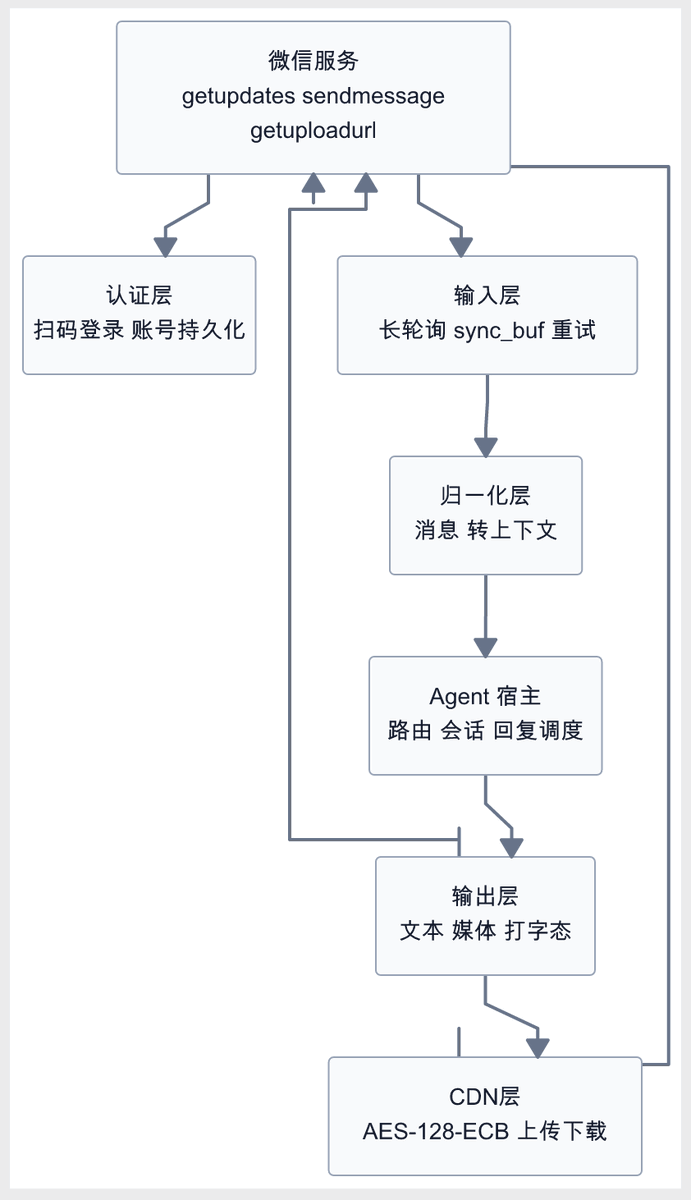
1. 架构
这个包不复杂,仅提供渠道适配能力。
上层是 OpenClaw 运行时。下层是微信长轮询与 CDN 接口。中间层负责认证、状态、消息归一化、会话桥接、媒体编解密。
1.1 入口在 `index.ts`。它注册 channel 和 CLI。
- `runtime.ts` 注入宿主 runtime。
- `channel.ts` 定义能力、登录、网关启动、文本发送、媒体发送。
- 主循环在 `monitor.ts`。它调用 `getUpdates` 长轮询,持久化 `get_updates_buf`,缓存 `typing_ticket`。它处理 会话过期,并做退避重试。
- 单条消息进入 `process-message.ts`。下载媒体,做命令鉴权,解析路由,记录 session,缓存 `context_token`。
- 文本走 `send.ts`。媒体走 `send-media.ts` 和 `cdn/upload.ts`。
文件先计算大小和 MD5,再申请上传参数,再做 AES-128-ECB 加密上传,最后回填 CDN 引用。
2. 交互 API
- 默认业务基地址:
ilinkai.weixin.qq.com
- 默认 CDN 基地址:
novac2c.cdn.weixin.qq.com/c2…
- 登录接口:
GET /ilink/bot/get_bot_qrcode
GET /ilink/bot/get_qrcode_status
- 消息与配置接口:
POST /ilink/bot/getupdates
POST /ilink/bot/sendmessage
POST /ilink/bot/getconfig
POST /ilink/bot/sendtyping
POST /ilink/bot/getuploadurl
- CDN 接口
/upload
/download
3. 如何接入Openclaw之外的其他agent
已知 API 之后,不需要复用这个包的原有结构,也不需要复用 OpenClaw 宿主,只需要实现一层面向微信协议的接入组件:
- `AuthClient`。负责扫码登录和 token 保存。
- `UpdatePoller`。负责调用 `getupdates` 并保存 `get_updates_buf`。
- `InboundMapper`。负责把微信消息转成你自己的 Agent 输入。
- `OutboundClient`。负责 `sendmessage`、`sendtyping`、`getuploadurl`、CDN 上传下载。
- `StateStore`。负责账号、游标、`context_token`、`typing_ticket`。
自己的 Agent 只需要暴露一个稳定接口。例如 `reply(input) -> output`。Weixin Gateway 在输入侧调用 Agent。在输出侧把结果拆成文本或媒体。
这里不需要 `resolveAgentRoute`、`recordInboundSession`、`createReplyDispatcherWithTyping` 这类 OpenClaw 组件。它们属于宿主框架。不是协议必需项。
落地时应保留三条边界:认证状态单独存。输入游标单独存。回复令牌单独存。
三者不能混在 prompt、记忆、对话历史里。这样才能直接替换 Agent 内核。
2
3
3
1,711


4 Jun 2025
Alchemy now has a new StateStore built on top of @benallfree 's DOFS running in a Durable Object.
It has roughly 70ms latency ⚡️ per operation and sets the stage for an Alchemy dashboard.
Shout out to to @johnmroyal for building it! 🚀

7
3
64
4,514

30 May 2025
Legal Marijuana: Dispensaries vs. New Bill - The $500M Gamble
#LegalMarijuana #CannabisDispensary #MarijuanaBill #CannabisLegislation #StateStore #CannabisBusiness #MarijuanaProfit #CannabisIndustry #NewBill #PolicyDebate #cannabiscommunity #cannabisculture #coughcountrytv #latenightgreen #mmemberville #stonerfam #420life #legalizeit
1
3
35
27 Apr 2025
If you use R2 StateStore, the “alchemy-state” bucket is now created lazily and automatically.
R2 bucket names don’t need to be globally unique (like AWS S3) which simplified this “bootstrap”.
Just that extra level of clean 👌
26 Apr 2025

I haven't done much open-source in a while. (Partly due to lack of 🔥 with work, friction in contributing, etc.)
BUT, @samgoodwin89 has been so response with alchemy.run, github.com/sam-goodwin/alche… took maybe ~20m 💪
1
7
1,034


20 Aug 2024
今、メインで利用してるのはKafka Streamsというフレームワーク上で、global statestoreというconsumer groupと独立してあるトピックの全てのパーティションデータを読み込んでローカルに復元してくれる機能があります。なので全てのノードにトピックの内容が複製されてる状態になります。データの入力はdebeziumによって1つのソースからKafkaに書かれます。なので、あるレコードに関する変更はRDBのbinlogを発生源としてレコードがどう変化したかを時系列として正しい順番で送信できることが保証できます。各ノードはフレームワークの機能を利用して入力を全ノードで受け取ってイベントを順番に適用すれば、正しい状態が復元できるという状態を構築できます。全てのノードは後から到達したイベントを同じ様に読み取ってローカルに展開したキャッシュの情報を更新・削除するだけで良くなる。流石に厳密にRDBで書いたものが即座に同期されてる状況は難しいですが、そこまでの厳密さが必要無いケースも多いので、そういったケースで活用してます。
1
4
1,167

22 Apr 2024
Building an app that uses Dapr pubsub, statestore and secrets, OpenAI and instructor for extraction of data, Azure Doc Intelligence, events with Event Grid, etc...
There's also a simple front-end: one page with a few tabs!
What took most of the time? The UI of course! 🤷♂️
#dev #ui #frontend
2
359

4 Feb 2024
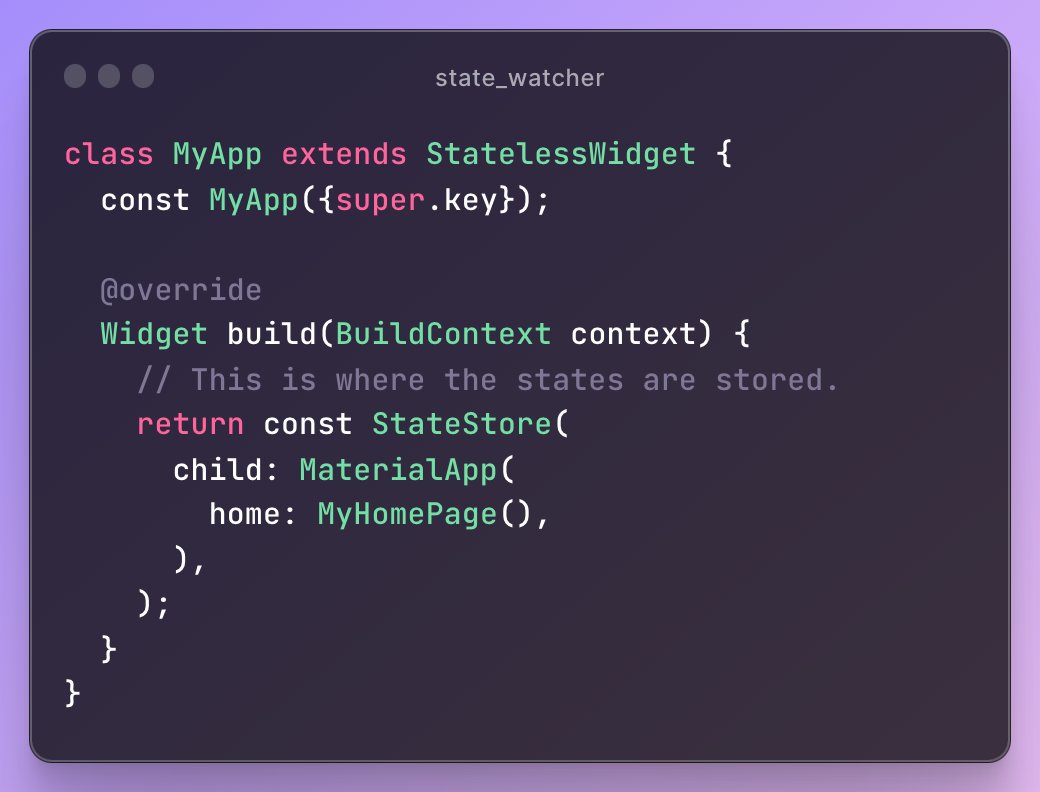
I wanted a simple API so there is not a lot of concepts to grasp.
First thing to do is to put a StateStore at the root of your app. This is where the states will be stored.
1
2
373

Dapr 2023 community video highlights:
Back to basics: APIs to rule them all (Dapr Statestore APIs) by @salaboy:
youtube.com/watch?v=BGx73XBm…
Watch the entire Dapr Sessions list at: youtube.com/playlist?list=PL…
2
3
818

15 Dec 2023
Same workaround as for 7.15CU3 helps:
update -> HKEY_CURRENT_USER ->
Software\Microsoft\Windows\CurrentVersion\ImmersiveShell\StateStore
-> ResetCache -> REG_DWORD -> 00000001
1
3
9
507

27 Oct 2023
Danger isn't even to mainnet yet, and we're generating bug reports.
This one belongs to @cometbft
2:15PM INF Closing statestore module=node3
2:15PM INF Closing evidencestore module=node3
2:15PM INF Closing application.db
panic: leveldb: closed
goroutine 3165 [running]:
github.com/cometbft/cometbft…(0x140023354c0, 0x1402a94b180?)
/Users/faddat/go/pkg/mod/github.com/cometbft/cometbft@v0.38.0/store/store.go:280 0x184
github.com/cometbft/cometbft…(0x14001176700, 0x680)
/Users/faddat/go/pkg/mod/github.com/cometbft/cometbft@v0.38.0/consensus/state.go:309 0xdc
github.com/cometbft/cometbft…(0x140010dc510, {0x1062ae250, 0x140095cc340}, 0x14006f2a0d0?)
/Users/faddat/go/pkg/mod/github.com/cometbft/cometbft@v0.38.0/consensus/reactor.go:925 0x644
created by github.com/cometbft/cometbft… in goroutine 1351
/Users/faddat/go/pkg/mod/github.com/cometbft/cometbft@v0.38.0/consensus/reactor.go:203 0x200
-----------------
occured while stopping danger with ctrl c
2
395

22 Sep 2023
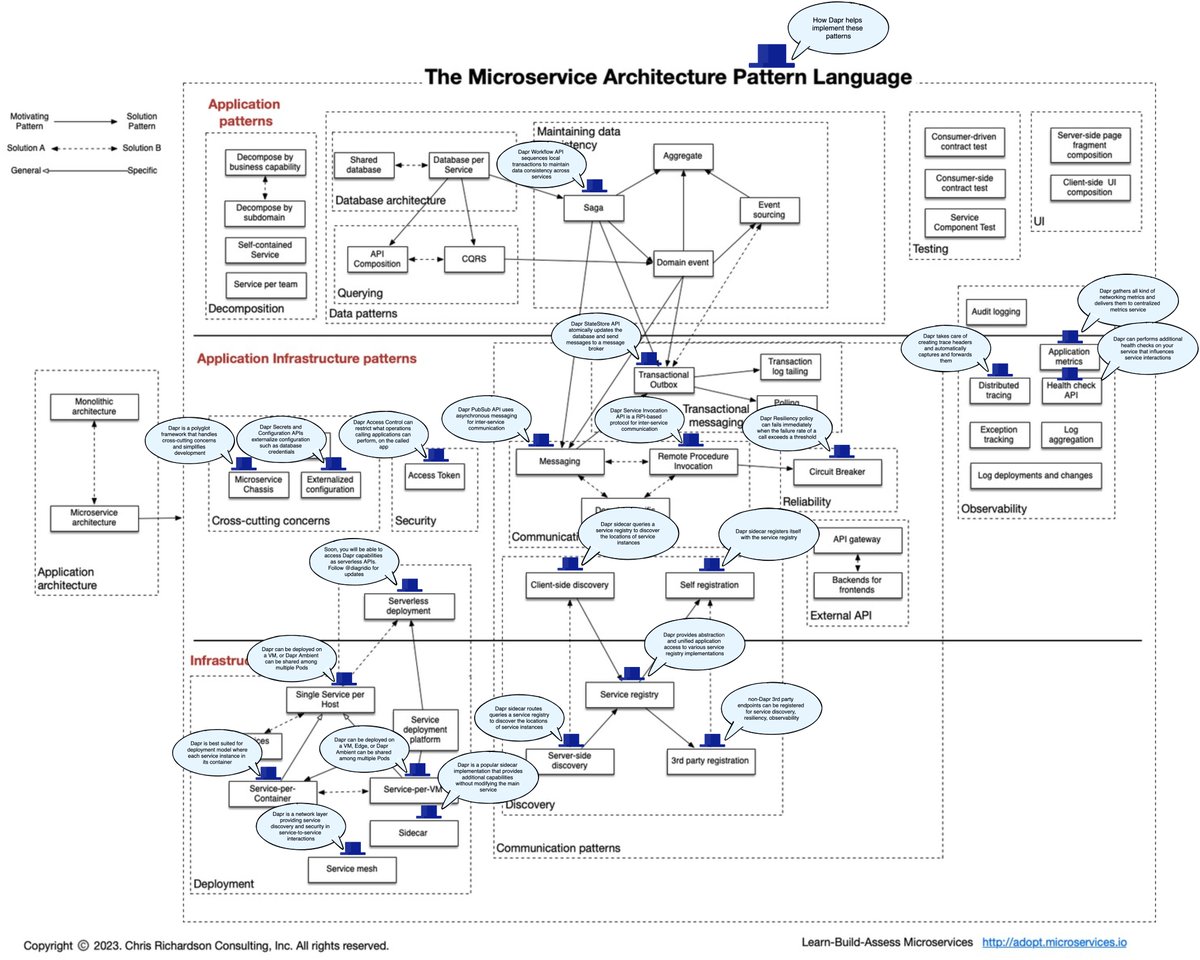
Patterns offer conceptual blueprints, but they remain abstract. Dapr translates Microservices Patterns into polyglot API implementations, aligned with cloud-native principles.
✅ Microservice Chassis: Address cross-cutting concerns and streamline development. Dapr, as a polyglot framework, excels here.
✅ Saga: Ensures data consistency across services. With Dapr's Workflow API, local transactions are sequenced to maintain this consistency.
✅ Transactional Outbox: Atomically updates databases and sends messages to brokers. This is achieved using Dapr's StateStore API.
✅ Messaging: Facilitates asynchronous inter-service communication. Dapr's PubSub API is designed for this purpose.
✅ Remote Procedure Invocation: A protocol for service communication. Dapr's Service Invocation API supports this.
✅ Circuit Breaker: Acts swiftly when call failure rates cross thresholds. Dapr's Resiliency policy ensures this.
✅ Access Token: Restricts operations that calling applications can perform. Dapr's Access Control manages this.
✅ Client-side Discovery: Discover service instance locations. Dapr sidecar queries a service registry for this.
✅ Externalized Configuration: Externalize configurations like database credentials. Dapr's Secrets and Configuration APIs handle this.
✅ Health Check API: Conduct additional health checks on your service. Dapr ensures this, influencing various service interactions.
✅ Distributed Tracing: Manage trace headers creation and forwarding. Dapr takes care of this.
✅ Application Metrics: Gather networking metrics. Dapr dispatches them to a centralized metrics service.
❗Check my latest post to dive deeper:
Dapr as the Ultimate Microservices Patterns Framework
diagrid.io/blog/dapr-as-the-…
2
34
121
20,909

16 May 2023
Here's an example of why I prefer OOP...
Look at the line of code in the first screenshot on the left
(This is #Rust that I wrote. It's probably terrible! Caveat emptor)
Let's see what's happening here:
• We're getting the value of `port` out of a mutex
• We're blocking processing because this mutex is asynchronous by default, but on this occasion we want to hold the app until we've resolved the value, hence we use `block_on()`
• We have to `lock()` the mutex to make sure nothing tries to write to it while we're trying to read from it
• We assign the value to a mutable variable called `port`
(Sorry if my explanations are inaccurate - this is just my understanding, happy to be corrected)
In isolation, I find this tricky to comprehend at a glance and always need a second or two to parse what's going on
What's worse (arguably) is that nothing about the language enforces helpful ergonomics, encouraging you to write code that is more easily readable by a human
If anything, it's the opposite - it encourages terseness until almost all meaning has left the building
For example, I could write the `block_on()` call with the namespace prefix (e.g. `tauri::async_runtime::block_on` in this case), but I'm not forced to and actually this can be the source of unexpected compiler errors later
Maybe your IDE will help or you're a quick study and you jump to import statements etc, but at first glance I think this can be quite tricky to decompose
Now take a look at the code on the right. It's a bit more verbose - for sure it won't float everyone's boat - but I find this much more expressive and it works the way my brain seems to work
From a quick glance, I can see that I'm getting a lock on some `$stateStore` (from which I can infer it is a mutex) and then getting the value out for the location specified in the lock ('port')
I've lost all reference to explicit blocking and I can assume that has been abstracted away - all I care about is the value
Under the hood, these two chunks could operate identically; it's just syntax and how we make things easier for ourselves: developer ergonomics and how much mental gymnastics we want to (not) do
But maybe that's just me 🤷🏼


2
3
1,610

18 Oct 2022
Imagine running a network of mesh actors at the edge and the state of your actors being persisted very close to them in a sqlite3 database. And still replicate the data to a cloud database? We are very close to achieving this with our Sqlite3 statestore github.com/eigr/spawn/pull/8…
1
4

12 Oct 2022
@addisonhuddy @rmoff and as promised, the link to our document statestore implementation used for serving our APIs: github.com/KOR-Financial/kaf…
2

19 Jan 2022
I did a meetup on Kafka Windowing last year and looking to expand on that in an upcoming meetup🤞.
To the team that has built @KafkaStreams - thank you!
Ideas for a better name of "statestore-ui" Vue application? How about Windex?
1
5