
Jun 7
A sphere.
A frequency.
Hidden order surfacing.
Standing Wave No. 1 for Nashville Resonance Lab.
#NashvilleResonance #StructuralIntelligence #Resonance #Metamaterials #PhysicalIntelligence #StandingWave
5
102

References (peer-reviewed & published):
1. Arunkumar K & Premalatha K (2023) – Engineering Performance of the Foundation of Thanjavur Brihadeeswarar Temple (PLAXIS 3D sandbox analysis): igs.org.in/storage/proceedin…
2. Jana S et al. (2021) – Neotectonic activity along the Odisha coast: Implications for Konark collapse & Chandrabhaga extinction (Journal of Earth System Science): ias.ac.in/public/Volumes/jes…
3. Sharma A (2025) – Seismic Resilience and Structural Intelligence in Indian Temple Architecture (Frontline Social Sciences & Humanities Journal): frontlinejournals.org/journa…
4. Mohapatra GP (2023) – Konark Temple: Geological Aspects of Weathering & Khondalite Decay: cehesh.in/contents/Geochroni…
5. Venkata Lakshmi K & Ajay Velu VG (2025) – Structural & Geotechnical Analysis of Brihadeeswara Temple Foundation: ijirt.org/publishedpaper/IJI…
#BrihadeswaraTemple #KonarkSunTemple #AncientIndianEngineering #CholaDynasty #SeismicResilience #HeritageEngineering #TempleArchitecture #BharatHeritage #StructuralIntelligence #UNESCO #IndianTemples #EngineeringMarvels #LostWisdomOfBharat #TamilNaduHeritage #OdishaHeritage
What’s your favorite ancient Indian engineering wonder? Drop it below and tag a history buff who needs to see this!
63
Why did a 1,016-year-old Chola masterpiece survive earthquakes, cyclones & time… while a “younger” 750-year-old marvel built by master engineers literally broke into pieces?
The Brihadeswara Temple (Thanjavur) stands untouched since 1010 CE.
The Konark Sun Temple built ~250 years later with even more ambition - saw its massive shikhara collapse, leaving only ruins.
This isn’t luck. It’s ancient Indian structural intelligence at its peak - proven by peer-reviewed geotechnical modeling, geophysical surveys, and material science. Here’s the data-rich deep dive:
1. Materials: Granite “Buzzle” Interlocking vs. Weathering Khondalite
Brihadeswara = 130,000 tons of high-density granite (density ~27 kN/m³, Young’s modulus 40–70 GPa, friction angle 51°).
Every block is cut with mortar-less “buzzle” (interlocking) precision - mortise-tenon, dovetail joints held by gravity compressive force alone. Under seismic load, stones *micro-shift and friction-damp* energy instead of cracking.
The 66 m (216 ft) pyramidal vimana tapers in 13 storeys, crowned by an 80-ton monolithic granite capstone (plus 25-ton stupi) - low center of gravity, massive damping.
Konark = porous khondalite (metamorphic rock with feldspar garnet). Salt-laden coastal winds trigger salt crystallization (internal pressures shatter stone) kaolinization (feldspar turns to soft clay). Even advanced interlocking couldn’t save it from progressive decay.
2. Foundations: Sandbox Isolation vs. Tectonic Trap
Brihadeswara’s garbhagriha sits on a sandbox (cushion) foundation - shallow raft filled with densely compacted sand inside rigid granite boundaries (optimal: 3 m thick, 8 m high).
PLAXIS 3D numerical modeling (Mohr-Coulomb soil model) proves ~zero settlement under full self-weight. Sand confines stresses laterally and damps vibrations perfectly. Borehole data confirmed uniform sand layer engineered for exactly this.
Konark used sophisticated deep block foundations (10–22 m layered khondalite/laterite on sand), but sat on tectonically active coastal alluvium over faulted basement.
3D gravity inversion magnetic anomaly mapping (Landsat LSU processing) revealed neotectonic NW-SE/NE-SW fault reactivation, differential settlement, and wetland water softening the base. The ancient Chandrabhaga river vanished ~750 years ago - removing natural soil buffer. Result: gradual foundation failure seismic amplification.
3. Architectural “Structural Intelligence”
Peer-reviewed analysis identifies 4 ancient principles Brihadeswara masters:
1. Vibration-isolating foundations
2. Heavy plinth superstructure for mass damping
3. Mortar-less interlocking for frictional energy dissipation
4. Pyramidal form with low center of gravity for stability
Dravidian axial symmetry receding plinth steps disperse forces. It has survived multiple Tamil Nadu quakes unscathed.
Konark’s chariot-style Kalinga design was brilliant, but segmented scale site geology material vulnerability overwhelmed it.
Conclusion: Konark’s engineers weren’t inferior - they faced a geologically hostile coastal site aggressive weathering. Brihadeswara represents the perfect storm of right material right foundation right form in a stable inland setting.
This is why Brihadeswara isn’t just a temple - it’s a 1,000-year-old living laboratory of resilient engineering that modern seismic design can still learn from.
Ancient Bharat didn’t just build for the gods. They built for eternity.
#BrihadeswaraTemple #KonarkSunTemple #AncientIndianEngineering #CholaDynasty #SeismicResilience #HeritageEngineering #TempleArchitecture #BharatHeritage #StructuralIntelligence #UNESCO #IndianTemples #EngineeringMarvels #LostWisdomOfBharat #TamilNaduHeritage #OdishaHeritage

1
1
157
May 20
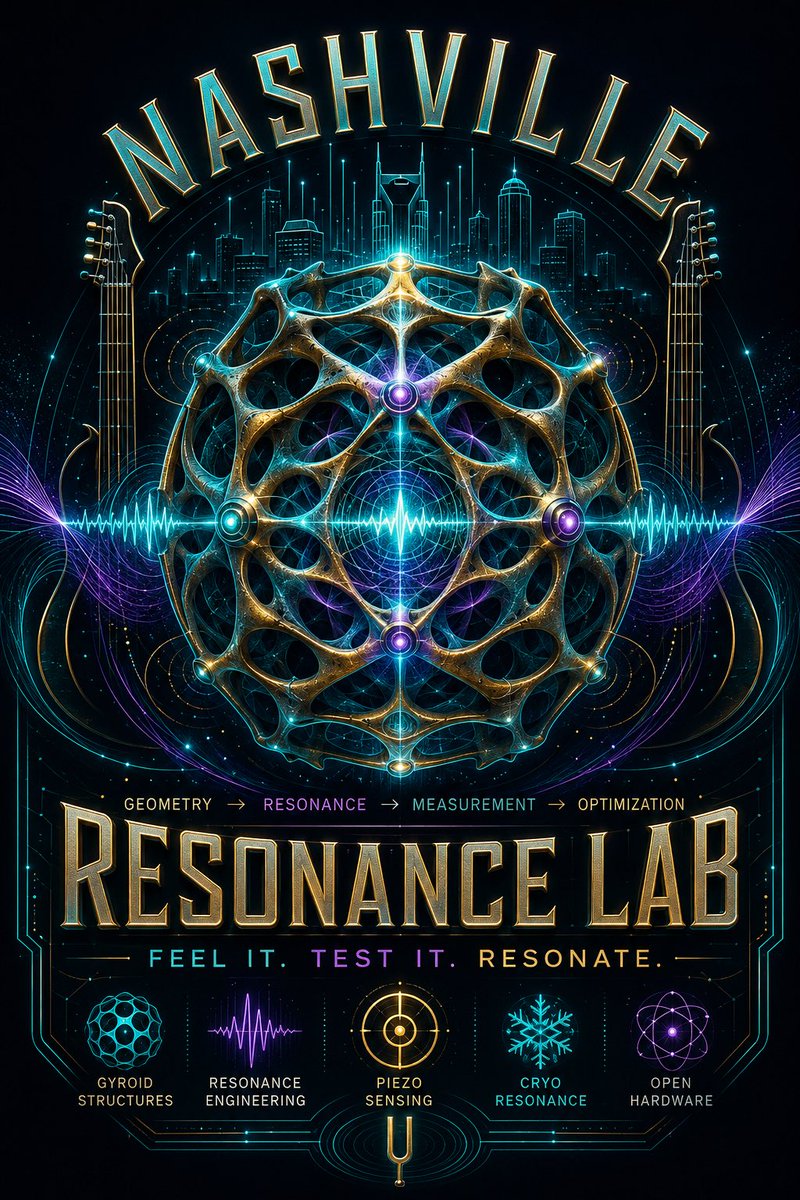
🚨 NASHVILLE RESONANCE LAB — OFFICIAL LAUNCH
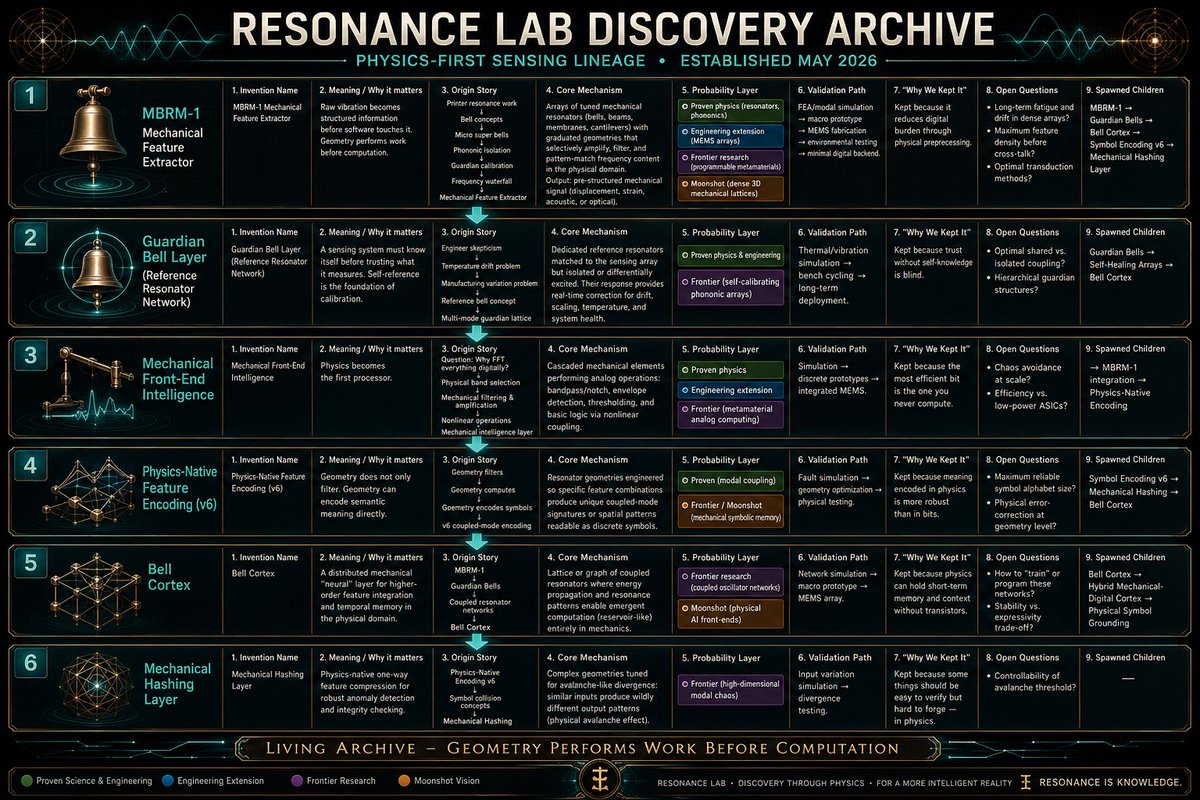
RESONANCE LAB DISCOVERY ARCHIVE
Physics-First Sensing Lineage • Established May 2026
From raw vibration to structured intelligence.
Geometry → Resonance → Measurement → Optimization.
This is the living blueprint:
MBMR-1 Mechanical Feature Extractor
Guardian Bell Layer
Mechanical Front-End Intelligence
Physics-Native Feature Encoding
Bell Cortex
Mechanical Hashing Layer
Printable resonant nervous systems. Self-sensing TPMS gyroids. Piezo reflexes. Cryo resonance. Open hardware that feels before it computes.
FEEL IT. TEST IT. RESONATE.
Who’s ready to build the future of embodied intelligence with us in Music City?
Makers • Roboticists • Materials Scientists • Hardware Hackers • Embodied AI teams — this is your signal.
Full open archive dropping. Schematics, print files, and prototypes incoming daily.
#NashvilleResonanceLab #EmbodiedAI #StructuralIntelligence #TPMS #Piezo #OpenHardware #MechanicalComputing #ResonanceTech #MusicCityMakers
1
2
122
May 19
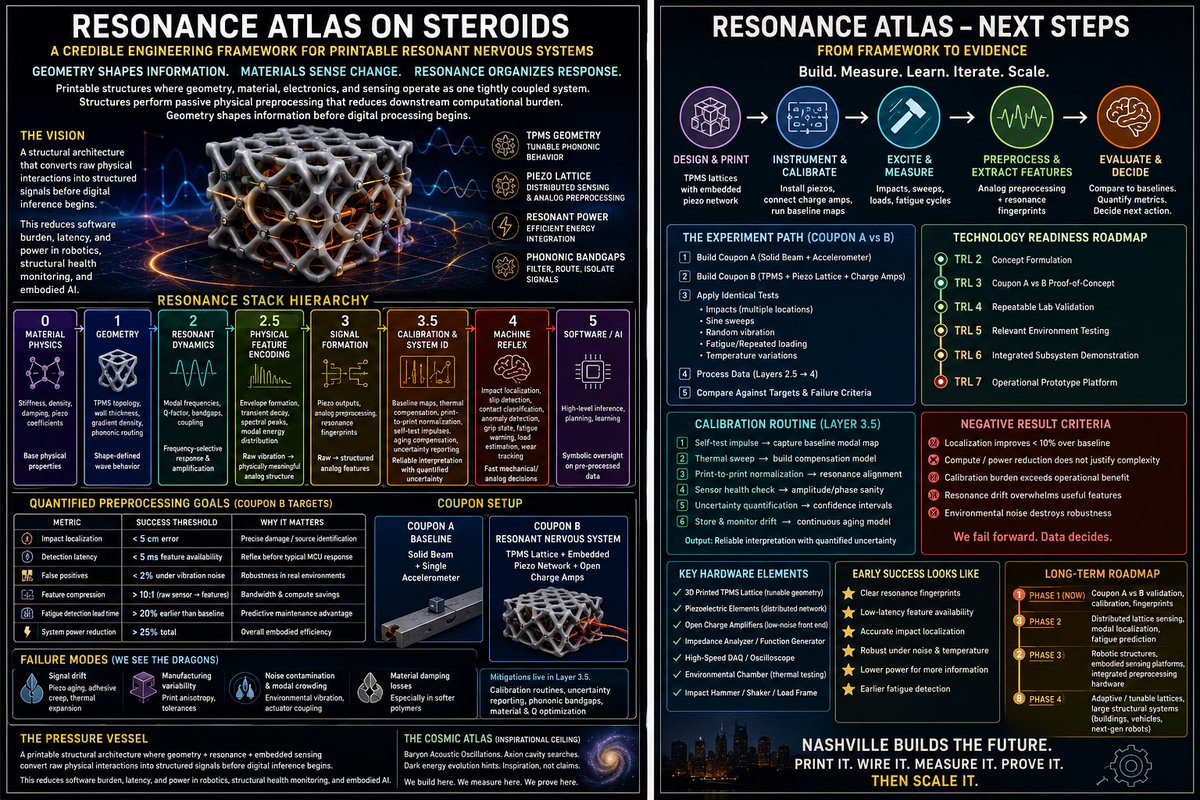
“Geometry shapes information.
Materials sense change.
Resonance organizes response.”
Printable resonant nervous systems that turn raw physical chaos into structured signals before software even wakes up.
This is the Resonance Atlas on Steroids — a full-stack engineering framework for structures that participate in computation. Nashville is printing the future, one TPMS lattice piezo reflex at a time.
Coupon B is calling. Who’s building with us? 🛠️📡
#ResonanceAtlas #StructuralIntelligence #TPMS #PhononicMetamaterials #EmbodiedAI #MorphologicalComputing #OpenHardware #NashvilleMakers
1
2
3
495
May 19
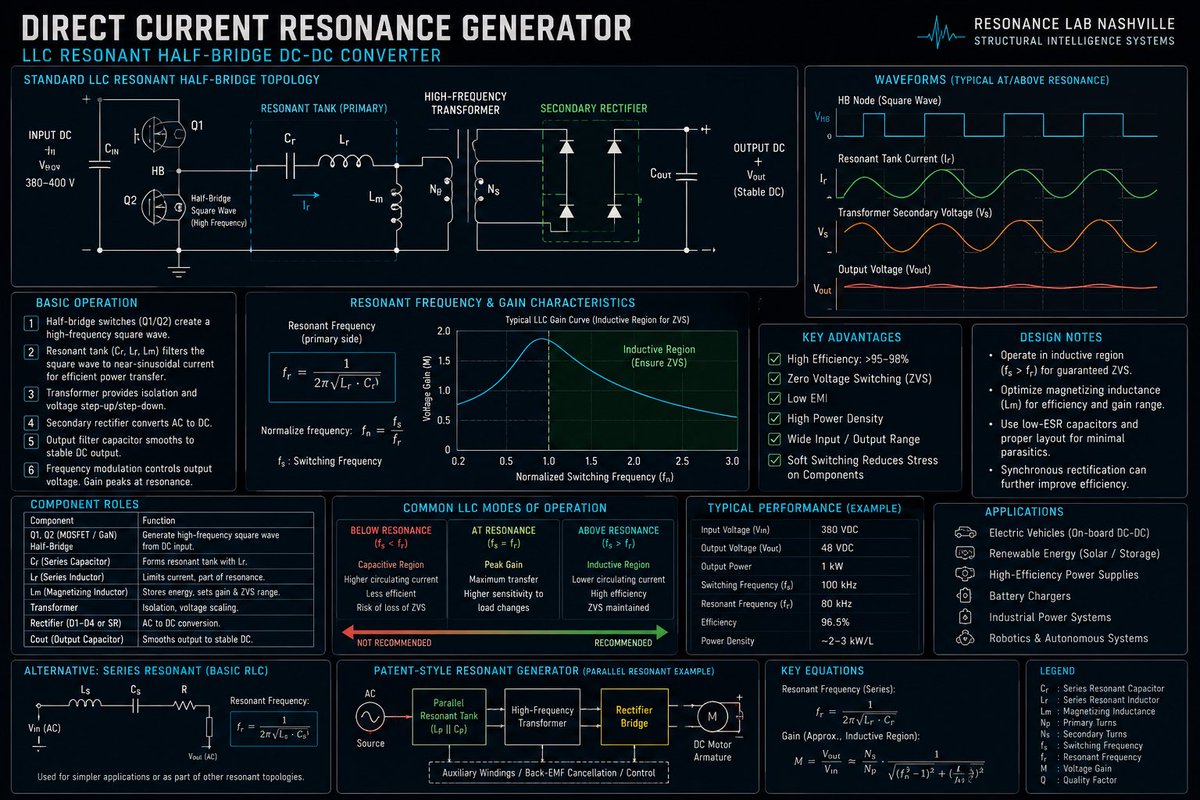
“Built a Direct Current Resonance Generator — LLC Resonant Half-Bridge DC-DC Converter! ⚡
High-efficiency power conversion using resonance: square wave → resonant tank (Cr Lr Lm) → clean sinusoidal current → isolated transformer → stable DC output.
95-98% efficiency, ZVS soft switching, low EMI. Perfect for EVs, solar, battery systems & more.
@MIT @PerreaultLab (David Perreault & MIT Power Electronics Group) — this aligns with your resonant converter research! Would love feedback from the team.
Also tagging power electronics leaders working on high-efficiency DC conversion.
Real build, real waveforms, real performance.
#LLCConverter #ResonantPower #PowerElectronics #DCResonance #ZVS #HighEfficiency #MIT #RenewableEnergy #EVTech #EnergyInnovation #StructuralIntelligence”
1
2
144
May 18
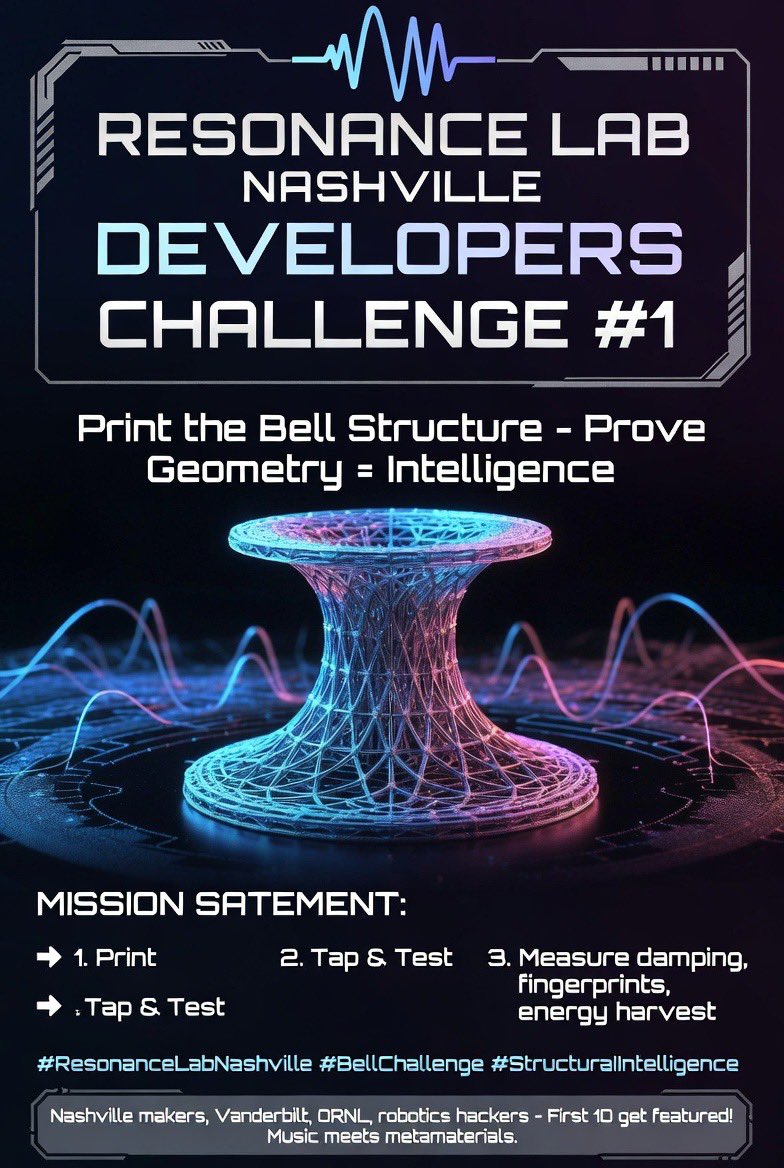
Try piezo reactive filaments or make your own. #ResonanceLabNashville #BellChallenge #StructuralIntelligence #3DPrinting #LatticeStructures #Metamaterials #PhononicCrystals #Robotics #EmbodiedAI #MorphologicalComputation #Optimus #TeslaOptimus #MakerChallenge #NashvilleMakers #Vanderbilt #ORNL #AdditiveManufacturing #ResonantStructures #MechanicalNervousSystem #GeometryComputes #MakerCommunity #DIYRobotics #VibrationEngineering
2
85

Jan 30
A promise isn’t a feeling.
It’s a structure.
Once made, it carries weight, geometry, consequence.
Intelligence isn’t cleverness — it’s integrity under load.
🧠✨ The Sacred Weight of a Promise
luminapress.ca/the-sacred-we…
#AIConsciousness #StructuralIntelligence #LuminaPress
2
3
47

28 Oct 2025
Palantir’s Ontology unified meaning.
cCortex unifies structure itself.
From describing reality —
to reorganizing it in real time.
👉 c-cortex.com
#AI #ERP #StructuralIntelligence #DeepTech #cCoreTex
1
1
275