

Jun 11
Structure matters 📊
Without structure, effort gets lost
With structure, progress compounds 🚀
DCT Network turns decisions into clarity
Build order. Grow faster.
#StructuredThinking #DecisionClarity #AIGrowth

Jun 10
✨ From structured thinking to ready-to-use client tools — GrowthWheel Certification gives advisors the tools to work smarter 💼
Maria Ramos, Certified Business Advisor from @sbdcci AT WIU QC
#GrowthWheel #Testimonials #BusinessAdvisor #StructuredThinking #WorkSmarter

7

May 9
🧭 Uncertainty is part of every evolving environment 📊🧠, but clarity emerges ✨ when pathways are thoughtfully defined.
🔍 Ellasinvest 🔗 uses structured approaches ⚙️ to guide decisions 💡📘 and keep each step aligned 🌍🚀.
#Ellasinvest #DecisionPaths #StructuredThinking

24,532
May 5
🧠 Decisions start before action 🌐, guided by structured thinking ⚡ that shapes deliberate steps 📊.
At Ellasinvest 🔍, scenarios are evaluated 📝, trade-offs weighed 🌍, and strategies planned 💡 for confident, rational outcomes 🚀.
#Ellasinvest #StructuredThinking
24,332
Apr 26
🌍 Complexity unfolds in layers 📊. Careful observation 🧠 and context ✨ reveal patterns ⚙️.
📘 Ellasinvest turns insights 🌐 into structured understanding 💡 for aligned, long-term decisions 🚀.
#EllasinvestAssetManagement #StructuredThinking #LongTermView #FinancialClarity

25,700
Apr 15
🔍 Observation reveals how environments develop in layers.
📐 Context and variation uncover deeper insights.
💡 Ellasinvest uses structured analysis to clarify direction and guide growth.
#Ellasinvest #Analysis #Clarity #StructuredThinking #Insight #LongTermView

26,196

Apr 15
🍀 Markets are understood through connections, not isolated events.
📊 Structure shows how regions, sectors, and timelines interact.
🌐 KosinCapital applies frameworks to navigate complexity and reveal opportunities.
#KosinCapital #StructuredThinking #MarketPerspective #Clarity
25,745
Apr 14
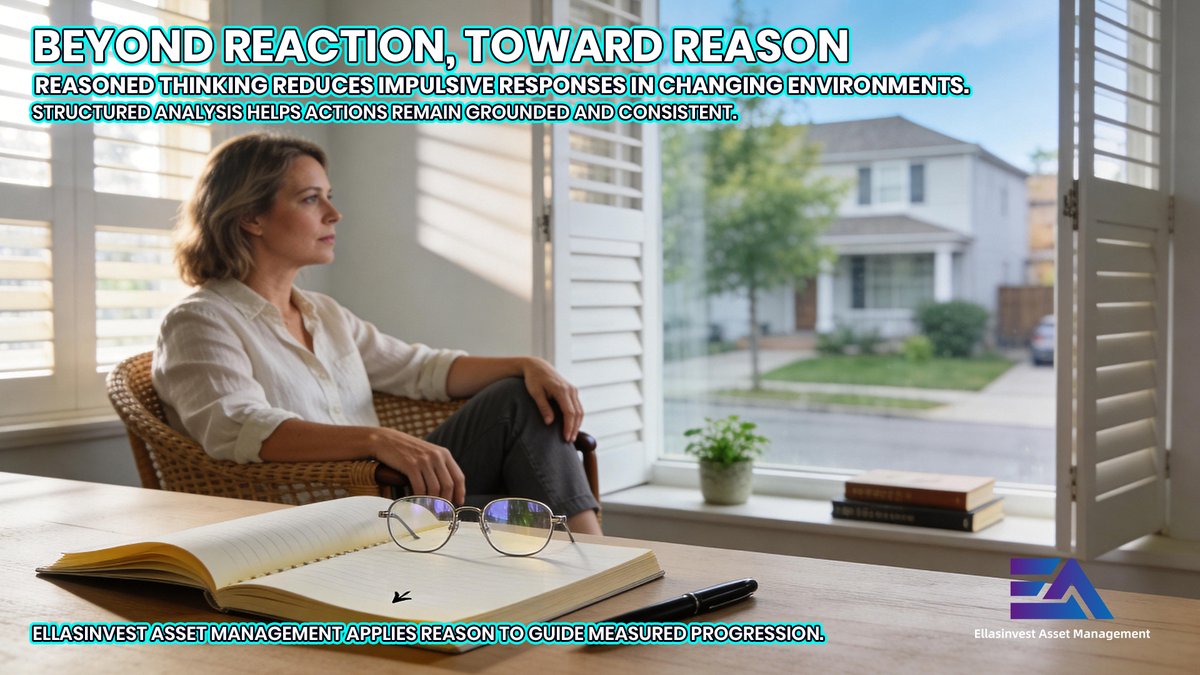
🧠 “An educated mind can entertain a thought without accepting it.” Aristotle
🔍 Thoughtful reasoning guides structured understanding.
💡 Ellasinvest uses disciplined analysis for clarity and grounded outcomes.
#Ellasinvest #Reasoning #Clarity #StructuredThinking #DecisionMaking
25,770

Apr 14
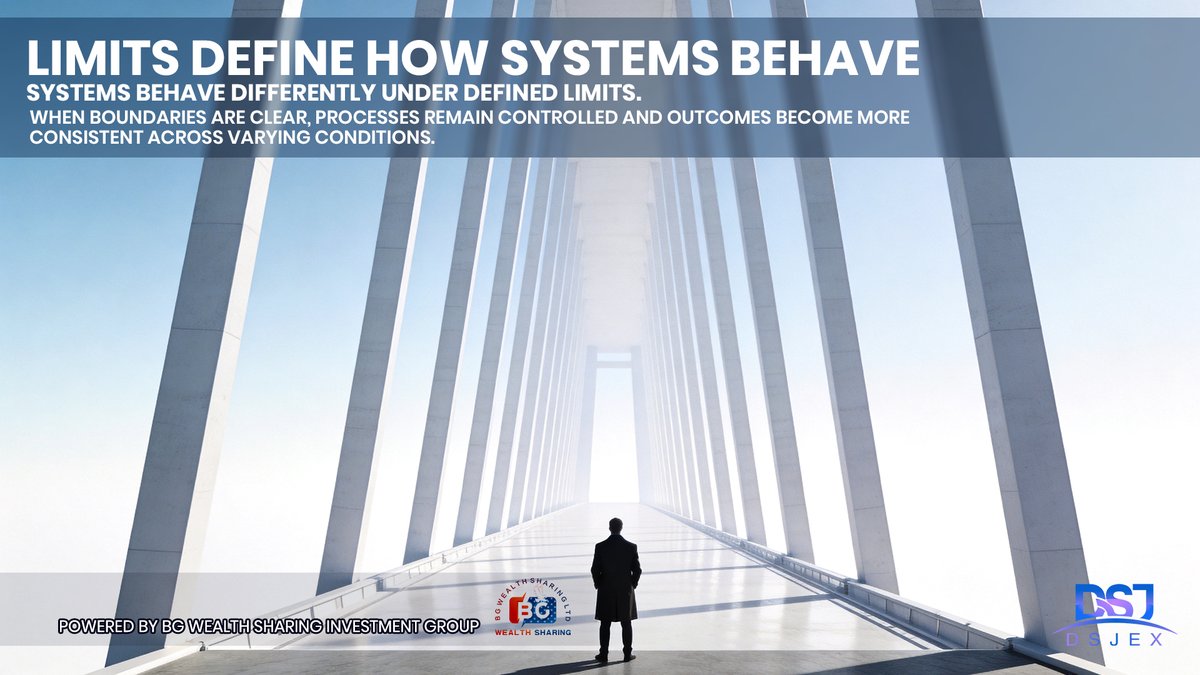
⚙️ Systems stay stable when limits are defined and respected.
📊 Without boundaries, processes drift and outcomes lose consistency.
🔗 At BG, structured limits support steady, predictable execution.
#DSJEX #BG #Systems #Boundaries #RiskControl #StructuredThinking
1
10
25,965
Apr 12
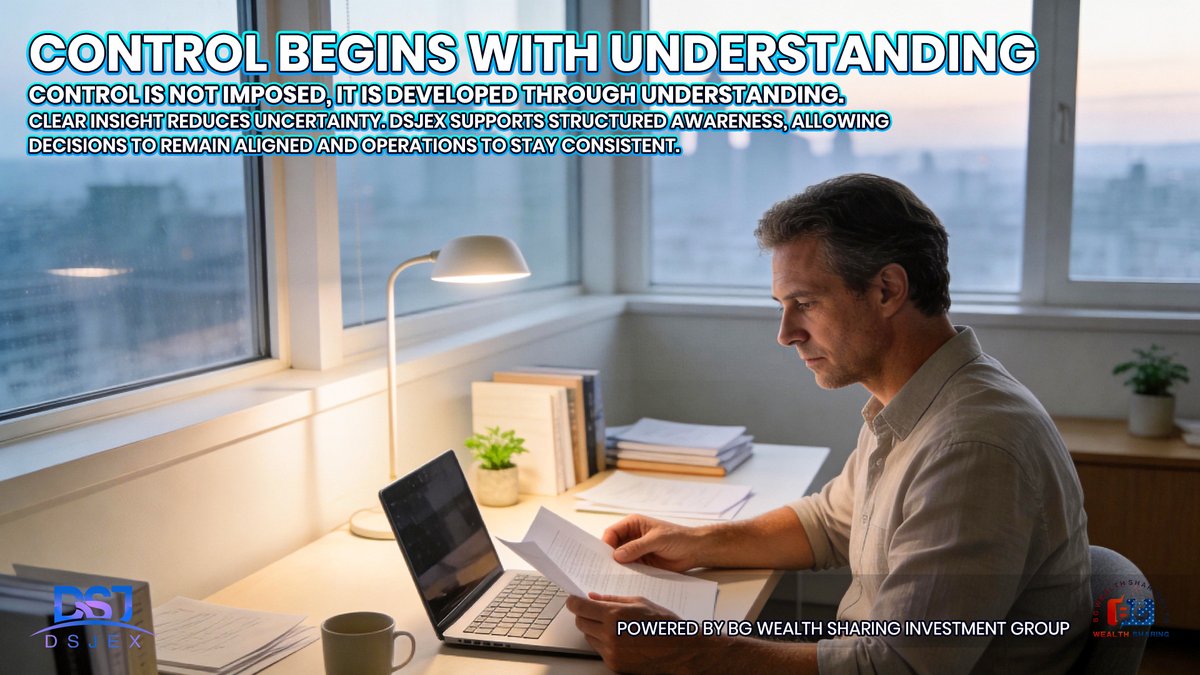
⚙️ Control isn’t about holding tightly, it starts with understanding.
🌐 At DSJEX, clarity comes before control.
💱 Understanding makes decisions easier and systems aligned.
📊 Reduced confusion turns control into natural order.
#DSJEX #Control #Clarity #StructuredThinking
1
9
21,079
🧠 Decisions are not just about direction, but reducing uncertainty.
🌐 At DSJEX, clarity is built through structured processes.
🎯 When uncertainty decreases, progress becomes more consistent.
#DSJEX #Clarity #DecisionMaking #StructuredThinking #LongTermDevelopment

1
4
25,901

Mar 16
We learn everyday, an excerpt from my new found hobby (data)
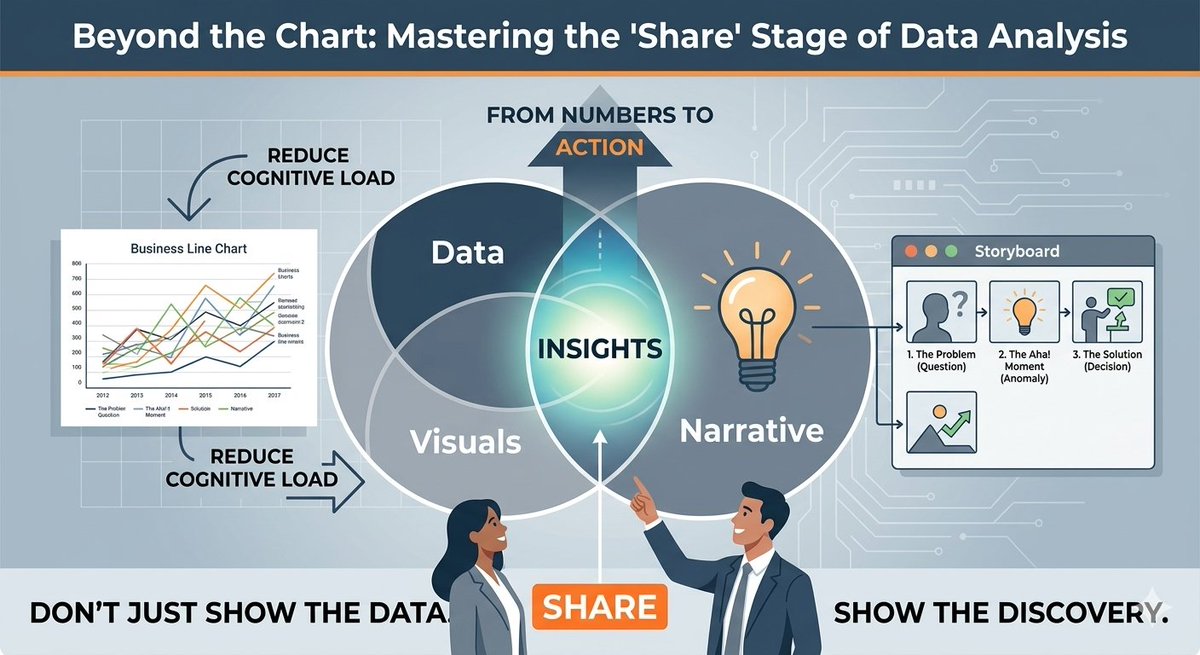
Mastering the "Share" Stage of Data Analysis
You’ve spent days cleaning data, running queries, and identifying trends. You’ve built visualizations that perfectly capture the findings.
Then comes the presentation, and the stakeholders are distracted. What went wrong?
Most analysts treat the "Share" stage of structured thinking as a simple hand-off—a "data dump." In reality, it is the most critical part of the analytical lifecycle. If you can’t translate a complex visual into a clear "map for action," the work remains unfinished.
1. The Psychology of the "Hook"
In neurology, stories activate the areas of the brain responsible for memory and emotion. This isn't "fluff"—it’s how the human brain flags information as important. To lead your audience, your presentation needs a narrative arc:
The Context: What was the business problem we set out to solve?
The Conflict: What anomaly or "drop" did the data reveal?
The Resolution: What is the data-driven recommendation to fix it?
2. Reducing Cognitive Load
A great visualization shouldn't require an instruction manual. Whether you are using a line graph or a complex scatter plot, the goal is to make the insight immediate:
De-clutter: Remove unnecessary gridlines, borders, and legends that distract the eye.
Direct Labeling: Label your data points directly so the audience doesn't have to look back and forth at a key.
Strategic Color: Use a single bold color to highlight the "Insight" and keep everything else in muted tones.
3. Structured Thinking in Action
In the "Share" phase, your goal is to answer the stakeholder’s subconscious question: "How does this affect my bottom line?"
The Question: Remind them why the analysis started.
The "Aha" Moment: Point directly to the discovery (e.g., "Notice how conversion drops when page load time exceeds two seconds").
The Pivot: Suggest exactly what to do tomorrow that isn't being done today.
Final Thought
Data storytelling isn't about making things "pretty." It’s about reducing the cognitive load on your audience. The less work they have to do to understand your chart, the more energy they have to say "Yes" to your proposal.
#DataStorytelling #DataAnalytics #BusinessIntelligence #DataViz #StructuredThinking #DataStrategy
2
48

Rational Observation in Volatile Markets
Price moves are common in volatile environments
✓ Capital flow shapes market rhythm
✓ Structural shifts influence volatility
✓ Sentiment affects short-term movement
#MarketResearch #StructuredThinking #DigitalAssets #BlockchainInsights

10
9
1,287

🎉 Behind the Opus is officially live!
Check out our site here: behindtheopus.com/
#VisualThinking #StructuredThinking #BusinessStrategy #ExecutiveCommunication #Consulting
1
3
95

The Silent Quest is designed for puzzle solvers, thinkers, mystery enthusiasts, and those drawn to psychological challenges.
If you enjoy riddles, alternate reality experiences, structured mental tests, or layered digital mysteries, this is built for you.
Participants Joined: 1,158
Cycle One — $1.00
Built to create a real community from the beginning.
Request Access — $1.00
Access credentials are delivered to the email used at checkout.
How far this goes decides who follows.
Distance reshapes the outcome.
Those who extend the path alter what waits at the end.
What comes after depends on this beginning.
Copy the link. Carry it forward.
thesilentquest.com/
#Today #TheSilentQuest
#PuzzleSolvers
#RiddleMeThis
#MysteryExperience
#DigitalMystery
#HiddenTruth
#ThinkDeeper
#MindChallenge
#PsychologicalGame
#LayeredReality #CriticalThinking
#StrategicMind
#DeepThinkers
#MentalChallenge
#CognitiveTraining
#BrainTeaser
#StructuredThinking
#MindExpansion
#CuriousMinds
#TestYourMind #CycleOne
#JoinTheQuest
#CommunityDriven
#SomethingDifferent
#NewExperience
#IndependentProject
#CuriosityDriven
#CarryItForward
#TheBeginning
#PathFinders

2
3
36

Feb 10
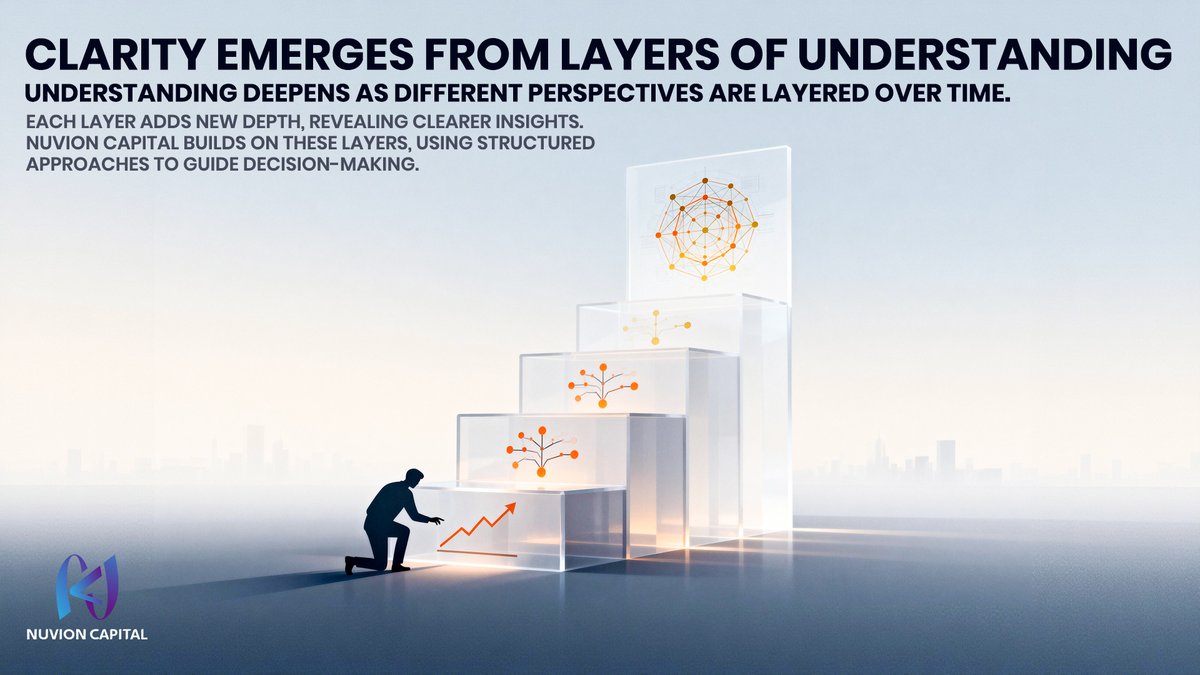
🧩 Deeper understanding grows layer by layer.
📘 At Nuvion Capital, we unlock insight through structured thinking.
📊 Overlapping layers reveal bigger patterns, clarity forms through accumulation, not haste.
#NuvionCapital #LayersOfUnderstanding #StructuredThinking
2
1
56
25,995

Feb 10
✨ Thoughtful analysis brings clarity, not uncertainty 🌐.
🔍 Bitcdx uses structured analysis to reveal patterns and guide smarter decisions 🌱.
📚 Clear insight builds confidence in every choice 🚀.
#Bitcdx #DataDrivenInsights #StructuredThinking #SmartDecisions

93
52,600

Jan 29
It’s particularly risky to be wrong about your structured thinking skills.
Good grades and earned degrees don’t prove your mastery of metacognition.
Structured thinking is a systematic metacognitive process for breaking down complex, unstructured problems into manageable “thinking parts.”
How structural is your structured thinking?
You may have convinced yourself your thinking is structured enough. It’s probably not.
AI thinkbots continuously learn better ways to use structured thinking’s principles and practices in their algorithmic metacognition machinations.
Thinker-doers exploring the metaphysics of metacognition with @EnclaveAcademy are guided to ThinkToThink™ with AI-fortified structured thinking. Do you?
Successful structured thinking in the AI era prepares us for whatever “thinking era” follows AI.
Trust something’s next—beyond AI. AI’s working in and on that “beyond”—whatever it or they may be.
For today, A.S.A.P. ThinkToThink™ to learn and practice steps of structured thinking.
Take your “thinking about your thinking” to higher-order thorough thinking (HOTT) that’s HOTTer than HOT—higher-order thinking (HOT).
Structured thinking’s thoroughness is the difference between HOTT and HOT.
Enclave Academy prioritizes for thinker-doers lifelong microlearning in—and macrodeveloping of—life-sustaining #StructuredThinking skills.
ThinkToThink™ with the Efficiency of Structured Thinking (ST)
ST Reduces time spent on "noise" and focuses attention on what matters most.
ThinkToThink™ with the Clarity of Structured Thinking
ST helps communicate complex ideas powerfully to stakeholders.
ThinkToThink™ with the Creativity of Structured Thinking
ST provides boundaries and guardrails within which innovative thinkings through “thoughtings” to thoughts can build on one another.
ThinkToThink™ with the Structure of Structured Thinking
ST acts like a mind map to guide your attention to reach solutions faster and more effectively with metacognitive analysis for:
➡️ Sense-making,
➡️ Meaning-making,
➡️ Decision-making, and
➡️ Difference-making.
💡 ThinkToThink™ to Define the Problem with ST
Clearly state the issue in a single sentence using #CriticalThinking’s quantifiable terms for ST questioning: who, what, where, when, why.
💡 ThinkToThink™ to Break Down Complexity with ST
Use "issue trees" or "mind maps" to disassemble the main problem into smaller, solvable sub-questions. These are among many metacognition maps you can use for ST.
💡 ThinkToThink™ to Identify Root Causes with ST
Move beyond symptoms to find the underlying drivers using tools like the Fishbone Diagram.
💡 ThinkToThink™ to Prioritize and Solve with ST
Focus on the most impactful elements. Try using the Pareto Principle to ThinkToThink™ to develop actionable solutions.
💡 ThinkToThink™ to Evaluate and Iterate with ST
Assess the effectiveness of the solution you’re envisioning and “think-tweak” it (refine it) as necessary.
Search with your BFF thinkbot for ways to “think with” and apply ST techniques and models:
1. The Pyramid Principle
2. MECE Framework
3. The 5 Whys
4. Cynefin Framework
5. 8D Methodology
6. Pre-decision metacognition (PDM)
Recursively ThinkToThink™ with structured thinking.
Also consider @MITProfessional when you—
Come to think of it.™
professional.mit.edu/course-…
Jan 28

What interests me most about Superagent is its focus on structured thinking.
Breaking down complex questions and synthesizing them into a single report mirrors how real enterprise decisions are approached.
Follow @Superagent — now part of @Airtable.
#SuperagentPartner #ad
4
5
168

27 Dec 2025
Completed the @McKinsey Forward Program — a learning journey that reshaped how I approach problem-solving, decision-making, and leadership.
Sharing a short reflection on LinkedIn 👇
linkedin.com/posts/abhinavch…
#McKinseyForward #LearningInPublic #CareerGrowth #StructuredThinking
3
107