

No it’s seems to be something there when I looked into it .. if I was the lawyer I definitely would’ve called witnesses from that school to testify about their bullying nature
Zach Conrad retweeted

What a blessing it is to belong to the Father of lights! And what a privilege it is to testify of His goodness to a world so desperate for love and forgiveness.
Chuck Smith
5
9
57

Congress must subpeona Melania Trump who must testify about her relationship involement connections with Jeffery Epstein and Chislaine Maxwell and what she knew about the Child Sex Trafficing.
#SubpeonaMelania
#SubpeonaMelania
#SubpeonaMelania


16

It cuts away so we don't see the actual tossing of the child. This leaves room for doubt. Hopefully the witnesses will testify.
1

Guess WE are sleeping on the top bunk yay!! I don't snore too often, Dan Heng and March 7th can testify. I like sleepovers. They are nice. Beware of the random screaming though.
1
1
2

This is a complete lie.
Further, these Epstein "victims" were offered the chance to testify before Congress and they refused.
And most were not victims at all anyway, just of-age prostitutes who plied their trade on a fancy island instead of street corners.
2


“I never explicitly accused him” doesn’t answer the question. If you’re sharing alleged proof and talking about zina punishments, can you stand before Allah and testify with certainty to what you’re implying?
3

Saskia Mostert would not be able to testify in The Hague about the subject she spoke about in Washington on June 3.
▪️ Study on global excess mortality with three Dutch co-authors in BMJ Public Health, as that study dates from May 2024.
deanderekrant.nl/arts-onderz…

1
6
Home o’ da’ Free, & da’ Dying retweeted

Democrats just said they will call the following Trump officials to testify before Congress over the Epstein cover-up: JD Vance, Karoline Leavitt, Kash Patel, Dan Bongino, Steven Cheung, and Susie Wiles.
Buckle up.
293
604
3,496
40,178

Are we talking about the f’n kids she went to comfort, never spoke to, then started her car before she went in John’s house?? Or when the niece was scheduled to testify and KR had a “ sick “ day? Coincidence it was the only day she missed?? Those kids?? Thank God she has none
1
4
Home o’ da’ Free, & da’ Dying retweeted

JD Vance. Susie Wiles. Karoline Leavitt.
Yesterday, Congress formally demanded all three testify about the White House's concealment of the Epstein files.
The Vice President is listed first.
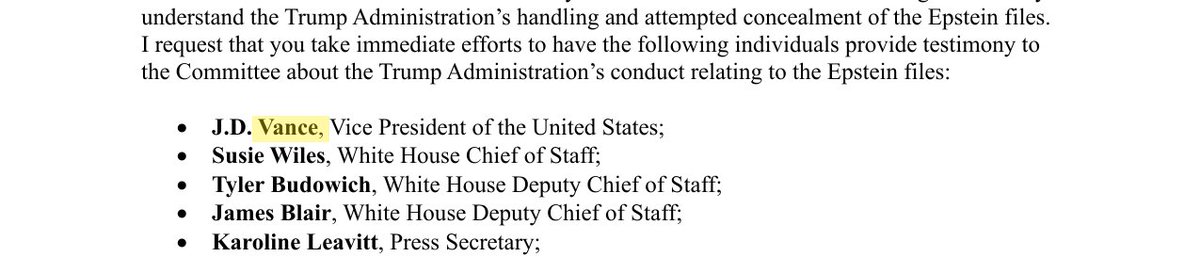
ALT House Oversight Ranking Member Garcia's June 11 2026 letter to Chairman Comer listing JD Vance Susie Wiles and Karoline Leavitt as officials demanded to testify about Epstein file concealment
104
2,603
8,314
53,420
Home o’ da’ Free, & da’ Dying retweeted

BREAKING: Democrats just officially requested the following Trump officials testify before Congress over the Epstein cover-up: JD Vance, Karoline Leavitt, Kash Patel, Dan Bongino, Steven Cheung, and Susie Wiles. Let’s go.
278
2,991
15,580
154,351

God has not left you without resources. He has given His Word to guide you and His Spirit to strengthen you. The Word and the Spirit testify as one, leading people from confusion to truth and from death to eternal life in Christ Jesus.
#ProphetElvisMbonye
Jun 13

God speaks to those who are standing ready and you've been sitting in discouragement too long.
rise the word is waiting for you.
Power of Prophecy
#ProphetElvisMbonye


I love running into missionaries when I'm traveling. I always go out of my way to testify to them of the great work they are doing.
1


12m
Very good Mark! The coming of God's Millennial Kingdom begs the question... what quantum leap events written (or explicitly inferred) within Scripture need to occur in order to bring the whole of humanity to the doorstep of the repentance that will usher in the 1000 year reign of Jesus? (keeping in mind that it is "the kindness of God that leads us to repentance" Romans 2:4):
The Rapture (witness)
The two witnesses
The 144,000 (more witnesses)
God's Spirit poured out on ALL flesh (as a witness)
The second coming of Jesus Christ (witness)
The words "witness" and "testify" carry a legal weight... implying that the things revealed are" from GOD," and "are TRUE!" This being the case, there are only two responses God will allow... accept or reject. (God holds us accountable for what we know, James 4:17, Romans 5:13, etc. )
2 Thessalonians 2:10
"because they refused the love of the truth"
This part of the verse underscores human responsibility in the rejection of the Gospel (The pure GOOD NEWS). The "love of the truth" implies a deep, affectionate acceptance of the Gospel message, which is THE TRUTH of Jesus Christ. John 14:6 identifies Jesus as "The Way, The Truth, and The Life," indicating that rejecting the Truth is ultimately rejecting Christ Himself. The refusal is a deliberate choice.
Yes, the world has some birth pangs to endure that will ultimately bring it into the millennial reign of Jesus Christ, but thank God THE WAY forward will always be clearly offered as a witness to ALL!
Thanks again for the thought-provoking writing!✝️🙂
3

Before the war, Japan had a system of licensed prostitution. Comfort women were essentially an extension of this system brought to the battlefield. The women who became comfort women were victims of poverty.
This was something both Japanese and Koreans knew. However, in the early 1990s, some anti-Japanese groups in Japan widely disseminated the absurd lie that the Japanese military, under the National Mobilization Law, had forcibly abducted Korean women like slaves to become comfort women.
However, the false image that "200,000 young Korean women were forcibly abducted by the Japanese military and made into sex slaves" still persists in South Korea and the international community. The comfort women issue for Japan is about how to dismantle this lie.
Finally, courageous scholars and activists have emerged in South Korea who are directly confronting this lie. I call them not pro-Japanese, but anti-anti-Japanese. This is because they are fighting against the lies of the anti-Japanese faction in South Korea, not defending Japan.
In July 2019, former Seoul National University Professor Lee Young-hoon published "Anti-Japanese Tribalism," arguing, with numerous academic grounds, that comfort women were licensed prostitutes managed by the military, not sex slaves. The book became a bestseller in South Korea.
As a spokesperson for the South Korean Ministry of Foreign Affairs recently admitted, the "evidence" for the forced abduction theory consists only of the testimonies of former comfort women and UN reports such as the Coomaraswamy report. However, the evidence in the Coomaraswamy report is based on a book by a Japanese man named Seiji Yoshida, who claimed to have abducted and forcibly taken women from the Korean Peninsula while serving in the Japanese military. In reality, South Korea has found no evidence of forced abduction of comfort women despite extensive searching.
Regarding the testimonies, researchers in Japan, including myself, have already verified that the same individuals have given contradictory accounts and that the stories do not match the historical context, rendering them unusable as "evidence." That's right, much later, Seiji Yoshida confessed that his claims of kidnapping and forcibly transporting women from the Korean Peninsula were completely false and fabricated. In South Korea, critical examination of the testimonies of former comfort women also began in earnest.
In April 2018, the courageous journalist Hwang Ui-won wrote a lengthy article examining the changes in the testimonies of former comfort women (a translated version was published in the August issue of the monthly magazine "Seiron").
Recently, Kim Byung-heon, director of the National History Textbook Research Institute, has been actively pursuing this work and isleading a movement demanding that the South Korean government revoke the designation of "comfort women victims." According to their research, for example, one former comfort woman who actively criticizes Japan initially stated that she "received a red dress and leather shoes from a private contractor and happily went along,
" but later, in her testimony to the US Congress and other places, she began to say that she was "threatened and taken away by Japanese soldiers."❗❗❗
And as the narrative of forced recruitment of comfort women by Japan became established, women from the Korean Peninsula, China, and other countries came forward and began to testify that they were kidnapped and forcibly taken away by the Japanese military. However, in reality, most of the comfort women who worked for the Japanese military were Japanese.❗❗❗
21