
27 Aug 2025
A Practical Guide to Transition State Analysis in Biomolecular Simulations with TS-DAR
1. This guide introduces TS-DAR, a novel computational framework for identifying transition states in biomolecular conformational changes. Transition states are critical yet sparse conformations that define rate-limiting steps in molecular processes, and TS-DAR offers a robust solution to detect them systematically.
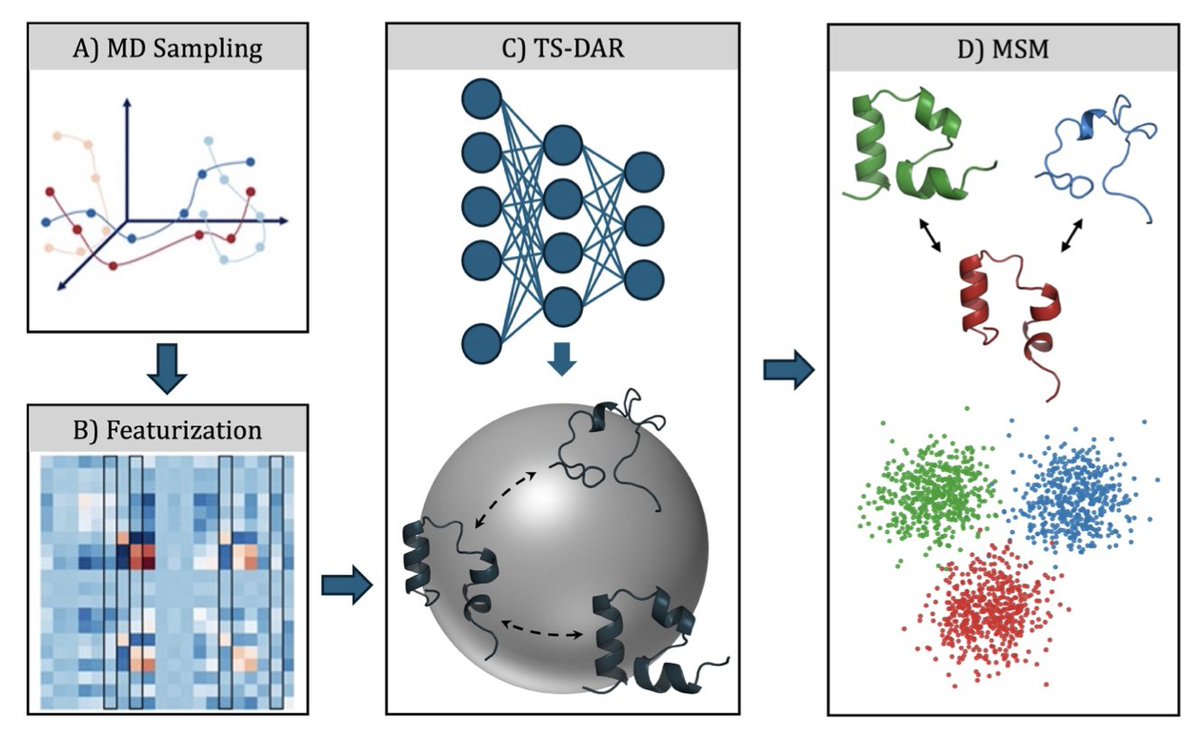
2. TS-DAR leverages a deep learning model to map protein conformations from molecular dynamics (MD) simulations onto a hyperspherical latent space. This low-dimensional representation retains essential kinetic information while allowing for the automated identification of transition states through a combination of VAMP-2 and dispersion loss functions.
3. The framework is particularly innovative in its use of out-of-distribution (OOD) detection. By treating transition states as OOD relative to metastable states, TS-DAR can identify these rare conformations that are crucial for understanding biomolecular mechanisms and developing targeted therapeutics.
4. The tutorial provides a step-by-step workflow for implementing TS-DAR, including MD sampling, featurization, model training, and MSM construction. It also offers practical advice on hyperparameter tuning and model evaluation, making it accessible for researchers in computational biophysics.
5. The efficacy of TS-DAR is demonstrated across multiple systems, from simple 2D potentials to complex biomolecules like the DNA motor protein AlkD. It outperforms previous methods in both accuracy and efficiency, uncovering novel insights into key interactions that enable proteins to overcome free energy barriers.
6. The guide includes detailed examples for alanine dipeptide, the villin headpiece (HP35), and protein phosphatase 2A (PP2A). These examples illustrate how TS-DAR can be applied to different systems, highlighting its versatility and potential for advancing studies on drug binding, enzyme activity, and mutation effects.
7. The integration of TS-DAR with MSMs allows for accurate kinetic modeling of biomolecular systems. The tutorial explains how to construct an MSM from TS-DAR-derived states and validate it using the Chapman-Kolmogorov test, ensuring that the model captures the essential long-timescale kinetics.
8. Future perspectives for improving TS-DAR are also discussed, such as incorporating equivariant neural networks for more efficient feature selection and using TS-DAR-derived collective variables for enhanced sampling techniques like metadynamics.
📜Paper: doi.org/10.26434/chemrxiv-20…
#BiomolecularSimulations #TransitionStateAnalysis #DeepLearning #ComputationalBiophysics #ProteinDynamics #DrugDiscovery #EnzymeActivity #MutationEffects
1
3
18
1,363