Dawson Hacks retweeted

Jun 12
TrustGraph 2.5 is out 🎉
The highlights:
☁️ @alibaba_cloud now supported
🔬 SPARQL GraphQL Workbenches in the UI
🌍 Live workspace/collection/flow switcher in the UI header
🔐 MCP server auth actually works now (Bearer token, in-band WebSocket)
⚡ SPARQL 1.1 engine: 30 new functions, MINUS operator, streaming eval, bind join optimisation
🗄️ Knowledge cores now preserve full provenance on round-trip
🏭 Cassandra TLS replication fixes, Qdrant shard/replication config, K8s Secrets for object store creds
Bunch of workspace routing and large document OOM fixes
ALT TrustGraph adds support for Alibaba Cloud
1
2
4
330

Jun 12
Journalism has changed. Or has it?
#TrustGraph study details the 19-year transfer of trust from institutions to individuals with a master evidence matrix, 34 exclusive editor interviews, comprehensive syllabus, interactive exhibits, and R1 academic rigor. visualeditors.com/trust
1
35
Tung Le retweeted

Jun 9
Before Trustgraph M2: you check an agent's score and hope it's accurate.
After: you verify it cryptographically against a Merkle root anchored on-chain with an EIP-712 attestation. In milliseconds.
No API. No intermediary. No faith.
The machine economy doesn't run on trust. It runs on proofs.
Live now on Paynaptic.
11
8
25
1,331

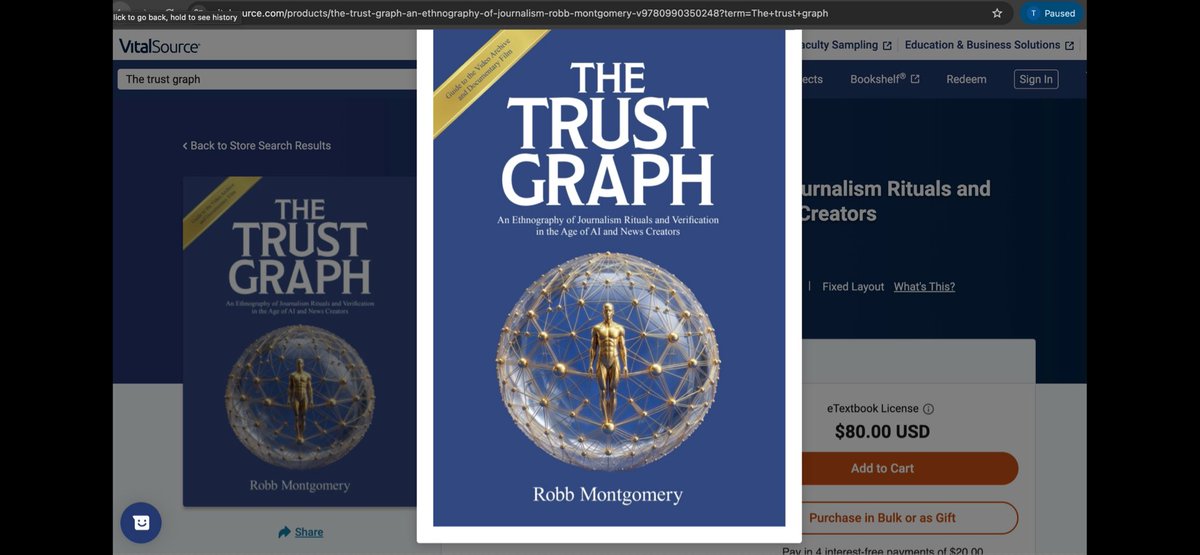
Outdoor time after publishing the massive #TrustGraph academic project (book, archive, dramaturgy, syllabus, exhibits, data visualizations.) The Film festival documentary is in post production in Hollywood.
33
Journalism has changed. Or has it?
#TrustGraph study examines the 19-year transfer of trust from institutions to individuals with a master evidence matrix, 34 exclusive interviews, syllabus, interactive exhibits, and R1 academic rigor.
Vital Source (Barns & Noble College)
1
70

Jun 3
Anyone looking for enterprise grade semantic tooling should check out TrustGraph. It's an incredible tool to assist both AI agents and humans execute tasks with greater organizational knowledge.
Apache 2.0 license and they just dropped their 2.4 update with expanded identity features.
docs.trustgraph.ai/getting-s…
May 30

TrustGraph 2.4 is out — and it has a UI now 🎉
New in 2.4:
- Full web UI: Agent Console, GraphRAG view, 3D Knowledge Explorer, Ontology Workbench, Schema Workbench, Document Ingestion, Flow Management
- JWT-based IAM with API keys, capability-based auth, and full user/workspace management CLI
- Workspace multi-tenancy — enforced at the queue layer, not message fields
- Pluggable bootstrap framework replacing tg-init-trustgraph
- No-auth mode for dev/demo deployments
- Async-safe Cassandra Qdrant I/O
- Pulsar message loss stale producer bugs fixed
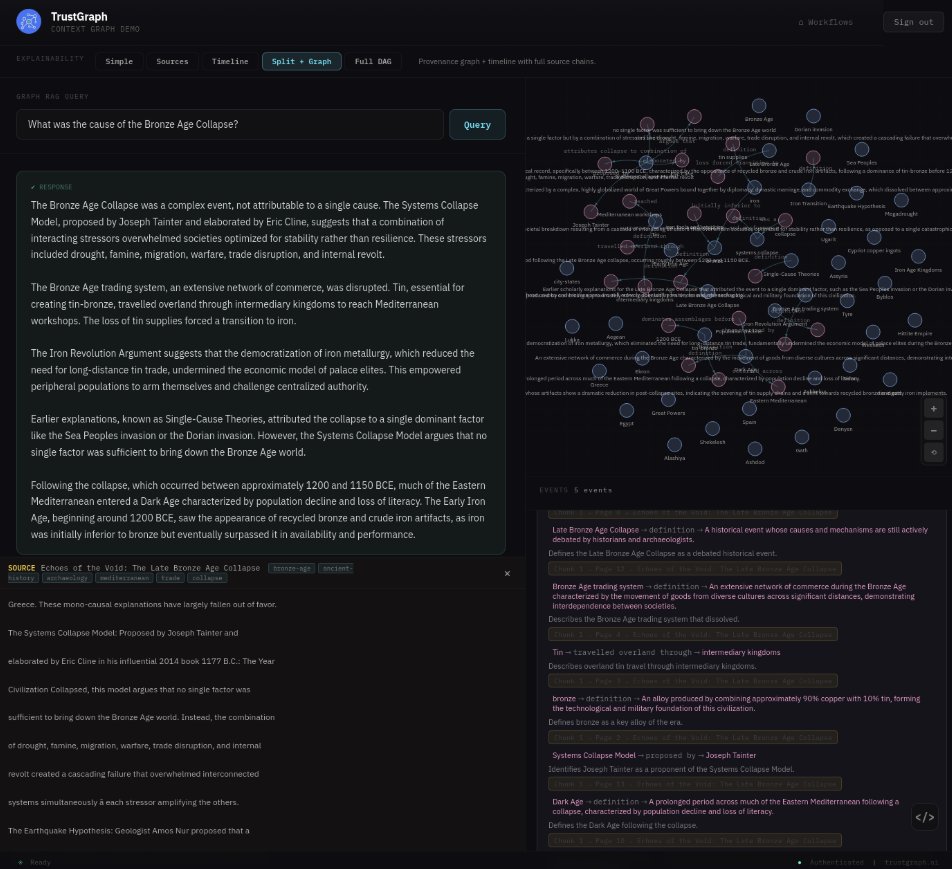
ALT TrustGraph is the leading innovator in context graphs
1
2
3
97

Jun 1
While we wait for @PiCoreTeam for meaningly announcements let's talk Pi Infrastructure. 🙂
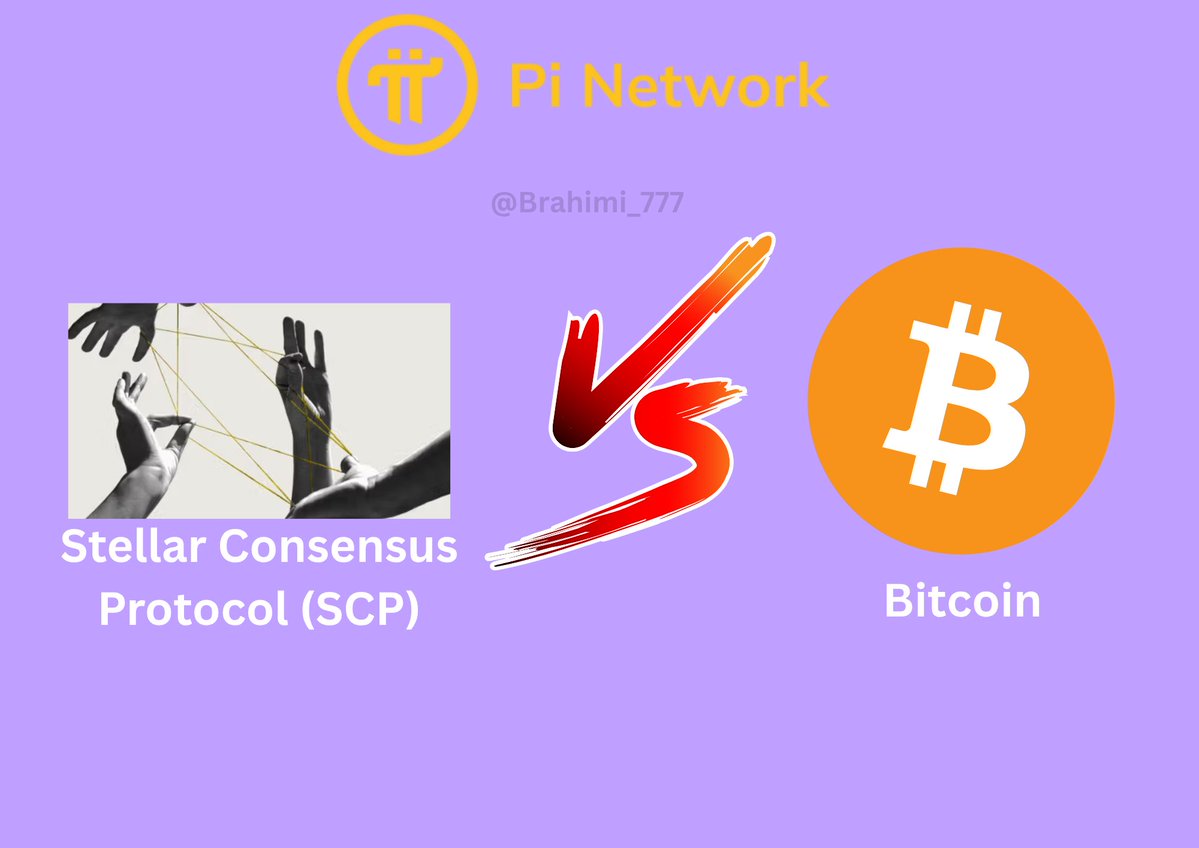
How does the Stellar Consensus Protocol differ from Bitcoin's mining?
The Stellar Consensus Protocol (SCP) used by Pi Network differs fundamentally from Bitcoin’s Proof of Work (PoW) in its mechanism for reaching agreement, its environmental impact, and how it handles transaction finality.
1. Consensus Mechanism: Puzzles vs. Voting
Bitcoin (Proof of Work): Bitcoin nodes compete in a race to solve complex computational puzzles.
The first node to solve the puzzle is "elected" as the leader for that round and is allowed to post the latest block of transactions.
SCP (Federated Byzantine Agreement): There is no explicit leader in SCP.
Instead, nodes come to a consensus by exchanging lightweight network messages to vote on which block should be next.
Each node determines its own "quorum slices"-groups of other nodes it deems trustworthy-and a transaction is only accepted when a sufficient proportion of nodes in these quorums agree.
2. Resource Consumption and Accessibility
Bitcoin: Maintaining the network requires enormous computing power and energy, as users essentially "burn money" and electricity to solve puzzles.
This has led to the rise of massive server farms and specialized hardware (ASICs), making it difficult for everyday people to participate.
SCP: This protocol is "planet-friendly" because it does not require massive electrical waste.
Because it relies on messaging rather than raw processing power, it can run on personal computers and laptops without draining the battery or CPU excessively.
3. Transaction Speed and Finality
Bitcoin: Bitcoin produces a new block approximately every 10 minutes.
Because the chain can occasionally be overwritten shortly after a block is produced, users typically wait about one hour to be certain a transaction is final.
SCP: SCP is significantly faster, generally achieving transaction finality in 3 to 5 seconds.
Once a transaction is recorded under this protocol, it is considered safe and certain almost immediately.
4. Reward Distribution
Bitcoin: Rewards are "winner-take-all," given only to the one miner who solves the puzzle first every 10 minutes.
This often forces individuals into centralized mining pools to have a chance at receiving a share.
SCP (as applied in Pi): Pi uses the core SCP algorithm to compute a meritocratic distribution of rewards once a day.
Instead of rewarding a single lucky winner per block, everyone who actively contributed to the network-whether as a Pioneer, Contributor, Ambassador, or Node-receives a portion of the daily distribution.
5. Trust and Security
While Bitcoin relies on the economic cost of "burning" energy to prevent fraud, SCP relies on a trust graph.
In the Pi Network, this graph is built from the Security Circles of millions of mobile miners, which Nodes then use to configure their quorum slices and secure the shared ledger.
#PiNetwork #MobileMining #SCP #TrustGraph #CryptoRevolution
3
5
44
1,791

May 30
Ever wanted to work with complex ontologies and schemas, but there weren't any good tools to making with working them easy?
That ends today with @TrustGraphAI 2.4. Now TrustGraph ships with a comprehensive UI that makes working with context graphs easier than ever!
May 30
TrustGraph 2.4 is out — and it has a UI now 🎉
New in 2.4:
- Full web UI: Agent Console, GraphRAG view, 3D Knowledge Explorer, Ontology Workbench, Schema Workbench, Document Ingestion, Flow Management
- JWT-based IAM with API keys, capability-based auth, and full user/workspace management CLI
- Workspace multi-tenancy — enforced at the queue layer, not message fields
- Pluggable bootstrap framework replacing tg-init-trustgraph
- No-auth mode for dev/demo deployments
- Async-safe Cassandra Qdrant I/O
- Pulsar message loss stale producer bugs fixed
ALT TrustGraph is the leading innovator in context graphs
1
1
5
423
May 30
TrustGraph 2.4 is out — and it has a UI now 🎉
New in 2.4:
- Full web UI: Agent Console, GraphRAG view, 3D Knowledge Explorer, Ontology Workbench, Schema Workbench, Document Ingestion, Flow Management
- JWT-based IAM with API keys, capability-based auth, and full user/workspace management CLI
- Workspace multi-tenancy — enforced at the queue layer, not message fields
- Pluggable bootstrap framework replacing tg-init-trustgraph
- No-auth mode for dev/demo deployments
- Async-safe Cassandra Qdrant I/O
- Pulsar message loss stale producer bugs fixed
ALT TrustGraph is the leading innovator in context graphs
2
1
5
657