
UKRAINE REWROTE THE RULES OF WAR
Most people think wars are won by whoever has the biggest guns, the most jets, the most tanks, the most missiles.
The war in Ukraine is quietly proving that old assumption wrong, and Washington had better be paying attention.
Since Russia's full-scale invasion in February 2022, Ukraine has built a war machine from scratch, not inside massive government factories, but inside a decentralized network of engineers, private startups, volunteers, and battlefield innovators working at speeds that traditional military procurement cannot match.
Ukraine's defense sector expanded from roughly 300 companies in 2022 to nearly 1,000 by 2025, with around 80% of them privately owned.
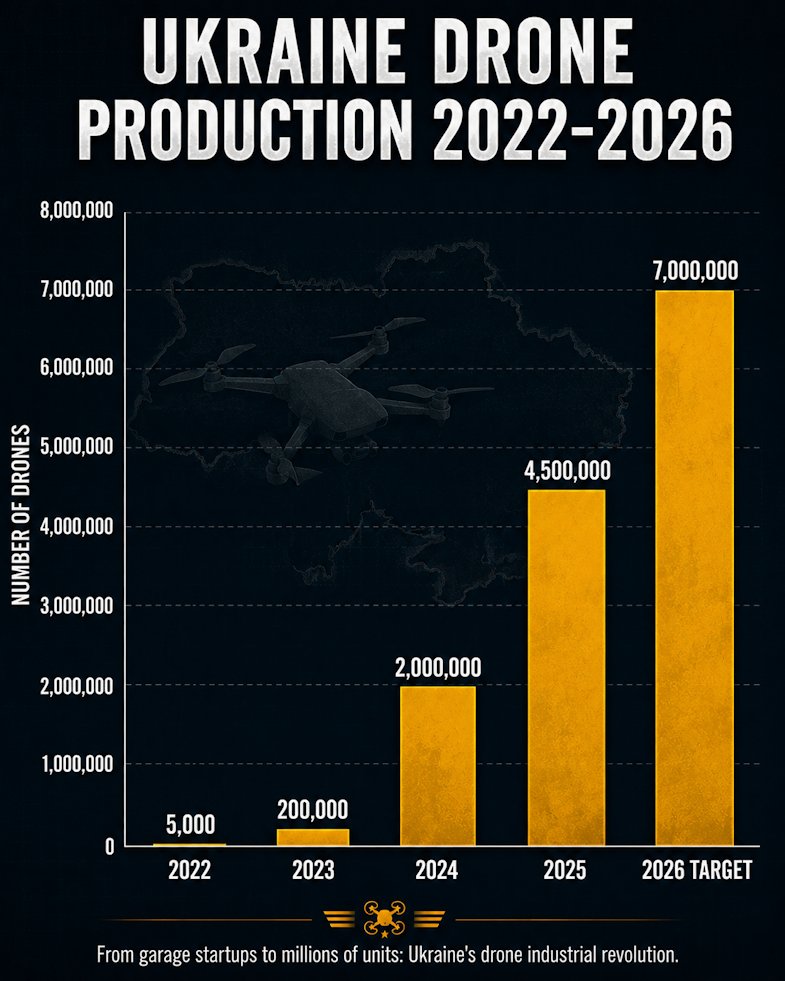
Ukraine went from producing a few thousand drones per year to an estimated 4.5 million in 2025, with a target of 7 million in 2026.
The United States and all of NATO combined produce a fraction of that number.
Engineers are the new generals
This battlefield transformation has exposed something uncomfortable for American defense planners.
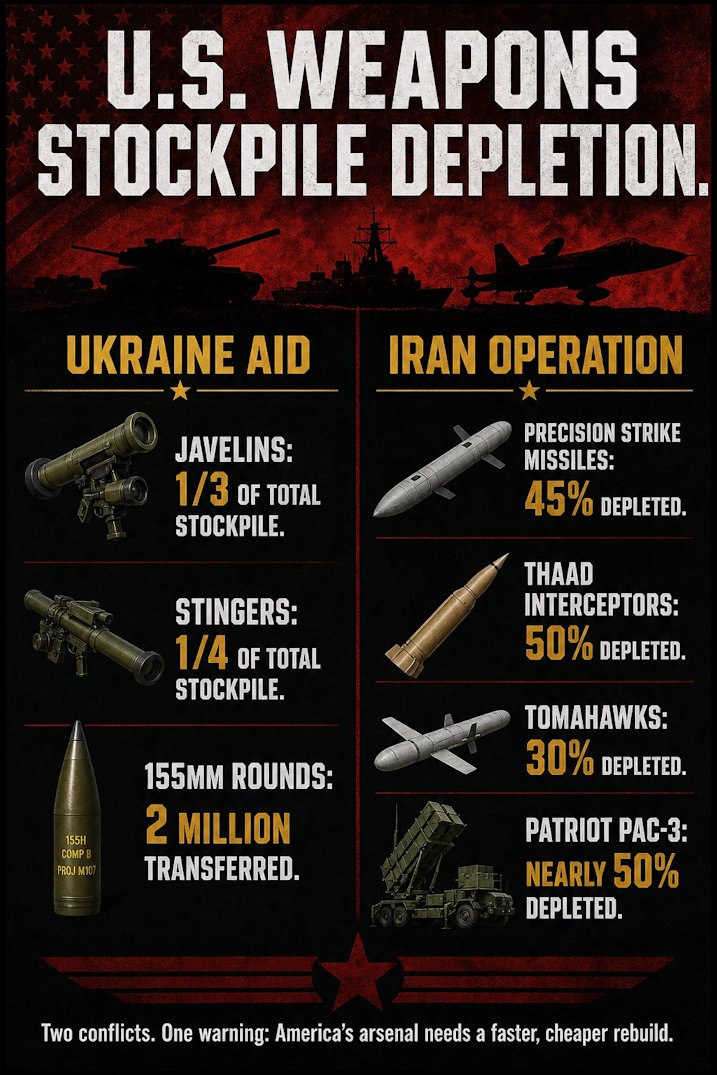
The U.S. shipped roughly one-third of its entire Javelin anti-tank missile inventory to Ukraine. One quarter of all Stinger shoulder-fired missiles followed. More than two million 155mm artillery rounds were transferred.
Raytheon acknowledged it would take at least five years at previous production rates to fully replenish the Javelin inventory alone.
At one point, Ukraine was burning through in 48 hours the same number of 155mm rounds the United States produces in an entire month.
Then came the Iran operation.
The U.S. burned through 45% of its Precision Strike Missile stockpile, roughly half of its THAAD interceptors, nearly half of its Patriot PAC-3 inventory, and more than 30% of its Tomahawk cruise missiles in a single conflict.
Each Tomahawk depends on rare earth magnets that China controls almost entirely. The weapons cupboard is not just getting empty.
Refilling it increasingly depends on Beijing.
This is not an argument against Lockheed Martin or Raytheon. America still needs advanced, high-end weapons systems.
But Ukraine is teaching a lesson those companies should be learning too: the side that can innovate fast and manufacture cheap may gradually overwhelm the side with better but far fewer legacy platforms.
The innovation ecosystem that changed warfare
General David Petraeus (@GeneralPetraeus), who has visited Ukraine ten times during the war, says the secret behind Ukraine's battlefield success lies in its overall command and control ecosystem that integrates surveillance, targeting, and kinetic strikes.
He concluded that Ukraine's lessons will form the basis for what he calls a "whole new concept of warfare."
U.S. Army Secretary Dan Driscoll (@SecDriscoll) told Congress in April 2026 that Ukraine has done "an absolutely amazing job of innovating" and that the U.S. military has much to learn from it.
According to the French Institute of International Relations, in modern high-intensity warfare, software integration and information management, not platform performance, are the primary drivers of operational tempo and combat effectiveness.
The army that writes better code may win as decisively as the army with the better tank.
Ukraine's defense ecosystem links battlefield units, startups, engineers, procurement channels, and foreign partners in a rapid adaptation cycle.
Unsuccessful designs are discarded quickly.
Successful ones are scaled across the force faster than any traditional acquisition system allows.
One FPV drone costs a few hundred dollars. One Javelin costs roughly $175,000. The math is not complicated.
The Pentagon is now negotiating to buy Ukrainian interceptor drones, having concluded that no American manufacturer can currently match Ukraine's price, delivery times, and battlefield-tested reliability.
That sentence deserves a second read.
America, the world's leading military power, is looking to a war-torn country for lessons in affordable battlefield innovation.
The Ukraine war is not just a European conflict. It is a live experiment in the future of warfare.
The country with the most F-35s does not automatically win the next war.
The country that can produce millions of cheap smart drones, update their software in days, and replace losses faster than the enemy destroys them has a serious strategic advantage.
America's defense establishment is world-class. But speed, adaptability, and industrial scale at low cost are not currently its strongest features.
Ukraine is proving they can be decisive.
Ukraine may be remembered as the war where engineers became as important as generals.
America innovates when it must. The question is whether we will learn this lesson now, or wait until we have no choice. 🇺🇸🎯 #AmericaFirst #FutureOfWar #UkraineWarLessons
CMC, 1
262

Feb 21
🚨𝗕𝗥𝗘𝗔𝗞𝗜𝗡𝗚 :𝗖𝗵𝗶𝗻𝗮 𝗥𝗮𝗰𝗲𝘀 𝘁𝗼 𝗖𝗼𝘂𝗻𝘁𝗲𝗿 𝗙𝗣𝗩 𝗗𝗿𝗼𝗻𝗲 𝗧𝗵𝗿𝗲𝗮𝘁 𝗔𝗳𝘁𝗲𝗿 𝗨𝗸𝗿𝗮𝗶𝗻𝗲 𝗪𝗮𝗿 𝗟𝗲𝘀𝘀𝗼𝗻𝘀
The Chinese military is developing innovative methods to counter FPV drones.
Following lessons learned in the war in Ukraine, Beijing considers FPV drones a real threat to ground forces and armored vehicles, and is racing against time to develop effective countermeasures.
#ChinaMilitary #FPVDrones #DroneWarfare #UkraineWarLessons #DefenceTechnology #ModernWarfare
1
7
17
1,081

26 Oct 2025
Posting tomorrow... PFC Podcast 252: Prolonged Tourniquet Conversion
Posting tomorrow... PFC Podcast 252: Prolonged Tourniquet Conversion
🚨 Battlefield Hack: Convert Tourniquets Early to Save Limbs! 🩹
In the chaos of Ukraine's front lines, up to 75% of tourniquets applied pre-hospital were unnecessary in hindsight. But for those that are? Delaying conversion can lead to deadly ischemia-reperfusion injury – think kidney failure from potassium overload.
From the latest Ukrainian study (via @prolongedfieldcare podcast):
🔹 Focus on the "middle group" – stable patients where surgeons fight to save the limb.
🔹 Key tip: Convert ASAP at the aid station. Success rate? 50-75%!
🔹 Winter woes: Extra layers make wound assessment tougher – double-check those bleeds.
Watch the full breakdown with Dr. John Holcomb on PFC Podcast Ep. 255. Link in bio! What's your go-to TQ conversion strategy? Drop it below 👇
#TacticalMedicine #TourniquetTraining #UkraineWarLessons #ProlongedFieldCare #CombatMedic #SOFMed #AustereMedicine #PFCpodcast
@SpecOpsMedics @GreenBeretMD @armyemdoc @DeltaDev_Team @NARescue
2
8
382

4 Feb 2024
Trump-Proofing Europe: How the Continent Can Prepare for American Abandonment >> foreignaffairs.com/united-st… - As Russia’s war in Ukraine enters its third year, Europe has performed far better than expected. For decades after World War II, it counted on the United States to be the ultimate guarantor of its security. The continent relied on Washington to guide NATO policy, provide nuclear deterrence, and forge consensus among European countries on controversial questions such as how to resolve the 2009–12 European debt crisis. Europe continued to take the U.S. security umbrella for granted after the Cold War ended, slashing defense spending, failing to stop the Bosnian genocide in the early 1990s, and refusing to play a political role in resolving the crisis in Syria, even as it remained the region’s biggest provider of humanitarian aid. After Russia invaded Ukraine in 2022, many anticipated that Europeans might balk at helping Kyiv. The last time Russian President Vladimir Putin marched over Ukrainian borders—annexing Crimea in 2014—Europe responded with weak sanctions and halfhearted attempts at diplomatic compromise while increasing its dependence on Russian gas. #EUPreparedness #TransatlanticFuture #StrongerTogether #EuropeanSecurity ️#UkraineWarLessons #DefenseSpendingBoost #EnergyIndependence

44

27 Nov 2023
Coming soon 🔜 at @StrategyFuture1 :
@WarVsPeaceOrg and @A_Swidzinski discuss lessons learned from the Ukraine War, trends in warfare, and the future of US grand strategy.
#UkraineWarLessons #WarfareTrends #USGrandStrategy #GeopoliticalInsights #FutureOfConflict #GlobalSecurity

2
5
185

20 Jun 2023
I'm going to have to learn how to write things more nicely about allies but 'what the funk'?
That 190k NATO target must be from ISAF-era, not 2031. There's not a single serious NATO member officer who thinks that's sufficient contribution for industrial war.
#Ukrainewarlessons
20 Jun 2023

Bundeswehr will need to purchase 190,000 rounds of 155 mm ammunition until 2031 to meet NATO targets. Current stock? 20,000 rounds. This of course is just a snap shot of German ammunition stockpile (or the lack thereof)-woes.
n-tv.de/politik/Pistorius-ma…
6
2
22
6,925