
1
Jonathan Brash MP retweeted

@JonathanBrash explains why he is supporting #VATsTheProblem campaign. hartlepoolmail.co.uk/news/po…
1
1
165
Emsworth Life retweeted

Jun 12

Really proud to have tabled this EDM and led the previous petition. We cannot let our hospitality sector wither away- I'm fighting for it- it's too important not to!
4
11
643
Hull & EY CAMRA retweeted

📣 We're backing the new #VATsTheProblem campaign, headed up by Tom Kerridge, which calls on the UK Government to reduce VAT for hospitality businesses.
🖋️ Sign the petition here: vatstheproblem.co.uk/
2
2
88
Thomas Giles Babb retweeted

Jun 11
The #VATsTheProblem petition has now reached 200,000 signatures.
Chef @ChefTomKerridge spoke to Newsnight about the huge cost pressures facing hospitality. A 10% VAT rate for hospitality could help save hospitality businesses in the UK.
We’re making great progress, but we need 1 million signatures to make the case to Government.
Sign the petition today 👇
vatstheproblem.co.uk/
1
18
43
1,574
Justin Mullender retweeted

The Night Time Industries Association supports Chef Tom Kerridge’s #VATsTheProblem campaign and is calling on businesses across the entire night-time economy to back a much-needed cut to VAT.
From #pubs, #bars, #clubs and #restaurants to l#ivemusic venues, #casinos, #nightclubs, #hybridspaces, #events promoters, #festivals, #hotels and the thousands of other important at hospitality businesses, this is an issue that affects us all.
Please Sign, Share, and Help us amplify this important message.
buff.ly/3j2deCB
#VAT #NightTimeEconomy #NTE
6
9
400
Justin Mullender retweeted

Ready for the Weekend? Have you signed #VATsTheProblem? - mailchi.mp/thedogatwingham/n…
1
2
30
Hospitality Proud retweeted

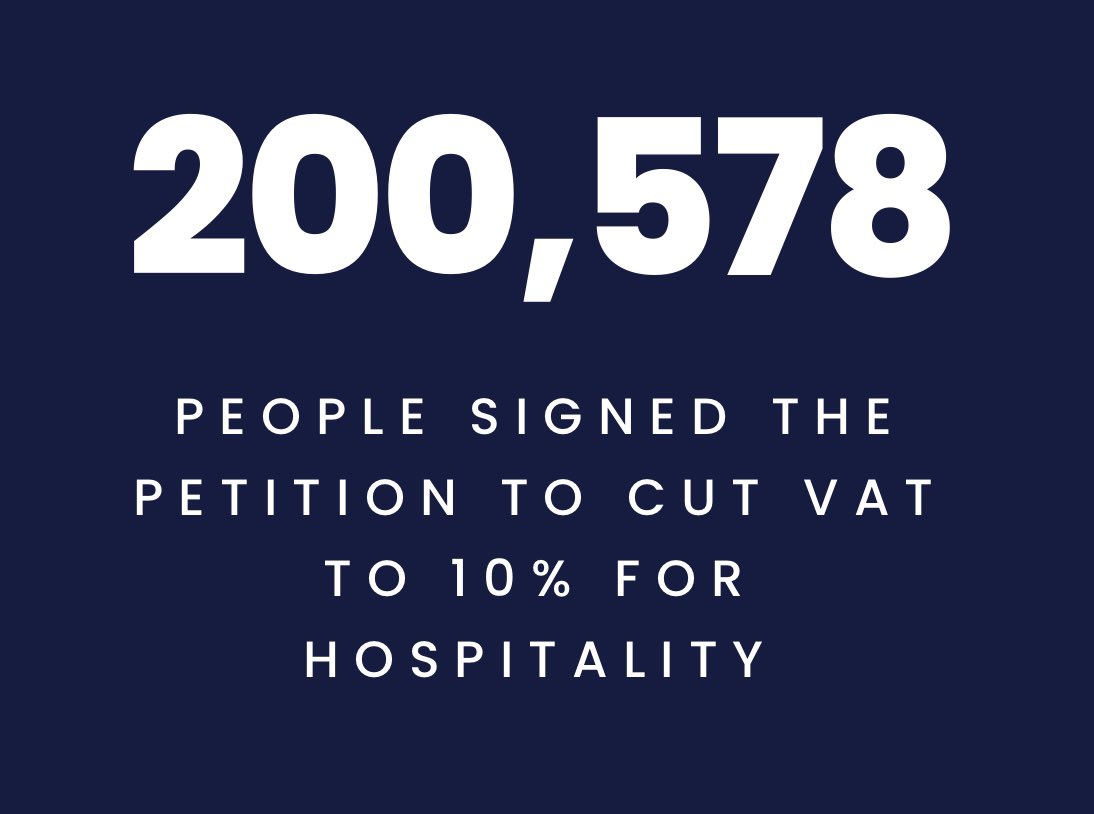
At 3pm today the #vatstheproblem campaign had reached 200,578 signatures
Let’s keep this going by signing and sharing
Visit vatstheproblem.co.uk to sign
@ChefTomKerridge @UKHofficial @beerandpub @ntiaofficial @BIIandBIIAB @HospUlster @IoH_Online
13
21
1,481
Jun 12
🚨 Hospitality VAT campaign passes major milestones
EDM (Early Day Motion) 65944 has reached milestone of over 40 MPs and support from nearly every major political party in Westminster.
At the same time, the wider #VATsTheProblem campaign has hit over 200,000 supporters, showing growing public and political backing for VAT for hospitality in line with Europe.
Momentum is building. One industry. One ask.
#VATsTheProblem #VATInlineWithEurope #Hospitality #Pubs #Restaurants #Tourism
edm.parliament.uk/early-day-…
Vatstheproblem.co.uk
1
12
33
8,938

Jun 12
This is a thoughtful and considered contribution, and I wanted to respond with why I agree with almost everything Dan says but arrive at a different conclusion - that the government should cut VAT for the sector.
👇
The simple version is that the government consistently tell us that unwinding the complexity of wider taxes leaving hospitality overtaxed is too complex. VAT is a Gordian solution.
*Unequal burden* - pre the first Reeves budget, it was estimated that the hospitality paid 66% of pre-tax profits in tax. Finance more like 32%. That inequality has grown materially since, in the ways Dan sets out. The issue isn’t how to pay for a hospitality tax cut, but why hospitality should be expected to pay more in the first place. I therefore dispute the framing of opposition to hospitality asking for help (Dan’s piece is of course far more nuanced and considered).
*Cost shock* - Dan kindly validates our estimation of the cost shock of Reeves budgets, and compares the VAT proposal against it. But that only extended the existing inequality. As above, the underlying situation was already unequal. The VAT proposal doesn’t just aim to redress the harm of the past two years, but to secure a wider rebalancing of the burden.
*Complexity* - business rates is a good example of this. The government couldn’t adjust business rates seriously in a way that would have delivered the manifesto commitment, because of the impact on US tech firms who underpay and the risk of retaliatory tarrifs. The tax code has evolved in a way that places a disproportionate burden on place-based businesses (about to get worse with the Holiday Tax), and the grown not build element of that creates policy complexity. VAT is an imperfect but operationalisable solution.
*Sector not size*. Dan rightly says that large businesses will benefit too. To me, that is not a weakness in our argument. Dan says that 45% of hospitality firms pay no VAT - that’s literally true, but not particularly meaningful. That 45% includes significant numbers of lifestyle and essentially dormant businesses. By definition [almost] anyone business with premises will pay VAT. Another metric using Dan’s footnotes to build the data is that something like 92% of jobs in the sector are with VAT registered firms, so really we’re looking at a support for the vast majority of jobs. Equally, unVATable businesses already receive generous support, so it’s not unreasonable to look elsewhere for where fairness is needed. The issue is that it’s the hospitality business model at all sizes which is suffering. It’s not SME vs Large. You’d rather be an SME fintech than a large restaurant chain from a tax perspective. Or indeed a large fintech than a small hospitality firm. One large holiday business has removed a million hours as a result this year. This is a sector problem and needs a sector solution.
I don’t dispute much of Dan’s analysis but I land in a different place. Vat is an achievable solution to the problem Dan and I agree exists.
#VATsTheProblem.
Jun 12

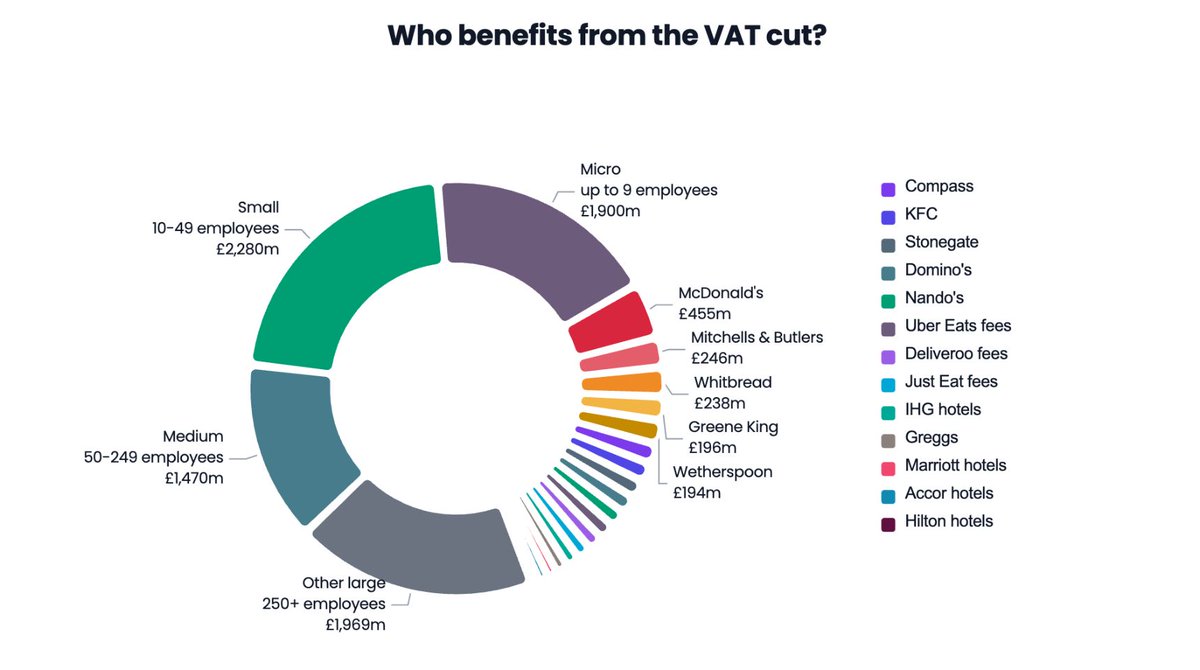
The hospitality industry wants their VAT cut to 10%. It will cost £12bn
Who benefits?
❌ The smallest most vulnerable businesses? Nope. 45% get nothing.
❌ Consumers? Nope - prices won't fall.
✅ Nearly half the cash goes straight to large chains. McDonald's gets £400m.
🧵:
5
8
18
10,845
Jun 12
There is a absolute hope that he is, he has said he will cut VAT for the #Hospitality industry - we as an industry must hold him to that. #vatstheproblem #vatinlinewitheurope
mca-insight.com/opinion/is-a…
6
4
19
1,133