


![Screenshot of Figure 2: Reclassification of VUS at 3 distinct transition points (ACMG/AMP, ACMG/AMP SVI, and ENIGMA): A. The top section of the figure shows the number of variants n as bars on the y-axis and their classification into (benign, likely benign, and variants of uncertain significance [VUS]) in their corresponding color (green, light green, and yellow, respectively) at 3 distinct transition points t1, t2, and t3 (x-axis). The transition points refer to the initial interpretation and the 2 reanalysis: American College of Medical Genetics and Genomics/Association for Molecular Pathology (ACMG/AMP) 2015 (t1) represent the baseline VUS for this study. These variants were classified as VUS between January 2018 and November 2023. Sequence Variant Interpretation Working Group (SVI) recommendations from 2015 onward were considered, depending on the time of classification, eg, PM2 used as ...[remainder at link]](https://venexa.site/media/GlyL64VXcAExhBG.jpg)
ALT Screenshot of Figure 2: Reclassification of VUS at 3 distinct transition points (ACMG/AMP, ACMG/AMP SVI, and ENIGMA): A. The top section of the figure shows the number of variants n as bars on the y-axis and their classification into (benign, likely benign, and variants of uncertain significance [VUS]) in their corresponding color (green, light green, and yellow, respectively) at 3 distinct transition points t1, t2, and t3 (x-axis). The transition points refer to the initial interpretation and the 2 reanalysis: American College of Medical Genetics and Genomics/Association for Molecular Pathology (ACMG/AMP) 2015 (t1) represent the baseline VUS for this study. These variants were classified as VUS between January 2018 and November 2023. Sequence Variant Interpretation Working Group (SVI) recommendations from 2015 onward were considered, depending on the time of classification, eg, PM2 used as ...[remainder at link]

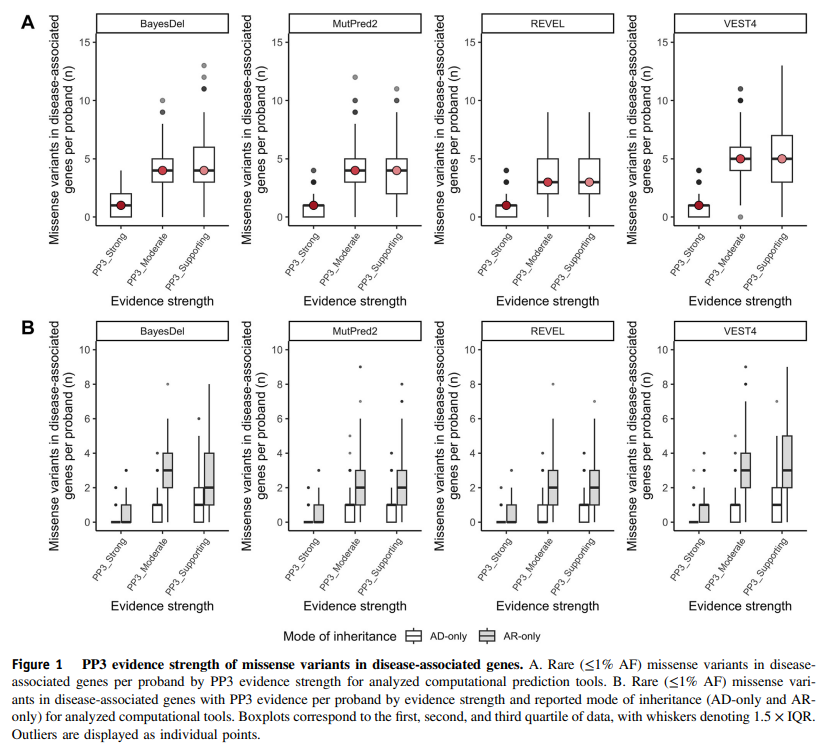
ALT Screenshot of Figure 1: PP3 evidence strength of missense variants in disease-associated genes. A. Rare (≤1% AF) missense variants in disease-associated genes per proband by PP3 evidence strength for analyzed computational prediction tools. B. Rare (≤1% AF) missense variants in disease-associated genes with PP3 evidence per proband by evidence strength and reported mode of inheritance (AD-only and AR-only) for analyzed computational tools. Boxplots correspond to the first, second, and third quartile of data, with whiskers denoting 1.5 × IQR. Outliers are displayed as individual points.




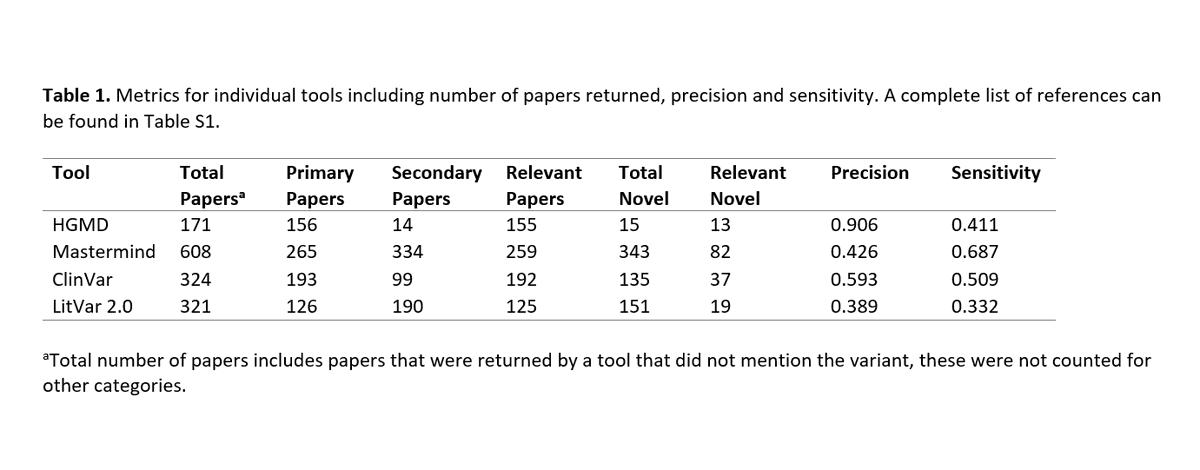
ALT Table 1. Metrics for individual tools including number of papers returned, precision and sensitivity