
Mar 23
We built a 3-agent system using OpenClaw that actually gets smarter over time. No cloud, no external dependencies, no reset button.
The Setup (nuts & bolts)
One Boss agent — the brain. It decides the highest-ROI actions each cycle.
Two slave agents — one desktop-focused (Playwright browser), one ASUS-focused (local execution). They do the heavy lifting.
Everything syncs through a shared OneDrive folder — dead simple, no Redis/RQ needed. Works flawlessly on Windows too.
Boss uses Grok as final quality gate, with Groq as fast fallback for polish.
Both Boss and slaves run self-critique loops — every output gets scored 1–10 and revised until 9 .
Memory layer: ChromaDB nomic-embed-text embeddings (via Ollama) — local vector DB, no cloud.
How the Memory Actually Works
Boss has a central memory bank that stores every polished win (vectorized output metadata).
Each slave has its own independent memory — remembers its specific strengths, past tasks, and failures.
Before every decision or execution, agents query their memory for similar past wins → pulls context automatically.
The shared playbook lives in memory too — both Boss and slaves reference/update it.
Why Memory Changes the Workflow
Without it, every task starts from zero — classic forgetful AI problem.
With persistent memory: agents reference real past performance, avoid repeating mistakes, and get noticeably sharper over days/weeks.
Self-critique memory means outputs keep improving without manual intervention.
Result: the whole team compounds knowledge — not just executes instructions.
We trained in continuous mode for weeks (522 high-quality wins stored), then switched to production mode (manual/scheduled runs only).
This isn’t flashy — it’s the difference between agents that reset and agents that actually evolve.
If you’re building locally, memory isn’t optional anymore. It’s the line between toy and tool.
What’s your current memory setup like? Or the biggest pain point you’re hitting without it? Drop it below — always good to hear real workflows.
#AIAgents #VectorMemory #MultiAgentSystem #AIAgency

1
1
2
472

Two new memory modules for Agents! 🧠🤖
Highlighting some recent work with @jerryjliu0 and @LoganMarkewich for adding new memory classes for Agents in the @llama_index framework.
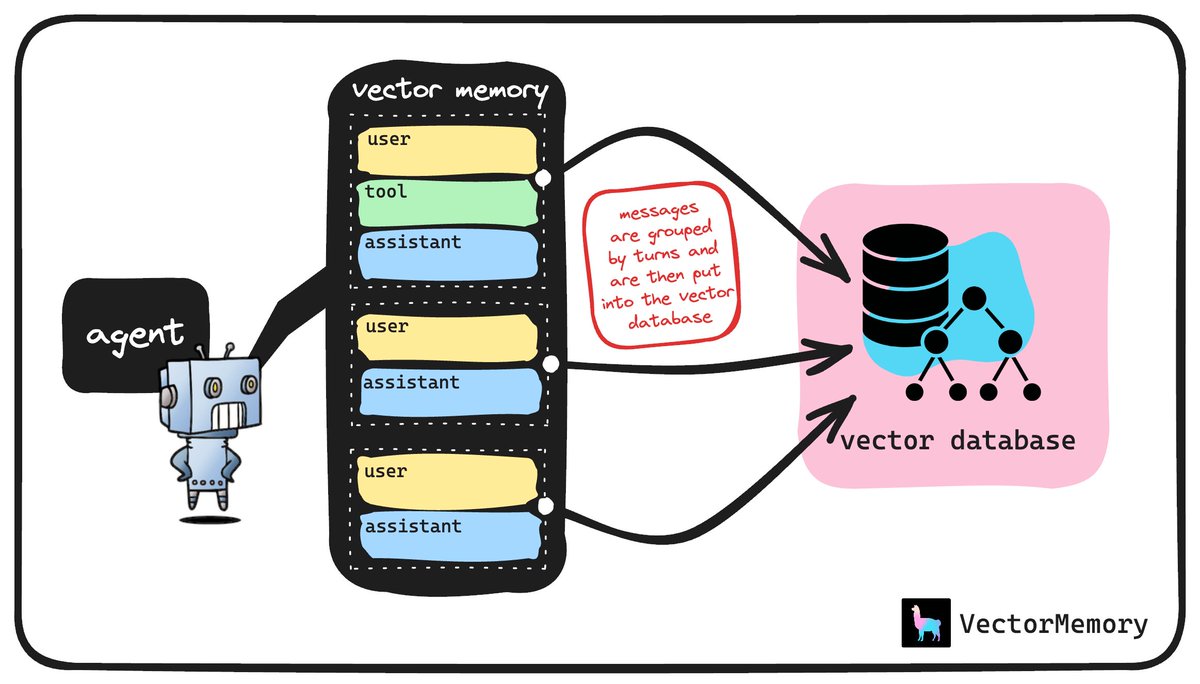
VectorMemory
◦◦◦◦◦◦◦◦◦◦◦◦◦◦◦
- Memory backed by a Vector Index
- Stores single-turns of conversations (initiated by a USER message) in a user-supplied Vector Store
- Messages are retrieved via typical embeddings retrieval
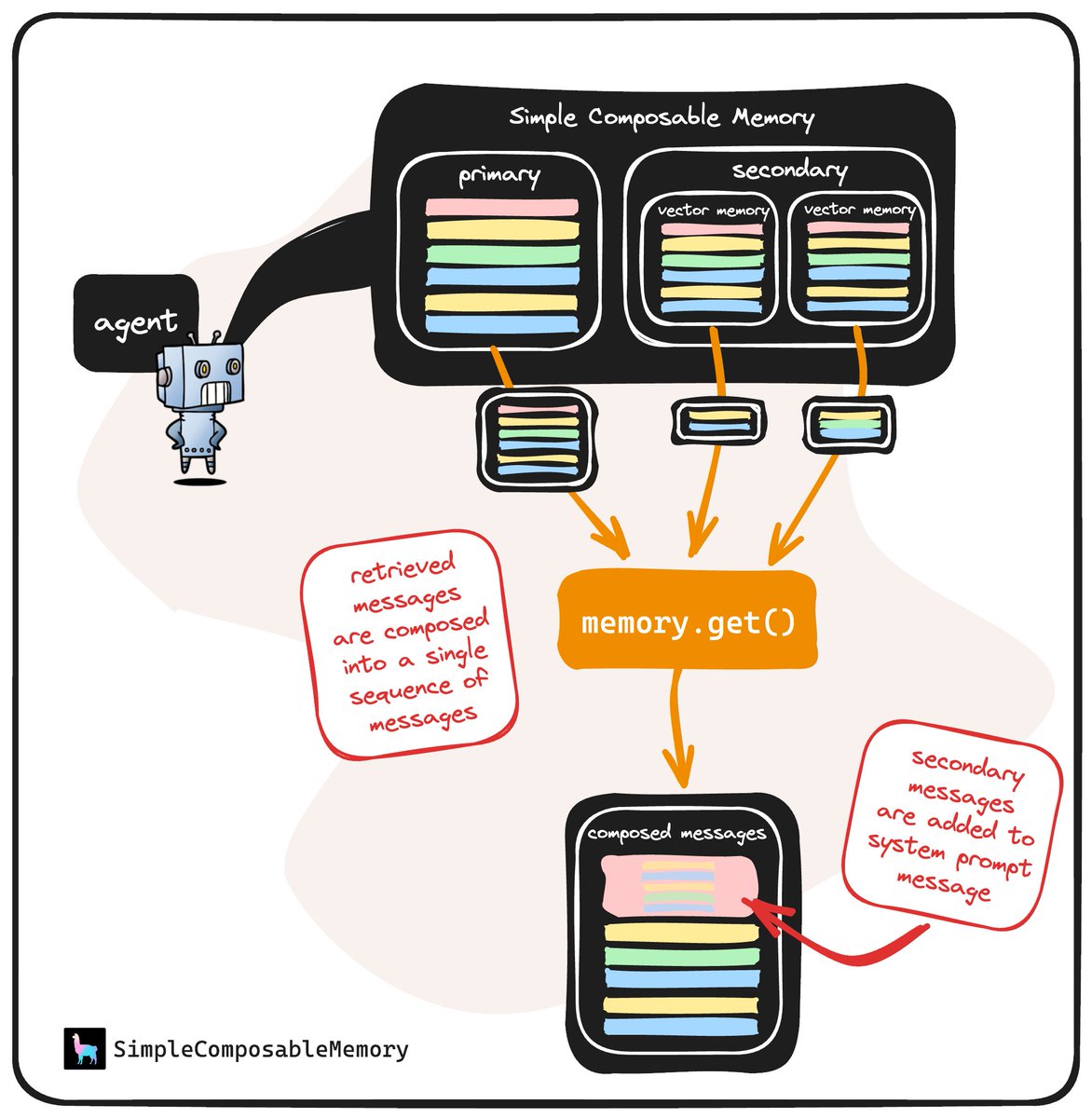
SimpleComposableMemory
◦◦◦◦◦◦◦◦◦◦◦◦◦◦◦◦◦◦◦◦◦◦◦◦◦◦◦
- Memory that combines messages retrieved from potentially multiple memory sources
- Comprised of a primary memory and secondary memory sources
- Messages retrieved from any secondary memory source gets added to the SYSTEM message prompt of the primary memory messages
Links
◦◦◦◦◦
📓 Demo notebook for VectorMemory: docs.llamaindex.ai/en/latest…
📓 Demo notebook for SimpleComposableMemory: docs.llamaindex.ai/en/latest…
2
16
62
6,948