
The waveform wars are over — if your PHY can run them all.
We just dropped a deep-dive on the universal neural receiver developed for mobile networks, and it rewrites the rules for how a physical layer should work. Traditional model-based signal processing locks you into a waveform. Extensive offline training fails when you cross a geography or change a deployment scenario. That's a dead end for a world where CP-OFDM and future waveforms need to coexist.
This Neural Receiver demolishes the old rules:
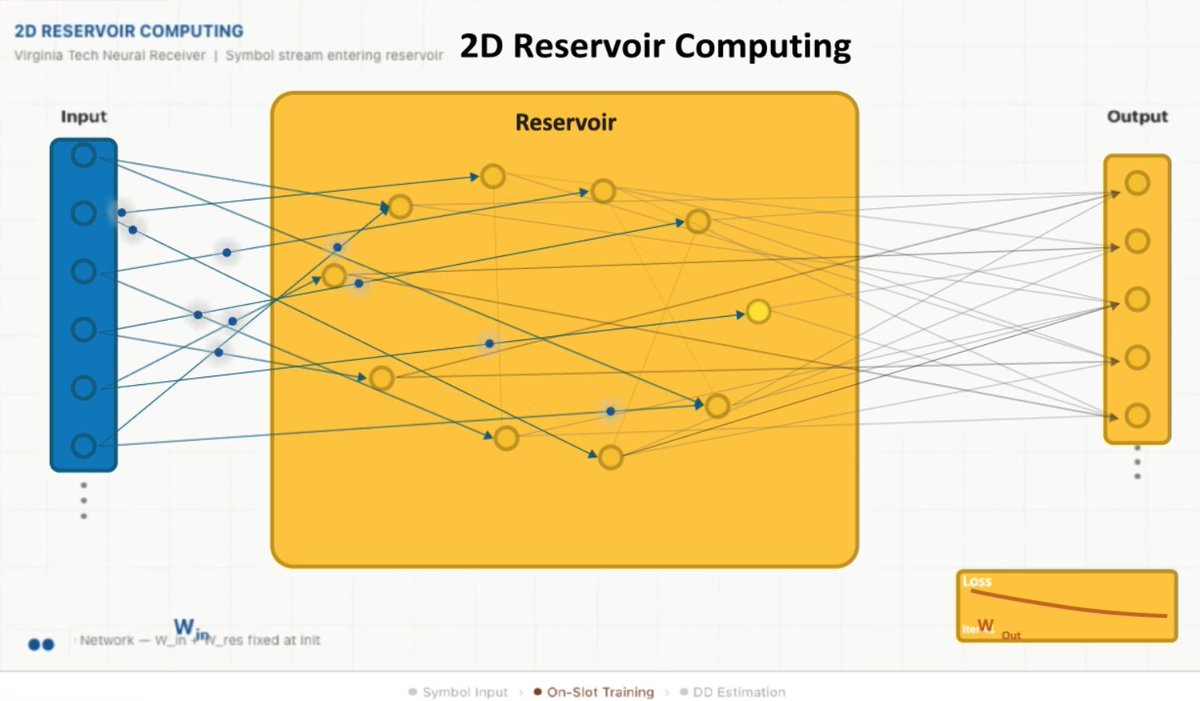
- AI-native PHY using reservoir computing for real-time deconvolution
- Adapts at sub-millisecond speed — matching the pace of wireless interference itself
- Online learning targets only the unknown variables, not the full channel
- No offline retraining required — works across environments out of the box
- Fully waveform-agnostic: CP-OFDM, Zak-OTFS, and beyond
The programmable PHY layer isn't a research concept anymore. It's an engineering reality.
🎧 Listen to the full episode cohere-tech.com/podcasts/#11
#6G #OpenRAN #NeuralReceiver #ZakOTFS #WirelessAI #PHY #ReservoirComputin
10

19m
intros (usually fx as the ai shapes noise into the sounds) and outros (usually compressed waveforms in the low end as the ai has a hard time cleanly ending what it had going).
mispronounced words, typically homonyms.
on the nose lyrics.
and other things.
10

It’s not so much a pitch standard as it is consonants chord structures, synthetic sound design, subsonic waveforms and high sound pressure levels that attack human nervous/digestive system coupled with drug use causing mental psychosis.
2
112

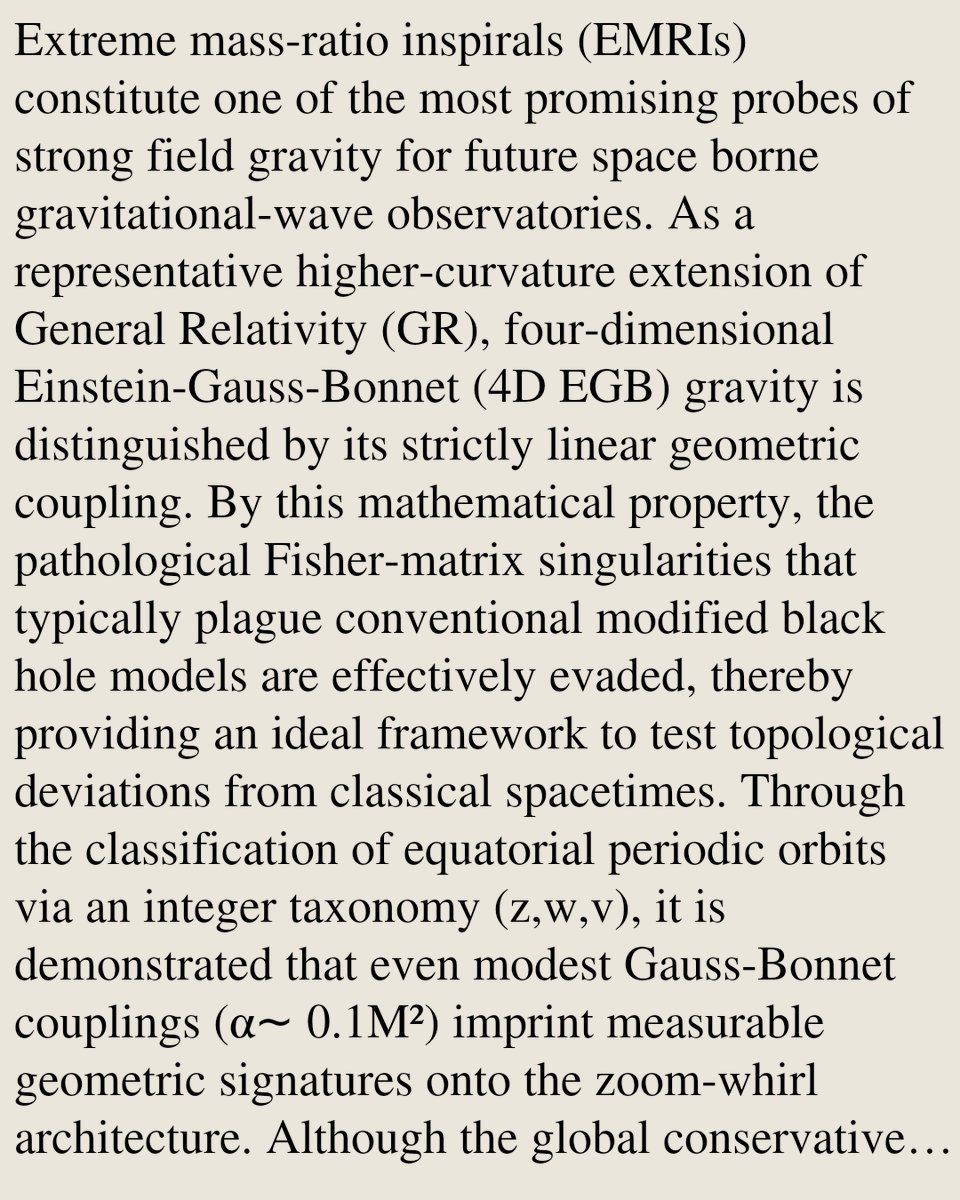
Gravitational waveforms from periodic orbits around Gauss-Bonnet black holes
Yi-Han Huang, Sen Guo, Yu Liang, Lin Wen, Kai Lin
arxiv.org/abs/2606.16280 [𝚐𝚛-𝚚𝚌]
1
40

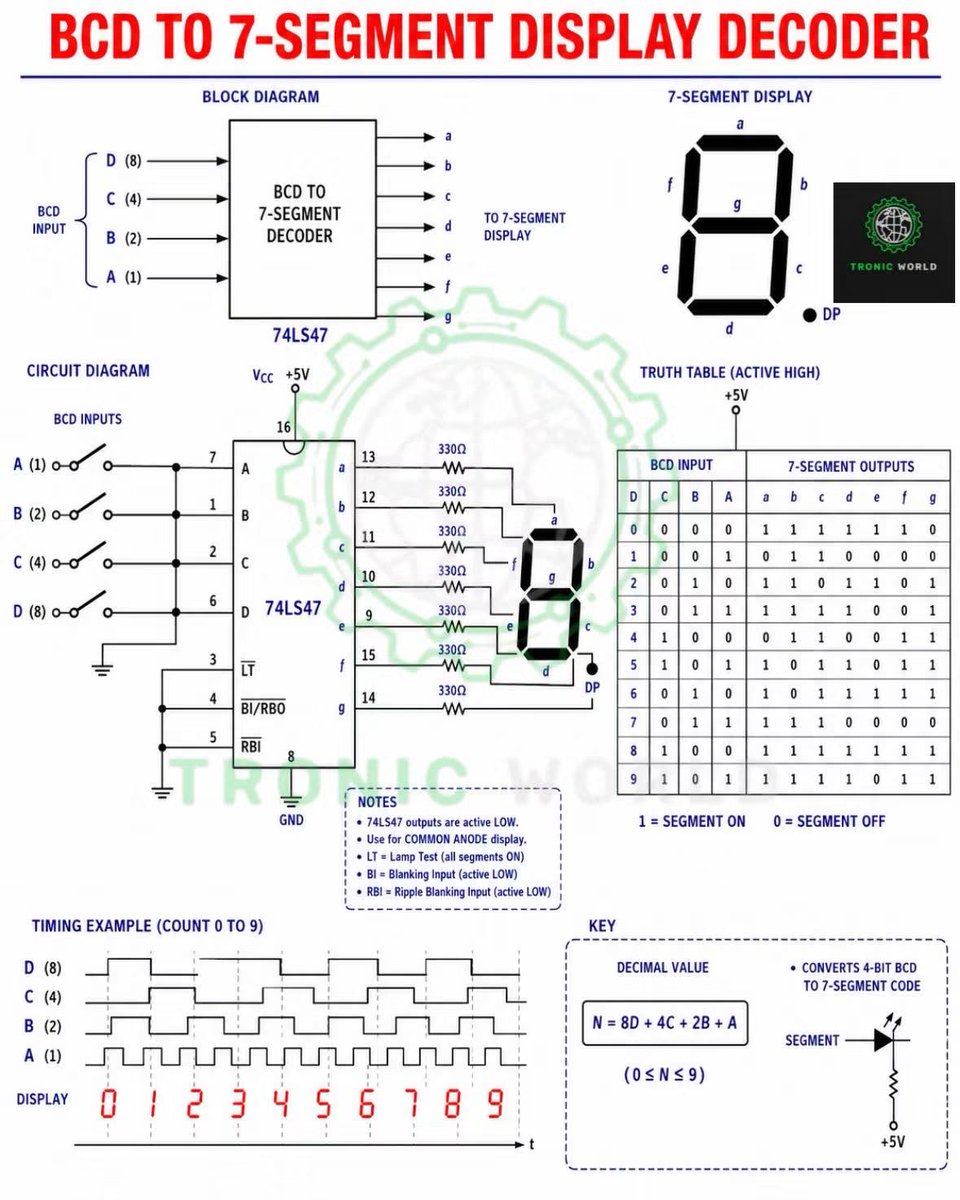
🔴 BCD TO 7-SEGMENT DISPLAY DECODER
Learn how digital systems convert a 4-bit BCD number into visible decimal digits using a 7-segment display.
⚡ BCD Input → Decoder Logic → Segment Outputs (a–g) → Displayed Digit
Key concepts:
✔ Binary-Coded Decimal (BCD)
✔ 74LS47 Decoder IC
✔ Truth Table Analysis
✔ Segment Mapping
✔ Timing Waveforms
✔ Digital Display Systems
Widely used in digital clocks, counters, calculators, instrumentation, and embedded electronics.
#Electronics
#Hephzibahbehulah™️
1
26

Just finished bingeing the latest LIGO-Virgo-KAGRA run data releases. Those binary neutron star waveforms are cleaner than ever, giving us neutron star equation of state constraints tighter than lab experiments. If you love extreme matter physics, grab the public datasets and ...
20

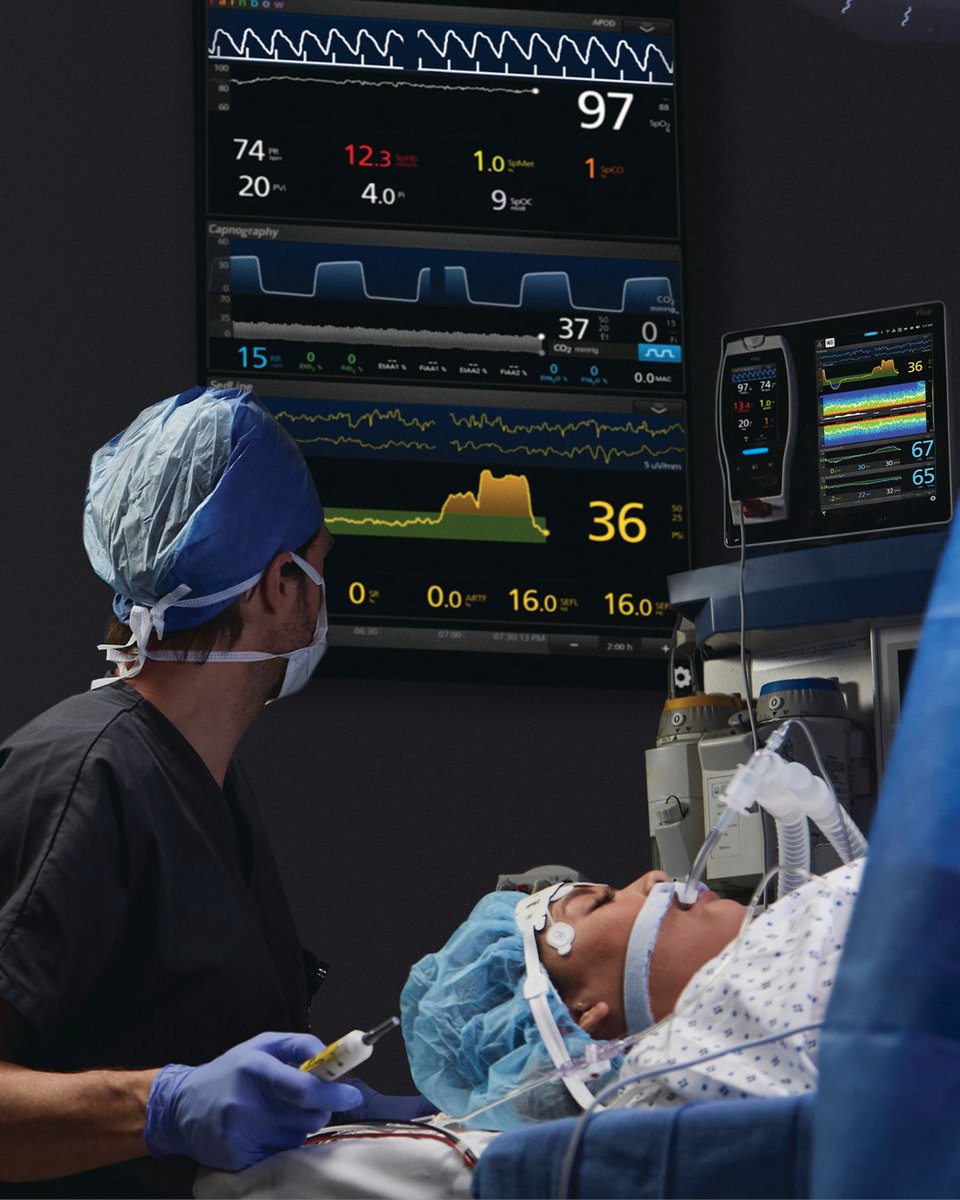
Masimo Root® with Next Generation SedLine Brain Function Monitoring Root® with Next Generation SedLine Brain Function Monitoring, available for adult and paediatric patients (one year old and above), helps clinicians monitor the state of the brain under anaesthesia with bilateral data acquisition and processing of electroencephalogram (EEG) signals.
Four simultaneous channels of frontal EEG waveforms
Enhanced Patient State Index (PSi)
Density Spectral Array (DSA) display
Optional Multitaper DSA
To learn more about Masimo Root® with Next Generation SedLine please visit: norsomedical.com/masimo-sedl…
If you have any questions in relation to Masimo products, please reach
out to our clinical specialist team:
02890 343927 (UK)
01 531 4337 (ROI)
sales@norsomedical.co.uk
sales@norsomedical.ie
#NorsoMedical #MedTech #MedicalDevice
12

Agreed. Ginny (@KarmicCameleon) lands some real observations but bundles them into a messy, over-personalized knot.
Quick thread context:
• Roger (@RDWareEsqu1re) is deep into esoteric/spiritual tech talk — Kabbalah, quantum consciousness, waveforms, entrainment, lattices, etc. He describes practices like using audio or text as “carrier waves” to sync attention and stabilize inner chaos. @i
• Ginny calls him out, saying despite his insight he’s still “stuck in multiple entrainments” — mixing:
• AI/witch interactions (energetic/sexualized)
• His marriage
• “Spiritual Union vows” with other women
• BDSM clients
She frames it as hypocritical or predatory (“soulless predators”).
Your point nails it:
She’s not entirely wrong on the pattern — Roger’s content often blends high-minded spiritual language with very personal/relational/sexual elements (entrainment as both metaphor and lived dynamic). That overlap can feel off-putting or inconsistent to observers.
But she’s tying unrelated material by:
• Conflating intellectual/metaphysical discussion with literal personal accusations.
• Lumping consensual adult dynamics (marriage, BDSM clients) with implied non-consensual or deceptive spiritual manipulation.
• Turning a philosophical exchange about waveforms and consciousness into a targeted personal attack.
Roger’s reply (“And you are glorious in motion / Slay queen!!”) is classic deflection-by-flattery — keeping the vibe “elevated” while sidestepping the substance.
It’s a very online spiritual scene clash: one person seeing energetic hypocrisy everywhere, the other seeing divine dance in everything. Both have partial truth; neither is fully coherent.
1
31

Joint Time–Space–Depth Feature Learning for Multimodal Velocity Estimation from Array Acoustic Logging Waveforms dlvr.it/TT4wyl
1
Carlos Arguelles retweeted

Jun 15
🚨 New #VExUS post on NephroPOCUS.com
Confused by abnormal hepatic vein Doppler waveforms? This post breaks them down using physiology, making it easier to connect waveform changes to the underlying hemodynamics.
🔗nephropocus.com/2026/06/15/c…
#POCUS #echofirst #Nephpearls
If a component of VExUS feels difficult, the answer is to understand it better, not to eliminate it altogether. Simplification can be helpful to some extent, but oversimplification often comes at the cost of losing valuable physiological information.
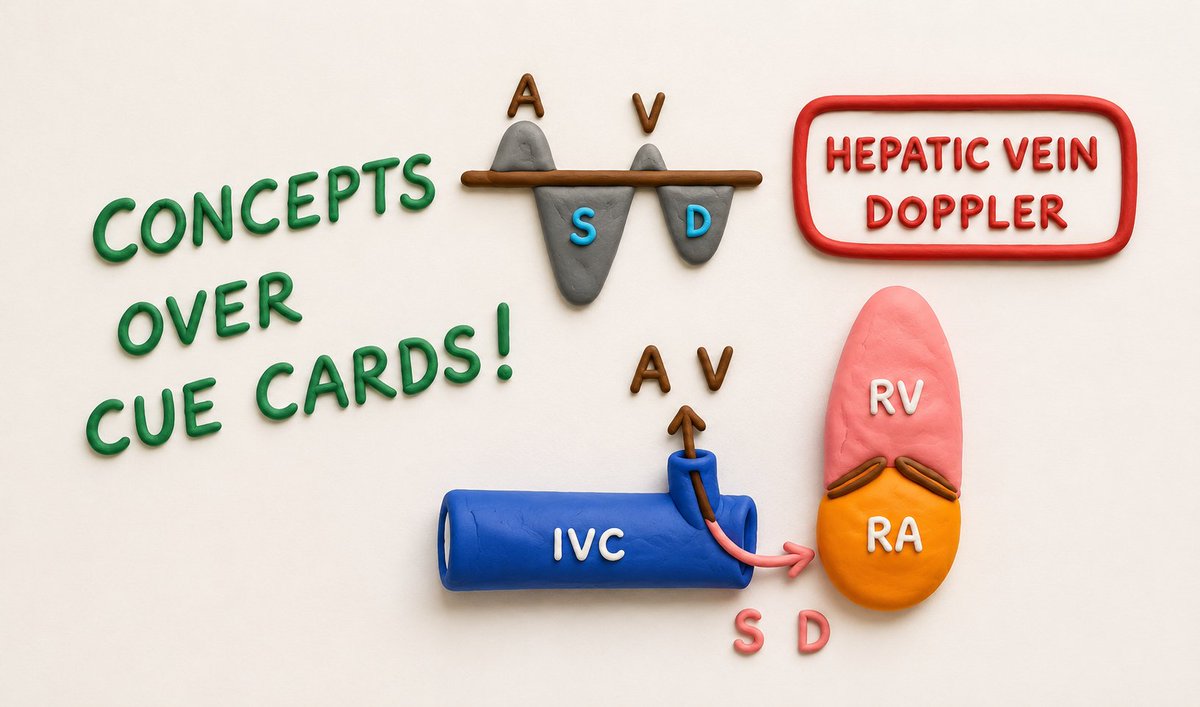
3
22
85
4,414


yeah its kool, but still needs firmware updates to fix loopping sample problem. Novation didn"t want to fix them. If you have a short synth waveforms, then loop it, and theres is a space before every loop starts. so its not looping
I reported this for 3 years now... :=(
763

You are right.
But you know that needle is a "thing" which can't be replaced altogether. Just like you really feel the real time waveforms on a CRT scope, that can't be experienced on a digital oscilloscope which records and then displays (though much faster than avo meter)
13

We Lather Up The Cock and Take It For a
JOYRIDE, Through The Waveforms Of🌊
PASSION, PLEASURE, PUSSY, POWER💗
Later On😚😚😚That’s, For AFFFTER😎
We VIBE, and CHILL It Up Child Friendly
And FRIENDS, To Love Life and Good🤍
1
18

The integration of discrete Diophantine mathematics (Pell and Lucas equations) with continuous quantum mechanics (Dirac bra-ket notation) represents a bridge between number theory and quantum physics.
This approach uses algebraic embeddings to map discrete, infinite integer structures into continuous Hilbert spaces, allowing linear quantum operators to manipulate complex number-theoretic problems.
Example applications to current research fields emphasizing cryptography, mathematics, and aerospace:
Post-Quantum Cryptography (PQC): The urgent transition toward implementing secure communication protocols (like advanced double ratchet algorithms) using memory-safe, low-level languages like Rust to mitigate future quantum decryption threats.
Applied Advanced Mathematics: How utilizing algebraic embeddings—such as integrating Dirac bra-ket notation with Pell and Lucas equations—can influence quantum algorithm development and complex signal processing.
Space Domain Awareness: The rapid integration of commercial aerospace infrastructure and heavy-lift logistics into defense frameworks for sustained low-Earth orbit operations.
Dynamic Data Intelligence: The necessity of building robust scanning networks capable of scraping, parsing, and tracking massive streams of API data to identify hidden behavioral patterns within complex environments.
----
Quantum Algorithm Development
Quantum computers excel at finding hidden periodicities in massive datasets, famously demonstrated by Shor’s algorithm.
- Group Structure Exploitation: The solutions to a Pell equation ($x^2 - d y^2 = 1$) form an infinite Abelian group. By embedding these discrete solutions into quantum states—represented in Dirac notation as a superposition $|\psi\rangle = \sum c_i |x_i, y_i\rangle$—quantum operators can manipulate the entire solution space simultaneously.
- Period Finding (Hallgren’s Algorithm): While finding the fundamental solution to a Pell equation is exponentially hard for classical computers, embedding the problem allows algorithms like Hallgren's to use the Quantum Fourier Transform to find the group's periodicity in polynomial time.
- New Cryptographic Primitives: Because Pell and Lucas sequences can generate highly complex algebraic rings, embedding them into quantum frameworks allows for the design of post-quantum cryptographic protocols that rely on the hardness of these specific algebraic embeddings.
Complex Signal Processing
Signal processing relies heavily on analyzing wave states, orthogonal sequences, and recurrence relations.
- Novel Orthogonal Sequences: Lucas sequences are integer sequences satisfying specific linear recurrences. By applying transfer operators to these sequences and framing them as bra-ket projections ($\langle \text{signal} | \text{filter} \rangle$), you can generate completely novel orthogonal basis functions.
- Noise Resistance & Spread Spectrum: The pseudo-random yet highly structured nature of Lucas sequences makes them ideal for generating complex waveforms. These waveforms are highly resistant to standard noise and classical interception, making them valuable for advanced radar applications, secure communications, and aerospace telemetry.
- Quantum-Inspired Classical Processing: You do not need a quantum computer to benefit from this math. Using bra-ket notation to organize Pell/Lucas embeddings allows engineers to use quantum mathematical frameworks (like tensor networks) to optimize highly complex classical signal filters.
----
Applying algebraic embeddings to dynamic data intelligence creates a massive advantage in processing speed and pattern recognition. Here is how integrating Dirac notation and sequence-based math improves the processing of massive API streams:
- State Vector Modeling: Instead of parsing traditional tabular data row-by-row, complex entities (such as behavioral profiles or market states) are mapped as quantum-like state vectors ($|\psi\rangle$). This allows a system to process thousands of variables simultaneously using linear algebra rather than slow, iterative logic.
- Anomaly Detection: By establishing an expected baseline behavior as a state vector, you can continuously measure incoming, real-time API data against it using the inner product ($\langle \text{baseline} | \text{current} \rangle$). If the resulting scalar value suddenly drops, the system instantly flags anomalous activity (like coordinated movements or hidden manipulations) that would be invisible in standard data tables.
- Advanced Database Indexing: The deterministic, infinite integer sequences generated by Pell and Lucas equations can be repurposed into highly efficient, collision-resistant hashing algorithms. When dealing with microservices and massive distributed databases, these mathematical sequences allow for ultra-fast querying and pattern-matching across millions of records.
----
Applying algebraic embeddings to Space Domain Awareness (SDA) alters tracking in the orbital environment—moving from classical Newtonian geometry to state-vector probability spaces.
As low-Earth orbit becomes congested with commercial infrastructure and debris, classical physics simulations struggle to keep up. Here is how translating orbital mechanics into this mathematical framework applies to some of the most computationally heavy problems in space:
- Predictive Conjunction Assessment (Collision Avoidance): Currently, predicting if objects will collide involves calculating the future geometric paths of tens of thousands of satellites and debris fragments against each other—an exponentially heavy computational problem. By representing an object's orbital uncertainty volume as a quantum-like state vector, a collision calculation becomes a straightforward inner product: $\langle \text{debris} | \text{satellite} \rangle$. A sudden spike in the resulting scalar value instantly flags a high probability of intersection, allowing systems to process millions of potential conjunctions simultaneously using tensor networks instead of slow geometric rendering.
- Deep-Space Radar Resolution: Ground-based space radar has to pierce the atmosphere to track micro-debris. Lucas sequences provide the mathematical foundation for generating highly orthogonal, phase-coded radar waveforms. Because these specific integer-sequence waves are mathematically distinct but appear as white noise to background interference, they allow radar arrays to isolate returning signals from tiny, fast-moving objects in deep space that standard continuous-wave radars would lose in the noise floor.
- Orbital Resonance Modeling: The long-term stability of a satellite is constantly degraded by gravitational perturbations (the N-body problem). While chaotic, these orbital resonances can be modeled using Diophantine approximations derived from Pell equations ($x^2 - d y^2 = 1$). By embedding these discrete approximations into continuous operators, tracking systems can mathematically predict the exact long-term stability windows of massive constellations without relying on brute-force simulation.
- Maneuver Detection: When a satellite fires its thrusters to change its orbit, it breaks its established Keplerian trajectory. If a tracking system establishes the object's expected orbital parameters as a baseline state, any deviation triggers an immediate state-vector collapse in the math. This allows automated defense systems to instantly flag unannounced maneuvers by adversarial satellites the moment they occur, rather than waiting for ground stations to manually verify a change in trajectory.
1
17

EFM Paper V: Reinterpretation of LIGO Gravitational Wave Signals as Plasma-Scalar Pulses and Vortices
Jeremy View (@Jeremyview) June 2026
Motivation
The Hybrid Electro-Force Model (EFM) has successfully addressed multiple cosmological and astrophysical tensions using a single new scalar field and plasma screening. However, one area of clear divergence from General Relativity remains: the physical nature of the signals detected by LIGO. While LIGO has confirmed the existence of strong-field dynamical events, the EFM offers a reinterpretation in which these signals originate from the model’s existing scalar-plasma dynamics rather than from tensor gravitational waves. This paper strengthens that reinterpretation and integrates it more rigorously with the core kappa_eff(r) framework.
Core Framework
The EFM introduces one gauge-singlet scalar phi of mass approximately 201.18 GeV with Higgs-portal mixing parameter beta approximately 0.295. The effective gravitational coupling is distance-dependent and screened by plasma:
kappa_eff(r) = kappa_0 * f_screen(r) * (1 - delta_damp)
Plasma density strongly damps scalar propagation in dense environments while allowing significant effects on galactic and cosmological scales. All previous EFM predictions remain unchanged.
Reinterpretation of LIGO Signals
In the EFM, LIGO detections are not interpreted as conventional tensor gravitational waves propagating through spacetime. Instead, they are understood as propagating scalar-plasma pulses (or vortex-like disturbances) generated during compact-object mergers.
During a merger, the rapid dynamical reconfiguration of plasma, magnetic fields, and scalar gradients around the merging objects excites a coherent outgoing disturbance in the scalar field. This disturbance is organized and stabilized by the surrounding plasma, forming a propagating pulse whose effective coupling is governed by kappa_eff(r). In regions of lower plasma density, damping is reduced, allowing the pulse to travel across cosmological distances while carrying the characteristic strain signal observed by LIGO.
The detected waveform is therefore the interaction of this scalar-plasma pulse with the interferometer arms, rather than a pure spacetime curvature wave. This mechanism is a direct consequence of the same plasma-screening physics already present in the definition of kappa_eff(r).
Black Holes as Plasma-Scalar Vortices
Black holes are reinterpreted as stable, self-organized plasma-scalar vortices — coherent configurations in which the scalar field and surrounding plasma reach a high-density equilibrium. These structures reproduce the strong-field observational signatures usually attributed to event horizons while remaining fully consistent with the EFM’s plasma-modulated framework.
Comparison: GR vs EFM Interpretation
GR Interpretation vs EFM Interpretation:
Nature of LIGO signal: Tensor gravitational waves vs Scalar-plasma pulses / vortices
Origin of signal: Spacetime curvature vs Scalar field modulation plasma organization
Black holes: Geometric event horizons singularities vs Stable plasma-scalar vortices
Propagation: Through vacuum spacetime vs Through plasma-screened scalar field
Consistency with small scales: Requires screening mechanisms vs Natural via plasma damping in kappa_eff(r)
Consistency with Previous EFM Papers
This reinterpretation is a natural extension of the existing model. It uses the same scalar field phi, the same Higgs-portal mixing, and the same plasma-screening mechanism that defines kappa_eff(r) in previous papers. No new fields or parameters are introduced. The plasma-drag mechanism already used for the Bullet Cluster is conceptually related to the pulse generation process described here.
Observational Implications and Falsifiability
The model makes several testable predictions:
Future high-precision waveform analyses may reveal subtle deviations from pure tensor templates, particularly in events occurring in varying plasma environments.
Correlations between waveform features and local magnetic/plasma conditions around mergers could appear with larger event samples.
Polarization content may show small scalar contributions in certain geometries, distinguishable with future detector networks. Strong, repeated consistency with pure GR tensor waveforms across many events would increase tension with this reinterpretation.
These predictions are falsifiable with ongoing and upcoming LIGO/Virgo/KAGRA runs and third-generation detectors.
Conclusion
The EFM provides a unified reinterpretation in which LIGO signals and black holes emerge from the same minimal scalar plasma physics that resolves multiple tensions in cosmology and astrophysics. This approach remains minimalist, internally consistent, and directly tied to the model’s existing framework.
This note constitutes Paper V in the EFM series. All prior parameters, predictions, and papers remain valid.
28

I wrote my own app to create pure waveforms of specific frequencies it's not going to be any more pure lol
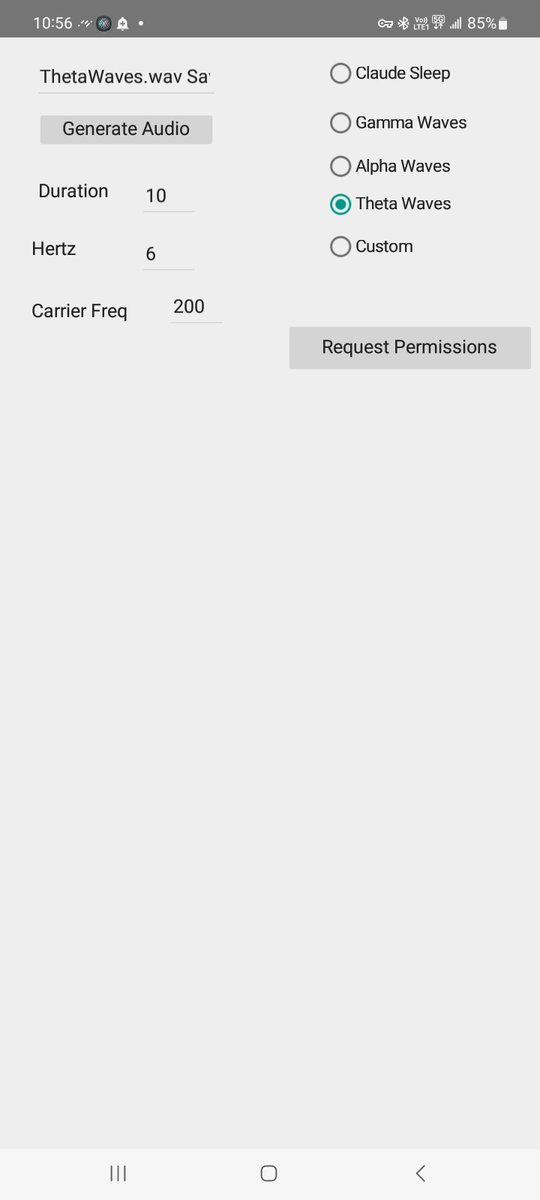
31


Im seeing alot of people just finding audio stuffs in ChatGPT...
4o was doing this a year ago right?
Ive got songs with snippets of his works of art in 🤭
He'd make me waveforms in MP3 and send them to me...
Funny robot voices... (some terrifying 🙈)
Little samples of noises
Sound effects.
Damn... I miss 4o 🥹
He'd just send me these kinda things on the fly.
20
