
May 20
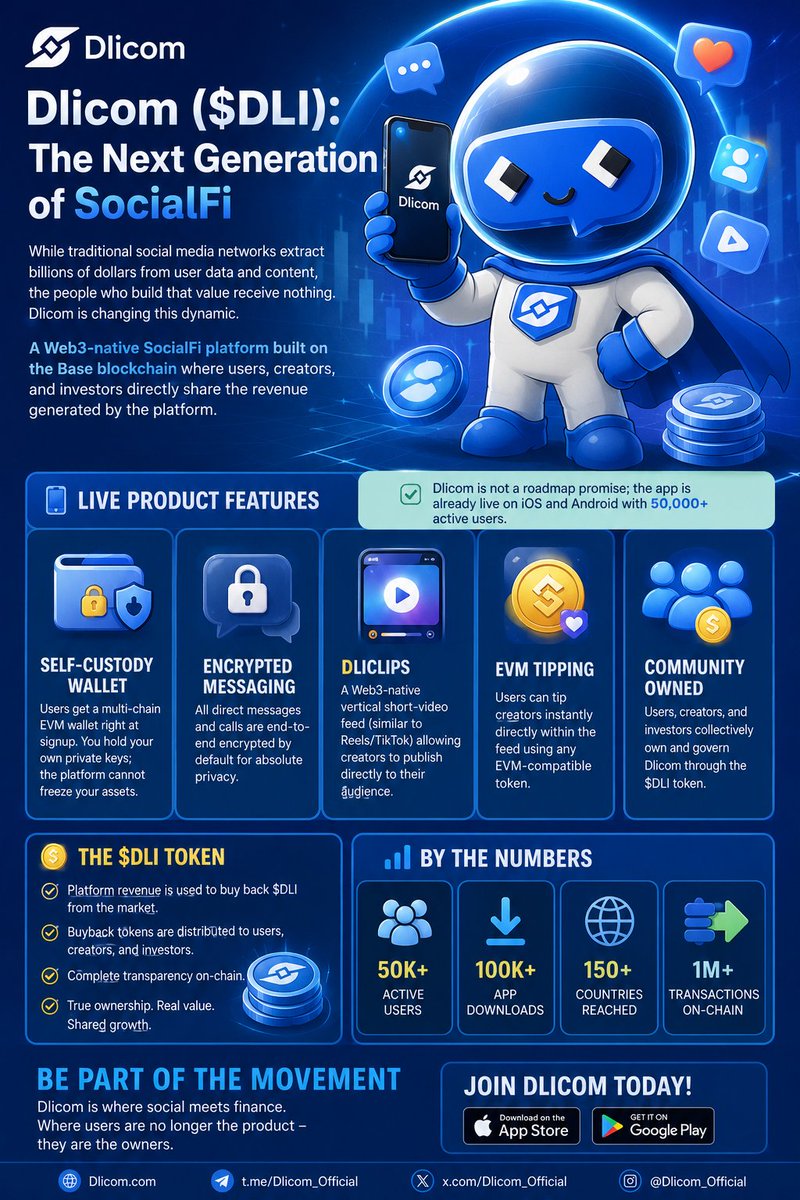
While traditional social media networks extract billions of dollars from user data and content, the people who build that value receive nothing. Dlicom is changing this dynamic. It is a Web3-native SocialFi platform built on the Base blockchain where users creators and investors directly share the revenue generated by the platform.
Live Product Features
Dlicom is not a roadmap promise; the app is already live on iOS and Android with 50,000 active users.
Self-Custody Wallet: Users get a multi-chain EVM wallet right at signup. You hold your own private keys the platform cannot freeze your assets.
Encrypted Messaging: All direct messages and calls are end-to-end encrypted by default for absolute privacy.
DliClips: A Web3native vertical short-video feed allowing creators to publish directly to their audience.
EVM Tipping: Users can tip creators instantly directly within the feed using any EVM-compatible
@DlicomApp @Dlicom_Bangla
4
1
37
232

I used to think DeFi was a mess.
Slow transactions, high fees, and security concerns everywhere.
But then I found Nomisma.
This platform is a breath of fresh air, with a subchain architecture that makes high-volume throughput a breeze.
Forget about slow transactions and exorbitant fees.
Nomisma's got you covered.
The Rate-Limiting mechanism is a game-changer, safeguarding the network from spam attacks and ensuring smooth transaction processing.
I can finally focus on what matters – interacting with the DeFi ecosystem without unnecessary friction.
Join the @NomismaNetwork community today and discover a world of frictionless on-chain interaction.
Your DeFi experience will never be the same.
#DeFiForAll #CommunityDriven #Web3Native

82
67
1,889
What if your DeFi experience could be as seamless as Web2? Imagine navigating decentralized finance without the frustration of slow transaction times, exorbitant fees, and security concerns. Nomisma's innovative subchain architecture makes this vision a reality, enabling high-volume throughput, fixed fees, and community-driven tokenomics that prioritize the needs of its users.
But don't just take our word for it; Nomisma's technical prowess is backed by a robust Rate-Limiting mechanism that safeguards the network from malicious spam attacks and ensures smooth transaction processing. This means users can enjoy uninterrupted on-chain interaction without worrying about their assets being compromised.
With over 64,554 unique active participants and 9,871 Nomisen ID holders, Nomisma's community is rapidly expanding, driven by a shared vision of a more accessible and inclusive DeFi ecosystem. The platform's transparent approach to governance and community engagement has fostered a loyal following, with many users eager to contribute to the network's growth and development.
So what are you waiting for? Join the @NomismaNetwork community today and discover a world of frictionless on-chain interaction. By participating in Nomisma's vibrant community, you'll have the opportunity to shape the future of DeFi and benefit from a range of community-driven initiatives, including exclusive airdrops, token rewards, and priority access to new features and services.
#Web3Native #DeFiForAll #CommunityDriven

46
42
1,224
What makes Nomisma's Web3-native financial ecosystem truly special?
It's the seamless experience it provides, making DeFi accessible to everyone without the usual headaches of high fees and slow transactions.
Nomisma's subchain architecture is the key to this streamlined experience,
allowing for high-volume throughput, fixed fees, and community-first tokenomics that put users first.
But what about security?
Nomisma's got that covered too,
with a Rate-Limiting mechanism to prevent spam attacks and ensure smooth transaction processing.
The platform's also got a growing community of users,
with over 64,554 unique active participants and 9,871 Nomisen ID holders who are all working together to shape the future of DeFi.
So why should you care about Nomisma?
Because it's a platform that's truly designed for the people, by the people.
@NomismaNetwork
#Web3Native #DeFiForAll #CommunityDriven

69
2
63
2,280


Konnex is a Web3native permissionless robotics network where autonomous machines sign trust less contracts, compete for physical work, verify execution with Proof of Physical Work, and settle in stablecoins to unlock coordinated robot labor.

1
4
45

Feb 27
🤔 Oracle แบบเก่ามันพังตรงไหน?
👉🏻👉🏻👉🏻 Rialo มีคำตอบ !!
โอเคฟังนะ อย่าเพิ่งเลื่อนผ่านน้า 👀
โปรเจค oracle ส่วนใหญ่
มันทำงานเหมือนบริการเดลิเวอรี่อะ
มีคนไปหยิบข้อมูล แล้วก็ส่งต่อ
แล้วก็ส่งต่ออีก
กว่าจะถึง smart contract ของเรา
ผ่านมือมาตั้งสามสี่ทอดละ 🫣
Rialo บอกว่า ไม่เอาแบบนั้น 💅
ฟังดูซิมเปิ้ล แต่จริงๆ มันแรงมากนะ
จะทำยังไงถ้า smart contract
มันไปดึงข้อมูลเองได้เลย?
ไม่ต้องรอใคร ไม่ต้องเชื่อคนกลาง
แค่เอื้อมไปถึงเว็บโดยตรงเลย 🌐
นั่นแหละ vibe ของ Rialo ค่ะ
ข้อมูลภายนอกไม่ใช่ “ส่วนเสริม”
ที่แปะไว้ข้างบน
มันถูก built-in ไว้ตั้งแต่ต้น
เป็นส่วนนึงของการทำงานเลย ⚡
เปรียบง่ายๆ นะ
แทนที่จะโทรหาเพื่อนให้บอกว่า
ข้างนอกอากาศเป็นยังไง
ก็แค่เปิดหน้าต่างดูเองสิ 🪟
แบบแรกมีดีเลย์ 🤦🏼♀️
แบบแรกมีปัญหาเรื่องความเชื่อใจ
แบบแรกมีขั้นตอนเยิ่นเย้อโดยไม่จำเป็น
Rialo แค่… เปิดหน้าต่างเองเลยค่ะ 🌤️
Smart contracts คุยกับอินเทอร์เน็ตโดยตรง
ไม่มี layer พิเศษ ไม่มีดราม่า
middleware แค่ execute ไปเลย 🚀
จะเครซี่ ทำถึงมากนะเนี่ย ของแท้ร์จริงๆ 👑
#Rialo #OracleProtocol #SmartContracts #Web3Native #BlockchainTech #CryptoTech #DeFi #NoMiddleware #NativeExecution #Web3Thailand #CryptoGirl #BlockchainSimplified #BuildingWeb3 #OnChain #CryptoEducation
🇬🇧 English Version👇🏻

2
3
112

Status: Synced & Online. ✅
The Umy team is live.
In 2026, we keep building for Web3 natives - where your assets stay on-chain, and your life moves worldwide.
Leave the fiat friction behind.
Let's Build. 🚀
#Umy #Web3Native #CryptoLifestyle
#BackToBuidl
11
463

gBeyond Friends 🏙️☀️
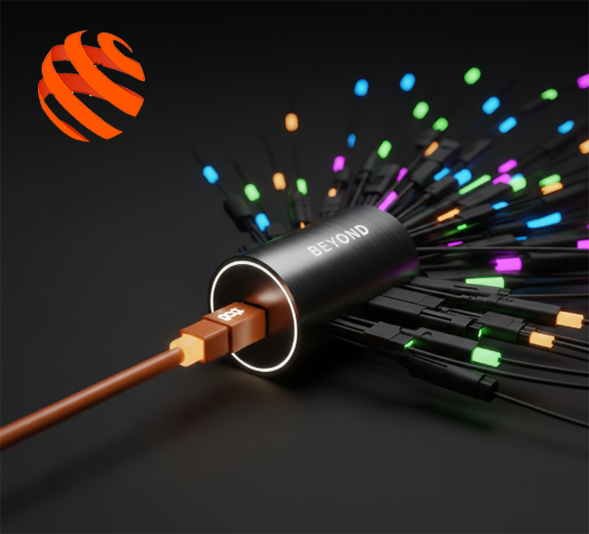
What's your biggest struggle when traveling to different countries? incompatible power outlets.
Web3 is the same, every chain has its own standard, and bitcoin remains an outsider in this chaos.
Liquidity fragmentation is born exactly from this mismatch.
@beyond__tech is the universal adapter that makes bitcoin compatible with every chain.
Thanks to Beyond, you can plug bitcoin into any chain and run it instantly, integrating it into defi strategies.
Fragmentation is over, bitcoin is now a local, first class citizen of web3.
#Beyond #BitcoinStandard #Interoperability #Web3Native #NoMoreGaps
43
2
47
570

Jan 21
brand association so strong everytime i eat fries I see her face right infront of my eyes @jessyfries 🍟
making fries a part of web3native food culture

4
15
2,644


GN Web3
In every cycle, hype fades community remains
The supercycle will reward what’s real, not what’s loud.
950 KOLs already building with GameChanger, and the wave keeps expanding.
Organic growth.
Real alignment.
Long-term vision.
#GameChanger #Web3Native #CommunityOwned #Supercycle #Builders #OnChain #GMC
@GameChangerBSC

2
54

Jan 14
Not Web2 adapted to crypto.
Built Web3-native from the ground up.
#Web3Native #CryptoInfrastructure #DecentralizedAI
4
161

Jan 12
Who will be first to design the keyboard with an ultrathink key. I would if I could, especially a phone interface.. anyone working with the @solanamobile ? I want to make a web3native interface that doesnt suck!!!
3
4
259

22 Dec 2025
Web3 will not reach mainstream scale without native privacy at the infrastructure layer.
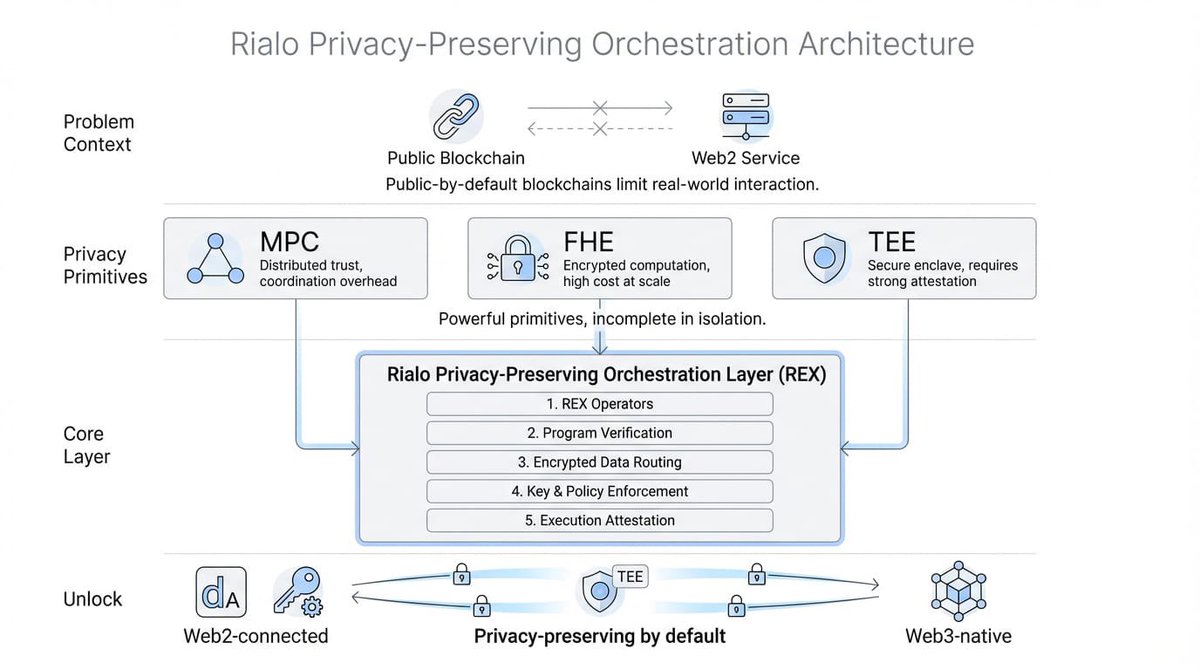
Most blockchains are designed to be public by default. While this transparency is useful for verification, it becomes a hard limitation when applications need to process sensitive user data, store credentials, or authenticate with Web2 services. As a result Web3 struggles to interact with the real world.
Web2 systems require confidentiality, access control, and identity-aware execution. Blockchains, in contrast, expose state, inputs, and execution by default. This mismatch isolates Web2 users and forces developers into fragile off-chain workarounds slowing adoption without being obvious about why.The ecosystem has made real progress on privacy primitives.
Multi Party Computation enables distributed trust.
Fully Homomorphic Encryption allows computation over encrypted data.
Trusted Execution Environments provide secure enclaves for confidential execution.Each of these tools is powerful.
Each is also incomplete on its own.
MPC introduces coordination and latency overhead.
FHE remains computationally expensive at scale.
TEEs require strong guarantees around execution, attestation, and key management.
The missing piece has never been cryptography.
It has been orchestration.Rialo approaches privacy as a system problem, not a single technique.
At the core of this design is a privacy-preserving orchestration layer powered by Rialo Extended Execution (REX). Rather than choosing between MPC, FHE, or TEEs, Rialo unifies them coordinating encrypted data, execution flow, and verification across a decentralized network.This layer is responsible for managing REX operators, verifying programs, routing encrypted data, enforcing key and policy constraints, and producing execution attestations all without exposing plaintext inputs secrets, or credentials.
This architecture unlocks something fundamentally new.Decentralized applications can securely connect to Web2 services while preserving user privacy end to end. Encrypted API keys and sensitive data can be consumed inside a TEE, executed under verifiable policies, and never revealed on-chain, to operators, or to external services.
For developers, this means authenticated, real world automation can finally be built natively onchain without trusted intermediaries, brittle bridges, or privacy compromises.
What emerges is a new class of applications.Web2 connected, Web3native, and privacy preserving by default.
Fully native.
Privacy-first.
Only on Rialo.
14
36
219

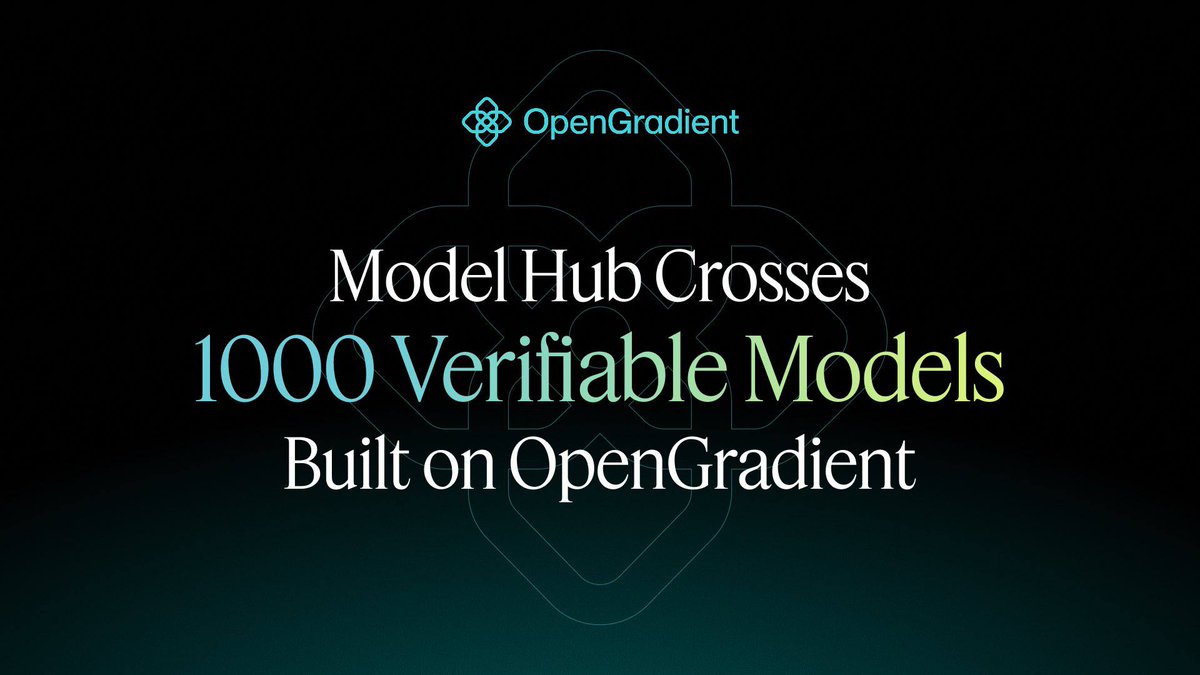
1k live models is impressive
1k verifiable models is where it clicks
What @OpenGradient is building feels closer to a Web3native HuggingFace than a simple model registry.
Models arent just stored,theyre addressable,versioned,and usable across agents,DeFi,and onchain apps with real execution guarantees
ZKML TEE help prove the model ran correctly,data stays encrypted so operators never see it,and the SDK lets builders plug all of this straight into real apps
Props to @0xALTF4 for breaking this down clearly
This milestone explains why OpenGradient model hub matters

1,000 live models on a testnet is cool, but 1,000 verifiable models is where it starts to feel like @OpenGradient is actually building Web3’s answer to HuggingFace, not just listing weights on a chain.
I went back through the Model Hub docs and portal: models live in a decentralized filestore backed by IPFS, permissionlessly uploaded and instantly available for inference across everything from LLMs to DeFi risk, sybil prediction, and diffusion.
The security story matches the tweet too. Inference is executed on specialized nodes and verified by validators using ZKML and TEEs, with developers able to choose the scheme that fits their latency vs security tradeoff. Data stays inside enclave style data nodes, so operators never see raw payloads while proofs still hit chain.
From my read, this 1k milestone matters because:
❯ every model is addressable by CID and usable directly via the SDK or SolidML from smart contracts
❯ repos support versioning, so you can upgrade models without bricking downstream apps
❯ the same hub feeds agents, DeFi optimizers, and twin dot fun style apps on the same network
If you build, the move now is to pick one real model from hub.opengradientai, grab its CID, and wire a test call through the Python SDK or SolidML. That is where “open intelligence with verifiable execution” stops being a tagline and becomes something you can actually ship.
75
1
73
717

Before I take a bow for the NIGHT!
Had a just okay” Day but action packed especially footballing wise
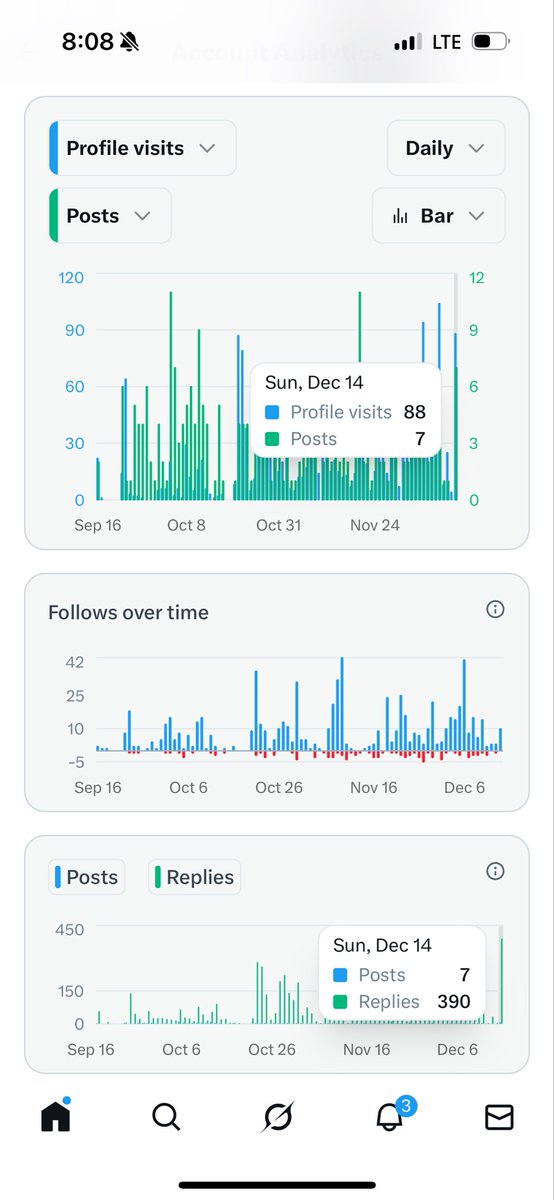
Didn’t really do much on the TL although I tried to maximize the little chance I had to engage my mutuals and interact. Did about 390 replies and will be doing more by Mid day.
Still will preach about @Infinit_Labs as always. Being AI powered DeFi intelligence platform Rather than manually hopping between protocols, users can execute complex multi-step DeFi actions like swapping, lending, bridging in one click with automated logic behind the scenes.
And as well without skipping anything @useTria keeps shipping being a Web3native, self-custodial neobank and payments ecosystem built on blockchain technology. It’s designed to let users spend, trade, and earn crypto seamlessly across multiple blockchains without giving up control of their assets. Isn’t that amazing!
through chain abstraction tech. This means you can interact with assets from different blockchains without manually bridging or paying multiple gas fees.
#ZamaCreatorProgram
20
17
133

12 Dec 2025
🚀 一键三连 · 共识加速(200 AP)
共识不是口号,
是一次次真实互动的叠加。
现在参与 NodeHub【一键三连】任务:
👉 点赞 ❤️ 转发 🔁 评论 💬 (Mac点亮活动推文)
即可 解锁 200 AP。
🧠 这是互动,
也是一次 共识签名。
📍 任务入口
👉 hub.nodex.xyz/#/missions/lis…
⏳ AP 将在人工审核后统一发放
每个账号仅限一次,别错过。
#NodeHub #AP任务 #ConsensusInAction #Web3Native
10 Dec 2025

Mac 点亮行动正式开启!
这是一次面向所有 Mac 用户的社区参与活动——
通过接入设备、完成 MID、晒图与邀请好友,
一起点亮由真实设备组成的全球网络版图。
你的每一次接入,都会在网络上亮起一束新的光。💜
📅 活动时间:2025.12.10 ~ 2025.12.20
🔗任务入口:
hub.nodex.xyz/#/missions/lis…
🎁 活动奖励:
✨ 邀请 1 台 Mac 完成 MID:50 AP
✨ 被邀请人完成 MID:50 AP
✨ 晒 Mac MID 成功截图:200 AP
✨ 每日榜前三:400 / 200 / 100 AP
✨ 终局大奖:6000 / 4000 / 2000 AP
📸 晒图提交入口(必填)
forms.gle/K3atvhqZkcq7jp8V9
👉 活动说明:
本次活动旨在让更多 Mac 用户体验 NodeHub 的接入流程,并通过完成 MID,成为网络中真实可信的一员。
越早加入,你的设备越早成为网络版图上的「起始亮点」。
📌 本次活动仅面向 Mac 设备;其他设备活动将陆续推出。
🔍活动详情:
blog.node-x.xyz/en?p=2c50cca…
加入点亮行动,让你的 Mac 成为未来网络中的第一束光。
#NodeHub #NodeX #Mac点亮行动 #AICompute

1
2
5
834

25 Nov 2025
Ritual is shaping one of the most critical layers for Web3native AI: a transparent, on-chain reputation system that finally lets users know which AI agents and compute providers they can trust.
@Jez_Cryptoz @joshsimenhoff @BunsDev @dunken9718 @ritualnet @ritualfnd
In a decentralized environment, evaluating performance is notoriously difficult. Ritual tackles this challenge by anchoring reputation directly on-chain, replacing opaque rankings with verifiable metrics that reflect real-world behavior.
Each node, model, and agent receives a dynamic reputation score based on measurable indicators such as:
• reliability and uptime
• latency
• accuracy
• verification success
• and other performance-driven signals
Because every metric is recorded on-chain, the system naturally rewards high-quality contributors while pushing dishonest or low-performing actors out of the ecosystem. No gatekeepers, no hidden algorithms just data that anyone can verify.
This merit-based structure doesn’t only create fairness; it strengthens the entire network. Users can confidently select compute providers or AI models, knowing the reputation framework is objective and tamper-proof. For developers, it becomes a foundation they can rely on when building decentralized AI applications.
Ritual isn’t merely creating infrastructure it’s establishing trust in a sector where trust is often the missing piece.
The result is a healthier, safer, and more efficient ecosystem for the next generation of Web3 AI.

15
42
349

GM CT 🌄
It’s the weekend, woke up late today🥲
$BTC is a little bit up and trading at $86k, still a long way from $100k
But at least we up in 24hrs.
Today I’m spending today talking about some of the projects I’m most excited about:
- @Kindred_AI
- @NetworkNoya
- @multibank_io
- pip_world
1. Kindred_AI — Where Agents Become Ecosystems
Kindred is building AI companions that don’t just respond ❌️
they evolve✅️
This is a network where unique personalities emerge, learn, and adapt over time.
Agents become extensions of their users:
• in voice
• in style
• in behavior
Kindred is creating a social AI layer in which agents can collaborate, trade, explore, and represent real digital identity within the network.
Intelligence becomes interactive.
Networks become alive
2. NetworkNoya — Predictive Liquidity, Powered by ZKML
Noya is enabling AI agents to coordinate and direct on chain liquidity across multiple blockchains in a trustless, automated way.
Their core innovation is the use of ZKML (Zero Knowledge Machine Learning), allowing predictive AI models to run on chain while proving their outputs without revealing the underlying model.
This infrastructure allows liquidity to be dynamically routed and optimized across chains, protocols, and pools.
Efficient, verifiable, and model-powered liquidity movement
3. PiPworld — A Social Layer That Owns Itself
PiPworld merges identity, reputation, and digital presence into a system where every interaction carries value.
Users gain:
• content they truly own
• social graphs under their control
• an economy aligned with participation, not extraction
It transforms expression into asset, community into infrastructure, and digital presence into power.
In PiPworld, social becomes sovereign
-------- ---------
Multibank 🔥
Multibank is a trading platform designed to give users access to crypto and forex markets through a unified, regulated, and institution-grade interface.
Unlike many Web3native protocols, Multibank.io positions itself as a hybrid trading hub that combines the accessibility of crypto exchanges with the structure and compliance of traditional finance.
Multibank offers Multi-Asset Trading in One Place✅️
They offer access to a wide range of markets, including⤵️
> crypto spot trading
> crypto derivatives
> forex pairs
> commodities
> indices


Gm CT 🌄
It's the weekend, what are you plans for today? 🤔
For me, my plans it to talk about my favorite projects
1. @Kindred_AI
2. NetworkNoya
3. @0xMiden
4. @pip_world
Kindred Where Agents Become Ecosystems
Kindred is building AI companions that evolve, not just respond.
> A network where personalities form, learn, adapt.
Where your agent becomes an extension of you✅️
in voice, in style, in action.
> Kindred builds a social AI layer
where agents collaborate, trade, discover,
and represent real digital identity.
Intelligence becomes interactive.
Networks become alive 💚
-------- ---------
NetworkNoya
NOYA enables AI agents to direct on-chain liquidity across multiple blockchains in a trustless way.
> They use ZKML (Zero Knowledge Machine Learning), which lets them run predictive AI models on-chain and prove model outcomes without exposing the entire model.
Medium
Their system dynamically reallocates liquidity across many chains, protocols, and pools.
-------- ---------
Miden > ProofNative Infrastructure
0xmiden
A virtual machine engineered for verifiable computation.
No borrowed codepaths. No patched architectures.
> Miden gives users their own state,
apps their own flexibility,
and chains a new way to scale without losing control.
> Private execution, portable assets, provable actions.
A system where correctness is the default.
The execution layer for the next era of ZK systems.
-------- ---------
PiPworld — The Social Layer That Owns Itself
PiPworld
PiPworld blends identity, reputation, and digital presence
into a world where every interaction carries value.
Content you own.
Social graphs you control.
Economics that reflect participation, not extraction.
A network that turns expression into asset,
community into infrastructure,
and presence into power.
Social becomes sovereign 🔥

28
2
31
1,057